How to resolve AdBlock issue?
Refresh this page
How to resolve AdBlock issue?
Refresh this page
Lake County News,California
  • Home
    • Registration Form
  • News
    • Education
    • Veterans
    • Community
      • Obituaries
      • Letters
      • Commentary
    • Police Logs
    • Business
    • Recreation
    • Health
    • Religion
    • Legals
    • Arts & Life
    • Regional
  • Calendar
  • Contact us
    • FAQs
    • Phones, E-Mail
    • Subscribe
  • Advertise Here
  • Login
How to resolve AdBlock issue?
Refresh this page

News

Measure U cost Lake County less than $4,000, Registrar reports

Details
Written by: LINGZI CHEN
Published: 04 March 2025
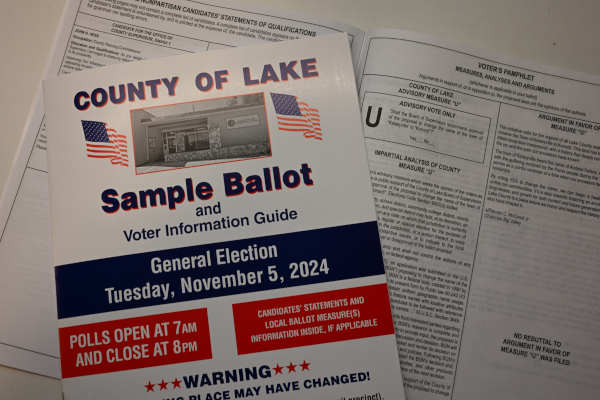
The Nov. 5, 2025, sample ballot booklet, which featured advisory Measure U on the proposed name change of the town of Kelseyville to Konocti. Photo by Lingzi Chen/Lake County News.


LAKE COUNTY, Calif. — The contentious Measure U — an countywide advisory vote on whether to rename Kelseyville to Konocti — cost Lake County no more than $4,000, according to the Registrar of Voters, nearly four months after the November election.

After consolidating all expenses, the 2024 General Election in Lake County totaled $237,807.99, excluding labor, Registrar of Voters Maria Valadez said in an interview at her office on Thursday.

Valadez said this amount covered costs for official ballots, sample ballots, postage, publication, services, supplies and printing.

Measure U accounted for $3,931.50 of that total, including $3,113.58 for additional sample booklet pages and $819.99 for translation services. No additional labor costs were incurred, Valadez said.

“That is the only over-and-above cost,” Valadez said, emphasizing that no extra postage or miscellaneous expenses were added.

“The election was going to happen regardless of Measure U,” she explained. “The question is always — how much more does Measure U cost?”

Valadez provided collated tables of bills detailing election costs, including expenses for all 16 ballot types across nine election districts.

She pointed to two financial differences between having and not having Measure U.

First, under California Election Code 10520, each district must reimburse the county for the actual costs of running an election in its jurisdiction. Since Measure U was on all ballots countywide, it changed how costs were distributed among districts compared to an election without it.

Second, Measure U itself added $3,931.50 to the overall cost. Without it, the election would have cost $233,876.49, Valadez said. Measure U increased the cost by 1.68%.

Valadez emphasized that while Measure U affected cost distribution among districts, it only increased the total election cost by $3,931.50.

In terms of labor, Valadez said that 3,400 hours of work was dedicated specifically to the election.

“So the hours worked for extra help and permanent hours did not increase because Measure U was on the ballot,” she said. “The hours are that for all elections, no matter what.”

Regarding the finalized cost of Measure U, Valadez said it ended up being less than $50,000, which was the maximum amount she previously had estimated it would cost.

Valadez: ‘Measure U cost the county $50,000’ was a misunderstanding

On July 31, the Board of Supervisors voted 3-2 to place the renaming of Kelseyville to Konocti before voters.

This was the board’s first and only collective action on the matter after the U.S. Board on Geographic Names, often referred to as the BGN, requested a recommendation 2024, following an October 2023 application of the name change from the local group Citizens for Healing.

During the contentious three-hour meeting, supervisors asked Valadez about the potential costs of adding the countywide measure to the ballot.

Based on past experience, Valadez said at that time that she estimated it to cost no more than $50,000. The figure was then repeated throughout the meeting, but Valadez was not given the opportunity to offer further clarification.

After that meeting, Valadez told Lake County News that standalone elections can run around $250,000. However, since there was already an election in November, the advisory measure itself would be folded into that election, hence lowering the cost, she said.

The figure of $50,000 was not only repeated during the special board meeting, but also referred to in following meetings about the name change and circulated on social media when people discussed the cost of Measure U.

For Valadez, that has been a misunderstanding that needs clarification.

“I said it shouldn’t cost more than $50,000; I never said it was going to cost $50,000. I was just providing an estimate,” Valadez said. “At that time, I didn’t know how many districts were actually going to the election and until that happens, you don’t know what the actual election cost is.”

Measure U went on the Nov. 5 ballot as an advisory measure. A "yes” vote on the measure supported the Board of Supervisors recommending approval of the town name from Kelseyville to Konocti whereas a “no” vote opposes it.

More than 70% of voters said “no” in the election. However, in a December Board of Supervisor meeting, supervisors voted 3-2 to recommend the name change and sent out a formal letter of recommendation to the BGN.

Ultimately, dislike of Measure U has been a common point of agreement among both supporters and opponents of the name change.

Supporters of the name change argued that it should be a moral decision, not determined by a majority vote. Opponents contended that the vote was a waste of time and money if the Board of Supervisors would not respect the results.

Email staff reporter Lingzi Chen at This email address is being protected from spambots. You need JavaScript enabled to view it.. 

Storm systems to bring rain, freezing temperatures

Details
Written by: Elizabeth Larson
Published: 04 March 2025
LAKE COUNTY, Calif. — The National Weather Service said storm systems are expected to move through Lake County this week, bringing showers and frosty temperatures.

Forecasters predict a “weak, fast moving system” will move through the area early Tuesday, bringing some wind plus chances of rain on Tuesday night.

That will be followed by another system on Wednesday and Thursday that the forecast said could give southern Mendocino and Lake counties “light sprinkles” totaling less than a quarter of an inch.

Late Thursday and early Friday morning, the National Weather Service forecasts frost throughout Lake County, with nighttime temperatures into the 30s.

Temperatures throughout the week and into Monday are forecast to range from the low 50s to the low 60s during the day and the low 40s at night. After nighttime temperatures dip into the 30s on Thursday and Friday, they will inch back up into the 40s during the weekend.

Rain will return to the forecast on Sunday and Monday, but so far rainfall totals haven’t been estimated.

Email Elizabeth Larson at This email address is being protected from spambots. You need JavaScript enabled to view it.. Follow her on Twitter, @ERLarson, and on Bluesky, @erlarson.bsky.social. Find Lake County News on the following platforms: Facebook, @LakeCoNews; X, @LakeCoNews; Threads, @lakeconews, and on Bluesky, @lakeconews.bsky.social.

Clearlake Police seek missing juvenile

Details
Written by: LAKE COUNTY NEWS REPORTS
Published: 04 March 2025
Aiden Murray. Courtesy photo.

UPDATE: Just before 1 p.m. Tuesday, March 4, police said Aiden has been located.

CLEARLAKE, Calif. — The Clearlake Police Department is asking for the public’s help in locating a missing boy.

Aiden Murray, 12, was last seen at Obsidian Middle School.

He is described as a white male, 5 feet 4 inches tall and 155 pounds, with brown hair and hazel eyes.

When he was last seen, he was wearing a blue Obsidian hoodie and black and white pajama pants.

If you have any information regarding his whereabouts please contact the Clearlake Police Department at 707-994-8251, Extension 1, for dispatch.

GOP lawmakers commit to big spending cuts, putting Medicaid under a spotlight – but trimming the low-income health insurance program would be hard

Details
Written by: Paul Shafer, Boston University and Nicole Huberfeld, Boston University
Published: 04 March 2025


Speaker of the House Mike Johnson addresses the media on Feb. 25, 2025, after the House narrowly passed his budget resolution calling for big spending cuts. Kayla Bartkowski/Getty Images

Efforts by Republicans in Congress to make steep spending cuts have stirred widespread concerns that the federal government may trim expenditures on Medicaid even though President Donald Trump has previously indicated that he’s unwilling to do that. This public health insurance program covers around 72 million people – about 1 in 5 Americans.

The Conversation U.S. asked Paul Shafer and Nicole Huberfeld, Boston University health policy and law professors, to explain why cutting Medicaid spending would be difficult and what the consequences might be.

What is Medicaid’s role in the health care system?

Created in 1965 along with Medicare, the public health insurance program for older Americans, Medicaid pays for the health care needs of low-income adults and children, including more than 1 in 3 people with disabilities. It also covers more than 12 million who qualify for both Medicare and Medicaid because they are both poor and over 65.

In addition, this safety net program pays the health care costs of more than 2 in 5 U.S. births. Medicaid is a joint federal/state program, driven by federal funding and rules, with the states administering it.

The Affordable Care Act was supposed to make nearly all U.S. adults under age 65 without children who earn up to 138% of the federal poverty level eligible for Medicaid. Prior to the 2010 landmark health care reform law, adults without children in most states could not get Medicaid coverage. The Supreme Court, however, made this change optional for states.

So far, 40 states – as well as Washington, D.C. – have participated in Medicaid expansion. The program’s growth has reduced the number of Americans without health insurance and narrowed coverage gaps for people of color and those with low-wage jobs who typically do not get employer-sponsored coverage.

Hundreds of studies have found that Medicaid expansion has improved access to care and the health of the people who gained coverage, while reducing mortality and bolstering state economies, among other positive outcomes.

Ten states haven’t expanded Medicaid yet. Two of them, Georgia and Mississippi, have seriously considered doing so.

Religious men, some in collars, stand together around a sign calling for Medicaid expansion in Mississippi.
Bishop Ronnie Crudup Sr., center, seen in May 2024, has called for the Mississippi Legislature to expand Medicaid in the state. AP Photo/Rogelio V. Solis

Why are you concerned about Medicaid’s funding?

A memo circulated among House Republicans in January 2025 included a menu of up to US$2.3 trillion in Medicaid cuts over 10 years. A House budget blueprint, approved in a 217-215 vote on Feb. 25, which fell largely along party lines, indicated that the Republican majority was instead aiming to reduce Medicaid spending by $880 billion over a decade.

To be clear, GOP lawmakers didn’t say they planned to do that.

Instead, they told the committee that oversees Medicaid and Medicare to identify cuts of that magnitude. Experts agree that slashing Medicare spending would be harder to pull off because Trump has made it clear he considers it off-limits, but at times he has suggested he might be open to trimming Medicaid. Trump says he supports the budget plan the House approved.

In an interesting coincidence, Medicaid itself costs around $880 billion a year between federal and state government spending. That suggests Republicans are aiming for an approximately 10% cut.

How does the program work?

If you’re eligible for Medicaid, by law you can enroll in the program at any time and get health insurance coverage.

If you require treatment for a condition Medicaid covers, whether it’s breast cancer or the flu, that happens with no – or low – out-of-pocket costs. Being enrolled in Medicaid means your medical treatment is covered and cannot be denied for budgetary reasons. The federal government contributes a share of what states pay for the health care of residents who enroll, but it can’t decide how much to spend on Medicaid – states do.

The federal match rate is linked to the per capita income of each state. That means a state with lower per capita income gets a higher federal match, with all states getting at least 50%. For states that participate in the Medicaid expansion, the federal match is 90% across the board for that population.

A dozen states have so-called trigger laws on their books that could automatically revoke Medicaid expansion if this enhanced match rate is lowered.

How can the federal government reduce its Medicaid spending?

The federal government could simply adjust the match rate, shifting more of the cost of Medicaid to states. But prior proposals have suggested a larger change, either through per capita caps or block grants.

Per capita caps would place a per-person cap on federal funding, while block grants would place a total limit on how much the federal government would contribute to a state’s costs for Medicaid each year. In turn, the states would likely cover fewer people, reduce their benefits, pay less for care, or some combination of such cost-cutting measures.

Either per capita caps or block grants would require a massive transformation in how Medicaid operates.

The program has always provided open-ended funding to states, and both states and beneficiaries rely on the stability of federal funds to make the program work. Imposing caps or block grants would force states to contribute significantly more money to the program or cut enrollment drastically. Assuming a substantial cut in federal funding for Medicaid, millions could lose health insurance coverage they cannot afford to get elsewhere.

Speaker Mike Johnson said that per capita caps and changing the federal match rates are not on the table, but they were included in the earlier House Republican memo detailing potential cuts.

Man in a suit and tie speaks at an outdoor podium above the words 'Save Medicaid.'
House Minority Leader Hakeem Jeffries, a New York Democrat, flanked by his fellow House Democrats, criticizes the House Republicans’ budget bill at the U.S. Capitol on Feb. 25, 2025. Saul Loeb/AFP via Getty Images

What else could happen?

Another idea many Republicans say they support is to add what are known as “work requirements.” The first Trump administration approved state proposals for Medicaid beneficiaries to complete a minimum number of hours of “community engagement” in activities like work, job training, education or community service to enroll and maintain Medicaid eligibility. This is despite the fact that the majority of Medicaid enrollees already work, are disabled, are caregivers for a loved one, or are in school.

Some politicians argue that making people work to receive Medicaid benefits would help them transition to employer-based coverage, so adding that restriction may sound like common sense. However, the paperwork this requires can lead to lots of working people getting kicked out of the program and is very costly to implement. Also, job training programs, volunteering and education, unless in a degree program, generally don’t come with health insurance coverage, making this reasoning faulty.

When Arkansas implemented Medicaid work requirements in 2018, despite the majority of enrollees already working, about 18,000 people lost coverage. The policy was poorly understood, and enrollees had trouble reporting their work activity. What’s more, the employment of low-income adults didn’t grow.


Is Medicaid vulnerable to waste or fraud?

Medicaid already spends less than Medicare or private health insurance per beneficiary. That includes spending on doctors, hospitals, medications and tests.

The Government Accountability Office – an independent, nonpartisan government agency – has estimated that preventing payments which shouldn’t be made, or overpayments, could lead to $50 billion in federal savings per year. The GAO cautions that “not all improper payments are the result of fraud.” This significant sum is still nowhere near the scale of the cuts Republicans apparently want to make.

Would Medicaid spending cuts be popular?

That’s very unlikely.

Polling and focus groups show that Medicaid is quite popular.

More than half of Americans say that the government spends too little on Medicaid, and only 15% say spending is too high.

We believe if Medicaid cuts were to be openly debated that members of Congress would be inundated with calls from constituents urging their lawmakers to oppose them. That is what happened in 2017, when the first Trump administration tried and failed to repeal the Affordable Care Act.

Should Medicaid be cut by anything close to $880 billion over the next decade, we’d expect to see millions of America’s poorest and most vulnerable people kicked out of the program and wind up uninsured. But that would only be the beginning of their problems. Uninsured people are more likely to wait too long before seeing a doctor when they get sick or injured, leading to worse health outcomes and widening the gaps in health between haves and have-nots.The Conversation

Paul Shafer, Assistant Professor of Health Law, Policy and Management, Boston University and Nicole Huberfeld, Professor of Health Law and Professor of Law, Boston University

This article is republished from The Conversation under a Creative Commons license. Read the original article.

  1. Thompson names Shock 2025 Lake County Woman of the Year
  2. Supervisors to discuss projects, Behavioral Health loan
  3. Lakeport City Council to discuss grant and federal funding requests
  • 364
  • 365
  • 366
  • 367
  • 368
  • 369
  • 370
  • 371
  • 372
  • 373
How to resolve AdBlock issue?
Refresh this page