How to resolve AdBlock issue?
Refresh this page
How to resolve AdBlock issue?
Refresh this page
Lake County News,California
  • Home
    • Registration Form
  • News
    • Education
    • Veterans
    • Community
      • Obituaries
      • Letters
      • Commentary
    • Police Logs
    • Business
    • Recreation
    • Health
    • Religion
    • Legals
    • Arts & Life
    • Regional
  • Calendar
  • Contact us
    • FAQs
    • Phones, E-Mail
    • Subscribe
  • Advertise Here
  • Login
How to resolve AdBlock issue?
Refresh this page

News

Whether GDP swings up or down, there are limits to what it says about the economy and your place in it

Details
Written by: Sophie Mitra, Fordham University
Published: 02 May 2025

Whether GDP swings up or down, there are limits to what it says about the economy and your place in it

The price of eggs might mean more to some Americans than what’s going on with GDP. Scott Olson/Getty Images

The Bureau of Economic Analysis released the latest U.S. gross domestic product data on April 30. In the first three months of 2025, it said, GDP contracted by 0.3%. The GDP growth rate captures the pace at which the total value of goods and services grows or shrinks. Together with unemployment and inflation, it usually receives a lot of attention as an indicator of economic performance.

Some economists and analysts said the economy might not be as bad as this rate’s decline might suggest. While this is the first time in three years that GDP has shrunk instead of growing, it is a relatively small decline.

This raises a critical question: Does a relatively small GDP contraction mean the economy is in trouble? I have spent much of my working life studying economic well-being at the level of individuals or families.

What I’ve learned can offer a different lens on the economy than you’d get from just focusing on the most popular indicators, such as the GDP growth rate.


GDP problems

The GDP growth rate has many limitations as an economic indicator. It captures only a very narrow slice of economic activity: goods and services. It pays no attention to what is produced, how it is produced or how people assess their economic lives.

GDP gets a lot of attention, in part, because of the misconception that economics only has to do with market transactions, money and wealth. But economics is also about people and their livelihoods.

Many economists would agree that economics treats wealth or the production of goods and services as means to improve human lives.

Since the 1990s, a number of international commissions and research projects have come up with ways to go beyond GDP. In 2008, the French government asked two Nobel Prize winners, Joseph Stiglitz and Amartya Sen, as well as the late economist Jean-Paul Fitoussi, to put together an international commission of experts to come up with new ways to measure economic performance and progress. In their 2010 report, they argued that there is a need to “shift emphasis from measuring economic production to measuring people’s well-being.”

Considering complementary metrics

One approach is to use a composite index that combines data on a variety of aspects of a country’s well-being into a single statistic. That one number could unfold into a detailed picture of the situation of a country if you zoom into each underlying indicator, by demographic group or region.

The production of such composite indices has flourished. For example, the Human Development Index of the United Nations, started in 1990, covers income per capita, life expectancy at birth and education. This index shows how focusing on GDP alone can mislead the public about a country’s economic performance.

In 2024, the U.S. ranked fifth in the world in terms of GDP per capita, but was in 20th place on the Human Development Index due to relatively lower life expectancy and years of schooling compared to other countries at the top of the list, like Switzerland and Norway.

Monitoring other indicators

Another approach is to rely on a larger number of indicators that are frequently updated. These other data points reflect a variety of perspectives about the economy, including subjective ones that convey personal perceptions and experiences.

For instance, in addition to inflation rates, there is data on stress due to inflation as well as inflation expectations. Both offer insights into people’s perceptions, perspectives and experiences about inflation.

During the COVID-19 pandemic, the annual U.S. inflation rate increased from 1% in July 2020 to 8.5% in July 2022. My research partners and I found, using U.S. Census data, that more than 3 in 4 adults in the U.S. were experiencing moderate or high levels of stress due to inflation at that time and continued to do so even after inflation went down in 2023.

More recently, the Trump administration’s sporadic tariff changes have made future prices more uncertain, which exposes people to risks. That, in turn, makes people adjust their expectations and feel worse off.

The share of consumers expecting higher inflation rates has climbed sharply in 2025, while consumer confidence has declined abruptly. About 1 in 3 consumers expect that there will be fewer jobs created in the next six months, which is almost as low as during the Great Recession of 2007-2009.

Consumers also have negative expectations about their own future income and worry about their own economic status.

At this moment, the U.S. economy has not officially entered a recession – which requires a longer period of GDP contraction than just one quarter. Although unemployment and inflation rates remain relatively low, the broad picture of the economy that takes into account people’s expectations and perceptions is troubling. To be clear, I’m not saying that just because of what the GDP data may indicate.

This article includes material from an article originally published on Aug. 7, 2018.The Conversation

Sophie Mitra, Professor of Economics, Fordham University

This article is republished from The Conversation under a Creative Commons license. Read the original article.
Federal legislators attempt to repeal California Clean Air Act waivers

Details
Written by: LAKE COUNTY NEWS REPORTS
Published: 02 May 2025
State officials on Thursday offered harsh criticism for the effort to target California’s clean vehicles program.

The Republican-controlled House used the Congressional Review Act, or CRA, in what critics said was an illegal move to attempt to repeal California’s Clean Air Act waivers, which authorize California’s clean cars and trucks program.

State officials said that attempt defies decades of precedent of these waivers not being subject to the CRA, and contradicts the non-partisan Government Accountability Office and Senate Parliamentarian, who both ruled that the CRA’s short-circuited process does not apply to the waivers.

“Trump Republicans are hellbent on making California smoggy again. Clean air didn’t used to be political. In fact, we can thank Ronald Reagan and Richard Nixon for our decades-old authority to clean our air,” said Gov. Gavin Newsom.

“The only thing that’s changed is that big polluters and the right-wing propaganda machine have succeeded in buying off the Republican Party — and now the House is using a tactic that the Senate’s own parliamentarian has said is lawless,” said Newsom. “Our vehicles program helps clean the air for all Californians, and we'll continue defending it. Washington may want to cede our economy to China but California is standing by American innovation.”

The state’s efforts to clean its air ramped up under then-Gov. Ronald Reagan when he established the California Air Resources Board.

California’s Clean Air Act waivers date back to the Nixon Administration — allowing the state to set standards necessary for cleaning up some of the worst air pollution in the country.

California’s climate leadership

State officials said pollution is down and the economy is up. Greenhouse gas emissions in California are down 20% since 2000 — even as the state’s GDP increased 78% in that same time period.

The state continues to set clean energy records. Last year, California ran on 100% clean electricity for the equivalent of 51 days — with the grid running on 100% clean energy for some period two out of every three days. Since the beginning of the Newsom Administration, battery storage is up to over 13,000 megawatts — a 1,600%+ increase.

California’s clean air authority

Since the Clean Air Act was adopted in 1970, the U.S. EPA has granted California more than 100 waivers for its clean air and climate efforts.

California has always demonstrated that its standards are feasible, and that manufacturers have enough lead time to develop the technology to meet them. It has done so for every waiver it has submitted.

Waivers do not expire and there is no process for revoking a waiver — which makes sense because governments and industry rely on market certainty waivers provide for years after they are granted to deliver clean vehicles and develop clean air plans.

Although California standards have dramatically improved air quality, the state’s unique geography means air quality goals still require continued progress on vehicle emissions.

Five of the 10 cities with the worst air pollution nationwide are in California. Ten million Californians in the San Joaquin Valley and Los Angeles air basins currently live under what is known as “severe nonattainment” conditions for ozone. People in these areas suffer unusually high rates of asthma and cardiopulmonary disease. Zero-emission vehicles are a critical part of the plan to protect Californians.

Police, county health agencies conduct outreach at encampments

Details
Written by: LAKE COUNTY NEWS REPORTS
Published: 01 May 2025
CLEARLAKE, Calif. — The Clearlake Police Department reported on its latest effort, in collaboration with county agencies, to address encampments through outreach and referrals to services.

On Wednesday, the department conducted a multi-agency outreach operation in collaboration with Lake County Behavioral Health Services and Lake County Adult Protective Services.

Police said the goal of the operation was to assess unlawful encampments, abandoned vehicles and debris accumulation, while simultaneously providing vital support services to individuals in need.

The operation focused on multiple locations, east of Walmart, a region known for illegal campsites, large-scale dumping and a history of fire hazards, police said.

During the operation, approximately 13 individuals were contacted. Police said all of the contacted individuals were provided with printed resource guides for housing, mental health and social service programs available throughout Lake County, along with care packages.

At the unoccupied encampments, the printed resource materials and care packages were left, so that the occupants would have access to them when they return, the department reported.

The city of Clearlake thanked Lake County Behavioral Health Services and Adult Protective Services for their assistance. “Their presence and expertise during this operation was instrumental in providing meaningful, person-centered outreach,” the city said.

Police said additional operations of this nature are planned throughout the city as part of an ongoing effort to address illegal encampments, reduce public health risks, fire hazards and connect individuals with services that promote improved quality of life.

Some travel, entertainment, recreation related industries back from pandemic downturn by 2022

Details
Written by: Maria Villarreal, Letha Rubin, Laura Tilley and Sandra Cooke-Hull
Published: 01 May 2025
At the height of the COVID-19 pandemic U.S. offices and entertainment venues shuttered, dealing a financial blow to travel and many other recreation-related industries.

As people started returning to work and recreation, many of these industries began to recover, with some reaching pre-pandemic levels as early as 2022, two years after the pandemic struck the United States.

In this article, we use U.S. Census Bureau employment and revenue data available to show how quickly selected recreation, travel, entertainment and other related industries rebounded from the pandemic.

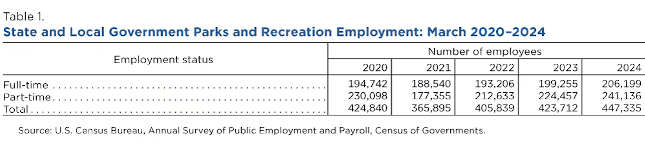
Table 1. State and Local Government Parks and Recreation Employment: March 2020-2024


Parks and recreation, hunting and fishing

The Census Bureau’s Annual Survey of Public Employment & Payroll (ASPEP) shows that the number of full- and part-time people employed by state and local governments at parks and recreational facilities (golf courses, camping grounds, public pools, marinas, etc.) initially declined from 2020 to 2021, but grew steadily the next three years (Table 1).

The ASPEP publishes annual public sector employment estimates for the pay period that includes March 12. These estimates give us timely pre-pandemic numbers, considering this reporting period was just days before the start of pandemic shutdowns.

State and local governments employed 365,895 parks and recreation workers in 2021, down 13.9% from 2020.

Most of the job loss was among part-time employees; about 22.9% of part-time employees were let go or left compared to 3.2% of full-time employees.

As residents increasingly engaged in outdoor activities, parks and recreation-related employment grew by 10.9% to 405,839 in 2022 and by 4.4% to 423,712 in 2023.

In the latest release of ASPEP data, parks and recreation employment grew by 5.6% to 447,335 employees in 2024, surpassing its pre-pandemic level.

Unlike many other recreation sectors, hunting and fishing license fee collections actually grew from 2020 to 2024. According to the Census Bureau’s Annual Survey of State Tax Collections, these totaled $1.8 billion in 2020, up 7.8% from 2019.

As other activities reopened, fee collections still grew but at a slower pace: up 3.4% in 2021, 0.1% in 2022, 1.4% in 2023 and 0.7% to $1.9 billion in 2024.


Travel and transportation

Air and sea travel

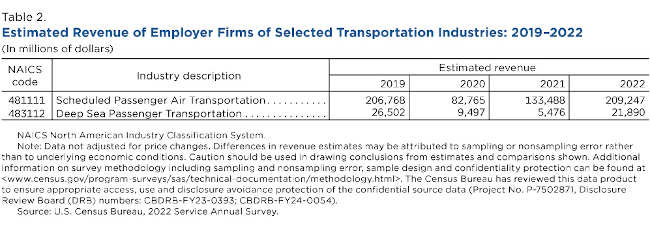
Revenue of Scheduled Passenger Air Transportation dropped 60.0% from $206.8 billion in 2019 to $82.8 billion in 2020 (Table 2), according to the Census Bureau’s 2022 Service Annual Survey (SAS) – which provides estimated revenues for employer firms across services.

The industry (which covers transportation of passengers and/or cargo over regular routes and on regular schedules) started to recover in 2021, with revenue climbing to $133.5 billion. It did not rebound to 2019 levels until 2022.

While the Deep Sea Passenger Transportation industry began to recover in 2022, it was still behind 2019 pre-pandemic levels (Table 2). This industry provides deep sea transportation of passengers to and from foreign ports.

According to the SAS, the revenue of this industry dropped 64.2% from $26.5 billion in 2019 to $9.5 billion in 2020. It continued to fall, dropping 42.3% to $5.5 billion in 2021.

In 2022, it soared 299.7% to $21.9 billion, a significant jump but still 17.4% lower than 2019 revenue levels ($26.5 billion). That year (2022), the Centers for Disease Control and Prevention (CDC) updated its pandemic cruise ship restrictions, allowing individual cruise lines to monitor their own COVID-19 protocols. But most major cruise lines did not drop testing requirements until fall 2022.


Taxi, charter bus and limousine services

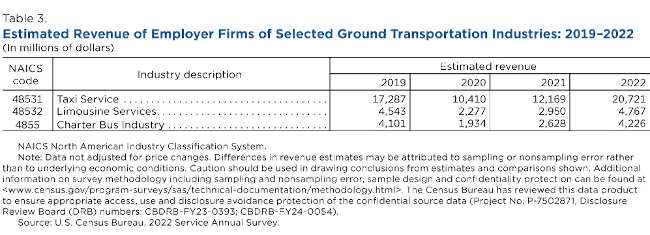
In 2019, the Taxi Service industry thrived with revenues of $17.3 billion, according to the SAS (Table 3). By the end of 2020, however, revenues had dropped 39.8% to $10.4 billion. The taxi service industry eventually surpassed its 2019 revenue by 19.9% to $20.7 billion in 2022.

The Charter Bus Industry and Limousine Services followed similar year-to-year revenue trajectories (Table 3).

In 2019, the charter bus industry had annual revenues of $4.1 billion. Revenues dropped 52.8% in 2020 to $1.9 billion but increased in 2021 and returned to pre-pandemic levels ($4.2 billion) in 2022.

Limousine Services had $4.5 billion in revenue in 2019, which fell 49.9% to about $2.3 billion in 2020. Revenues increased 29.6% in 2021, followed by another 61.6% in 2022.


Entertainment: Promoters of performing arts, sports and similar events

During the COVID pandemic, many live entertainment events were cancelled or postponed for over a year. According to Oxford Economics, a leading global economic advisory firm, concerts and other live entertainment significantly drive economic activity across the United States, also contributing to off-site spending in places like local bars, restaurants, transportation, lodging, parking and retail.

The New York Times reported that in 2020, the sports industry and music festivals faced one of their largest economic challenges in a decade.

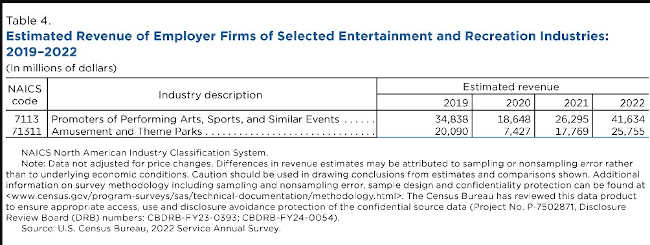
According to the SAS, the Promoters of Performing Arts, Sports, and Similar Events industry experienced a 46.5% decrease in revenue from $34.8 billion in 2019 to $18.6 billion in 2020 (Table 4).

But from 2021 to 2022, revenue went up 58.3% from $26.3 billion to $41.6 billion, surpassing 2019 levels.

The Amusement and Theme Parks industry also bounced back (Table 4).

This industry’s revenue fell 63.0% from $20.1 billion in 2019 to $7.4 billion in 2020. In 2021, revenues rose 139.2% to $17.8 billion and in 2022 by 44.9% to $25.8 billion, exceeding pre-pandemic levels.

Maria Villarreal is a survey statistician in the Census Bureau’s Accommodations, Entertainment, and Consumer Services Branch of the Economy-Wide Statistics Division. Letha Rubin is a supervisory survey statistician in the Census Bureau’s Healthcare and Educational Services Branch of the Economy-Wide Statistics Division. Laura Tilley is a survey statistician in the Census Bureau’s Information and Business Services Branch of the Economy-Wide Statistics Division. Sandra Cooke-Hull is an economist in the Census Bureau’s Public Sector Programs Office of the Economy-Wide Statistics Division
  1. Whooping cough is making a comeback, but the vaccine provides powerful protection
  2. Clearlake Animal Control: ‘Halo’ and the dogs
  3. Judge in Scotts Valley Pomo’s Vallejo casino lawsuit rules against allowing other tribes to intervene
  • 303
  • 304
  • 305
  • 306
  • 307
  • 308
  • 309
  • 310
  • 311
  • 312
How to resolve AdBlock issue?
Refresh this page