How to resolve AdBlock issue?
Refresh this page
How to resolve AdBlock issue?
Refresh this page
Lake County News,California
  • Home
    • Registration Form
  • News
    • Education
    • Veterans
    • Community
      • Obituaries
      • Letters
      • Commentary
    • Police Logs
    • Business
    • Recreation
    • Health
    • Religion
    • Legals
    • Arts & Life
    • Regional
  • Calendar
  • Contact us
    • FAQs
    • Phones, E-Mail
    • Subscribe
  • Advertise Here
  • Login
How to resolve AdBlock issue?
Refresh this page

News

What makes people flourish? A new survey of more than 200,000 people across 22 countries looks for global patterns and local differences

Details
Written by: Victor Counted, Regent University; Byron R. Johnson, Baylor University, and Tyler J. VanderWeele, Harvard University
Published: 03 May 2025


Flourishing is about your whole life being good, including the people and places around you. Westend61 via Getty Images

More recently, researchers have focused on the idea of flourishing, not simply as happiness or success, but as a multidimensional state of well-being that involves positive emotions, engagement, relationships, meaning and accomplishment − an idea that traces back to Aristotle’s concept of “eudaimonia” but has been redefined within the well-being science literature.

Flourishing is not just well-being and how you feel on the inside. It’s about your whole life being good, including the people around you and where you live. Things such as your home, your neighborhood, your school or workplace, and your friends all matter.

We are a group of psychological scientists, social scientists and epidemiologists who are all contributors to an international collaboration called the Global Flourishing Study. The goal of the project is simple: to find patterns of human flourishing across cultures.

Do people in some countries thrive more than others? What makes the biggest difference in a person’s well-being? Are there things people can do to improve their own lives? Understanding these trends over time can help shape policies and programs that improve global human flourishing.

What does the flourishing study focus on?

The Global Flourishing Study is a five-year annual survey of over 200,000 participants from 22 countries, using nationally representative sampling to understand health and well-being. Our team includes more than 40 researchers across different disciplines, cultures and institutions.

With help from Gallup Inc., we asked people about their lives, their happiness, their health, their childhood experiences, and how they feel about their financial situation.

The study looks at six dimensions of a flourishing life:

  1. Happiness and life satisfaction: how content and fulfilled people feel with their lives.

  2. Physical and mental health: how healthy people feel, in both body and mind.

  3. Meaning and purpose: whether people feel their lives are significant and moving in a clear direction.

  4. Character and virtue: how people act to promote good, even in tough situations.

  5. Close social relationships: how satisfied people are with their friendships and family ties.

  6. Financial and material stability: whether people feel secure about their basic needs, including food, housing and money.

We tried to quantify how participants are doing on each of these dimensions using a scale from 0 to 10. In addition to using the Secure Flourish measure from Harvard’s Human Flourishing Program, we included additional questions to probe other factors that influence how much someone is flourishing.

For example, we assessed well-being through questions about optimism, peace and balance in life. We measured health by asking about pain, depression and exercise. We measured relationships through questions about trust, loneliness and support.

Who is flourishing and why?

Our first wave of results reveals that some countries and groups of people are doing better than others.

We were surprised that in many countries young people are not doing as well as older adults. Earlier studies had suggested well-being follows a U-shape over the course of a lifespan, with the lowest point in middle age. Our new results imply that younger adults today face growing mental health challenges, financial insecurity and a loss of meaning that are disrupting the traditional U-shaped curve of well-being.

Married people usually reported more support, better relationships and more meaning in life.

People who were working – either for themselves or someone else – also tended to feel more secure and happy than people who were seeking jobs.

People who go to religious services once a week or more typically reported higher scores in all areas of flourishing – particularly happiness, meaning and relationships. This finding was true in almost every country, even very secular ones such as Sweden.

It seems that religious communities offer what psychologists of religion call the four B’s: belonging, in the form of social support; bonding, in the form of spiritual connection; behaving, in the cultivation of character and virtue through the practices and norms taught within religious communities; and believing, in the form of embracing hope, forgiveness and shared spiritual convictions.

But some people who attend religious services also report more pain or suffering. This correlation may be because religious communities often provide support during hard times, and frequent attendees may be more attentive to or more likely to experience pain, grief or illness.

Your early years shape how you do later in life. But even if life started off as challenging, it doesn’t have to stay that way. Some people who had difficult childhoods, having experienced abuse or poverty, still found meaning and purpose later as adults. In some countries, including the U.S. and Argentina, hardship in childhood seemed to build resilience and purpose in adulthood.

Globally, men and women report similar levels of flourishing. But in some countries there are big differences. For example, women in Japan report higher scores than men, while in Brazil, men report doing better than women.

Where are people flourishing most?

Some countries are doing better than others when it comes to flourishing.

Indonesia is thriving. People there scored high in many areas, including meaning, purpose, relationships and character. Indonesia is one of the highest-scoring countries in most of the indicators in the whole study.

Mexico and the Philippines also show strong results. Even though these countries have less money than some others, people report strong family ties, spiritual lives and community support.

Japan and Turkey report lower scores. Japan has a strong economy, but people there report lower happiness and weaker social connections. Long work hours and stress may be part of the reason. In Turkey, political and financial challenges may be hurting people’s sense of trust and security.

One surprising result is that richer countries, including the United States and Sweden, are not flourishing as well as some others. They do well on financial stability but score lower in meaning and relationships. Having more money doesn’t always mean people are doing better in life.

In fact, countries with higher income often report lower levels of meaning and purpose. Meanwhile, countries with higher fertility rates often report more meaning in life. These findings show that there can be a trade-off. Economic progress might improve some things but weaken others.

One of the authors reflects on what the survey data reveals about what helps people truly flourish across the world.

The big picture

The Global Flourishing Study is helping us see that people all over the world want many of the same basic things: to be happy, healthy, connected and safe. But different countries reach those goals in different ways. There is no one-size-fits-all answer to flourishing. What it means to flourish can look different from place to place and from one person to another.

One challenge with the Global Flourishing Study is that it uses the same set of questions in all 22 countries. This method, known as an etic approach, helps us compare results across cultures. But it can miss the nuance and local meanings of flourishing. What brings happiness or purpose in one country or context might not mean the same thing in another.

We consider this study to be a starting point. It opens the door for more emic studies – research that uses questions and ideas that fit the values, language and everyday life of specific cultures and societies. Researchers can build on this study’s findings to expand how we understand and measure flourishing around the world.The Conversation

Victor Counted, Associate Professor of Psychology, Regent University; Byron R. Johnson, Distinguished Professor of the Social Sciences and Director of the Institute for Studies of Religion, Baylor University, and Tyler J. VanderWeele, Professor of Epidemiology, Harvard University

This article is republished from The Conversation under a Creative Commons license. Read the original article.

What does it mean to live a good life? For centuries, philosophers, scientists and people of different cultures have tried to answer this question. Each tradition has a different take, but all agree: The good life is more than just feeling good − it’s about becoming whole.
Space News: On Jupiter, it's mushballs all the way down

Details
Written by: Robert Sanders
Published: 03 May 2025
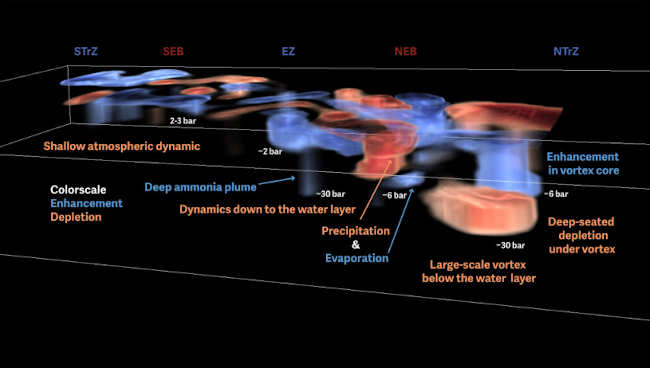
A cross section of the upper atmosphere, or troposphere, of Jupiter, showing the depth of storms in a north-south swath that crosses the planet's equator, or equatorial zone (EZ). Blue and red represent, respectively, higher- and lower-than-normal abundances of ammonia gas. By tracking the ammonia, two new UC Berkeley studies show that the rapidly changing weather systems on Jupiter are mostly very shallow (left), though two types of storms — rapidly rising plumes of ammonia (center) and tornado-like vortices — punch more deeply and are responsible for unmixing atmospheric gases. Large-scale storms produce mushballs that rain downward even deeper than the plumes and vortices. (Graphic credit: Chris Moeckel, UC Berkeley.)

Imagine a Slushee composed of ammonia and water encased in a hard shell of water ice. Now picture these ice-encrusted slushballs, dubbed "mushballs," raining down like hailstones during a thunderstorm, illuminated by intense flashes of lightning.

Planetary scientists at the University of California, Berkeley, now say that hailstorms of mushballs accompanied by fierce lightning actually exist on Jupiter. In fact, mushball hailstorms may occur on all gaseous planets in the galaxy, including our solar system's other giant planets, Saturn, Uranus and Neptune.

The idea of mushballs was initially put forth in 2020 to explain nonuniformities in the distribution of ammonia gas in Jupiter's upper atmosphere that were detected both by NASA's Juno mission and by radio telescopes on Earth.

At the time, UC Berkeley graduate student Chris Moeckel and his adviser, Imke de Pater, professor emerita of astronomy and of earth and planetary science, thought the theory too elaborate to be real, requiring highly specific atmospheric conditions.

"Imke and I both were like, ‘There's no way in the world this is true,’" said Moeckel, who received his UC Berkeley Ph.D. last year and is now a researcher at UC Berkeley's Space Sciences Laboratory. "So many things have to come together to actually explain this, it seems so exotic. I basically spent three years trying to prove this wrong. And I couldn't prove it wrong."

The confirmation, reported March 28 in the journal Science Advances, emerged together with the first 3D visualization of Jupiter's upper atmosphere, which Moeckel and de Pater recently created and describe in a paper that is now undergoing peer review and is posted on the preprint server arXiv.

The 3D picture of Jupiter's troposphere shows that the majority of the weather systems on Jupiter are shallow, reaching only 10 to 20 kilometers below the visible cloud deck or “surface” of the planet, which has a radius of 70,000 km. Most of the colorful, swirling patterns in the bands that encircle the planet are shallow.

Some weather, however, emerges much deeper in the troposphere, redistributing ammonia and water and essentially unmixing what was long thought to be a uniform atmosphere. The three types of weather events responsible are hurricane-like vortices, hotspots coupled to ammonia-rich plumes that wrap around the planet in a wave-like structure, and large storms that generate mushballs and lightning.

"Every time you look at Jupiter, it's mostly just surface level," Moeckel said. "It's shallow, but a few things — vortices and these big storms — can punch through."

"Juno really shows that ammonia is depleted at all latitudes down to about 150 kilometers, which is really odd," said de Pater, who discovered 10 years ago that ammonia was depleted down to about 50 km. "That's what Chris is trying to explain with his storm systems going much deeper than we expected."

Inferring planet composition from observations of clouds

Gas giants like Jupiter and Saturn and ice giants like Neptune and Uranus are a major focus of current space missions and large telescopes, including the James Webb Space Telescope, in part because they can help us understand the formation history of our solar system and ground truth observations of distant exoplanets, many of which are large and gaseous. Since astronomers can see only the upper atmospheres of faraway exoplanets, knowing how to interpret chemical signatures in these observations can help scientists infer details of exoplanet interiors, even for Earth-like planets.

"We're basically showing that the top of the atmosphere is actually a pretty bad representative of what is inside the planet," Moeckel said.

That's because storms like those that create mushballs unmix the atmosphere so that the chemical composition of the cloud tops does not necessarily reflect the composition deeper in the atmosphere. Jupiter is unlikely to be unique.

"You can just extend that to Uranus, Neptune — certainly to exoplanets as well," de Pater said.

The atmosphere on Jupiter is radically different from that on Earth. It's primarily made of hydrogen and helium gas with trace amounts of gaseous molecules, like ammonia and water, which are heavier than the bulk atmosphere. Earth's atmosphere is mainly nitrogen and oxygen. Jupiter also has storms, like the Great Red Spot, that last for centuries. And while ammonia gas and water vapor rise, freeze into droplets, like snow, and rain down continually, there is no solid surface to hit. At what point do the raindrops stop falling?

"On Earth, you have a surface, and rain will eventually hit this surface," Moeckel said. "The question is: What happens if you take the surface away? How far do the raindrops fall into the planet? This is what we have on the giant planets."

That question has piqued the interest of planetary scientists for decades, because processes like rain and storms are thought to be the main vertical mixers of planetary atmospheres. For decades, the simple assumption of a well-mixed atmosphere guided inferences about the interior makeup of gas giant planets like Jupiter.

Observations by radio telescopes, much of it conducted by de Pater and colleagues, show that this simple assumption is false.

"The turbulent cloud tops would lead you to believe that the atmosphere is well mixed," said Moeckel, invoking the analogy of a boiling pot of water. "If you look at the top, you see it boiling, and you would assume that the whole pot is boiling. But these findings show that even though the top looks like it’s boiling, below is a layer that really is very steady and sluggish."

The microphysics of mushballs

On Jupiter, the majority of water rain and ammonia snow appears to cycle high up in the cold atmosphere and evaporate as it falls, Moeckel said. Yet, even before Juno's arrival at Jupiter, de Pater and her colleagues reported an upper atmosphere lacking in ammonia. They were able to explain these observations, however, through dynamic and standard weather modeling, which predicted a rainout of ammonia in thunderstorms down to the water layer, where water vapor condenses into a liquid.

But radio observations by Juno traced the regions of poor mixing to much greater depths, down to about 150 km, with many areas puzzlingly depleted of ammonia and no known mechanism that could explain the observations. This led to proposals that water and ammonia ice must form hailstones that fall out of the atmosphere and remove the ammonia. But it was a mystery how hailstones could form that were heavy enough to fall hundreds of kilometers into the atmosphere.

To explain why ammonia is missing from parts of Jupiter’s atmosphere, planetary scientist Tristan Guillot proposed a theory involving violent storms and slushy hailstones called mushballs. In this idea, strong updrafts during storms can lift tiny ice particles high above the clouds — more than 60 kilometers up. At those altitudes, the ice mixes with ammonia vapor, which acts like antifreeze and melts the ice into a slushy liquid. As the particles continue to rise and fall, they grow larger — like hailstones on Earth — eventually becoming mushballs the size of softballs.

These mushballs can trap large amounts of water and ammonia with a 3 to 1 ratio. Because of their size and weight, they fall deep into the atmosphere — well below where the storm started — carrying the ammonia with them. This helps explain why ammonia appears to be missing from the upper atmosphere: it’s being dragged down and hidden deep inside the planet, where it leaves faint signatures to be observed with radio telescopes.

However, the process depends on a number of specific conditions. The storms need to have very strong updrafts, around 100 meters per second, and the slushy particles must quickly mix with ammonia and grow large enough to survive the fall.

"The mushball journey essentially starts about 50 to 60 kilometers below the cloud deck as water droplets. The water droplets get rapidly lofted all the way to the top of the cloud deck, where they freeze out and then fall over a hundred kilometers into the planet, where they start to evaporate and deposit material down there," Moeckel said. "And so you have, essentially, this weird system that gets triggered far below the cloud deck, goes all the way to the top of the atmosphere and then sinks deep into the planet."

Unique signatures in the Juno radio data for one storm cloud convinced him and his colleagues that this is, indeed, what happens.

"There was a small spot under the cloud that either looked like cooling, that is, melting ice, or an ammonia enhancement, that is, melting and release of ammonia," Moeckel said. "It was the fact that either explanation was only possible with mushballs that eventually convinced me."

The radio signature could not have been caused by water raindrops or ammonia snow, according to paper co-author Huazhi Ge, an expert in cloud dynamics on giant planets and a postdoctoral fellow at the California Institute of Technology in Pasadena.

"The Science Advances paper shows, observationally, that this process apparently is true, against my best desire to find a simpler answer," Moeckel said.

Coordinated observations of Jupiter

Scientists around the world observe Jupiter regularly with ground-based telescopes, timed to coincide with Juno's closest approach to the planet every six weeks. In February 2017 and April 2019 — the periods covered by the two papers — the researchers used data from both the Hubble Space Telescope (HST) and the Very Large Array (VLA) in New Mexico to complement Juno observations in an attempt to create a 3D picture of the troposphere.

The HST, at visible wavelengths, provided measurements of reflected light off the cloud tops, while the VLA, a radio telescope, probed tens of kilometers below the clouds to provide global context. Juno's Microwave Radiometer explored the deep atmosphere of Jupiter over a limited region of the atmosphere.

"I essentially developed a tomography method that takes the radio observations and turns them into a three-dimensional rendering of that part of the atmosphere that is seen by Juno," Moeckel said.

The 3D picture of that one swath of Jupiter confirmed that most of the weather is happening in the upper 10 kilometers.

"The water condensation layer plays a crucial role in controlling the dynamics and the weather on Jupiter," Moeckel said. “Only the most powerful storms and waves can break through that layer.

Moeckel noted that his analysis of Jupiter’s atmosphere was delayed by the lack of publicly available calibrated data products from the Juno mission. Given the current level of data released, he was forced to independently reconstruct the mission team’s data processing methods — tools, data and discussions that, if shared earlier, could have significantly accelerated independent research and broadened scientific participation. He has since made these resources publicly available to support future research efforts.

The work was funded in part by a Solar System Observations (SSO) award from NASA (80NSSC18K1003).

Robert Sanders writes for the UC Berkeley News Center.

Lake County joins regional push to protect landline services in rural areas

Details
Written by: LINGZI CHEN
Published: 02 May 2025
MIDDLETOWN, Calif. — At a California Public Utilities Commission workshop, Lake County leaders, alongside regional officials, discussed concerns over communication in rural California and called for continuous landline services to the region.

The California Public Utilities Commission, or CPUC, held panel discussions at Twin Pine Hotel and Casino on April 4 with tribal, public safety and rural county leadership as part of a rulemaking proceeding on carrier of last resort.

The workshop was the first in a series of public participation events focused on potential changes to the rulemaking proceeding, which could affect landline services across the state.

Speakers throughout the day emphasized the essential role of reliable landline service in rural California, where cell towers are sparse, weather conditions are challenging, more residents rely on copper lines and public safety depends on having redundant communication systems — especially during emergencies like wildfires, floods and power outages.

Lake County District 5 Supervisor Jessica Pyska, Sheriff Luke Bingham and Middletown Rancheria of Pomo Indians Chairman Moke Simon joined state officials and leaders of other tribes and counties — including Mendocino, Inyo, Nevada and San Mateo — in the discussion.

A carrier of last resort, often referred to as COLR, is a telecommunications provider obligated to offer basic phone service — typically landline service — to any customer within a designated area.

AT&T is the designated COLR in much of California, including Lake County, and is the largest one in the state.

In 2023, AT&T California filed an application requesting relief from its obligations. The CPUC rejected the application in June 2024.

During the review process, the Lake County Board of Supervisors submitted a letter to CPUC, opposing AT&T’s request, warning of “considerable dangers” to residents who rely solely on landlines and lack alternative communication options.

Also in June 2024, the CPUC opened a new proceeding to consider making changes to the current COLR rules.

Current rules state that a COLR cannot end its service obligations unless another provider assumes the responsibility. Changes to such rules could affect the conditions of COLR withdrawal.

“A company that is no longer designated as COLR could stop providing basic service,” CPUC says in a fact sheet regarding the rulemaking.

Communication ‘redundancy’ is key for public safety and personal emergencies

Public safety panelists emphasized the importance of communication “redundancy” during emergencies, stressing the need for multiple methods in rugged rural areas where cell coverages are sparse and unreliable.

They noted that copper infrastructure and landline services remain critical, even alongside modern wireless systems.

“We're a very rural community, we're a very rugged community in different areas, and that causes a lot of communication problems within our communities, even within our own dispatch system,” said Lake County Sheriff Bingham, adding that there were times when radio or cell phone systems broke down.

“So our goal within the OES [Office of Emergency Services] branch of the sheriff's office in the county is to always have those redundant systems of notification and communication within the county,” Bingham said.

Speakers made references to wildfire disasters when communication was challenging and dependable landlines were key.

“During the 2017 wildfires, we had our copper lines,” said Mendocino County Sheriff Matthew Kendall. “The poles had been burned and they were laying on the ground, but I was still able to make it to a fire department, pick up a landline, dial it and connect with Cal Fire.”

He added, “These layers — this redundancy that we have in place — is very, very important for first responders from the beginning to the end of an event.”

Kendall then pointed to two things that have “historically worked” in Mendocino that he still thought are important today: local radio and copper lines, which he personally still keeps at home.

"If we remove one of those layers, the devil's in the details on some of these things," Kendall said, adding that these systems are essential not only during wildfires, but also in everyday emergencies — like when someone falls off a ladder or during a public safety power shutoff.

“Without the ability to make a phone call, contact 911, contact EMS [emergency medical services] or fire or the sheriff's office,” he said, “people are going to suffer, and so that's a huge concern for me, if we start taking things off the plate that have historically worked for us.”

Having multiple communication methods available is also important for first responders to locate callers.

“Worst case — the fiber connection burns up and there's no redundant path for the VoIP customer to be able to call, you're not going to know where they're at,” said Paul Troxel, 911 Branch Manager of the California Governor’s Office of Emergency Services, or Cal OES.

“The cell coverage here is very spotty,” said Supervisor Pyska later in the rural county officials panel.

She referenced medically fragile constituents who only have a landline, residents who do not have access to cell service despite living in a populated community, and those who live in an area that suffers from regular floods.

“These are the people that I’m really, really concerned about,” she said. “This is not an unusual story.”

Potential for a ‘drastic negative impact on public safety’

Each year, more than 26 million 911 calls are received statewide, according to Troxel. Of those, 87% come from a wireless device, about 4% come from a “plain old telephone POTS line” and about 6% from a VoIP line, he said.

Sheriff Bingham later added that in Lake County, his dispatch center receives 35,000 to 38,000 calls of 911 every year.

If landline communication is taken away from the residents, “that’s still a large amount of 911 calls that we would not be able to receive and respond to,” Bingham said of the 1,400 to 1,520 calls based on the 4% estimate.

While Troxel clarified that the percentage was an aggregated state data and he did not have the data specific to rural areas, it could be a much bigger number, said Andrew White, chief of Martinez Police, who left the city of Clearlake as the police chief in 2022.

“I would suspect the percentages are a lot higher as you go to the rural areas,” said White, reiterating the importance of providing “redundancy” in the area.

“It’s pretty few and far between that you can get access to fiber infrastructure,” White said.

Toward the end of the panel discussion, the CPUC asked how it could minimize impacts to public safety if the commission does determine that “some areas may not require a designated COLR obligation.”

“I think that is the million dollar question — if these services go away, what will be there?” Kendall said.

“I think especially in Lake County, just knowing the geography of Lake County, I think the investment in the infrastructure to cover the areas that are currently covered by copper lines would far exceed what the current cost is for those copper lines,” Bingham said.

“I think you could see a drastic negative impact on public safety, if just suddenly tomorrow it’s decided that this isn’t there,” White said of the potential changes in the rulemaking. “I think it needs to be done over time.”

Kendall mentioned that various telecommunication companies have coverage maps for cell service that do not accurately reflect their actual coverage.

“Although they look good when I look at them, a lot of them make me laugh — because they will have full coverage in places where I've been standing just two days prior, unable to make any phone calls,” Kendall said.

“It’s got to be boots on the ground and actually go test it — go test it,” he said.

Email staff reporter Lingzi Chen at This email address is being protected from spambots. You need JavaScript enabled to view it.. 

Lake County Economic Development Corp. secures Catalyst Award to strengthen regional health care workforce

Details
Written by: LAKE COUNTY NEWS REPORTS
Published: 02 May 2025
LAKE COUNTY, Calif. — The Lake County Economic Development Corp., or LCEDC, has been selected as a Catalyst awardee through the Redwood Region RISE initiative meant to improve health care.

With an investment of $650,000, LCEDC will advance the development of the Lake County Healthcare Education and Simulation Center — also known as the Health Education and Regional Training, or HEART, Hub — a transformative project designed to address workforce shortages and elevate health care training opportunities in Lake County and the broader Redwood Region.

“This award marks a significant step in our commitment to strengthening Lake County’s health care infrastructure and workforce development,” said Tim Stephens, CEO of Sutter Lakeside Hospital. “Through state-of-the-art simulation facilities, we are equipping future health care professionals with the hands-on skills needed to serve our communities, ensuring sustainable job growth and improved health outcomes.”

As part of the Catalyst Awards program, which allocates over $8.1 million in funding to support high-impact economic development projects, LCEDC’s initiative aligns with Redwood Region RISE’s 10-year Regional Roadmap.

The awards prioritize projects that foster inclusive economic development, particularly in priority and disinvested communities, with over 70% of funding directed to such initiatives.

LCEDC is collaborating with leading industry partners and educational institutions to ensure the success and long-term sustainability of the HEART Hub. The organization said these partnerships provide essential expertise, resources, and curriculum development to enhance workforce training in Lake County.

Partners include:

• Sutter Health, Lake County Tribal Health Consortium, Adventist Health Clearlake, Partnership Healthplan of California, Hospital Council of Northern and Central California: Clinical expertise and workforce development support.

• Lake County Office of Education, Mendocino County Office of Education, Mendocino College, Woodland College, Mendocino Lake Adult and Career Education Consortium, Lake and Mendocino Schools, Redwood Coast K16 Educational Collaborative, Sonoma State University: Health care curriculum design and simulation training.

• Workforce Alliance of the North Bay: Career pathways and job placement initiatives.

• Lake County Chamber of Commerce, county of Lake, MotherWise: Community and government support.

By engaging with local health care providers, educational institutions, and workforce development leaders, LCEDC is ensuring that the center serves as a pipeline for well-trained professionals entering the health care industry.

The HEART Hub contributes to the roadmap’s focus on health and caregiving, reinforcing regional health care resilience and expanding career pathways for local workers.

By offering advanced training programs and simulation-based learning, the project helps address critical workforce shortages while preparing health care professionals to meet the evolving needs of our community.

As part of this initiative, LCEDC and the HEART Hub partners remain committed to collaborating with local, state and federal partners to secure further investment and amplify the long-term impact of this program.

With implementation expected to begin in May 2025 and completion set for September 2026, LCEDC is eager to drive innovation, expand training opportunities, and position Lake County as a hub for health care education.
  1. Whether GDP swings up or down, there are limits to what it says about the economy and your place in it
  2. Federal legislators attempt to repeal California Clean Air Act waivers
  3. Police, county health agencies conduct outreach at encampments
  • 302
  • 303
  • 304
  • 305
  • 306
  • 307
  • 308
  • 309
  • 310
  • 311
How to resolve AdBlock issue?
Refresh this page