How to resolve AdBlock issue?
Regional
- Details
- Written by: Caltrans
“The CTC’s welcome decision to green light more than half a billion dollars to maintain and repair California’s aging transportation infrastructure is not only in keeping with our time-tested ‘fix-it-first’ strategy but also represents another big step to build and maintain a transportation system that serves all who travel in California, whether by foot, bicycle, bus, train or automobile,” said Caltrans Acting Director Steven Keck.
Projects approved this week include:
· $2.1 million toward erosion control on Route 36 near Bridgeville in Humboldt County.
· $11.5 million toward improvements on Route 96 at Aikens Creek Bridge, Bluff Creek Bridge, Slate Creek Bridge and Rube Creek Bridge on Route 169 in Humboldt County.
· $3.5 million toward culvert replacement on U.S. 101 near Garberville from the Alderpoint Road Overcrossing to south of Myers Flat in Humboldt County and on Route 271 near Piercy in Mendocino County.
· $4.1 million toward construction of a retaining wall and roadway realignments on U.S. 101 near Piercy in Mendocino County.
· $1.8 million toward roadway realignments on Route 1 in Mendocino County near Gualala.
· $1.4 million toward pavement and guardrail upgrades on U.S. 101 near Willits in Mendocino County.
· $1.2 million toward pavement and guardrail upgrades on U.S. 101 near Fortuna in Humboldt County.
· $1.88 million toward improvements at Elk Creek Bridge on Route 1 near Fort Bragg in Mendocino County.
The CTC also approved the 2022 State Highway Operation and Protection Program, or SHOPP, a four-year, $17.9 billion program of projects to preserve and protect the state highway system.
Most of the 2022 SHOPP projects are focused on improving pavement, bridges and other highway infrastructure. All the 2022 SHOPP projects are available on the Caltrans’ Ten-Year Project Book website, ProjectBook.dot.ca.gov.
SB 1 provides $5 billion in transportation funding annually split between the state and local agencies. Road projects progress through construction phases more quickly based on the availability of SB 1 funds, including projects that are partially funded by SB 1.
For more information about transportation projects funded by SB 1, visit RebuildingCA.ca.gov.
- Details
- Written by: California Department of Water Resources
The California Department of Water Resources announced it has released $29.8 million in funding to the Friant Water Authority, or FWA, to repair segments of the Friant-Kern Canal, a key water conveyance facility in the San Joaquin Valley damaged by land subsidence.
“Through this investment, we are furthering a partnership to restore California’s major water conveyance systems to improve the resiliency of California’s water supply during drought and flood conditions,” said DWR Director Karla Nemeth. “The projects, when completed, will maximize the canal’s capacity to move water efficiently through the system and improve California’s ability to boost and store its water supply.”
The state-funded program, which aligns with Gov. Newsom’s Water Resilience Portfolio to improve water quality and supplies for California, is part of a cooperative approach to fixing California’s water conveyance infrastructure pursued by local, state, and federal agencies, who will financially support the projects.
The Friant-Kern Canal plays a critical role in delivering water to one million acres of farmland and more than 250,000 Californians from Fresno to Bakersfield.
In January, FWA began the first phase of the Friant-Kern Canal Middle Reach Capacity Correction Project, which will restore carrying capacity along 33 miles of the 152-mile-long canal in eastern Tulare County.
The Friant-Kern Canal, owned by the U.S. Bureau of Reclamation, has lost more than 60 percent of its original conveyance capacity in the middle section due to land subsidence. Phase one of the project is expected to cost $292 million and be completed by early 2024.
“This funding is a large part of the reason that we were able to break ground on the Friant-Kern Canal Middle Reach Capacity Correction Project in January,” said FWA Chief Executive Officer Jason Phillips. “Our partners at the State of California have invested in the San Joaquin Valley’s future at a critical time, and we are grateful to the Newsom Administration and for DWR’s dedicated efforts to release these funds as quickly as possible in recognition of the urgent need to implement the project.”
The Friant-Kern Canal is one of four projects that will receive funds as part of a $100 million initiative in the California Budget Act of 2021 to improve water conveyance systems in the San Joaquin Valley.
DWR is working on agreements for projects on the Delta-Mendota Canal, San Luis Canal, and California Aqueduct.
To receive program funding, participants must show proof of adequate non-state cost share to match the state financial assistance.
Program funds will be used to pay for planning, permitting, design, and construction of near-term subsidence rehabilitation projects, such as raising canal embankments or repairing check structures. Agencies with funded projects will need to investigate the risk of subsidence and how to prevent continued subsidence.
An additional $100 million in funding is slated for the coming fiscal year.
Subsidence is a long-term issue for water conveyance systems that has been exacerbated by recent droughts. If not addressed, continued subsidence will further reduce the water delivery capacity of regional canals and aqueducts and increase the costs for remediation.
- Details
- Written by: California Department of Fish and Wildlife
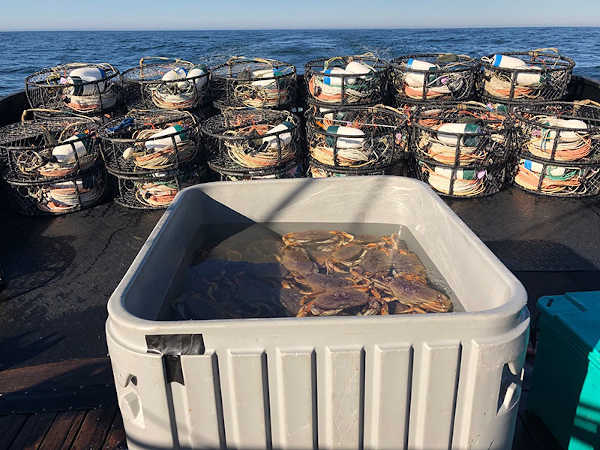
California Department of Fish and Wildlife Director Charlton H. Bonham has assessed entanglement risk under the Risk Assessment Mitigation Program (RAMP) and announced the closure of the commercial Dungeness crab fishery in Fishing Zones 3, 4, 5 and 6 (Sonoma/Mendocino county line to the U.S./Mexico border) effective at noon on April 8, 2022.
This closure is being implemented because of two recent humpback whale entanglements that occurred off San Mateo County and in Monterey Bay involving California commercial Dungeness crab fishing gear.
All commercial Dungeness crab traps must be removed from the fishing grounds by the April 8 closure date.
While this closure shortens the season for many fishermen, the RAMP regulations are designed to minimize risk and provide for a long-term viable fishery for all Californians.
In addition, the Director has authorized the Lost and Abandoned Gear Retrieval Program to begin removing commercial Dungeness crab traps left in the water beginning April 15, 2022, at noon in Zones 3, 4, 5 and 6.
CDFW asks fishermen and mariners to be on the lookout for entangled whales and report them so that a disentanglement response team can be mobilized to remove the gear. Reports can be made to 1-877-SOS-WHALE or contact the U.S. Coast Guard on VHF Channel 16.
The recreational fishery in these zones remains open but may be subject to a future trap restriction when humpbacks return to forage during the spring and summer.
In addition, CDFW is continuing a Fleet Advisory and reminds all in the commercial and recreational fisheries to implement best practices, as described in the Best Practices Guide.
“The past few seasons have been difficult for fishing families, communities and businesses, but it is imperative that we strike the right balance between protecting humpback whales and providing fishing opportunity,” said Director Bonham. “The fleet has done an impressive job helping CDFW manage risk of entanglement in the commercial fishery, including starting to remove fishing gear when the entanglements were first reported. This partnership helps ensure we protect future opportunities to fish and the incredible biodiversity of our ocean.”
A map of all Fishing Zones can be found on the CDFW website.
For more information related to the risk assessment process, please visit CDFW’s Whale Safe Fisheries webpage.
For more information on the Dungeness crab fishery, please visit CDFW’s Crab webpage, including FAQs for the 2021-22 commercial fishing season and FAQs for the new recreational crab trap regulations.
- Details
- Written by: Caltrans
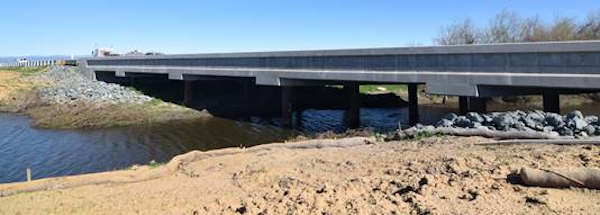
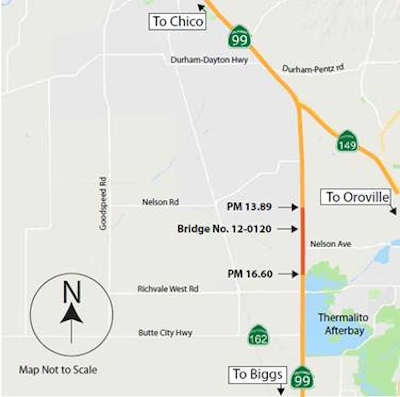
BUTTE COUNTY, Calif. — Caltrans announced Monday it has completed construction of the new Cottonwood Creek Bridge in Butte County.
The $15.3 million project includes $3.2 million in funding from Senate Bill (SB) 1, the Road Repair and Accountability Act of 2017.
The new bridge, located on State Route 99 north of the Thermalito Afterbay reservoir, replaces an aging structure damaged by erosion.
Over the years, swiftly moving water from Cottonwood Creek removed sediment around the bridge piers, compromising the integrity of the structure.
“The project is part of Caltrans’ effort to rehabilitate or replace several bridges in Butte County and neighboring Yuba and Sutter counties,” said Caltrans District 3 Director Amarjeet S. Benipal. “We’re continuing to honor our SB 1 commitments to all California travelers.”
In addition to building a new bridge, construction crews realigned a segment of roadway and widened the Nelson Avenue intersection at SR 99 by providing an additional left-turn lane onto eastbound lanes.
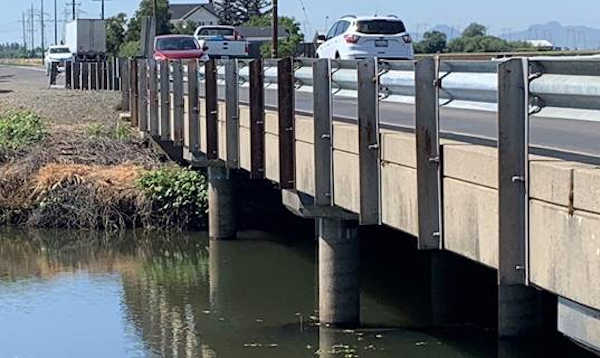
In the past two years, Caltrans has also upgraded the Western Canal Bridge on SR 99 in Butte County and replaced the SR 70 Simmerly Slough Bridge north of Marysville, the SR 20 Wadsworth Canal Bridge in Sutter County, and the SR 20 Dry Creek Bridge in Yuba County.
SB 1 provides $5 billion in transportation funding annually split between the state and local agencies. Road projects progress through construction phases more quickly based on the availability of SB 1 funds, including projects that are partially funded by SB 1.
For more information about other transportation projects funded by SB 1, visit rebuildingca.ca.gov.