 How to resolve AdBlock issue?
Regional
- Details
- Written by: OFFICE OF CONGRESSMAN JARED HUFFMAN
The HPF grants fund preservation programs at tribal offices ensure preservation of tribal sites and cultural traditions.
“My district is home to many tribes, whose culture and history have been a deeply important part of the fabric of our community since time immemorial,” said Rep. Huffman. “Thanks to the investments made by Congress in this year’s funding bill, over a million dollars is heading their way to preserve places of cultural significance, ensuring America’s diverse history is protected and celebrated.”
These funds, totaling $1,166,615, are being delivered to 17 tribes in California’s Second Congressional District:
• $65,029 to the Bear River Band of the Rohnerville Rancheria;
• $65,281 to the Blue Lake Rancheria;
• $65,270 to the Cher-Ae Heights Indian Community of the Trinidad Rancheria;
• $65,184 to the Dry Creek Rancheria Band of Pomo Indians;
• $66,925 to the Elk Valley Rancheria;
• $66,378 to the Federated Indians of Graton Rancheria;
• $81,586 to the Hoopa Valley Tribe;
• $69,511 to the Hopland Band of Pomo Indians;
• $67,921 to the Karuk Tribe;
• $67,275 to the Kashia Band of Pomo Indians of the Stewarts Point Rancheria;
• $65,433 to the Pinoleville Pomo Nation;
• $66,258 to the Resighini Rancheria;
• $77,617 to the Round Valley Indian Tribes;
• $67,285 to the Sherwood Valley Rancheria Band of Pomo Indians of California;
• $64,732 to the Tolowa Dee-ni' Nation;
• $65,512 to the Wiyot Tribe;
• $79,418 to the Yurok Tribe.
Administered by the NPS, these funds are appropriated annually by Congress from the Historic Preservation Fund.
Since its inception in 1977, the HPF has provided more than $2 billion in historic preservation grants to states, tribes, local governments, and non-profit organizations.
- Details
- Written by: Caltrans
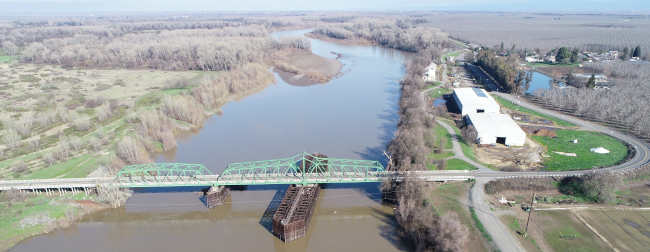
GLENN COUNTY, Calif. — Caltrans broke ground on Thursday on a major Sacramento River bridge and viaduct replacement project on State Route 162 in the Butte City area of Glenn County.
The $106 million project includes $13.8 million in funding from Senate Bill (SB) 1, the Road Repair and Accountability Act of 2017.
“With about 1,200 farms, agriculture serves as the engine that drives Glenn County’s economy,” said Caltrans District 3 Director Amarjeet S. Benipal. “The new Butte City Bridge and viaduct will enhance motorist safety and meet the needs of today’s larger farm tractors and commercial trucks that serve the county’s $750 million-per-year farm economy.”
For more than seven decades, residents, travelers, farmers and school buses have relied on the Butte City Bridge to cross the Sacramento River.
On average, more than 2,700 vehicles, including more than 270 trucks, travel daily on the bridge, which connects the county seats of Willows in Glenn County and Oroville in Butte County.
The aging structure serves as a vital transportation link connecting Glenn, Colusa and Butte counties. Without the bridge, motorists would have to travel more than 30 miles to connect back to State Routes 162 and 45.
Crews will construct a new bridge and viaduct featuring 12-foot traffic lanes and 8-foot shoulders in each direction just north of the current alignment. The structure will feature a 4,686-foot cast-in-place prestressed box girder.
A 14-foot eastbound shoulder will be constructed on SR 162/Main Street from east of McDougall Street to south of Eureka Street in Butte City.
SB 1 provides $5 billion in transportation funding annually split between the state and local agencies. Road projects progress through construction phases more quickly based on the availability of SB 1 funds, including projects that are partially funded by SB 1. For more information about other transportation projects funded by SB 1, visit www.rebuildingca.ca.gov.
Caltrans District 3 maintains more than 4,385 lanes miles of state highway in 11 Sacramento Valley and Northern Sierra counties. The department issues updates about road conditions on Twitter and on Facebook. For real-time traffic information, go to http://quickmap.dot.ca.gov/ or download the free Caltrans QuickMap app from the App Store or Google Play.

- Details
- Written by: Office of Assemblymember James C. Ramos
AB 1936 would rename the University of California Hastings College of the Law and include restorative justice provisions.
The college was named for Serranus Clinton Hastings who hired private militias that massacred the Yuki and Round Valley people in the 1850s so he could steal their lands.
Hastings then used his wealth, derived in part from the slaughter, to become California’s first Supreme Court chief justice and attorney general.
Ramos is the first California Native American elected to the Legislature in the state’s 172-year history, The lawmaker is a lifelong resident of the San Manuel Indian Reservation whose own clan was almost exterminated in the 1800s by similar militias in the San Bernardino Mountains.
Yuki and Round Valley tribal descendants asked Ramos to help them rename the college which the Legislature created in 1878 when it approved a law creating and supporting the law school.
The 1878 Legislature also approved naming it for Hastings after he contributed $100,000 in gold coins toward funding the college.
“My bill requires the law school, in consultation with the Yuki and Round Valley Indian tribes’ descendants, to rename the campus,” Ramos said. “It allows for a transparent and inclusive rebranding process. For too long, exclusion of Native Americans from decisions affecting them has been the norm. No one in the Legislature asked the Yuki or Round Valley people if Hastings was a good name for the law school in the 19th Century,” Ramos said. “Hastings hired militias to kill Native Americans in Mendocino County and took their land to build his wealth. Afterward, he used his fortune to give money to found the school and bear his name. So, in a very real sense the founding of the law college was paid for by the suffering of the Yuki and Round Valley people. It is time in the 21st Century to remedy this grievous injustice.”
Ramos added, “AB 1936 guarantees a collaboration between the tribes and the college in selecting a new name and in undertaking initiatives, some already underway, to mitigate past atrocities. Rather than just changing the letterhead, my bill is also about making sure the Round Valley and Yuki people feel heard, so their history and suffering are not dismissed. This is a crucial step toward healing a traumatic history and rectifying wrongs that were never remedied.”
“We cannot let a prominent institution that teaches about law and justice continue to be associated with a person who committed atrocious actions against Native Americans. This bill ensures that the Round Valley Indian Tribe and Yuki people get a seat at the table as the university finds a new name,” said Joint Co-Author Assemblymember Phil Ting (D-San Francisco).
Yuki Committee Vice Chair to the Round Valley Indian Tribes Tribal Council Mona Oandasan said, “We stand behind AB 1936 because it ensures our inclusion in the selection of a new name for the school. Renaming the law college without the inclusion of our voices is dismissive and offensive and would bypass the difficult conversations that must continue. Last November, the school’s board of directors approved a rebranding of the school, and now the Legislature must also act.”
“I support the continued discussions on this issue and the leadership of Assemblymember Ramos in ensuring that the voices of California’s First People are included in the selection of a new name for the College of the Law,” Assembly Speaker Anthony Rendon (D-Lakewood) said.
“Approval of AB 1936 allows the Legislature and state of California to make amends for their role in sanctioning and rewarding the barbarities Hastings committed more than a century and a half ago,” said James Russ, president of the Round Valley Tribal Council. “It is never too late to try to correct a wrong. Hastings’ actions almost exterminated our people and separated families from the lands where they had lived for millennia. Through approval of AB 1936, we hope that along with the school we can reach consensus on a name that honors our ancestors and does not let us forget the high price they paid in its creation.”
Ramos applauds the law school for engaging with the Yuki and Round Valley tribes to acknowledge its founder’s brutal history, for undertaking restorative justice initiatives and its recent agreement to rename the college.
AB 1936 “restorative justice” amendments include having the college:
- Form a nonprofit organization with the descendants’ tribal governments to help in raising capital, organizing pro bono legal assistance and other support for tribal members, to assist tribal leadership with federal, state and county matters, water and property rights, economic development, and efforts to meet the social needs of the community.
- Dedicate a permanent public memorial to the Yuki people on campus that includes historical explanations and cultural presentations.
- Create an Indian Law Program and related academic and education programs at the college available to all students interested in Indian law.
- Assist with efforts to preserve Yuki history.
- Provide financial assistance for Yuki descendants to attend postsecondary educational programs.
- Provide outreach and support so Yuki students can attend the law college.
- Assist with repatriation of tribal remains and artifacts.
- Submit reports on the progress of achieving these measures to the Assembly Committee on Higher Education and the Assembly Select Committee on Native American Affairs.
AB 1936 is sponsored by the Round Valley Indian Tribes. Supporters also include the Barona Band of Mission Indians, California Nations Indian Gaming Association, Cahto Tribe, Coyote Valley Band of Pomo Indians, Habematolel Pomo of Upper Lake, San Manuel Band of Mission Indians, Santa Ynez Band of Chumash Indians, Sherwood Valley Band of Pomo Indians, Tule River Tribe, UC Hastings Alumni for Justice and Accountability, and the Yurok Tribe.
Coauthors include Assemblymembers Steve Bennett (D-Ventura), Isaac Bryan (D-Jefferson Park), Wendy Carrillo (D-Los Angeles), Cristina Garcia (D-Bell Gardens), Mike Gipson (D-Carson), Devon Mathis (R-Visalia), Sharon Quirk-Silva (D-Fullerton), Carlos Villeda (R-Stockton), and Senators Bob Archuleta (D-Norwalk) and Lena Gonzalez (D-Long Beach).
- Details
- Written by: GLENN COUNTY SHERIFF’S OFFICE
The Glenn County Sheriff’s Office said the Butte County Sheriff’s Office Search and Rescue received a report of a deceased person near a sandbank along the Sacramento River south of Hamilton City at 2:45 p.m. Sunday.
The Butte County Sheriff’s Office Boating and Patrol Division located and recovered the deceased person, the Glenn County Sheriff’s Office reported.
The location of the body later was determined to be within the Glenn County Sheriff’s Office jurisdiction.
Glenn County Sheriff’s office said its deputies and coroners responded and took possession of the deceased.
The cause of death, identity and any further description of the deceased were undetermined as of Tuesday.
The Glenn Investigations and Narcotics Task Force is actively investigating the circumstances surrounding the individual’s death and is checking surrounding jurisdictions for any reported missing persons.
Anyone with information regarding the circumstances of this incident is urged to contact the Glenn County Sheriff’s Office GLINTF Division.
Members of the Glenn County Sheriff’s Office can be contacted in person at 543 West Oak Street in Willows, by phone at 530-934-6431, or by calling 911 in cases of an emergency.
For general information visit www.countyofglenn.net/sheriff or follow the agency on Facebook at www.facebook.com/glenncountysheriff.