 How to resolve AdBlock issue?
Regional
- Details
- Written by: California State Parks
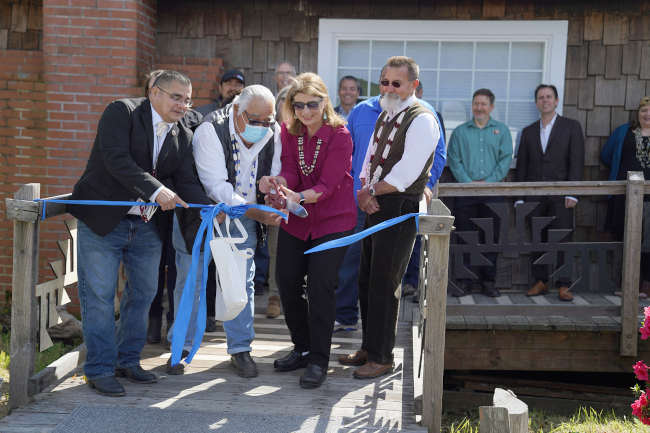
On Thursday, the Yurok Tribe, in partnership with California State Parks, Parks California and Redwood National Park, celebrated the grand opening of the recently renovated and renamed Chah-pekw O’ Ket’-toh “Stone Lagoon” Visitor Center, the first tribally operated visitor center within the State Park system.
More than 150 tribal and state park officials as well as state and federal Congress members and agency representatives traveled up to Yurok Country to attend the special celebration.
Broadcasted by Parks California, the livestreamed part of the event featured commentary from the tribe, California State Parks and Redwood National Park as well as Yurok elders who informed viewers about the tribe’s unique relationship to the coastal lagoon.
“The restoration of our role as the steward of Chah-pekw O’ Ket’-toh represents a significant step toward the healing of our people,” said Joseph L. James, the Chairman of the Yurok Tribe. “We are extremely proud to be the first tribe in California to operate a visitor center within the state park system. It is humbling to know this precedent sets the stage for many other tribes to follow suit. I would like to thank the North Coast Redwoods State Park for taking the time to build a reciprocal relationship with the tribe and taking action to correct an historic wrong.”
“I hope public land managers from all over California and the entire US use the partnership between the state park and the tribe as a blueprint to build solid working relationships with sovereign tribal nations in their regions,” added California State Parks North Coast Redwoods Superintendent Victor Bjelajac. “Our partnership on the visitor center, renaming of Sue-meg State Park and condor restoration projects are only the beginning. I know we will embark on many more equally exciting endeavors in the not so distant future.”
Managed by Yurok Cultural Resources Director and Tribal Heritage Preservation Officer, Rosie Clayburn, the Chahpekw O’ Ket’-toh “Stone Lagoon” Visitor Center now contains a multitude of digital and conventional displays that reflect the tribe’s longstanding cultural connection to the lagoon.
The tribe and park hired Yurok interpreters to share the tribe's history from pre-contact to contemporary times.
“Visitors have an opportunity to learn about the tribe from Yurok citizens,” Clayburn said.
For countless generations, Yurok families occupied multiple villages, such as Chah-pekw and Cho-chkwee, near the coastal lagoon.
The residents of the villages lived in relative peace until the California Gold Rush, when European settlers attempted a genocide against the tribe and neighboring indigenous nations.
The tribe endured several devastating atrocities during this tumultuous time period, but the Yurok people were never removed from the region.
In fact, many contemporary Yurok citizens are descendants of the Chah-pekw and Cho-kwee villagers who survived the Native American holocaust.
One of the descendants, Yurok Tribal Council Member Sherri Provolt, assisted in the formation of the agreement that paved the way for the tribe to operate the Chah-pekw O’ Ket’-toh Visitor Center.
“It feels really good to regain our rightful place as the primary caretaker of Chah-pekw O’ Ket’-toh,” said Tribal Council Member Provolt. “I know our ancestors would be proud that we are making positive change for future generations of Yurok people and natives throughout the state.”
The tribe is making progress in other big ways too. The soon-to-be realized reintroduction of the California condor was also recognized at the event.
Later this month, the Yurok Tribe and Redwood National Park plan to release the first four condors to take flight in the region since the late 1800s.
The Northern California Condor Restoration Program, composed of biologists and technicians from the tribe and Redwood National Park, will be managing the new flock. A more detailed announcement will be made when the release date is finalized.
Since 2008, the tribe has been laying the groundwork to reintroduce condors in Yurok Country.
With support from Redwood National Park, US Fish and Wildlife Service and the Administration for Native Americans, as well as the Bureau of Indian Affairs, Pacific Gas and Electric and many other contributors, such as the Global Conservation Fund, the Yurok Wildlife Department completed the tremendous amount of work required to reintroduce the critically endangered species.
The following tasks represent a small fraction of what they had to accomplish in order to make condor reintroduction a reality: extensive environmental assessments, contaminant analyses, constant fundraising, planning, designing and constructing facilities, performing intensive community outreach and coordinating with numerous stakeholders and collaborators.
In the Yurok worldview, Prey-go-neesh (condor) is one of the most sacred species. The bird is featured prominently in the tribe’s creation story and performs an essential function in the White Deerskin Dance and Jump Dance.
“The purpose of the Jump Dance and White Deerskin Dance is to bring balance to the world. Our condor restoration work is a representation of this sacred obligation. Through condor reintroduction, we are fixing an imbalance in the natural world and restoring a critical part of our culture,” said Chairman James.
As California State Parks’ statutory partner, Parks California’s mission is to help strengthen parks and inspire all to experience these extraordinary places.
The Yurok Tribe is the largest tribe in California with more than 6,300 members. The tribe’s ancestral territory comprises 7.5% of the California coastline, spanning from the Little River to the south and Damnation Creek to the north. The eastern boundary is the Klamath River’s confluence with the Trinity River.
The tribe is a leader in natural resource management, fisheries restoration and cultural protection.
- Details
- Written by: Cal Fire Mendocino Unit
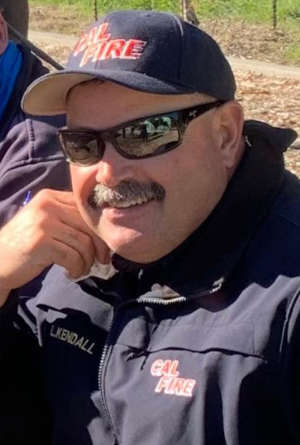
MENDOCINO COUNTY, Calif. — The Department of Forestry and Fire Protection, or Cal Fire, Mendocino Unit has welcomed its new unit chief, Luke Kendall.
Chief Luke Kendall began his career in 1991 as a firefighter I in the Mendocino Unit.
He worked through the ranks to fire captain in the Mendocino Unit, or MEU, before transferring in 2006 to the Siskiyou Unit Fire Prevention Bureau as the pre-fire engineer.
In 2007, Kendall became a peace officer and moved to the unit’s fire captain specialist position. While in this position he was the unit’s law enforcement field training officer, firearms instructor, and a board member of the Siskiyou County Arson Taskforce.
In 2010, Chief Kendall promoted to battalion chief in the Scott Valley Battalion. During this time, Chief Kendall supervised the unit’s Rescue Group Cadre and assisted in the rewrite of the Units Strategic Fire Plan.
In 2017, Chief Kendall promoted to assistant chief at Deadwood Camp.
Throughout Chief Kendall’s career he has served on several committees and teams including the Redwood Empire Hazardous Incident Team as a hazmat specialist.
Since 2018, Chief Kendall has participated in Cal Fire incident management teams and was recently appointed as the deputy incident commander of Cal Fire Incident Management Team 1.
Chief Kendall is excited to return to the Mendocino Unit where his father was a fire captain for more than 25 years and his brother, Matt Kendall, is the current Mendocino County sheriff.
Chief Kendall is looking forward to building strong cooperative agency relationships, supporting Cal Fire personnel as they face longer and more challenging fires, and serving the community in which he grew up.
- Details
- Written by: Caltrans

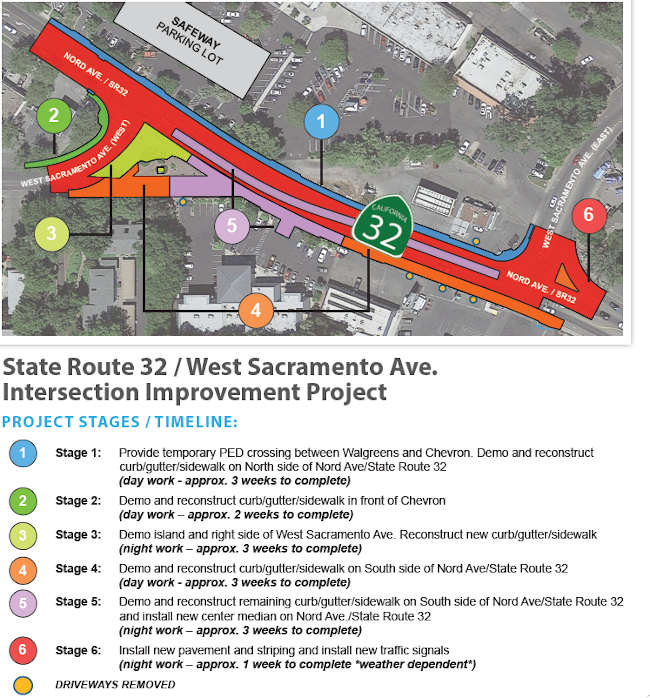
CHICO, Calif. — Caltrans is alerting motorists and residents that construction is scheduled to resume Monday, April 4, on an intersection and roadway project on State Route 32/Nord Avenue near California State University, Chico.
Construction crews will be working during weekday daytime and nighttime hours and on occasional Saturdays between West Sacramento Avenue east and West Sacramento Avenue west through mid-July.
Traffic-interfering work will be restricted to the overnight hours. Residents in the area may hear loud construction noise, including OSHA-required vehicle backup warning alarms, during nighttime roadwork.
The $5.7 million safety project calls for installing new traffic signals and overhead lighting, median curbs and islands at West Sacramento Avenue (east and west), upgrading sidewalks and curb ramps, restriping the bicycle lanes with green paint and rehabilitating the pavement. Lamon Construction of Yuba City is the prime contractor.
Caltrans advises motorists to “Be Work Zone Alert.” The department will issue construction updates on Twitter @CaltransDist3 and on Facebook at CaltransDistrict3. For real-time traffic, click on Caltrans’ QuickMap quickmap.dot.ca.gov/ or download the QuickMap app from the App Store or Google Play.
- Details
- Written by: California Department of Fish and Wildlife
LAKE TAHOE, Calif./Nev. — The Lake Tahoe Interagency Bear Team, a partnership between the California Department of Fish and Wildlife, California State Parks, Nevada Department of Wildlife, Tahoe Regional Planning Agency, and the USDA Forest Service, is asking all community members to expect increased bear activity following the Caldor Fire as bears prepare to emerge from their winter dens.
Generally, fire can be a revitalizing event for a forest, with downed logs providing great forage spots for hungry bears looking for insects such as termites and grubs.
Wild animals are typically resilient and able to adapt to fire and other environmental changes: It’s part of their nature.
However, during last year’s Caldor Fire, some bears and other wildlife were forced to flee from the flames.
While some bears were hit by vehicles on highways, others may have traveled to the Tahoe Basin for refuge, while many sheltered in large pockets of unburned forest or were temporarily displaced.
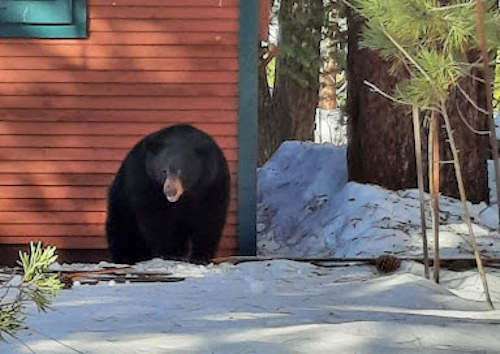
A black bear stands next to a South Lake Tahoe home it was attempting to enter. During the evacuation last fall, when streets and homes were empty and no one was around to secure houses, vehicles, dumpsters, or other attractants, habituated bears in the Tahoe Basin — meaning those bears already comfortable around people or those bears that look to people, their homes, and cars for food — were left to roam neighborhoods freely with little resistance. These habituated bears suddenly had no humans yelling, making noise, chasing or hazing them, and no electric deterrents because of power outages.
In the Tahoe Keys community, bears broke into garage doors, windows, and vehicles, causing some homeowners thousands of dollars in property damage (video). The lack of consequences during the evacuation period will have rippling and lasting effects on bear behavior for seasons to come.
Because bears are so intelligent, once they learn something, it’s difficult to break their bad habits. For this reason, it’s extremely important to be proactive in preventing bad habits from forming in the first place.
Due to the amount of damage bears caused to homes, the California Department of Fish and Wildlife last year conducted a Trap/Tag/Haze operation in South Lake Tahoe to provide relief to hard-hit areas, which allowed residents to begin repairs, replace doors, refrigerators, and other damaged items in order to move back into their homes.
Bears were marked and moved to nearby, unburned habitat in an attempt to interrupt the cycle of break-ins and food rewards that went unchecked during evacuations.
Once moved, these bears were hazed upon release with airhorns, paintball guns, and nonlethal rounds, to give the bears a negative human interaction that will hopefully prevent them from returning to the area.
Not all these problem bears were caught and hazed, as evidenced by the continued presence of several bears that continued to break into homes in the Tahoe Keys area throughout the fall and winter months.
While what happened during the Caldor Fire evacuation couldn’t be prevented, homeowners and visitors can do their part to prevent or deter this kind of bear behavior in the future, especially as this mild winter turns to spring and bears begin to emerge from their dens in search of food.
Below are steps residents and visitors can take to help Tahoe bears live a wild but fruitful and healthy life:
• Businesses should require employees to keep dumpsters locked at all times.
• Use bear-resistant trash containers.
• Do not allow unsecured attractants such as bird feeders.
• Remember that feeding bears (or any wild animal) is against the law.
For more information on peacefully coexisting with bears, visit www.TahoeBears.org. To report human-bear conflicts:
• In California, contact the California Department of Fish and Wildlife at 916-358-2917 or report online using the Wildlife Incident Reporting (WIR) system at apps.wildlife.ca.gov/wir.
• Non-emergency wildlife interactions in California State Parks can be reported to its public dispatch at 916-358-1300.
• In Nevada, contact the Nevada Department of Wildlife at 775-688-BEAR (2327).
• If the issue is an immediate threat, call the local sheriff’s department or 911.