 How to resolve AdBlock issue?
Regional
- Details
- Written by: Cal Fire
Acquisition of these forested properties increases opportunities for critical research, forest restoration and public recreation.
These two new properties, comprised of 2,246 acres along South Cow Creek in Shasta County and 267 acres in the headwaters of the Bear River in Nevada and Placer counties, were acquired as part of the Pacific Watershed Lands Stewardship Council’s commitment to permanently conserve watershed lands for the public good.
The lands are being donated from Pacific Gas and Electric and will be managed in partnership with the Shasta Land Trust and Bear Yuba Land Trust who will hold conservation easements on the properties.
“The addition of the Cow Creek and Bear River properties to the Cal Fire demonstration state forest system is another exciting chapter in California state forest stewardship,” said Kevin Conway, Cal Fire’s State Forest Program manager. “The properties that currently make up the forest system were first acquired nearly a century ago as clear-cut forests. Since then, we have successfully demonstrated how to re-grow forests, restore habitat, and provide for public recreation, among many other values. These recently acquired acres have not been as extensively logged, and we’re excited to steward these areas for forest health, conservation and restoration, climate and fire resiliency, and the many other values that these special areas provide.”
California’s demonstration state forests serve as a living laboratory for how to care for and manage California’s forest lands for multiple benefits — recreation, watershed protection, wood products and sustainable timber production, and habitat restoration — given a changing climate and increasingly severe and intense wildfire seasons.
The forests provide unique research and demonstration opportunities where environmental scientists, foresters, and other researchers can study the effects of various forest management and restoration techniques to help inform management practices for government, nonprofit and private forestland owners.
“These important additions to our state forest system offer an opportunity to further the valuable research and ecological work underway on California state forestlands while contributing to critical climate goals. Adding these parcels to the California state forest system bolsters Cal Fire’s continued commitment to providing forest landowners and others with timely, relevant information about forest management,” said Cal Fire Deputy Director for Resource Management Matthew Reischman.
Common activities on state forest lands include evaluating sustainable timber harvesting techniques that test current forest practice rules, watershed restoration, a variety of university research projects to help answer pressing forest management questions, and other activities such as cone collecting for seed, and recreation such as mushroom collecting, hunting, firewood gathering, horseback riding, camping, mountain biking and hiking.
Adding these properties follows the 2019 acquisition of the North Fork Mokelumne River property comprising 1,054 acres in Amador County.
In total, Cal Fire will receive seven properties from the Stewardship Council by early 2023 bringing the total acreage of California’s demonstration state forest system to over 84,000 acres statewide. These properties will increase the diversity of forest types under Cal Fire’s stewardship and create new opportunities for research and demonstration of sustainable forestry techniques.
Cal Fire will work collaboratively and closely with the Bear Yuba Land Trust and Shasta Land Trust who hold the conservation easements on these properties to ensure that the scenic, open space, forest, wildlife habitat, recreation, and historic and cultural values are protected forever.
The properties will be stewarded for these multiple uses under a Forest Management Plan to be approved by the Board of Forestry and Fire Protection.
For more information about California’s demonstration state forests, visit the Cal Fire website.
- Details
- Written by: Caltrans
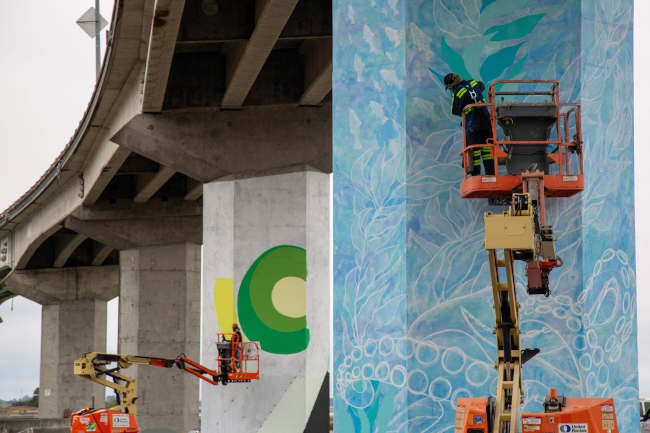
EUREKA, Calif. — Caltrans and the city of Eureka on Monday kicked off the Samoa Bridge Murals project, part of this year’s annual Eureka Street Art Festival.
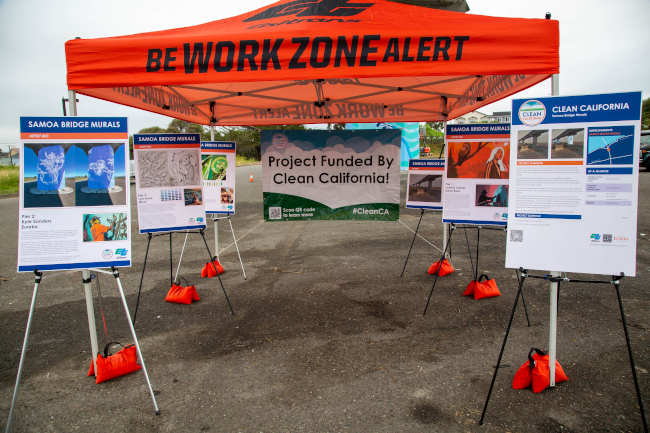
The project is made possible through Gov. Gavin Newsom’s Clean California initiative, a sweeping $1.1 billion, multiyear cleanup effort led by Caltrans to remove trash, create thousands of jobs and engage communities to transform public spaces.
“Eureka’s idea to use Samoa Bridge as a concrete canvas for large-scale murals — art being created over the seven days of the festival by Northern California artists as the public looks on — is truly inspiring, ingenious, inclusive and fun,” said Caltrans Director Tony Tavares. “The creative and community-oriented aspects of this Humboldt Bay waterfront project are great examples of what Gov. Newsom had in mind when he launched the Clean California initiative last year and charged Caltrans with its implementation.”
The Samoa Bridge Murals project will adorn four of the land-based columns that support the bridge, which spans Humboldt Bay on State Route 255.
The $307,000 project will simultaneously beautify the recreational area, discourage graffiti, foster local pride, benefit a low-income area and advance plans for future improvements on the waterfront.
“The Clean California initiative has allowed the department to work collaboratively with local communities to beautify areas in ways which have not previously been possible,” said Caltrans District 1 Director Matthew Brady. “This project fulfills a yearslong discussion with our partners in Eureka.”
The murals will be created by California artists Joshua Lawyer of Santa Rosa, Kyle Sanders of Eureka, Laci Dane of Wiyot and Jessica Cherry of Crescent City, all of whom have prior large-scale mural experience.
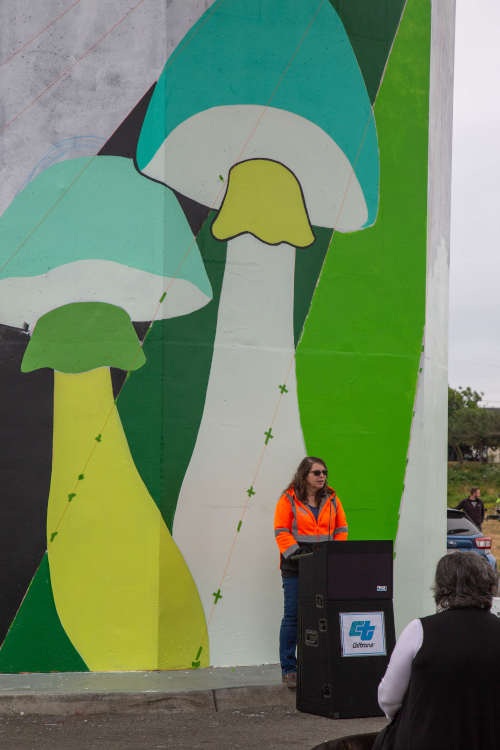
Artists were chosen through the Eureka Street Art Festival, an annual, weeklong event focused on creating accessible art in public spaces to support community revitalization and attract visitors.
The community is invited to participate in the unique opportunity to interact with artists throughout the week as they create large-scale works of art.
“We are very excited about this project with Caltrans,” said Jenna Catsos, co-founder of the Eureka Street Art Festival. “The community partnerships are one of the best parts of this Festival, and this is allowing us to bring public art to Eureka on a huge scale. These colorful pieces will really brighten the waterfront, and we are pleased to be bringing a great group of artists on for this project."
This project is among 126 Clean California beautification projects worth $312 million designed to transform communities and create connectivity along the state highway system.
Additionally, in March, Gov. Newsom announced 105 Clean California projects statewide funded by nearly $300 million in Clean California local grants to remove litter and transform public spaces in underserved communities. Collectively, these projects are expected to generate 7,200 jobs.
Since launching Clean California in July last year, Caltrans has removed more than 812,000 cubic yards of litter from state highways — the equivalent of 13,000 tons or enough to fill 249 Olympic-size swimming pools — and hired 735 new team members as part of Clean California, including 565 maintenance workers who collect litter and remove graffiti.
For more information, visit CleanCA.com.
- Details
- Written by: Elizabeth Larson
Studies have shown that certain cetaceans — specifically, orcas, beluga whales, pilot whales, and false killer whales — are cognitively, emotionally, and socially complex animals who cannot thrive in captivity.
Whales who are held for display often exhibit signs of suffering and distress — and die significantly younger than whales who live in the wild. Currently, there are roughly 50 whales being held in captivity in the United States.
“The science and tragic real-life experiences have shown us time and again that marine mammals suffer from being in captivity — often being exploited and abused. But our laws and practices don’t reflect that,” said Rep. Huffman. “We need to finally make the humane changes that have been needed for decades. With our bill, these extraordinary mammals can thrive and be appreciated where they belong — in the wild.”
“Whales are among the most intelligent, fascinating, and beautiful creatures in the world,” said Rep. Schiff. “And they deserve to live freely in their natural habitats — not in captivity where their lives are defined by the four walls of a concrete tank. The SWIMS Act would protect these magnificent creatures, and I want to thank Sen. Feinstein and Representatives Huffman and DelBene for their partnership on this important legislation.”
“The conditions these whales live in contribute to far shorter life spans — captive orcas typically live just 12 years compared to 40 years in the wild — and there is significant evidence that captivity is excruciating for these mammals. SeaWorld announced in 2016 that its current orcas in captivity will be its last; the federal government should expand on this example and prohibit all new captive whales for purposes of entertainment,” said Sen. Feinstein.
“Orcas are icons of the Pacific Northwest and they should stay free in the wild. The science is clear — when these marine mammals and other large whales are kept in captivity, they are often exploited, treated poorly, or abused,” said Rep. DelBene. “The legislation we are introducing today will strengthen our animal welfare laws by ending future capture and breeding of these creatures for public display. These majestic marine mammals should be observed and cherished in their natural habitat where they belong, not in captivity.”
Specifically, the SWIMS Act would:
Amend the Marine Mammal Protection Act of 1972 to prohibit the taking, importation, or exportation of these whales for the purpose of public display.
Amend the Animal Welfare Act to prohibit any breeding of these whales for future public display.
Allow exemptions for animals being transported to a sanctuary setting or released to the wild.
Rep. Huffman has been a leader in calling for an end to marine mammal captivity. His efforts have included:
• In November 2021, he led a bicameral letter to the U.S. Department of Agriculture (USDA) calling on the agency to take immediate steps to improve standards of care for marine mammals in captivity.
• In 2015, Huffman, Schiff, and Sens. Feinstein and Boxer asked the Office of Budget and Management to publicly release a proposed rule to reflect input from the scientific community, nonprofits, and the public to improve protections for captive marine mammals.
• Before that, Huffman and Schiff passed an amendment to the Agriculture Appropriations bill for USDA to conduct and update the science necessary for Animal Welfare Act regulations on captivity of orcas and cetaceans. The Schiff-Huffman amendment passed with unanimous bipartisan support.
• Huffman and Schiff have also introduced earlier iterations of this legislation, namely the Orca Responsibility and Care Advancement (ORCA) Act.
The SWIMS Act is co-sponsored by Representatives Carolyn B. Maloney (D-N.Y.), Rick Larsen (D-Wash.), Steve Cohen (D-Tenn.), Tony Cárdenas (D-Calif.), and Alan Lowenthal (D-Calif.). It is endorsed by the Nonhuman Rights Project, Animal Welfare Institute, Michelson Center for Public Policy, Animal Defenders International, Cetacean Society International, People for the Ethical Treatment of Animals, CompassionWorks International, Physicians Committee for Responsible Medicine, Earth Island Institute, Endangered Species Coalition, Oceanic Preservation Society, FOUR PAWS USA, Performing Animal Welfare Society, Whale Sanctuary Project, and Born Free USA.
- Details
- Written by: CENTER FOR BIOLOGICAL DIVERSITY
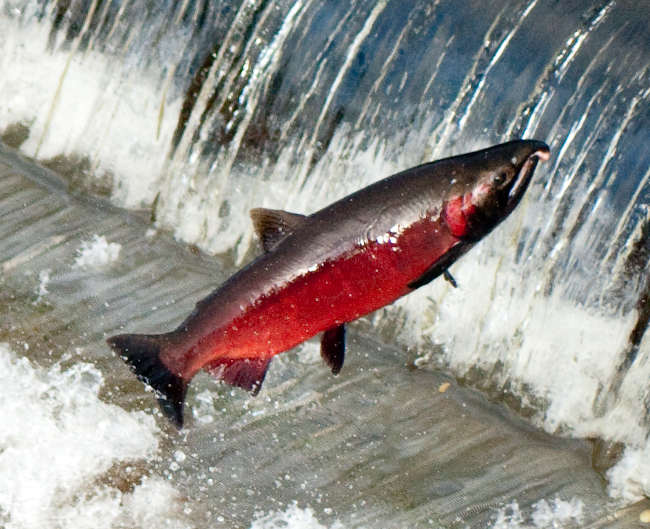
MARIN COUNTY, Calif.— The Marin County Board of Supervisors unanimously approved a conservation ordinance on Tuesday that would protect coho salmon habitat and end a 15-year legal battle over California’s most important watershed for the endangered species.
The Stream Conservation Area Ordinance would set development limits and improve riparian habitat and water quality for Central Coast coho and steelhead populations in the San Geronimo Valley and Lagunitas Watershed.
The Center for Biological Diversity and the Salmon Protection and Watershed Network had sued the county for failing to adopt conservation measures that were deemed necessary under its own environmental analysis.
“It’s about time the endangered coho salmon get the protection to survive a warming planet,” said Peter J. Broderick, a senior attorney at the Center. “I’m relieved that after many years of litigation, the county has finally agreed to do the right thing and adopt these common-sense measures before it’s too late.”
Legal challenges from the conservation organizations resulted in a string of losses for the county.
In April a Marin County Superior Court judge ruled the county violated state environmental law by failing to mitigate the cumulative impacts to coho and steelhead from streamside development in the watershed, which were allowed under the 2007 Countywide Plan.
“We stood our ground and are delighted that we finally have science-based regulations that will give the endangered coho salmon a fighting chance at survival in Marin,” said Todd Steiner, an ecologist and executive director of SPAWN. “This population is critical to the survival of the species throughout Central California.”
Development and habitat loss are the primary threats to the dwindling salmon populations, which are protected under the federal Endangered Species Act and the California Endangered Species Act. The San Geronimo Valley is home to approximately half of the entire Lagunitas Watershed coho population, one of the largest Central Coast coho populations remaining in California.
The new ordinance will ensure there will be “no net loss of habitat” in the last undammed headwaters of the Lagunitas Watershed, which runs through state and national park lands before emptying to the Pacific Ocean in Tomales Bay.
The Center and SPAWN are represented by attorneys at the Stanford Law School Environmental Law Clinic and the Law Offices of Michael W. Graf.
The Center for Biological Diversity is a national, nonprofit conservation organization with more than 1.7 million members and online activists dedicated to the protection of endangered species and wild places.
The Salmon Protection and Watershed Network, or SPAWN, is a program of the global ocean conservation nonprofit Turtle Island Restoration Network that protects endangered marine species around the world.