 How to resolve AdBlock issue?
Recreation
- Details
- Written by: Carrie Wilson
Late 8 a.m. start time for abalone unfair
Question: Just a note (complaint) … the start time of 8 a.m. for abalone is very, very unfair. The two lowest tides of the year are in May and June, and you just eliminated them.
Rock pickers are put into a shorter collection time and can make even more hurried decisions to take an under-size ab off a rock.
You are punishing all rock pickers and putting them in danger by forcing them to dive for abs when they are not good divers (thus, in danger of drowning).
The 8 a.m. rule does not adversely affect the divers at all. You already closed off way over half the state of California. There is no way that abalone hunters can wipe out the abalone population.
I go rock picking for abalone with six others and we all share these thoughts. (Fred M., San Francisco).
Answer: The California Department of Fish and Wildlife (CDFW) made recommendations to the Fish and Game Commission to reduce the take of abalone because recent scuba surveys had shown lower numbers of abalone at popular abalone sites, particularly in Sonoma County.
According to CDFW Marine Environmental Scientist Jerry Kashiwada, the current Abalone Recovery and Management Plan (ARMP) recommends a 25 percent reduction in the take of abalone when the density (number of abalone in a standard area) reaches the low levels seen in the most recent surveys.
Density in the Fort Ross area was so low it reached an ARMP “trigger” for closure to allow the abalone population to recover.
The commission had a choice between the 8 a.m. start time, reduction of daily limit to two abalone, reduction of the limit on the abalone card, reduction of the season (more closed months), reduction of take for Sonoma and Marin counties or some combination those proposed changes.
The 8 a.m. start time was initially proposed by CDFW wildlife officers who had been seeing large numbers of rock pickers at all low tides and believed that segment of the fishery was unsustainable.
The officers observed rock pickers were taking more time to find legal limits, were less likely to get a limit and were removing and returning more short abalone, many of which were unlikely to survive the handling.
The later start time also helps officers by eliminating predawn fishing hours when the light is too dim to observe violations.
The effect of the new start time was estimated using data from returned abalone report cards, but the actual effect is unknown since it depended on whether many people would shift to later hours.
Data from abalone cards returned this year will provide a clearer picture of the effects of the regulation changes.
The timing of low tides is variable from year to year and while the 8:00 a.m. start reduces the number of low tides available, there usually are some days with suitable tides.
The lower numbers of abalone being taken by rock pickers may make it easier to find abalone at higher tide levels than in the past.
The activities of sport fishermen might not be sufficient to cause extinction of abalone species but they can reduce abalone populations to the point that the abalone are spaced so far apart that their chances of reproducing are very low.
At low abalone population levels, many people might stop participating in the fishery because it is too difficult to find abalone.
Reducing abalone populations to low levels also makes them more vulnerable to events like the 2011 die-off that affected abalone in much of Sonoma County.
CDFW is currently in the process of developing a Red Abalone Fishery Management Plan and revising sections of the ARMP.
For more information, please visit the CDFW Invertebrate Management Project Web site at www.dfg.ca.gov/marine/redabalonefmp/ .
Can a non-hunter carry an unloaded shotgun when with other hunters?
Question: While hunting on a game bird club, can a non-licensed, non-hunter carry an unloaded shotgun while walking with other hunters? (Anonymous)
Answer: While it may not technically violate the law for you to carry an unloaded shotgun without a license, by doing this with others who have ammunition and are taking game, it will likely generate many questions by the wildlife officer contacting you in the field.
Whether or not you have a hunting license is not an element of “take.”
You may argue you are not taking game, but the officer has sufficient evidence to prove you are.
Do you really want to put yourself through the hassle of going to court?
Leave the firearm behind if you want to go with your buddies while they are taking game.
Carrie Wilson is a marine environmental scientist with the California Department of Fish and Wildlife. While she cannot personally answer everyone’s questions, she will select a few to answer each week in this column. Please contact her at
- Details
- Written by: Editor
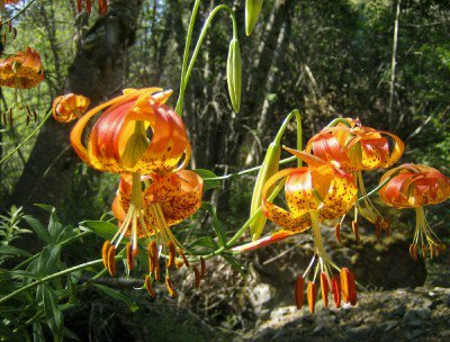
LAKEPORT, Calif. – Fairy lanterns, Ithuriel’s Spear, beardtongue – they sound like a new Hobbit movie.
How about Scarlet Pimpernel, Chinese houses, goldfield … Highland Springs is home to an astonishing number of native plants and species endemic to California, including some rare and endangered flowers.
The Highland Springs Trails Volunteers, along with their botanist friend Ed Dearing, have been leading walks this spring that cover trails that pass through oak woodlands, riparian, grey pine and chaparral habitats as well as areas of serpentine.
Whether you like the cool-sounding “common” names or you are interested in the botanical history and Latin names, the walks are lively and informative.
The last wildflower walk will take place this summer pending the bloom of a remote and hidden, yet accessible fairyland of California Tiger Lily.
For more information including meeting place, go to www.highlandspringstrailsvolunteers.com and contact the group.
- Details
- Written by: Carrie Wilson
Aggressive deer gone rogue in local park
Question: I had a weird thing happen the other day. I was walking with my dog in a local Monterey park when a doe deer came right up to us.
My dog ran out after her and the next thing I knew I heard yelping and looked out to see the doe standing over my 60-pound dog, kicking it repeatedly. This cannot be normal!
Typically, the deer run away from my dog when he chases them. There’s something wrong with this deer. Can you please come get this rogue deer so that it does not threaten other people in our neighborhood? (Spooked in Monterey)
Answer: While this situation may seem unusual, there is probably nothing wrong with this doe.
You should be aware that this is fawning season and it sounds like this doe may have had a young fawn or fawns nearby that it was trying to protect.
For California black-tailed deer, fawning season runs roughly April through July, and during this time the does can be very protective and will do all they can to defend their young against predators.
These deer may view domestic dogs as a threat even if the dog is being walked by the owner on a leash or even in the owner’s backyard.
This doe may have viewed your dog as a potential predator and instinctively acted quickly and aggressively to drive it away from the area in order to protect her fawn(s) against this perceived threat.
Does that have lost their fear of people may also act aggressively toward humans who wander too close to their fawns. This is a temporary situation and aggressions usually subside once the fawns become more mobile.
Does will hide their fawns in locations away from other does while they go out foraging. This ensures that the fawns imprint on their mothers and not on another doe.
In urban or suburban areas, these fawning sites may quite often be in public parks or secluded backyards where plenty of plant life creates protective cover.
Once the fawns become strong enough to travel and can keep up with their mother, the doe will lead them back to where she lives.
In the interim, it is best for you and other dog owners this time of year to give any deer you encounter a wide berth and keep your dogs on a leash.
Fishermen on boats with firearms
Question: We do not have a concealed carry permit but while camping we keep a loaded pistol in our camper for personal protection.
We would prefer not to leave it in the camper while we are out on the boat fishing. Is it legal to carry an unloaded firearm (pistol) on a boat while fishing in the ocean?
If so, does it have to be in plain sight or can it be kept in a glove box on the boat? (Lisa G., Granite Bay)
Answer: California Penal Code, section 25400 provides: A person is guilty of carrying a concealed firearm when the person does any of the following:
1. Carries concealed within any vehicle that is under the person’s control or direction any pistol, revolver, or other firearm capable of being concealed upon the person.
2. Carries concealed upon the person any pistol, revolver, or other firearm capable of being concealed upon the person.
3. Causes to be carried concealed within any vehicle in which the person is an occupant any pistol, revolver, or other firearm capable of being concealed upon the person.
However, the above section does not apply to, or affect, licensed hunters or fishermen carrying pistols, revolvers, or other firearms capable of being concealed upon the person while engaged in hunting or fishing, or transporting those firearms unloaded when going to or returning from the hunting or fishing expedition (California Penal Code, section 25640).
A summary of firearms laws is available online at http://dfg.ca.gov/enforcement/ under “Helpful Information” on the right margin.
Out-of-state hunter safety cert valid here?
Question: I recently moved to California from Michigan and am wondering if I will be required to take another hunter safety class to be able to hunt here?
Also, during archery season, are you able to hunt from a tree stand or an elevated platform? (Noah S.)
Answer: California has no restrictions against using tree stands. And no, you will not need to take another hunter education course as long as you can show proof that you have passed a hunter education class in Michigan or can produce a valid hunting license issued to you within the last two years.
If you cannot produce proof of a hunter ed class or a recent hunting license, you will need to complete another course to get your hunting license.
Information regarding hunter education courses in your area is available online at www.dfg.ca.gov/huntered/index.aspx .
Carrie Wilson is a marine environmental scientist with the California Department of Fish and Wildlife. While she cannot personally answer everyone’s questions, she will select a few to answer each week in this column. Please contact her at
- Details
- Written by: Editor
The California Department of Fish and Wildlife (CDFW) just published the fourth and final 100-year special anniversary issue of the highly respected scientific journal California Fish and Game.
Print copies of the latest issue, focusing on special fisheries, and the three previous issues on native plants, marine life and terrestrial wildlife, are available for purchase through Aug. 31. Volumes 1, 2 and 4 are $6.47 each, plus tax and shipping. Volume 3 is $8.25, plus tax and shipping.
All four issues are also available for download at no charge. Links to both options can be found at www.dfg.ca.gov/publications/journal/contents.html .
The newly released special fisheries issue includes both historical accounts and the results of original research on fisheries ecology conducted by CDFW scientists, as well as by scientists in other resource management agencies, academic institutions and non-governmental organizations.
It features an introduction by Fran Pavley, chair of the Senate Natural Resources and Water Committee, and additional remarks co-authored by CDFW Director Charlton H. Bonham and E. Philip Pister, retired CDFW fisheries biologist.
In her introduction to the fisheries issue, Pavley writes, “This topic is appropriate-or perhaps ironic-in this third year of severe drought, when fresh water supply is a critical issue for all Californians. The drought's effects may be even more severe on wildlife than on humans, since fish and animals can't store, import pump groundwater, or buy water in bottles. They live or die with what nature (and sometimes we) can provide.”
California Fish and Game is an internationally recognized research publication read primarily by scientists in the fields of conservation, ecology and natural resource management.
It focuses on the wildlife of North America's west coast (primarily California) and the eastern North Pacific Ocean, but occasionally includes material from elsewhere.
It is the longest continuously running scientific journal in California.