 How to resolve AdBlock issue?
Recreation
- Details
- Written by: Carrie Wilson
Fishing or foul hooking?
Question: When sport fishing for black bass, California Department of Fish and Wildlife (CDFW) regulations say the fish must willingly take the bait in its mouth.
However, it doesn't say if the hook has to be inside the mouth or not.
For example, when fishing a multi-hook bait, can the hook go from the outside to the inside of the mouth?
As bass often hit these baits while attempting to eat it, the rule seems a little vague. (Randy R.)
Answer: No, this would be considered foul hooking and not legal since the fish is essentially snagged rather than voluntarily trying to eat the lure or bait.
Angling is defined in the regulations to only include “such manner that the fish voluntarily takes the bait or lure in its mouth.”
The outside of its mouth is not in its mouth (California Code of Regulations Title 14, section 1.05).
Hunting pigs and turkey simultaneously
Question: There is a bit of a debate going on the Nor-Cal Wild Pig Hunters Facebook group regarding the legality of hunting pigs and turkey simultaneously during turkey season.
Is it legal to carry No. 6 shot shells (for turkey) and rifled slugs (for pigs) at the same time while out hunting turkey in an area that holds pigs?
Many say it is common practice, others say it is illegal to carry slugs (or any shell holding larger than No. 2 shot) while pursuing turkey.
Who’s right? (Mark, San Bruno)
Answer: It would be legal to hunt pigs and turkeys simultaneously because a slug is not shot.
A hunter who possesses shot size larger than No. 2 could be cited while turkey hunting, but the regulation limiting shot size that may be possessed when taking turkey does not address slugs.
Methods authorized for taking big game (wild pig) include shotgun slugs, rifle bullets, pistol and revolver bullets, bow and arrow and crossbow (2014-2015 Mammal Hunting Regulation booklet, page 24, section 353).
Methods of take for resident small game (wild turkey) are shotguns 10 gauge or smaller. Shotgun shells may not be used or possessed that contain shot size larger than No. BB, except that shot size larger than No. 2 may not be used or possessed when taking wild turkey (CCR Title 14, section 311(b)).
How can I prove my innocence regarding a fishing citation?
Question: If I am cited by a wildlife officer for a short fish or an overlimit of crustaceans but believe I am innocent, how can I prove it?
Do I have to go to court at my own expense to prove my innocence? (Dustan B.)
Answer: If you believe that you are innocent of the violation(s) you were charged with, then yes, you need to appear in court on the date listed on the citation.
You will then have the opportunity to enter a plea of guilty, no contest or not guilty. If you enter a plea of not guilty, you will have your opportunity to explain your side of the story to the judge.
Fishing with mosquito fish/guppies for bait?
Question: I live in the Central Valley, Fresno to be exact. In inland waters where mosquito fish are resident, is a person legally able to use “mosquito fishes” as bait (similar to using minnows as bait)?
I would already presume transferring them from one body of water to another is prohibited, but what if the body of water is already inhabited by mosquito fish? (John T., Fresno)
Answer: Mosquito fish are not native to California waters but were introduced into California around 1922 to consume and suppress mosquitos and their larvae.
Allowable live baits that may be used in the Central District, which includes the Fresno area, can be found in section 4.20 of the 2014-2015 California Freshwater Sport Fishing Regulations booklet (page 17). Legally acquired mosquitofish can be legally used in any body of water for bait except those listed under 4.20(f).
Use and transportation of bait fish is strictly regulated in the Freshwater Fishing Regulations booklet (CCR Title 14, section 4.00) to prevent the inadvertent transfer of a baitfish species from one body of water to another.
It’s a good idea to double-check this section of the regulations booklet whenever you are transporting baitfish to your favorite fishing spot.
Carrie Wilson is a marine environmental scientist with the California Department of Fish and Wildlife. While she cannot personally answer everyone’s questions, she will select a few to answer each week in this column. Please contact her at
- Details
- Written by: Editor
NORTH COAST, Calif. – A Senate Joint Resolution authored by Sen. Mike McGuire protecting the Smith River watershed received overwhelming support, winning approval from the State Senate, and sending the resolution to the State Assembly for its final vote.
Mike McGuire advocated for Smith River protection on the Senate floor April 9, urging his fellow senators to help him ensure the state's premiere wild and scenic river would be protected from the devastating effects of a proposed strip-mining operation along the North Fork of the Smith River in southern Oregon, just over the California border.
“Any future mining activities will unnecessarily put the people and wildlife that rely on the Smith River at risk and would create irreversible impacts to the entire watershed,” Senator McGuire said.
SJR 3 – the Smith River Watershed Protection measure – urges the president of the United States and Congress to permanently safeguard the currently unprotected North Fork of the Smith River watershed in Oregon from any mining activities.
Co-authoring the resolution are Senators Mark Leno and Fran Pavley, along with Assemblymembers Jim Wood, Marc Levine, Bill Dodd, Mark Stone and Das Williams.
Recently, the Panama-based Red Flat Nickel Corp. submitted a plan to drill up to 59 test mine shafts on 3,980 acres, which could allow for one of the largest nickel, cobalt and chromium mines in the Western United States.
Any mining would have irreversible negative impacts to water supplies, the North Coast’s economy and the environment in California’s portion of the Smith River Watershed.
“Mining of any kind in the Smith River Watershed is simply unacceptable. I will work tirelessly to protect our river, which is one of the premier salmon fisheries in the lower 48 states and the source of drinking water for tens of thousands of residents in Del Norte County, including Crescent City,” said McGuire.
The Smith River is the primary source of drinking water for the majority of Del Norte County’s 28,000 residents, and is a crucial waterway for the endangered Coho salmon and other important fish runs. The Smith also offers a multitude of recreational activities that are a primary driver of the Del Norte economy.
Support for the resolution is broad and includes the United States Department of the Interior, California State Parks, the Crescent City Council, Del Norte Board of Supervisors, the Smith River and Elk Valley Rancherias, Trout Unlimited and many more.
- Details
- Written by: Editor
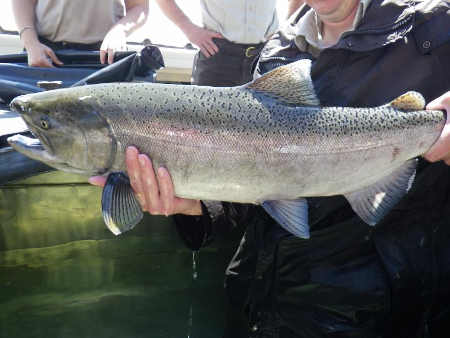
Recommendations by the California Department of Fish and Wildlife (CDFW) to provide dual areas of protection to Sacramento River winter-run Chinook salmon were approved by the state Fish and Game Commission on Friday.
An emergency regulation closing 5.5 miles of spawning habitat above the city of Redding on the Upper Sacramento River will go into effect on or about April 27.
Enhanced protective measures were also included in the ocean sport and commercial fisheries regulations for the 2015 season.
“We are taking proactive measures on two fronts to protect these endangered fish both in the ocean and on their natal spawning habitat,” said CDFW Chief of Fisheries Stafford Lehr. “The fishing communities have stepped forward to support these measures and work towards long-term sustainability of the resource. None of us wanted to be in this situation, but heading into a fourth year of extreme drought calls for extreme measures.”
The emergency regulation closes all fishing on the 5.5 mile stretch of the Sacramento River from the Highway 44 Bridge where it crosses the Sacramento River upstream to Keswick Dam.
The area is currently closed to salmon fishing but was open to trout fishing. The closure will protect critical spawning habitat and eliminate any incidental stress or hooking mortality of winter-run salmon by anglers.
The commission also adopted ocean sport fishing regulations, which will mirror federal regulations approved earlier this week.
CDFW, in consultation with representatives of California's sport and commercial salmon fishing industries, recommended additional strategic protective measures for winter-run Chinook salmon to the Pacific Fishery Management Council (PFMC).
Following a two-month evaluation process, the PFMC recommended federal regulations that provide for sport and commercial seasons off California designed to target more abundant stocks, including Sacramento River fall-run Chinook salmon, while minimizing contact with winter-run Chinook.
“The CDFW proposal to reduce the allowable ocean harvest rate on winter-run salmon and change the timing and location of ocean fisheries south of San Francisco was accepted by the PFMC after in-depth analysis, review and discussion,” said Marci Yaremko, CDFW's representative to the PFMC. “The Commission concurred with these recommendations, realizing their conservation benefit to all winter-run.”
It is highly unusual for a state to propose even stricter guidelines on a listed species than required by the federal Endangered Species Act.
However, CDFW scientists believe the additional protection provided in the emergency river closure and additional ocean fishing restrictions will help a significant segment of the winter-run population to avoid losses.
- Details
- Written by: Editor
LAKE COUNTY, Calif. – The Redbud Audubon Society April field trip will be to the Mendocino Botanical Gardens.
Participants are asked to meet Saturday, April 18, at the Botanical Gardens at 18220 Highway 1, Ft. Bragg at 9 a.m.
Leader Pat Harmon reports that the gardens present several habitats with a variety of birds to see.
Seabirds, such as the scoters, to hummingbirds, warblers, thrushes, and a variety of other songbirds will be seen and heard.
There is a fee to enter the gardens: $10 senior, $14 general; but if 12 or more people attend, the rate is reduced to $7.50 per person.
You are encouraged to bring a lunch to enjoy at the gardens, as the café is not yet open for the season.
Redbud Audubon will not officially arrange carpooling as some folks attending this outing plan on spending the night. However, individuals are encouraged to make their own carpooling arrangements.