 How to resolve AdBlock issue?
Recreation
- Details
- Written by: Editor
Starting July 1, nonlead ammunition will be required when hunting on all California Department of Fish and Wildlife (CDFW) lands and for all Nelson bighorn sheep hunts anywhere in the state.
CDFW reminds hunters who plan to hunt bighorn sheep or at any CDFW wildlife area or ecological reserve where hunting is allowed on or after July 1, 2015 to acquire nonlead ammunition well ahead of their hunt.
Hunters also are encouraged to practice shooting nonlead ammunition to make sure firearms are sighted-in properly and shoot accurately with nonlead ammunition.
Nonlead ammunition for some firearm calibers may be in short supply so hunters should plan accordingly.
In October 2013, Assembly Bill 711 was signed into law requiring the phase-out of lead ammunition for hunting anywhere in the state by July 1, 2019.
The bill also required an implementation plan designed to impose the least burden on California's hunters while adhering to the intent of the law.
In order to determine what was least disruptive to hunters, CDFW coordinated question and answer sessions at sportsmen's shows, held meetings with hunting organizations and hosted a series of eight public workshops throughout the state.
CDFW then presented draft regulations, as modified by public input from these workshops, to the Fish and Game Commission.
In April 2015, the Fish and Game Commission adopted CDFW's proposed regulations and implementation plan.
Further phase-out of lead ammunition for hunting in California will continue on July 1, 2016, when nonlead ammunition will be required when hunting with shotguns for upland game birds (except for dove, quail and snipe), small game mammals, fur-bearing mammals and nongame birds except for when hunting at licensed game bird clubs.
Nonlead ammunition will also be required when taking wildlife with shotguns for depredation purposes anywhere in the state.
Starting July 1, 2019, hunters must use nonlead ammunition when taking any animal anywhere in the state for any purpose.
Lead ammunition may still be used for target shooting. Existing restrictions on the use of lead ammunition in the California condor range remain in effect while implementation proceeds.
Hunting is not allowed at all CDFW wildlife areas and ecological reserves. For those areas where hunting is allowed, nonlead ammunition will be required starting July 1, 2015.
Hunters are reminded to be familiar with all hunting regulations before going into the field.
More information on the phase-out of lead ammunition for hunting in California can be found at www.wildlife.ca.gov/Hunting/Nonlead-Ammunition .
- Details
- Written by: Carrie Wilson
Night fishing or sleep fishing?
Question: The other night while camping/fishing at Clear Lake, the whole campground was bombarded by a sting of rangers at 4 a.m. waking up campers with flashlights in our eyes to check fishing licenses.
I was in my tent looking through the window at my poles and popped out when I heard someone walking up on our campsite. It was a ranger and he said I was not allowed to sleep with my poles in the water (I wasn’t asleep, but that’s beside the point).
My poles were about 6 to 8 feet from me and he told us that if we wanted to sleep we had to reel them in. Our poles had bells on them and glow sticks.
He said we weren’t “actively fishing.” Is this correct?
Catfishing at night with a bell on your pole and being woken up by a jingle jingle has always been pretty standard stuff.
Can you please clarify this? (Adam S., Lodi)
Answer: The ranger was correct. If you have your hook and line in the water, it must be closely attended.
Angling is defined as taking fish by hook and line with the line held in the hand, or with the line attached to a pole or rod held in the hand or closely attended in such a manner that the fish voluntarily takes the bait or lure in its mouth (California Code of Regulations Title 14, section 1.05).
If you are angling with a pole not in your hand, you should be closely attending and watching it and able to immediately grab the rod to reel it in if a fish bites your hook.
The reason for the law is to reduce hooking mortality for fish that swallow a baited hook and then struggle against the line.
If the hook is impaled, the line will restrict gill movement. If you were to catch an undersized bass or trout at night, it may not pull hard enough on the line to disturb you from the tent, and then the fish would likely be dead when you checked your line the next morning.
Bottom line … fishing from inside your tent, whether you’re asleep or not, is not considered “actively fishing” or closely attending to your fishing line.
Can restaurants prepare and serve customers’ sport-caught abalone?
Question: I have a question regarding abalone used for commercial restaurant use. Would it be illegal for someone to catch abalone (legally according to current regulations) on their property, and then sell and serve it to customers at their own restaurant located on their property?
Are restaurants allowed to sell wild abalone at all? (Katelyn S.)
Answer: No, it is not legal for someone to catch abalone under a California sport fishing license and then serve it as a meal to a paying customer no matter where the restaurant is located.
Fish and invertebrates caught under the authority of a sport fishing license may not be bought, sold, traded or bartered (Fish and Game Code, section 7121).
Sport-caught abalone may be given away but cannot be sold in any form, even if it’s being made into a meal.
In most cases, sport-caught abalone may not even be possessed in a restaurant. The only exception would be if the person who lawfully took or otherwise legally possessed the abalone remained present on the premises while the restaurant cook/chef prepared the abalone for consumption by the person who lawfully took it (FGC, section 2015).
Currently, there is no legal commercial fishery for California’s native abalone (FGC, sections 5521 and 5521.5).
However, there are licensed abalone aquaculture farms in the state that raise abalone for the commercial market, as well as commercial fish businesses that import wild-caught and aquaculture abalone into California through a special CDFW importation permit. No non-native, live abalone may be imported into California, though.
Bone collector donates preserved specimens to local schools
Question: I am a bone collector. I have been collecting my entire life but have recently been able to clean and preserve specimens at a museum level.
I mainly collect local native species that have fallen victim as "road kill" but I also collect on hikes and at the beach. After I clean and preserve a specimen, I donate it to local schools.
I was wondering if there might be any licensing available for this kind of work. I would love to have some documentation to share in the event I run into the authorities. I have a biology degree and happily offer all specimens for educational benefit.
Thank you for your time and consideration. (Anonymous)
Answer: To legally do what you are proposing, you will need to have a scientific collecting permit issued through the California Department of Fish and Wildlife (CDFW) to operate as a biological collector for various schools or institutions in need of specimens.
See California Code of Regulations Title 14, section 650 for further information. Mountain lions require a special permit. See CCR Title 14, section 251.4.
Carrie Wilson is a marine environmental scientist with the California Department of Fish and Wildlife. While she cannot personally answer everyone’s questions, she will select a few to answer each week in this column. Please contact her at
- Details
- Written by: Editor
HIDDEN VALLEY LAKE, Calif. – Clearlake Youth Soccer League will have its last registration table this Sunday, June 28.
The registration will take place from 10 a.m. to 3 p.m. at the Hidden Valley Lake Water District in Hidden Valley Lake.
Applicants can still register online in lieu of coming to a registration table at www.calnorth-cysl.affinitysoccer.com .
New applicants should bring a birth certificate to the registration table at the water district and be prepared to upload a birth certificate for new applicants when registering online.
Regular registration ends on June 30.
The cost is $80 and includes a jersey, shorts and socks.
Late registrations will be accepted up until July 8 with a $25 fee.
If you have registration questions please email
Persons age 10 and up that would like to be a referee this year can email
- Details
- Written by: Editor
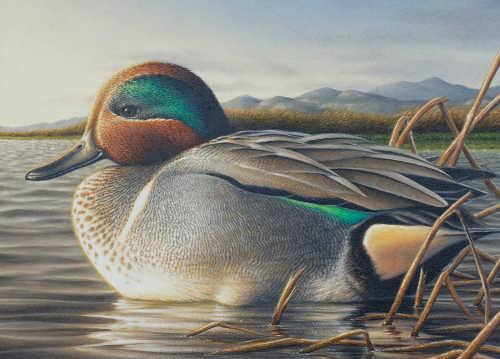
A painting by Chuck Black of Bozeman, Mont., was chosen as the winner of the 2015 California Duck Stamp Art Contest.
The painting, which depicts an American green-winged teal, becomes the official design for the 2015-2016 stamp.
Following the contest held June 17 in Davis, the judges complimented Black's painting, praising the artist's anatomic accuracy, and attention to feather detail and habitat.
“I am extremely grateful to have been chosen,” said Black, a professional wildlife artist. “Having recently switched to oil paint from acrylic, I am thrilled to have such positive feedback because it reassures me that I am going in the right direction. I wanted to make the painting a true depiction of waterfowl but did not want to distract from the duck itself. That is why I decided to go with one drake instead of a lot of ducks ... I wanted the bird to be prominent.”
Black and 20 other artists from around the country submitted entries for this year's contest, sponsored by the California Department of Fish and Wildlife (CDFW).
Jeffrey Klinefelter of Etna Green, Ind., placed second, Frank Dolphens Jr., of Omaha, Neb., placed third and Timothy Schreiber of Lincoln, Ala., received honorable mention.
The top four paintings will be displayed at the Pacific Flyway Decoy Association's 45th Annual Classic Wildlife Art Festival in Sacramento, which is scheduled July 11-12.
Since 1971, the California Duck Stamp Program's annual contest has attracted top wildlife artists from around the country.
The contest is traditionally open to artists from all 50 states in order to ensure a wide pool of submissions.
All proceeds generated from stamp sales go directly to waterfowl conservation projects throughout California.
In the past, hunters were required to purchase and affix the stamp to their hunting licenses. Today, hunters are no longer required to carry the stamps because California's modern licensing system prints proof of additional fees paid directly onto the license.
However, CDFW still produces the stamps, which can be requested on CDFW's Web site at www.dfg.ca.gov/licensing/collectorstamps .
The subject of the 2016 California Duck Stamp Art Contest will be the lesser snow goose, with details on that contest to be released at a later date.