 How to resolve AdBlock issue?
Recreation
- Details
- Written by: California Department of Fish and Wildlife
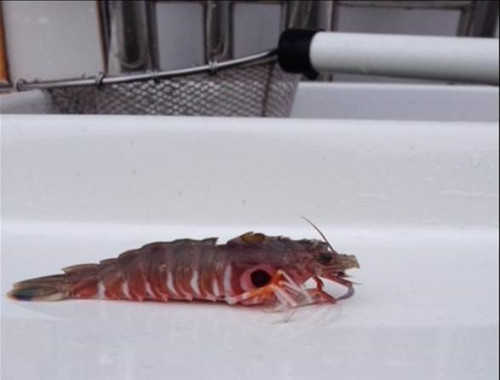
Can you identify this shrimp?
Question: In May of 2016, this shrimp drifted by our boat at night while we were fishing for squid on the south side of Catalina Island. I have been unable to identify it. Can you tell me what it is? (Kenny)
Answer: This is a target prawn (Sicyonia penicillata), also known as rock shrimp due to the rock-like hardness of the shell.
They are commonly found along the Gulf of California and on the western coast of the Baja California peninsula. You may take any type of ocean shrimp in California waters.
If you're interested in learning how to fish for these interesting shellfish, please check out the crustaceans section of the current Ocean Sport Fishing regulations for the regulations, legal gear, limits and other information you will need to know (California Code of Regulations Title 14, sections 29.05, 29.10 and 29.80).
Help with problem geese
Question: My neighbors and I have a major problem with Canada geese. We live on a street that parallels an irrigation canal. Approximately 25 to 35 geese invade our yards every day, three to five times a day.
They block the intersection and streets in all directions on their way, and they do a lot of damage to the grass and plants as well as inundate our yards, sidewalks and streets with feces.
Do you have any suggestions on what we can do to control the problem? We also get mallards, but in much smaller numbers and they do far less damage.
Is it possible to control the geese without scaring off the ducks? All we've managed to do is herd the geese from one yard to another, which is not a very good solution. (Bernie)
Answer: This is a very common human-wildlife conflict. These are likely molting geese and they're out searching for food along the canal. This time of year the grass dies back and the green grass they need becomes scarce, right when their normal need for food is multiplied due to the increased energy demand of re-growing feathers. Irrigated lawns and other landscaping plants are obvious attractants.
California Code of Regulations Title 14, section 251.1 forbids the harassment of animals (including birds), but makes an exception for landowners or tenants who are driving or herding birds or mammals for the purpose of preventing property damage.
In this case, you might be able to install a temporary fence that would keep the geese out. Or you could contact the maintenance division of the agency that maintains the canal, as they may have a solution too.
Other options include non-lethal methods of harassment such as dogs, laser pointers (green works best) and chasing them away so they are scared of humans.
CCR Title 14, section 503 speaks specifically to nuisance Canada geese, and the conditions under which you can obtain a permit to trap and relocate them.
Hunting with a companion dog
Question: I have a deer tag for X3B for 2018 season. My wife will come along with me, and since we have nobody to stay home to take care of the dog, we will need to bring the dog along for several days for our hunting trip too. We don't use the dog for deer hunting. Is it legal to have a non-hunting dog with me on a deer hunting trip? (Minh)
Answer: Congratulations on drawing a tag for X3B! That's a beautiful part of California. Yes, this is legal. Per the California Code of Regulations Title 14, section 265(c)(1), you are limited to one dog per licensed hunter during the general season only (sorry, no dogs are allowed during archery season!).
Be aware, if you happen to have a bear or bobcat tag in your possession as well, Fish and Game Code, section 3960 prohibits you from having a dog at all. Good luck with your hunt.
Why do I need a license in international waters?
Question: Why does a United States citizen (a resident of California) need a fishing license to fish international waters off the California coast? (Anonymous)
Answer: California waters extend from the shore (high tide line) out to three nautical miles, federal waters stretch from three nautical miles to 200 nautical miles and international waters begin at 200 nautical miles out. All waters out to 200 nautical miles are still patrolled and managed cooperatively with the federal government.
Any fish taken outside of 200 nautical miles must still meet all fishing regulations in order to be brought back into U.S. waters, and all fish landed at California ports must additionally meet all California regulations.
Fisheries in all state and federal waters have regulations and many have strict management guidelines to properly manage the take of various species to assure overfishing does not occur which could collapse those and related fisheries.
Regulations and limitations of fishing activities and take is imperative, especially in waters of a state populated by nearly 40 million people.
If you have a question for the California Department of Fish and Wildlife, email
- Details
- Written by: California Department of Fish and Wildlife
The late-afternoon tours run from Oct. 6 through February 2019. They are offered the first, second and third Saturdays and Sundays of each month for the five-month duration of the cranes’ fall-winter stay.
Online registration is required and is available as early as eight weeks prior to tour dates.
Registration began in mid-August for October tour dates. November tour dates will become available starting Sept. 15.
Registration and additional information is available at the CDFW Bay Delta Region’s Sandhill Crane Wetland Tour page. Please note that purchase of a one-day Lands Pass for a nominal fee is required with registration.
“We are very pleased to offer public tours at the reserve and to showcase the benefits of the restored wetlands,” said CDFW Bay Delta Region Manager Gregg Erickson. “These natural resources belong to everyone. All of us have a part in taking care of them as well as enjoying them.”
The Woodbridge Ecological Reserve is accessible at any time for self-guided tours. A series of informative, interpretive panels are located at the reserve’s southern unit at 11154 W. Woodbridge Road, Lodi. Staying through sunset is recommended to witness the sights and sounds of “fly-over” as groups of sandhill cranes return to roosting spots for the evening.
CDFW is also proud to co-sponsor the Lodi Sandhill Crane Festival scheduled for Nov. 2 to 4. Information about festival tours and activities is available at www.cranefestival.com/index.php.
- Details
- Written by: California Department of Fish and Wildlife
Tree squirrels may be taken only in the open zone during the open season, from between one half hour before sunrise to one half hour after sunset.
A map of the state’s tree squirrel hunt zones can be found on the California Department of Fish and Wildlife Web site, along with the full tree squirrel regulations.
Four types of tree squirrels are game species and can be hunted in California.
The Western gray squirrel and the Douglas squirrel are both native to California while the Eastern fox squirrel and the Eastern gray squirrel are introduced and not native to the state.
These tree squirrels can be hunted in the open zone during the open season under authority of a hunting license in California. No other validations are required.
A fifth species of tree squirrel, the northern flying squirrel, is not a game species and may not be taken. Flying squirrels are small, native tree squirrels that are seldom encountered due to their nocturnal nature and preference for mature forest habitats with complex canopy structure.
Tree squirrel population levels fluctuate from year to year based on prevailing weather conditions and the annual production of nuts, acorns and seeds for forage.
“Given favorable mast (acorn) production years in 2016 and 2017, we anticipate that population levels and opportunities for hunting should be good in 2018,” said Matt Meshriy, an environmental scientist with CDFW’s Upland Game Program. “We continue to see numbers of invasive Eastern fox squirrels and Eastern gray squirrels increasing as these species have expanded their range in and adjacent to urban centers. The native Western gray squirrels and Douglas squirrels are often displaced where they overlap with invasive eastern species, but the native squirrels are better adapted to California’s forest and woodland habitats.”
In recent years, approximately 10,000 to 15,000 hunters have reported hunting tree squirrels annually and their combined statewide bag has ranged from 50,000 to 75,000.
National forests provide some of the best opportunity to hunt tree squirrels in California. Bureau of Land Management lands and CDFW wildlife areas may also provide opportunity for squirrel hunting.
Please note that nonlead shot is required when taking tree squirrels and all resident small game mammals anywhere in California. Please plan accordingly.
For more information, please see the CDFW nonlead ammunition page.
- Details
- Written by: U.S. Cellular
At the end of the program, the final three winning coaches will receive a donation of $50,000, $20,000 and $10,000, respectively, to help their school.
The first place coach will also be awarded with a Samsung tech prize package, valued at $30,000, for their school.
Until 11:59 a.m. CT on Sept. 10, U.S. Cellular is encouraging residents to visit www.TheMostValuableCoach.com to nominate their favorite current coach of K-12 school-affiliated sports teams, who has made a profound impact on them or their team, school or community.
“U.S. Cellular recognizes the commitment from coaches who connect to the good in all of us, and wants to celebrate the incredible work they’re doing in their communities,” said Erryn Andersen, director of sales for U.S. Cellular in the northwest market. “We’re looking forward to hearing inspiring stories about great coaches.”
U.S. Cellular is teaming up with Green Bay Packers wide receiver, Randall Cobb, to help identify the Most Valuable Coach.
Along with online voting from fans, Cobb will be part of a panel of judges who will help choose the three winning coaches based on leadership qualities and the positive impact they have on their community, school and players.
“I am fortunate to have worked with great coaches who have had a significant influence on both my professional and personal life,” said Cobb. “Coaches have the unique opportunity to motivate their players to excel as leaders both in the game and in their city. I’m looking forward to recognizing these men and women who are making a difference.”
Following the nomination period, U.S. Cellular will evaluate each nominee based on the positive impact they have had on their players, school and city as well as their leadership qualities.
The Top 50 coaches will be announced on Sept. 18 at noon CT, which marks the beginning of public voting to help select the Final 15 coaches, ending at 11:59 a.m. CT on Oct. 8.
U.S. Cellular will award the school of each Final 15 coach with a $5,000 donation and will celebrate with them at a local event at the school. A short video sharing each coach’s story will also be posted on www.TheMostValuableCoach.com.
Public voting to help determine the final three winning coaches begins at noon CT on Oct. 11 and runs until 11:59 a.m. CT on Nov.13.
The winning coaches will be announced on Nov. 20.
For more information, eligibility and to view the official program rules, please visit www.TheMostValuableCoach.com.