 How to resolve AdBlock issue?
Recreation
- Details
- Written by: California Department of Fish and Wildlife
The recreational fishery for Dungeness crab will open for remaining areas on Saturday, Nov. 3.
State health agencies determined that Dungeness crab in state waters from Patrick’s Point, Humboldt County (41° 8.00’ N. Latitude) north to the California/Oregon state line have unhealthy levels of domoic acid and recommended a closure of the recreational fishery in this area. Other areas of the coast will open as scheduled.
The recreational closure includes state waters from Patrick’s Point, Humboldt County (41° 8.00’ N latitude), north to the California/Oregon state line (42° N latitude). State waters extend three nautical miles beyond outermost islands, reefs and rocks. Recreational take and/or possession of Dungeness crab is prohibited in closed waters.
This closure shall remain in effect until the Director of the Office of Environmental Health Hazard Assessment, in consultation with the State Public Health Officer at CDPH, determines that domoic acid no longer poses a significant risk to public health and recommends lifting the fishery closure in this region.
CDFW will continue to coordinate with CDPH and OEHHA to test domoic acid levels in Dungeness crab to determine when the Dungeness crab recreational fishery in this area can safely be opened.
Pursuant to Fish and Game Code, section 5523, the Director of CDFW will notify the Fish and Game Commission of the closure and request that the Commission schedule a public discussion of the closure at its next scheduled meeting.
Domoic acid is a potent neurotoxin produced by a naturally occurring marine alga, whose levels can be increased under certain ocean conditions, and can accumulate in shellfish, other invertebrates and sometimes fish. It causes illness and sometimes death in a variety of birds and marine mammals that consume affected organisms.
At low levels, domoic acid exposure can cause nausea, diarrhea and dizziness in humans. At higher levels, it can cause persistent short-term memory loss, seizures and death.
- Details
- Written by: California Department of Fish and Wildlife
This triggers the closure of the adult Chinook salmon fishery on the Trinity River from the Old Lewiston Bridge to the Highway 299 West Bridge at Cedar Flat.
This reach will remain open for harvest of jack (2-year-old) Chinook Salmon (22 inches or less).
All adult Chinook salmon caught must be immediately released and reported on the angler's report card.
Anglers may still fish for adult Chinook salmon in the Lower Trinity reach of the Klamath basin. All other sectors are currently closed to adult harvest.
Anglers may monitor the quota status of open and closed sections of the Klamath and Trinity rivers by calling the information hotline at 800-564-6479.
For more information regarding Klamath River fishing regulations, please consult the 2018-2019 California Freshwater and Supplemental sport fishing regulations at www.wildlife.ca.gov/regulations.
- Details
- Written by: Lake County Land Trust
The guided walks at Rodman Preserve offer visitors an opportunity to enjoy wildlife and the beauty of Lake County. Each Saturday walk is led by a different Land Trust volunteer.
Visitors often enjoy returning for walks, learning from the diverse guides for each walk and enjoying the changing seasons.
The month of October offers opportunities to explore fall.
The Saturday, Oct. 27, walk will be guided by Roberta Lyons. Lyons enjoys birding, sharing about the land and identifying wild grasses. Visitors will have the opportunity to learn about native and invasive grasses.
Participants should meet at the Rodman Preserve and Nature Education Center. The Preserve is located at 6350 Westlake Road, Upper Lake.
To get there take the Nice-Lucerne Cut-off from Highway 29, between Lakeport and Upper Lake. Turn east onto the Nice-Lucerne cut-off, then left on to Westlake Road. The preserve entry is to the immediate right after turning on to Westlake Road.
The preserve is owned and operated by the Lake County Land Trust, a local, 501(c)3 charitable nonprofit organization directly involved in protecting important land resources; wetlands, wildlife habitats, parks, forests, watersheds, riparian stream corridors, lakeside areas and trails.
- Details
- Written by: California Department of Fish and Wildlife
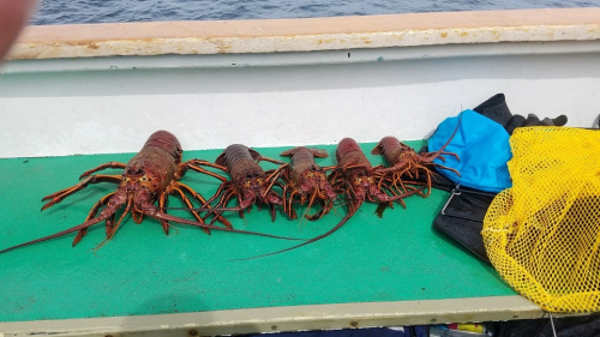
Can I use a live well for lobster?
Question: I'm new to lobster diving and have a couple of questions. We are planning an overnight trip to Catalina and are planning on diving one night and then an early morning dive the next day.
Are we allowed to keep our catch in an underwater live fish box to keep our catch alive? Would we also be allowed to share the underwater live fish box with other divers in our group? (Joseph)
Answer: California's spiny lobster sport fishery will kick off at 6 a.m., Saturday, Sept. 29 and will continue through March 20, 2019.The use of live wells or bait tanks for the purposes of preserving your catch on a vessel is not prohibited. Commingling the catch of lobsters is allowed.
The daily bag limit for lobster is seven per person and an individual may not possess more than seven at any time except when a valid declaration for a multi-day trip has been obtained.
The minimum size is 3 and 1/4 inches measured in a straight line on the mid-line of the back from the rear edge of the eye socket to the rear edge of the body shell. All lobsters shall be measured immediately and any undersize lobster shall be released immediately into the water.
Divers shall measure lobsters while in the water and shall not remove undersize lobsters from the water. Hoop netters may measure lobsters out of the water, but no undersize lobster may be placed in any type of receiver, kept on the person or retained in any person's possession, or under his or her direct control.
All hoop netters and divers must possess a sport fishing license (except those under 16 years old or anyone hoop netting from a public pier), lobster report card and a measuring device (California Code of Regulations Title 14, section 29.05(c)) when taking lobsters.
Prior to beginning fishing activity, the cardholder must record the month, day, location and gear code on the first available line on the report card. When the cardholder moves to another location code, or finishes fishing for the day, they must immediately record on the card the number of lobster kept from that location (as per CCR Title 14, section 29.90).
Additional sport lobster regulations and general fishing information can be found in the California Spiny Lobster Fishing brochure. Also, make sure you're aware of the Marine Protected Area boundaries and restrictions at Catalina Island and other locations in southern California.
Why can't I hunt squirrels in Southern California?
Question: I am a new hunter and I am wondering why squirrel hunting is not allowed in Los Angeles and other counties. Is this a political thing?
I find it hard to believe there is a declining population of squirrels, and I can't think of any reason why hunting them would not be allowed. I would like to go out for some but it seems ridiculous that I might have to drive four hours for squirrels. (Connor W.)
Answer: In about two-thirds of California (including all of the northern counties and the Central Valley), it is legal to hunt tree squirrels. The southern counties (including a sliver of Kern County, as well as all of Santa Barbara, Ventura, Los Angeles, Orange, Riverside, San Bernardino, Riverside, San Diego and Imperial counties) and the eastern counties (Mono and Inyo) are closed to squirrel hunting. You can find a map here.
We are often asked why there's no hunting in areas where it seems squirrels are plentiful. In California's southern counties, the squirrels you're seeing are very likely Eastern fox squirrels, which do very well in urban, highly populated areas where hunting cannot be used as a management tool.
These non-native squirrels have displaced the native Western grays that once inhabited the area. Western grays prefer forested habitat, which is limited in the closed zone and fragmented further by development, leaving remaining populations with limited habitat connectivity.
This map shows the distribution of suitable habitat for the Western gray squirrel, which is consistent with the parts of the state where tree squirrel hunting is legal.
Based on these concerns about Western gray squirrel populations, the California Fish and Game Commission opted to restrict all tree squirrel hunting in the southernmost counties. If hunting were allowed, the native squirrels would be disproportionately impacted, so the restrictions are in place to help protect them.
Dungeness season opener
Question: Could you confirm when the Dungeness season starts for 2018? (Anna)
Answer: The statewide recreational season is scheduled to start on the first Saturday of November, which this year would fall on Nov. 3. We do not yet have any information on domoic acid levels in Dungeness crab.
That information will be released by the California Department of Public Health in October. Health advisories and closure information can be found at www.wildlife.ca.gov/Fishing/Ocean/Health-Advisories.
If you have a question for the California Department of Fish and Wildlife, email