 How to resolve AdBlock issue?
Recreation
- Details
- Written by: California Department of Fish and Wildlife
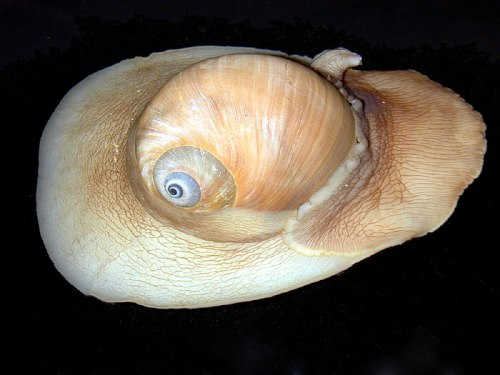
Question: Can I catch moon snails in Marin County? I read one regulation that said no moon snails can be caught north of the Golden Gate Bridge, but I want to catch them at Dillon Beach. (Douglas)
Answer: You read the regulations correctly. Moon snails are classified as mollusks and the state's saltwater fishing regulations address them specifically. They are open to fishing and collection all year with a limit of five snails.
Moon snails, however, may not be taken north of the Golden Gate Bridge, as per California Code of Regulations (CCR) Title 14, section 29.71, a protection that dates to the 1980s. Since Dillon Beach is north of the Golden Gate Bridge, no moon snails can be collected there.
The good news is that you don't have to travel far to legally take moon snails, which are considered a delicacy in some cultures. They are, after all, the marine equivalent of the land snail – better known as escargot – feted in French cooking.
San Mateo County, just down the peninsula, is a popular area for collecting moon snails, which are often taken incidentally by those out looking for gaper clams. Don't forget, you'll need a current fishing license in your possession to take moon snails or any other mollusk. Good luck!
Dealing with troublemaking ravens
Question: We are a small family farm and raise chickens, ducks, turkeys and geese. I know that there is a provision in the Fish and Game regulations that allows landowners to destroy (shoot) crows that are damaging farm fields or other crops.
However, we have a problem with ravens that have eaten many eggs and disturbed our birds on nests. We have had zero hatches this year. Most of our income usually comes from chick hatches and we can barely pay the bills this year. These ravens are literally going into our coops, barns and some of our birds have had injuries defending their nests.
Are there any provisions for those of us who raise livestock and not crops? (Jessie)
Answer: We are very sorry to hear about the difficulties experienced at your farm. You are correct in that federal and state regulations allow the taking of crows by landowners, tenants or other authorized parties when crows are committing or about to commit depredations upon agricultural crops and livestock.
Although the American crow is listed as a protected species under the federal Migratory Bird Treaty Act, the federal government allows the taking of problem crows without a depredation permit (Code of Federal Regulations Title 50, section 21.43) as do state regulations (CCR Title 14, section 472).
There is also a crow hunting season which runs from Dec. 1 through Apr. 4.
Ravens are another matter entirely, as they are a protected species under the Migratory Bird Treaty Act and a Federal Migratory Bird Depredation Permit is required to kill ravens that are causing damage to your farm. A depredation permit should always be your last resort. It is intended to be a short-term fix, not a long-term solution.
There could be opportunities to better protect and more safely house the chickens, ducks, turkeys and geese on your farm to keep out ravens and other potential predators. Secure, predator-proof housing is the best defense to protect the birds you raise.
Hazing is another legal option to keep the ravens away. You do not need a federal depredation permit to harass or scare ravens away, provided the birds are not killed or injured in the process and they are not sitting on active nests and disturbed to the point it causes the eggs not to hatch or their chicks to die or become injured.
The federal depredation permit application will specifically ask you what nonlethal deterrents such as hazing or harassment you have tried and what long-term deterrent measures you intend to take to eliminate or reduce the need for killing ravens in the future.
We wish you and your family farm better success in the future.
Can I use corn for carp bait?
Question: Can I fish for carp with corn in California rivers? (Shane)
Answer: Corn is permitted as bait for carp – and any other species of fish and in any type of inland waters where bait is allowed. CCR Title 14, section 4.00 address the bait issue: "Legally acquired and possessed invertebrates, mollusks, crustaceans, amphibians (except salamanders), fish eggs and treated and processed foods may be used for bait."
There are several commercially available processed corn baits on the market. Canned corn is also popular with kokanee anglers. The one caveat is that corn is prohibited in special regulation waters where only artificial lures can be used. An alphabetical list of waters with special regulations is available in the back of the 2018-2019 California Freshwater Sport Fishing Regulations booklet.
If you have doubts about whether special regulations apply, it is best to check if the river you plan to fish is included on the list and what the specific regulations may be.
If you have a question for the California Department of Fish and Wildlife, please email
- Details
- Written by: Mendocino National Forest
There will be no services or maintenance at Covelo district campgrounds until spring 2019.
The Oak Flat Campground – operated by Pacific Gas and Electric – and the Middle Creek Campground on the Upper Lake Ranger District remain open, depending on weather.
Dispersed camping across the forest is an option for those seeking a primitive camping experience. Officials advise calling the district office closest to your destination to check on conditions prior to traveling.
To prepare for a trip to the Mendocino, tell a friend or relative where you are going and when you are returning. Carry emergency equipment and appropriate maps in your vehicle and remember that food, gas, and lodging are not available on the forest road network or within forest boundaries.
Know before you go. Check the weather forecast and be prepared for winter conditions. Be aware that the weather can change suddenly in the high country. It’s important to remember that cell phone coverage is not reliable in many areas of the forest. Always practice Leave no trace ethics and pack out what you pack in.
Recreation information is available here.
- Details
- Written by: California Department of Fish and Wildlife
The wildlife area will be closed to all public access and activities, including hunting and fishing, until further notice.
- Details
- Written by: Sierra Club Lake Group
Those interested in participating are asked to meet at the carpool parking lot at the corner of Live Oak Drive and Highway 29 in Kelseyville at 8:30 a.m. or at 9 a.m. at the intersection of Kelsey Creek Drive and Carder Road. Drive down the road and park on the left side before the locked gate.
The hike follows a moderately sloped dirt road and continues to the small building on the top of Mahnke Peak with a great view over the geyser power plants. The elevation gain is 2,116 feet.
Bring lunch and two liters of water.
Rain cancels the hike.
There is a maximum of 12 participants and reservations are required. To reserve a spot contact leader Paul Farley at