 How to resolve AdBlock issue?
Recreation
- Details
- Written by: Napa Valley Cricket Club
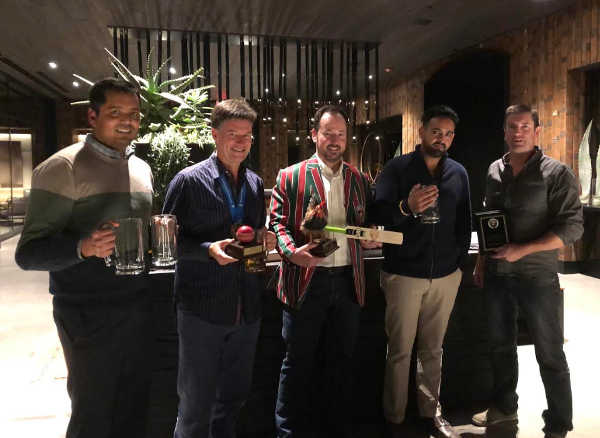
NAPA VALLEY, Calif. – The Napa Valley Cricket Club, or NVCC, had its annual Player of the Year awards hosted by the club’s main sponsor Clos du Val winery recently.
The year 2018 was the club’s busiest season yet on the field which meant that that competition was again strong this year for the four statistical based awards.
In addition to these NVCC President Rob Bolch awarded an annual President’s Award to a member who has contributed to the club over and above.
The winner of the 2018 award was New Zealander Martin Mackenzie. Mackenzie, a member of the club since its founding in 2012 was honored by Bolch for his substantial behind the scenes work in 2018.
The winner of the “All Rounder” of the year award was Indian Karan Grewal, who takes the award for the second year running. Grewal contributed strongly in all three cricketing disciplines – batting, bowling, and fielding – in 2018.
Grewal’s numbers for 2018 were: batting – 14 innings for 351 runs with an average of 29.25 runs and a high of 67 runs; in the bowling department, Grewal bowled 86.2 overs at a cost of 361 runs taking 24 wickets with an average of a wicket every 15 balls bowled. In the field, Grewal took 7 catches.
The individual awards for batting, bowling, and fielding were won by Indian Sorabh Das, New Zealander Bernie Peacock and again Das for the fielding award. Das batted 15 innings for 266 runs with an average of 17.73 runs and a high of 55 runs. Peacock bowled 68.1 overs at a cost of 264 runs taking 20 wickets with an average of a wicket every 13.2 balls. Das excelled in the field in 2018 with 8 catches, and he was also involved in 1 run-out.
Bolch handed out a number of milestone awards during the evening with Club Captain Bernie Peacock receiving an award for his “Hatrick” (three wickets in consecutive balls) against Marin CC in August.
Now that the NVCC is seven years old a number of members have reached other milestones and they were recognized on the night. Phil Bourke, Peacock, and Bijoy Ojha have now all played 50 matches for the NVCC while Irishman Andrew Healy marked 2018 by taking his 50th wicket. Mackenzie becomes only the second player in the clubs’ history to score more than 1000 runs while Bourke is the first player in the history of the NVCC to pass the 50 catches / stumpings / run-outs milestone.
NVCC President Bolch paid tribute on the evening to all of those who have made 2018 such a successful year both on and off the field. The NVCC toured to Los Angeles early in 2018, playing at the famed Woodley Park, and hosted visiting teams from Malibu and Vancouver, and ran a number of very successful and well attended social events throughout the year.
As the awards drew to a close the Life Members of the NVCC - Bourke, Healy, Pete Carson, and Tim Irwin - bestowed life membership on club president Bolch in recognition of the contribution that he made since the foundation of the club.
- Details
- Written by: California Department of Fish and Wildlife
The new regulations were adopted by the California Fish and Game Commission in mid-December. Anglers should check CDFW's Web site for the current regulations before fishing for groundfish, as changes can occur in-season. Groundfish regulations printed in the 2018-19 ocean regulations book are now out of date.
CDFW worked closely with recreational stakeholders to develop the following changes:
– A decrease to the daily bag and possession limit for lingcod from two to one fish in the Mendocino, San Francisco, Central and Southern Management Areas. The Northern Management Area lingcod bag limit remains at two fish. CDFW recently published a blog post that provides a detailed explanation about this change.
– Boat-based fishing for groundfish in the San Francisco Management Area opens on April 1, two weeks earlier than last year.
– California scorpionfish (sometimes referred to as sculpin) is now open year-round in the Southern Management Area.
– The Rockfish Conservation Area (RCA) boundary has increased to 75 fathoms (450 feet) in the Southern Management Area.
– The depth limit has increased to 40 fathoms (240 feet) inside the Cowcod Conservation Area, where select groundfish species may be taken or possessed.
– The 40 and 75 fathom depth boundaries are defined by federal waypoints and can be found in Code of Federal Regulations Title 50, Part 660, Subpart C.
Many of these changes were made in response to the outcomes of recent stock assessment science. Populations of yelloweye rockfish and cowcod, which were declared overfished in 2002 and 2000, respectively are increasing faster than anticipated.
The improved status of these species allowed fishery managers to recommend management measures that provide some additional fishing opportunity.
Similarly, in the spring of 2018, the canary rockfish sub-bag limit increased to two fish statewide, as the catch of this recently rebuilt stock was well under the recently increased harvest limit.
Take and possession of bronzespotted rockfish, cowcod and yelloweye rockfish remains prohibited statewide.
For more detailed information on the new 2019 recreational groundfish regulations and to stay informed of in-season changes, please call the Recreational Groundfish Hotline at (831) 649-2801 or visit CDFW's summary of recreational groundfish fishing regulations for 2019. For background information on groundfish science and management, please visit CDFW's Marine Region Groundfish webpage.
- Details
- Written by: California Department of Fish and Wildlife
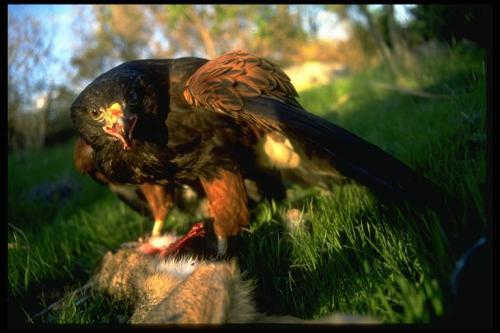
What can I do about a hawk eating its lunch in my yard?
Question: How can we discourage hawks from eating their prey in our backyard? Two days ago we watched a hawk eat a dove, making a huge mess everywhere. It came back today with a different bird, leaving a bloody mess and two feet behind. Is there a way to properly haze them or otherwise shoo them away? (Tierney)
Answer: It sounds like the raptor is just doing what raptors naturally do. If it's not causing harm or damage to your property (other than just making a mess), one could argue that this is a rare opportunity to watch nature at work, up close, in your own backyard - in this case, predator/prey dynamics.
If you really find the front-row view bothersome, you may be able to discourage the raptor from coming into your yard to eat its prey by putting up a plastic owl figure or placing reflective ribbons along your fence line, similar to deterrent techniques used in agricultural operations. If you're currently using a bird feeder, take it down, as bird feeders will attract the smaller birds that are a common source of prey for some hawks.
Understand it's a trade-off: if you do these things, you'll also discourage other birds from coming into your yard.
What is legal to collect for a home aquarium?
Question: I've been doing some research to see if it is ok to collect marine animals and/or plants for a private tank aquarium, but have not been able to find much information. Is it ok to put any type of "fin fish" in an aquarium? Is it ok to put invertebrates (clams, rock scallops, sea urchin, octopus, shrimp, etc.) in an aquarium? What about legal-size California spiny lobster, or marine plants? (Garrett)
Answer: The only finfish you may possess and display in your home aquarium are those purchased legally through a commercial aquarium vendor and/or pet supply business. Live finfish may not be collected from the wild for aquarium display because it is illegal to transport live "finfish" from the wild (California Code of Regulations Title 14, section 1.63).
Live marine invertebrates may be collected, but only under the authority of a sport fishing license, and only those species allowed under a sport fishing license may be taken. In addition, any species with sport fishing restrictions (e.g. bag, size, possession, season limits, methods of take) are still covered under those regulations, and so collectors must also abide by these laws.
Invertebrates collected under the authority of a sport fishing license may not be used to establish breeding colonies for sale or trade with other people. Any trading, selling or possession for sale or trade of these animals constitutes commercial marine aquaria pet trade activity and requires all parties to hold "marine aquaria collectors permits" authorizing this practice. A marine collector's permit is also required for any animals on display for the public.
Marine plants or algae, with the exception of eel grass (Zostera), surf grass (Phyllospadix) or sea palm (Postelsia), may be harvested from the wild as long as they are not taken from state marine reserves. State marine conservation areas and state marine parks may prohibit take. The daily bag limit on all marine aquatic plants for which the take is authorized is 10 pounds wet weight in the aggregate.
Can I archery shoot near a residence?
Question: I am curious about the regulation restricting shooting within 150 yards of an occupied dwelling. Does that apply to archery-type shooting, where one would be shooting directly away from the dwelling? (George)
Answer: California Fish and Game Code, section 3004 (a) states: It is unlawful for a person, other than the owner, person in possession of the premises, or a person having the express permission of the owner or person in possession of the premises, while within 150 yards of an occupied dwelling house, residence, or other building, or within 150 yards of a barn or other outbuilding used in connection with an occupied dwelling house, residence, or other building, to either hunt or discharge a firearm or other deadly weapon while hunting.
The 150-yard area is a "safety zone." This means that no firearm or other deadly weapon such as a hunting bow can be discharged while hunting within 150 yards of the stated buildings without "express permission" (assuming you are not the owner or tenant of the property), and no hunting can occur inside that 150 yard zone without meeting the above requirements.
Shooting a firearm or bow for target practice would not be prohibited under section 3004 - but there could be city or county restrictions that apply, so it is incumbent upon you to check local ordinances. Section 3004 (b) also states that it is unlawful for a person to intentionally discharge a firearm or release an arrow or crossbow bolt over or across a public road or other established way open to the public in an unsafe and reckless manner. This applies to any type of shooting with a firearm or bow that is shot over a road.
If you have a question for the California Department of Fish and Wildlife, email
- Details
- Written by: California Department of Fish and Wildlife
The area from the Patrick's Point, Humboldt County (41° 8.00' N. Latitude) north to the California/Oregon state line was closed due to elevated levels of domoic acid. Public health agencies have determined that domoic acid no longer poses a significant risk to public health in this area.
The recreational Dungeness crab fishery is now open in this area.
Under recent amendments to Section 5523 of the Fish and Game Code, the CDFW Director may provide a minimum of 72-hours' notice before a gear setting period.
Therefore, the director has declared the commercial fishery to open at 12:01 a.m. on Friday, Jan. 25, 2019 to be preceded by a 64-hour gear setting period that would begin no earlier than 8:01 a.m. on Tuesday, Jan. 22, 2019.
For more information, please see the Frequently Asked Questions regarding the 2018-19 Dungeness crab commercial season.