 How to resolve AdBlock issue?
Recreation
- Details
- Written by: California Department of Fish and Wildlife
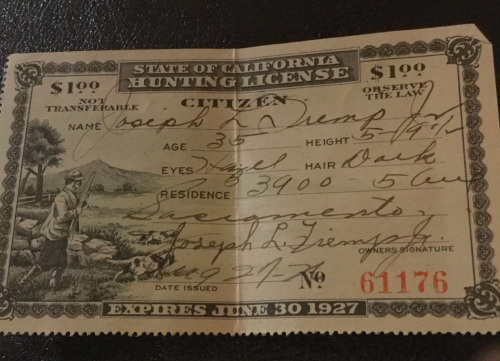
Question: My grandfather was born in 1890 and was a resident of Sacramento. Recently I was going through some documents that were given to me years ago upon his passing, and I found his 1927 fishing and hunting licenses. The cost was $1 each. I thought these were really cool and wonder what you might be able to tell me about them. (Gary)
Answer: Congratulations on owning a piece of California history! The California Legislature began requiring hunting licenses in 1907 as a way to provide additional funding for enforcement of the state's game laws. Sport fishing licenses became a requirement in 1914.
For the first two years, hunting licenses were issued in the form of metal tags stamped with a serial number and expiration date.
In 1909, the state transitioned to the pictorial hunting license depicting beautiful images of sportsmen and wildlife. Your 1926-1927 license represents the last year that pictorial licenses were issued.
Subsequent licenses were considered "semi-pictorial" because they featured elaborate borders and fonts, but no illustrations other than the official seal of the California Department of Fish and Game (as we were then called). Pictorial fishing licenses were produced between 1914 and 1926.
License collector Ira W. Cotton published a book in 2007 entitled California Pictorial Hunting and Fishing Licenses: Handbook and Valuation Guide (PaperQuest Press, Omaha, Nebraska).
According to Cotton, "California was the first to issue pictorial wildlife licenses and without doubt has issued the most beautiful licenses of any state."
Cotton's book includes an exhaustive list of prices for hunting and fishing licenses sold at auction. The prices vary dramatically depending upon the condition of the license and the amount of bidding competition. Three 1927 hunting licenses are listed, with sale prices of $9, $35 and $72, respectively. Six 1927 fishing licenses are listed, with sale prices ranging from $6 to $29.
What can I take from the shoreline?
Question: When my family visited the beach, we found some edible seaweed, small crabs, small clams, turban (top) shells and mussels. These were located about 10-20 yards from the edge of the sea. What are the regulations for catch or take? Would I need a license? (Boik)
Answer: The daily bag limit on all marine aquatic plants for which take is authorized for non-commercial use is 10 pounds, wet weight in the aggregate.
Except as provided in California Code of Regulations Title 14, sections 30.00 and 30.10, there is no closed season, closed hours or minimum size limit for any species of marine aquatic plant.
Marine aquatic plants may not be cut or harvested in state marine reserves, and regulations within state marine conservation areas and state marine parks may prohibit cutting or harvesting of marine aquatic plants (CCR Title 14, section 632(b)).
Eel grass (Zostera), surf grass (Phyllospadix) or sea palm (Postelsia) may not be cut or disturbed (CCR Title 14, section 30.10). You do not need a fishing license to take marine plants, including kelp, for non-commercial use.
Tidal invertebrates may not be taken in any tidepool or other areas between the high tide mark and 1,000 feet seaward and lateral to the low-tide mark, with the exceptions of red abalone, limpets, moon snails, turban snails, chiones, clams, cockles, mussels, rock scallops, native oysters, octopuses, squid, crabs, lobsters, shrimp, sand dollars, sea urchins and worms (CCR Title 14, section 29.05 (b)).
Take of all invertebrates is prohibited within state marine reserves. Take of certain invertebrates may be prohibited within state marine parks and state marine conservation areas as per sub-section CCR Title 14, section 632(b).
All other rules and regulations apply to the species listed above which include but are not limited to bag/possession limits, seasons, gear restrictions, possession of a measuring device (CCR Title 14, section 29.05(c)), and special closures. A sport fishing license is required to take tidal invertebrates.
When is a good time to collect shells?
Question: This is probably a strange question, but I am wondering if you keep records of when it is a good time to collect shells, and what beaches are best to collect from. I know that different times of the year there are more than other times, such as up in Mendocino. (Sharon)
Answer: CDFW does not collect data pertaining to the collection of seashells. In general, however, the best time to collect shells is during a low or minus tide, as the lower than average tide heights allow collectors to locate shells usually covered by water, sand and high surf.
Tide books or tidal apps may provide information on the tide predictions for your area. Each tidal area contains a variety of shells based on habitat structure. It is unlawful to injure, damage, take or possess any living, geological or cultural marine resource within state marine reserves.
Take or possession of any living, geological or cultural marine resource may be prohibited within state marine parks and state marine conservation areas as per sub-section CCR Title 15, section 632(b).
Please remember that when you are hunting for shells, you should never turn your back on the ocean, as ocean conditions are unpredictable and can quickly turn dangerous.
If you have a question for the California Department of Fish and Wildlife, please feel free to ask us via email at
- Details
- Written by: California Department of Fish and Wildlife
According to California 2018-19 supplemental sport fishing regulations, the take of 4,800 fall chinook salmon at the hatchery triggers the reopening of the recreational chinook salmon fishery on the Upper Trinity River between the mouth of Indian Creek, near Weaverville, and Old Lewiston Bridge, at 12 a.m. on Monday, Nov. 19.
Recreational anglers will be able to harvest two chinook salmon, with no more than one adult greater than 22 inches, per day in this reach. The possession limit is six chinook salmon, and no more than three adults.
Reopening this stretch of the Trinity River is designed to allow anglers to catch surplus hatchery chinook salmon now that the number of adults needed for spawning has been achieved at the hatchery.
The lower Trinity River, downstream of Hawkins Bar, and the upper Klamath River, upstream of I-5 near Hornbrook, are the other sections of the river that remain open to the take of adult chinook salmon. All other quota areas are closed to the take of adult chinook salmon.
The take of jack salmon, those equal to or less than 22 inches, may be taken in all areas of the Klamath basin, with the exception of the mouth of the Klamath River, which is closed for the remainder of the year. The daily bag limit for jack salmon in these areas is two fish per day and no more than six in possession.
Anglers may monitor the quota status of open and closed sections of the Klamath and Trinity rivers by calling the information hotline at 800-564-6479.
For more information regarding Klamath River fishing regulations, please consult the 2018-2019 California Freshwater and Supplemental Sport Fishing Regulations at www.wildlife.ca.gov/regulations.
- Details
- Written by: California Department of Fish and Wildlife
Pursuant to the California Environmental Quality Act Guidelines, section 15082(c), public scoping sessions will be held to identify potentially significant effects on the environment that may result from the proposed regulations, as well as any feasible mitigation measures that should be addressed in the draft environmental document.
Both meetings will be held Friday, Nov. 30, at the CDFW Wildlife Branch, 1812 Ninth St. in Sacramento.
The scoping meeting for elk will be held from noon to 1 p.m., and the scoping meeting for bighorn sheep will be held from 1:30 to 2:30 p.m.
Existing law (Fish and Game Code, section 3950) designates elk (genus Cervus) and bighorn sheep (subspecies Ovis canadensis nelsoni) as game mammals in California.
Fish and Game Code, section 332 provides that the Fish and Game Commission may fix the area or areas, seasons and hours, bag and possession limit, sex and total number of elk that may be taken pursuant to its regulations.
Fish and Game Code, section 4902 provides that the Commission may authorize sport hunting of mature Nelson bighorn rams.
State law (Fish and Game Code, section 207) requires the Commission to review mammal hunting regulations and CDFW to present recommendations for changes to the mammal hunting regulations to the commission at a public meeting.
Mammal hunting regulations adopted by the Commission provide for hunting elk and bighorn sheep in specific areas (hunt zones) of the state (California Code of Regulations Title 14, sections 362, 364 and 364.1).
- Details
- Written by: California Department of Fish and Wildlife
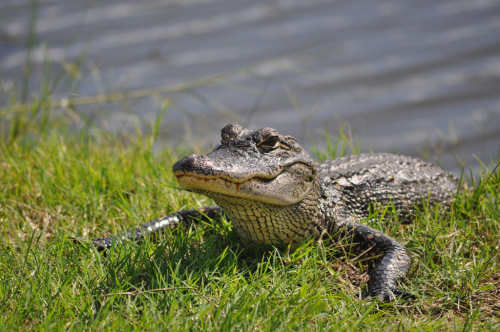
Can I start an alligator farm?
Question: There was once an alligator farm in Los Angeles. It's not there anymore but I am wondering what it would take to start an alligator farm in California. What kind of permits would I need to raise them for meat and their hides? Could I legally bring alligators into the state or import them from other states that allow them? (Kent, Florida)
Answer: Although it is long gone, yes, you are correct about the past existence of an alligator farm in California!
Research indicates there was a place called Los Angeles Alligator Farm that opened near the turn of the last century in Southern California. It persisted in one form or another for several decades before closing due to a decline in visitors. It was more of a tourist attraction than a place where alligators were raised and sold for meat and leather, which is what most people think of when they hear the word "farm."
Today, there are three primary laws that make your business idea non-viable. In 1991, the California Legislature enacted section 5062 of the Fish and Game Code (FGC), which states that no permit shall be issued for the operation of a farm for alligators or any species of the family crocodilidae if the animals are kept for the use and sale of the meat or hides.
FGC, section 2118(f), states it is unlawful to prohibit import, transport, possess, or release alive into this state any wild animal of the family crocodilidae. California Penal Code, section 653o, states that commencing on Jan. 1, 2020, it shall be unlawful to import into this state for commercial purposes, to possess with intent to sell, or to sell within the state, the dead body, or any part or product thereof, of a crocodile or alligator.
There are plenty of permitted facilities in California that have alligators (including zoos, sanctuaries and other educational facilities), but the law prohibits any of these facilities from raising the animals to sell the meat or hides.
Laws that prohibit possession of alligators and crocodiles unfortunately don't stop some people from acquiring these animals or bringing them into the state illegally. California's wildlife officers have at least a few cases per year of illegal possession.
Most people who acquire alligators and crocodiles illegally have no idea how to properly care for them, which creates an animal welfare issue. We also don't want non-native animals – especially predatory ones – being accidentally or intentionally released into California's wild.
In short, current law prohibits you from acquiring a permit to farm alligators, import them or even possess them in California, and by January 2020, you wouldn't be able to sell any parts thereof, regardless of where they came from.
Salmon fishing in the Delta
Question: Is it legal to fish for salmon in the Delta, below the I-80 bridge? (Mark)
Answer: Mark, bridges are important landmarks and boundaries with regard to salmon fishing regulations in California. If you are referring to fishing below the Caltrans Maintenance Worker Memorial Bridge that spans the Sacramento River in West Sacramento, Sacramento River regulations apply.
The season in that part of the river system runs from July 16 through Dec. 16 with a daily limit of one Chinook Salmon with two Chinook Salmon in possession.
Traveling further west down Interstate 80 near Crockett, the Carquinez Bridge is the dividing line between ocean salmon sport fishing regulations to the west and inland regulations to the east.
Below – or west – of the Carquinez Bridge, the ocean Chinook Salmon season is open from June 17 through Oct. 31, 2018, with a minimum size limit of 20 inches and a daily bag limit of two salmon. Depending on where you are fishing east of the Carquinez Bridge in the Delta, different regulations may apply.
In the San Joaquin County portions of the Delta, for instance, Mokelumne River salmon regulations may apply. The salmon season there runs from July 16 through Dec. 16 with a daily limit of two Chinook Salmon.
Please consult the 2018-2019 California Supplement Sport Fishing Regulations along with the 2018-2019 California Freshwater Sport Fishing Regulations for detailed boundaries and descriptions. We thank you for being a conscientious salmon angler and wish you good luck the remainder of the season.
If you have a question for the California Department of Fish and Wildlife, please feel free to ask us via email at