 How to resolve AdBlock issue?
Education
- Details
- Written by: Editor
Specifically, these bills help increase the quantity, availability and practicality of using digital textbooks in the classroom.
“I am happy to sign these bills that build on the goals of California’s first-in-the-nation digital textbook initiative,” said Schwarzenegger. “With smart legislation such as this, California can lead the nation toward a more technologically advanced education system that meets the needs of today’s students while freeing up resources for schools to invest in other vital priorities in this difficult economic time.”
SB 48 by Senator Elaine Alquist (D-San Jose) requires that any individual, firm, partnership or corporation that offers textbooks for sale at the University of California, the California State University, the California Community Colleges or any private postsecondary education institution in the state, to the extent practicable, make them available, in whole or in part, for sale in an electronic format by Jan. 1, 2020.
SB 247 by Senator Elaine Alquist (D-San Jose) will allow K-12 school districts to provide their students with electronic textbooks which should free up limited resources for other critical education priorities. This bill also opens the door for more technology-based instruction which can improve student performance in science, technology, engineering and mathematics (STEM) classes with the use of creative and fun software to demonstrate complex STEM concepts.
AB 1398 by Assemblymember Bob Blumenfield (D-San Fernando) changes the definition of “technology-based materials” to include the electronic equipment required to make use of those materials only if that equipment is to be used by pupils and teachers as a learning resource and specifies that a district that is out of compliance with existing requirements to provide pupils sufficient textbooks or instructional materials is not authorized to purchase electronic equipment pursuant to this bill.
In May, the Governor launched the first-in-the-nation digital textbook initiative which is designed to ensure California’s students have access to high-quality, cost-effective instructional materials and to open the door to a more technologically advanced education system.
In August, the Governor announced that 16 free digital textbooks for high school math and science classes met at least 90 percent of California’s rigorous standards, and four met 100 percent.
- Details
- Written by: Editor
The legislation, SB 592 by Sen. Gloria Romero (D-Los Angeles) and SB 191 by Sen. Roderick D. Wright (D-Inglewood), removes a significant roadblock for charter schools wanting to access over $900 million in voter-approved Propositions 44, 55 and 1D funds for construction projects and simplifies the funding formula for charter schools.
“I am committed to ensuring California’s kids have the opportunity for a quality education and charter schools are proving that their innovative approaches can provide it,” said Schwarzenegger. “That is why I am signing these bills to cut red tape and simplify funding formulas to allow charter schools the chance to thrive here in our state.”
SB 592 amends existing law to allow a charter school facility’s title to either be held by a government entity or the charter school itself.
Because existing law states that funds cannot be released for school construction projects unless a school district holds the property’s title, charter schools can experience delays and even be prevented from ever being built.
This legislation removes the barrier to funding and puts construction on the fast track.
SB 191 simplifies the existing charter school funding formula to establish a uniform funding model for charter high schools, thereby eliminating a fiscal disincentive for school districts to approve petitions for charter high schools.
The number of charter schools in California has increased steadily – from 382 in 2003-04 to 746 in 2008-09. The Governor's Office said he is fighting to lift the cap on the number of charter schools allowed in the state entirely with his legislative package to make California eligible and highly competitive for federal Race to the Top funds – a $4.35 billion federal competitive grant program in the American Recovery and Reinvestment Act designed to support education reform and innovation.
- Details
- Written by: Kaitlyn Sliger
Ashley Wiebusch said, “I got to ride a horse! It was awesome. Her name was Duchess and she matched me perfectly.”
We have two new students who joined us at Carlé, Paul LaRue and Ashli Bonsey. Welcome to Carlé and we hope you enjoy it here.
Our CHILY winner was Katie Boulrice, congratulations. The student of the week is Lucas Powell,
who is a wonderful student doing a great job in all of his classes.
Birthdays last week were Jeffrey Martin and Shanea Bullard. Happy birthday and we hope you had a great time.
Pamela Bordisso, a great counselor from Yuba Community College, came to Carlé to talk to the seniors about going to college and future careers they are interested in pursuing. Thank you, Pamela, for talking to our students.
Carli Tippett was also a great help at Carlé, preparing a lunch for the staff members and the students they chose to accompany them. Carli had help with cooking from four students who have a passion for cooking. Those students were Ellie Hackler, Michelle LaRue, Winter Gray and Kaitlyn Sliger. Thank
you for assisting Carli in making such a great meal.
“The food was delicious and the company was delightful. It was a classic Carlé event,” said Alan Siegel.
Ms. Tippett will be running this great reward meal once a month this year at our school.
The CAHSEE, high school exit exam was held at Carle on Oct. 6 and 7 for the students who needed to pass it in order to graduate. Our picture day was on Oct. 8; we would like to thank Mugshots for coming to our school and taking the pictures.
On Oct. 9 our school went to Highland Springs for our annual advisory field day, with activities and a barbecue. The Lake County Land Trust dinner was held Oct. 10. It's an annual fundraiser for this great organization whose goal is to preserves open spaces and help the environment here in Lake County.
Also, on Oct. 8 it was the first chance for Carlé to assist the Lake County Co-op with JoAnn Saccato at the senior center. The first students that worked there were Danielle Hudson and Katie Boulrice. As you can see Carlé is determined to help our community to the best of our ability.
Kaitlyn Sliger is a student at Carlé Continuation High School in Lower Lake.
- Details
- Written by: Editor
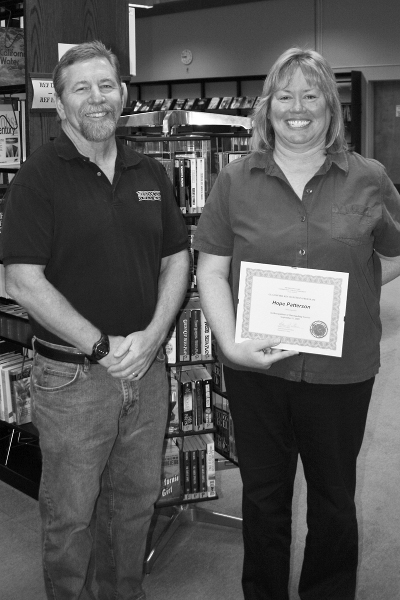
UKIAH – Mendocino College Library Specialist Hope Patterson was selected in September for the initial quarterly award of classified staff.
She was nominated for the honor by her supervisor, Mendocino College Librarian John Koetzner.
“I feel honored to receive this award and I appreciate the nomination by my supervisor,” who Patterson said is very supportive of his staff and is always looking for ways to improve service to students and staff.
Hope said she was grateful for the on-the-job training she received when she was hired as a student assistant by the college’s first library director, Leila Cassidy, and library assistant, Carol Howlett.
“I benefited from their years of experience and education and I thank them for giving me my start in the library,” Patterson said.
Patterson has worked for Mendocino College for 35 years. She graduated from Anderson Valley High School in 1974 and began attending Mendocino College that same year.
While attending Mendocino College, Patterson began working as a student employee in the college library. A year later she was hired as a library clerk and eventually became the library specialist.
“Hope is an incredible self-starter who not only does her job at 100 percent, but she looks for ways to help the library department function well as a team, offering ideas to make things better for students and staff. Her dedication and pleasant personality make her a delightful person to have in our department. I’m lucky to work with her,” Koetzner said.
The Mendocino College Foundation has allocated $2,000 for 2009-10 for the first year of a classified staff recognition program, with one recipient selected Sept. 1, Nov. 16, Feb. 1 and April 16.
The recipient will be selected by the Mendocino College superintendent/president, two vice-presidents and director of human resources based on supervisor nominations, contributions to the college and longevity.
The winner will have the opportunity to decide which college program will receive $500 which can be used by that program in support of the college’s strategic goals.
Mendocino College’s strategic goals are the following: Become a learner-centered institution by focusing on student success; improve student access to college programs and services; enhance the student learning experience by providing educational, cultural and social opportunities beyond the classroom; maximize the procurement and efficient use of financial, human and physical resources; build new and stronger relationships with businesses, educators, agencies and other constituents of our communities.
Patterson requested that the $500 from the foundation be used for the Mendocino College Automotive Technology Program. The plan is to set up a small computer network in the auto tech lab, which students can use to look up parts and access the service/repair database. Currently, there is only one computer which is heavily used and students must wait in line.
For more information about Mendocino College, visit www.mendocino.edu .