 How to resolve AdBlock issue?
News
The fire in the 16200 block of 32nd Avenue near Wilkinson Avenue was first reported at about 4:45 p.m. Saturday.
The first units on the scene found a fully involved single-wide mobile home with other structures threatened. Shortly afterward, two vehicles were reported to be on fire, according to radio traffic.
Minutes later, firefighters at the scene reported that a nearby home also was catching fire.
Lake County Fire Chief Willie Sapeta told Lake County News that the fire initially was in the single-wide mobile home, which had a small shed next to it and was within about 15 feet of a stick-built home.
He said the fire passed from the trailer to the shed, and then to the other home.
Sapeta said firefighters’ ability to respond was hampered by downed power lines on 32nd Avenue and about 1,000 rounds of ammunition going off in the mobile home and the adjacent shed.
Shortly after 5 p.m., Sapeta reported over the radio that they had shaky containment on the fire, but resources would remain on scene for several more hours as they worked to completely put out the fire and conducted overhaul.
In addition to Lake County Fire, Northshore Fire and South Lake Fire sent resources, with Kelseyville Fire called but later canceled, Sapeta said.
He said four engines, three water tenders, a rescue unit, two medic units and a company officer were part of the response.
During the incident, a fire hydrant’s valve failed and shut down the water, so firefighters lost all water supply, which Sapeta said caused him to have to call for two more water tenders.
He said he sent firefighters to other hydrants to check the water system due to concerns that a water main had broken, but the issue was only with the one hydrant nearest the scene.
Sapeta said the trailer was a complete loss, with about 40 percent of the stick-built structure damaged. Three cars also were burned, as were tires and debris.
He said a father and daughter who lived in the trailer were not home when the fire occurred. They were concerned their black lab had died in the fire, but later the dog walked up, unharmed, Sapeta said.
A woman who lived in the house next door and who is related to the trailer’s residents was able to get out of the home safely with her dogs, Sapeta said.
Email Elizabeth Larson at
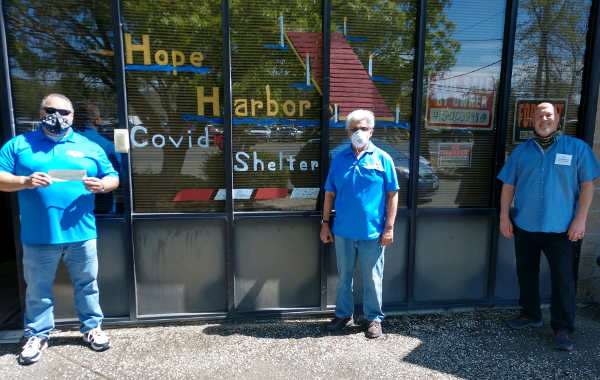
LAKEPORT, Calif. – The Lakeport Rotary has donated $1,000 to support the Hope Harbor warming center, which is now acting as a COVID-19 shelter for the homeless.
Lakeport Rotary President Jeff Warrenburg and Treasurer Marty Diesman presented a $1,000 check to Gary Deas, Hope Harbor’s operations manager, on Wednesday.
The warming center is located in the former Record-Bee offices at 2150 S. Main St. in Lakeport.
In late March, the center opened up on a 24/7 basis and was allowed to expand its population after receiving an emergency funding allocation from the state, as Lake County News has reported. The goal is to remain open through April.
The center is serving more than 35 individuals, who can stay inside the building or in their vehicles in the parking lot. There also is room for campers, and a shower trailer and portable toilets are available.
Dinners are being sponsored by residents who pay for food from local restaurants as well as those who bring food. Lunch and breakfast are being supplied by the Clear Lake Gleaners, Lakeport Senior Center and other donors.
“The Lakeport Rotary is pleased to assist in this valuable resource for those in our community who are facing very challenging times,” said Jeff Warrenburg.
The Lakeport Rotary Club meets every Wednesday at noon via Zoom conference/video calls.
Those interested in more information about the Lakeport Rotary Club can contact Warrenburg at 925-381-0359.
While the shelter has moved most of its dogs into foster, potential adopters can make appointments to meet and adopt available dogs.
The following dogs are ready for adoption or foster.

‘Buddy’
“Buddy” is a male spaniel mix with a black and white coat.
He is dog No. 3667.

‘Freckles’
“Freckles” is a female Australian Cattle Dog mix with a short red and white coat.
She has been spayed.
She is dog No. 3668.

‘Mitch’
“Mitch” is a male American Staffordshire Terrier with a short brindle and white coat.
He is dog No. 3733.

‘Princess’
“Princess” is a female German Shepherd with a black and tan coat.
She has been spayed.
Princess is young and energetic. She previously lived around a smaller dog and has been around the office cat. She will benefit from training and attention.
She is dog No. 3669.

‘Tyson’
“Tyson” is a male American Staffordshire Terrier with a short gray and white coat.
He has been neutered.
He is dog No. 1863.

‘Woodrow’
“Woodrow” is a male Staffordshire Bull Terrier with a black and white coat.
He is dog No. 3281.
Clearlake Animal Control’s shelter is located at 6820 Old Highway 53, off Airport Road.
Hours of operation are noon to 4 p.m. Tuesday through Saturday. The shelter is closed Sundays, Mondays and major holidays; the shelter offers appointments on the days it’s closed to accommodate people.
Call the Clearlake Animal Control shelter at 707-273-9440, or email
Visit Clearlake Animal Control on Facebook or at the city’s website.
Email Elizabeth Larson at

He survived the last great plague in London and the city’s Great Fire. He was imprisoned and persecuted for his religious and political views. There was no happy ending for the journalist Daniel Defoe, author of “A Journal of a Plague Year.” When he died in 1731, he was mired in debt and hiding from his creditors.
Yet Defoe, born in 1660, left behind a work of fiction that is one of the most widely published books in history and – other than the Bible – the most translated book in the world. Like many great works of fiction, it speaks across centuries, especially now as we face the COVID-19 pandemic.
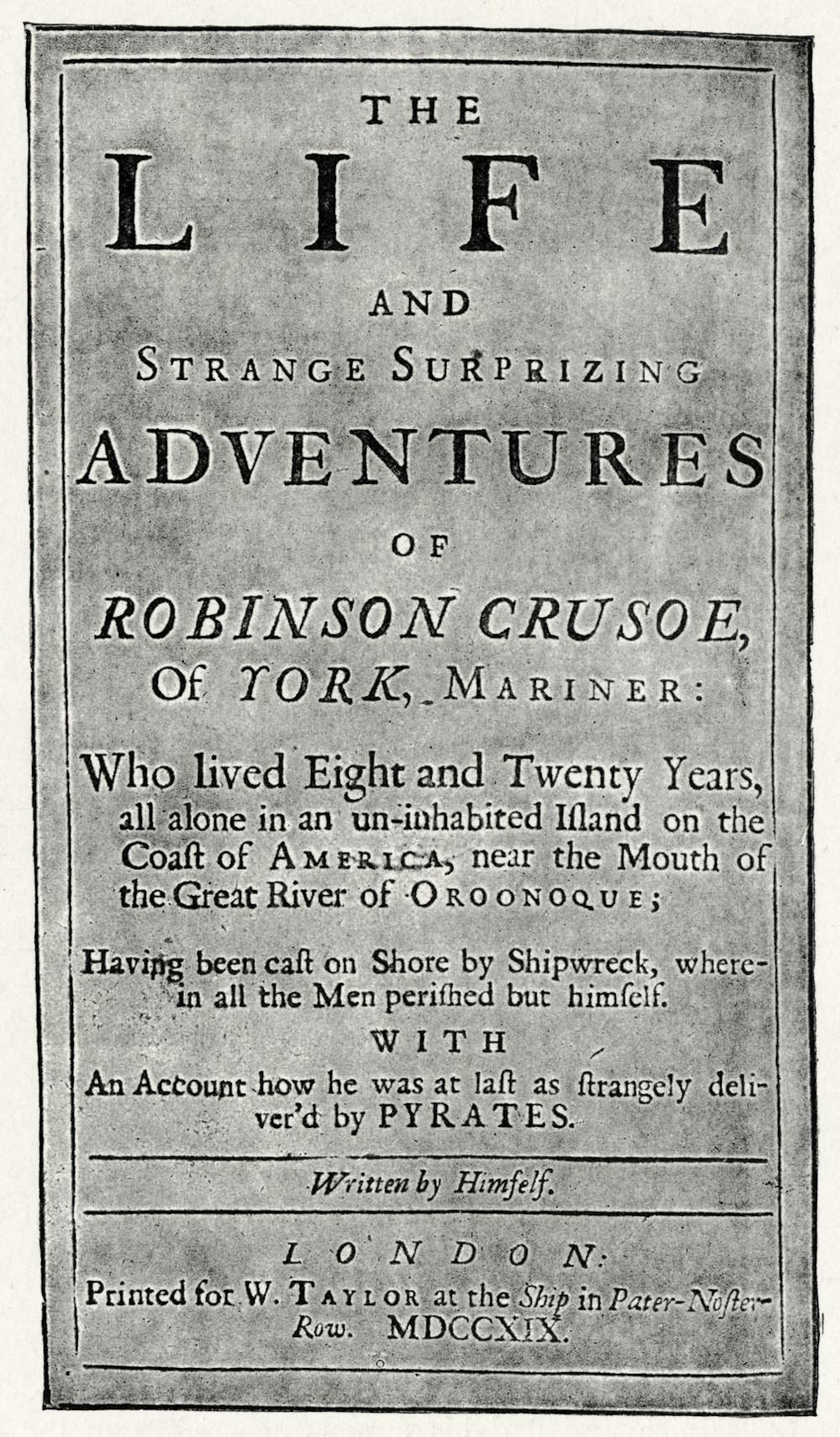
The book is “Robinson Crusoe,” written by Defoe and first published in 1719. Crusoe is an Englishman who leaves his comfortable life, goes to sea, gets captured by pirates and sold into slavery. Later, he emerges from a shipwreck the sole survivor. He sustains himself alone on a tropical island for 28 years, relying on grit, imagination and the few things he salvaged from the ship. His tale offers lessons for us all.
As a physician and scholar, I have taught Defoe’s novel many times to my students at Indiana University. I believe it is one of the best books to read as we endure the uncertainty and isolation due to COVID-19, because it invites us to reflect on existential issues at the core of a pandemic.
What matters in our lives?
For those hunkered down in the midst of a pandemic, one of Robinson Crusoe’s lessons is understanding the folly of worldly goods. Crusoe finds gold but realizes it is of no value to him, not even worth “taking off of the ground.” In his former life, money had become a “drug.” Now, marooned on an island, he learns what is truly necessary and rewarding in life.
Like Crusoe’s shipwreck, sheltering in place during COVID-19 interrupts long-established habits and rhythms of life. With this interruption comes a chance to examine our lives. What is genuinely necessary in life? And what things turn out to be little more than distractions? For example, where on such a spectrum would we situate the pursuit of wealth or caring well for loved ones?
Making do with very little
Crusoe quickly learns to be open to discovery. When he first arrives on the island, he finds it barren, inhospitable and threatening, like a prison. Over time, he comes to recognize it as home. As he explores the island and learns to live in harmony with it, it protects and sustains him. The island emerges as an unending source of wonder that at first he couldn’t see.
As my family and I have sheltered in place, we have shared a similar experience. We are taking more walks and lingering longer at the dinner table. Now that we are not rushing as much from one thing to another, we’ve discovered what it means to be in one place and simply savor being together.
Necessity, the mother of invention
Alone on an island, Crusoe can’t rely on anyone but himself to provide the things he needs. On the day of his shipwreck, he is naked, hungry and homeless. He laments that, “considered by his own nature,” man is “one of the most miserable creatures of the world.” Out of necessity, he figures out how to make the things he needs.

A pandemic renews opportunities for necessity to give birth to invention. Just as Crusoe finds within himself a resourcefulness he didn’t know he had, confinement can reveal new ways of living and creating. Even simple things such as cooking, reading, handcraft, writing and conversation may turn out to have more to offer than we supposed.
A wasted life and forgiveness
One of the greatest challenges Crusoe faces is unburdening himself of the guilt he bears for his misspent life. It had been devoted to getting rich and dominating other people – at the time of his shipwreck, he had been on a voyage to secure slaves for his plantation. But on the island, he begins to see the beauty in simple things. For example, he finds trees indescribably beautiful, a beauty so profound that it is “scarce credible.”
Something similar can transpire in the lives of the homebound. Frustration and disappointment can fade, to be replaced by new and unexpected sources of fulfillment. It may be something that we experience, such as a bird singing in the morning, but it can also be of our own doing. The tools lie at our fingertips – mail, phone and social media provide all we need to reach out to others with a kind word or helping hand.
Gratitude for what we have
One of the most profound transformations that Crusoe experiences is spiritual. Alone, he begins to meditate on the Bible he recovered from the shipwreck, reading Scripture three times per day. He attributes his newfound ability to “look on the bright side of my condition” to this habit, which gives him “such secret comforts that I cannot express them.”
By the time Crusoe is rescued after nearly three decades, he is a new man. He has formed the deepest friendship of his life with Friday, a man he rescued from death. He has learned the most profound lesson that “all our discontents about what we want spring from the want of thankfulness for what we have.”

A life of isolation
Enforced quiet and separation because of coronavirus can reacquaint some of us with the value of peace, while solitude can whet our appetites for the joys of true fellowship. Just as the shipwrecked Crusoe is reborn, so trying times can clarify for us the true bounties of our lives.
A pandemic can seem like the end, but it can also serve as a beginning. We are, in a way, cut adrift. Yet a new and ultimately more fertile landfall lies ahead, at least for those of us who are not sick, broke or homeless. If we heed Defoe’s inspiration, these unprecedented challenges can transform us into wiser and more caring human beings.
[You need to understand the coronavirus pandemic, and we can help. Read The Conversation’s newsletter.]
Richard Gunderman, Chancellor's Professor of Medicine, Liberal Arts, and Philanthropy, Indiana University
This article is republished from The Conversation under a Creative Commons license. Read the original article.
On Sept. 16, 1987, policymakers and scientists from around the world gathered at the International Civil Aviation Organization’s headquarters in Montreal, preparing to take action on the day’s most urgent topic: Depletion of the Earth’s protective ozone layer.
Two years before, researchers from the British Antarctic Survey had stunned the world with the first paper demonstrating that atmospheric ozone levels over Antarctica were dropping at an astonishing rate during the southern hemisphere spring.
Shortly after the British paper, NASA showed images from its Total Ozone Mapping Spectrometer, or TOMS, that not only confirmed the falling ozone levels, but also showed the extent was broader than anyone realized. The “ozone hole,” as the severely depleted region was dubbed, was the size of the entire Antarctic continent.
Some scientists had warned since the 1970’s that chemicals called chlorofluorocarbons (CFCs) posed a threat to the ozone layer, but no one knew for sure what was causing the ozone hole to develop. The discovery lent urgency to the discussion: How could the world repair the ozone layer before it was too late?
Ozone – a chemical made of three oxygen atoms – is mostly found in a layer about 8-30 miles above Earth’s surface, in the stratosphere. It absorbs harmful ultraviolet (UV) radiation from the Sun, shielding plants, animals and humans from damage ranging from crop death to skin cancer.
“If there were no ozone layer, the Sun would sterilize Earth’s surface,” said Paul Newman, chief scientist for Earth Sciences at NASA’s Goddard Space Flight Center in Greenbelt, Maryland.
On September 16, 1987, Newman was a young atmospheric scientist at Goddard, analyzing data coming back from the Antarctic Airborne Ozone Expedition or AAOE – where another NASA scientist, Susan Strahan, stood with her colleagues looking at a bulletin board in Punta Arenas, Chile.
Strahan analyzed atmospheric chemistry data from the sleek, long-winged ER-2 plane flying into the Antarctic polar vortex to measure ozone and chemicals that could react with it.
That day’s data would yield the famous “smoking gun plot”: The data showing that as a chemical called chlorine monoxide increased in the Antarctic stratosphere, ozone decreased. Chlorine monoxide was known to be present in the atmosphere, but had previously been observed only at lower concentrations than the AAOE team measured — these levels came from a complex set of chemical reactions occurring in the Antarctic following the breakdown of CFCs by UV radiation in the stratosphere.
The data disproved other theories and gave scientists evidence that CFCs were causing the ozone hole.
Strahan and her colleagues’ data would not be published until later, but by the end of that day in 1987, twenty-seven nations agreed to the Montreal Protocol on Substances that Deplete the Ozone Layer: “Perhaps the single most successful international agreement to date,” said former United Nations Secretary-General Kofi Annan in 2003.
The Montreal Protocol created a timetable for controlling production and consumption of CFCs. Over the next few years, the science of ozone depletion was more firmly established, manufacturers introduced replacement chemicals that were safer for the environment, and the Montreal Protocol was strengthened several times to stop wide-scale production and use of CFCs and related molecules.
The long journey toward recovery had begun.
Today, Newman and Strahan are leaders in atmospheric science and both sit at NASA Goddard: Newman as chief scientist for Earth Sciences and co-chair of the Scientific Assessment Panel, or SAP, to the Montreal Protocol, Strahan as a principal scientist for the Universities Space Research Association. And today, they both keep an eye on Earth’s atmosphere, continuing NASA’s long-running research and monitoring efforts on stratospheric ozone (which go back to the 1970s) into the future.
CFCs: Danger at high altitudes
CFCs were not always the villain in this story. Invented for use as refrigerants in the 1920’s, CFCs represented a technological breakthrough: They were versatile, but more importantly, they were neither toxic nor flammable. Older refrigeration chemicals were lethal if leaked; CFCs did not harm human health or react with other chemicals in the lower atmosphere.
The problem is that while CFCs are inert at the surface, the story changes in the stratosphere.
“CFCs are emitted at the surface. We make a fridge, and the compound leaks out,” said Strahan. “The emissions start in the troposphere (the atmospheric layer closest to Earth’s surface) and work their way up to the stratosphere.”
Once CFCs diffuse above the protection of the ozone layer, UV radiation breaks them apart, releasing highly reactive chlorine atoms. At first, these react with other chemicals to create hydrochloric acid and chlorine nitrate – called “reservoir gases,” Strahan said, because they typically store chlorine in stable molecules.
But the polar regions support chemical reactions that could not happen anywhere else on Earth. The intense cold of polar winters allows the formation of thin clouds, despite low atmospheric moisture. And the polar vortex winds encircle the Antarctic region, trapping the chemicals within its boundary.
Hydrochloric acid and chlorine nitrate react on the surfaces of these the thin cloud particles to free the reactive chlorine once again, and when the Sun returns in the spring, the UV radiation initiates the catalytic chlorine-ozone reactions that destroy the ozone layer. One chlorine atom can destroy thousands of ozone molecules – and with millions of tons of CFCs pumped into the atmosphere from the 1920’s through the early 1990’s, the Antarctic polar region bore the brunt of the damage.
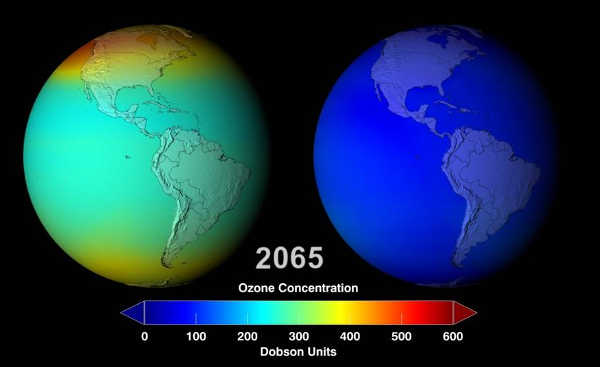
“If we had done nothing, if the Montreal Protocol had not been signed, by this time things would have been quite disastrous,” said Newman. “Ozone levels would be way down; UV levels would be way up. Because of increased UV radiation at the surface, we would have had global crop losses, people would sunburn faster and skin cancer would be going up. Food prices would shoot up; the poor people of the world would have greatly suffered.”
Comparison of projected 2065 global ozone levels with and without Montreal Protocol reductions.
First steps to recovery
Today, 33 years later, the ozone hole is showing its first signs of recovery. Strahan and her colleague Anne Douglass published one of the first studies in 2018 confirming that atmospheric chlorine levels are falling in step with reduced ozone depletion over Antarctica – proof that the Montreal Protocol is working.
These first hopeful signs represent a global success story: Policymakers, scientists and companies around the world joined forces to find a solution to an urgent problem. Much of the data that empowered these decisions came from NASA scientists and instruments.
Ongoing ground- and space-based monitoring of ozone and other trace gases, by NASA and other institutions, will help inform development of environmental policies designed to make sure levels continue trending in a positive direction even in the midst of other changes, such as Earth’s warming climate.
“If you don’t know how much ozone is up there, you don’t know if it’s getting better or worse,” said Strahan. “If it does change, was it natural variability or was it caused by humans? Having a long data record of ozone and other gases directly related to its chemistry is really important.”
Today, NASA monitors ozone from space using the Microwave Limb Sounder (MLS) and Ozone Monitoring Instrument aboard its Aura spacecraft, and the MLS also measures trace gases containing chlorine.
Strahan and Douglass’ 2018 study used MLS measurements of hydrochloric acid, a form that chlorine takes after destroying ozone, to calculate total stratospheric inorganic chlorine above Antarctica.
Inorganic chlorine compounds like hydrochloric acid have no carbon molecules, which allows researchers to differentiate between them and chlorine still tied up in CFCs.
Additionally, the Stratospheric Aerosol and Gas Experiment III measures ozone and trace gases from its vantage point aboard the International Space Station, and the NASA-NOAA Ozone Mapping Profiler Suite aboard the Suomi-NPP satellite measures both total column ozone and ozone profiles.
These instruments had precursors on earlier NASA satellites, and they – along with space, air and ground measurements from partner organizations like the National Oceanic and Atmospheric Administration and global partners – will help scientists keep track of the ozone hole’s recovery.
“When it comes to a clear sign the ozone hole is going away, it could still be a couple decades before we can look up and say it’s smaller every single year than it was in the early 2000s,” Strahan said. “Most years since then, it’s been a bit smaller, but occasionally we’ll have a really cold year and a big hole again. We’re going to have that kind of variability going forward, but once we get to 2040 or so, there will be so much less chlorine that the holes will be smaller even in cold years. It will be a long, bumpy road, but we’re headed in the right direction. We just need to be patient and keep up the good work.”
Jessica Merzdorf works for NASA’s Goddard Space Flight Center in Greenbelt, Maryland.
Special Districts reported the testing results on Friday.
Last month, Special Districts began participating in a project to look for evidence of SARS-CoV-2 – the name given by the World Health Organization to the novel coronavirus which causes COVID-19 – at the treatment plants it operates, as Lake County News has reported.
The firm Biobot, based in Somerville, Massachusetts, is conducting the surveillance testing for Special Districts as part of its COVID-19 response program.
A wastewater epidemiology firm with a mission of transforming wastewater infrastructure into public health observatories, Biobot launched its pro bono program to map COVID-19 across the U.S. in collaboration with researchers at MIT, Harvard and Brigham and Women's Hospital.
Special Districts said the goal is to track the virus’ intensity and spread across the country and provide public health agencies with data in responding to the pandemic.
Beginning on March 26, the tests began on a weekly basis at Special Districts’ sewage treatment plants. Results were available three to five days after each round of testing.
The agency said the first four samples taken on March 26 did not detect the virus; neither did the next round of samples taken on April 1.
However, samples taken on April 8 detected the presence of SARS-CoV-2 at all four treatment plants, Special Districts reported.
Three days earlier, on April 5, Lake County’s first COVID-19 case was confirmed and, since then, testing has confirmed five other cases.
“The presence of COVID-19 in all four treatment plants does suggest we may have community transmission,” Special Districts reported.
Lake County Public Health Officer Gary Pace said in a Friday statement that the test results of the untreated sewage confirmed suspicions from recent contact investigations that there have been some undetected infections in the county over the last month.
He also noted, “Recent evidence, including the raw sewage testing, does suggest it is probable community transmission of the coronavirus has occurred in Lake County,” explaining that it hadn’t been previously identified due to a lack of adequate testing.
So far, just over 300 tests have been conducted, and Pace said his agency is working hard to get more supplies and laboratory access, and the state is promising some changes in the coming weeks.
“Since there have been limitations in testing access, many people with mild illness in the community haven’t been able to be tested. However, it is reassuring we have not seen a rise in serious illness or hospitalizations,” Pace said.
The Centers for Disease Control and Prevention reported that while SARS-CoV-2 has been detected in the feces of some patients diagnosed with COVID-19, the amount of virus released from the body in stool, how long the virus is shed and whether the virus in stool is infectious are not known.
While it also isn’t known if there is risk for transmission from the feces of an infected person, the CDC said it’s expected to be low based on data from previous outbreaks of related coronaviruses, such as severe acute respiratory syndrome, or SARS, and Middle East respiratory syndrome, or MERS.
The CDC said that, based on data so far, the risk of SARS-CoV-2 being transmitted through sewage systems “is thought to be low.” While transmission of the virus through sewage may be possible, there is no evidence that has occurred.
County officials said Special Districts staff working in the treatment plants wear appropriate protective equipment to keep them safe.
Firms and universities researching sewage
Biobot told Lake County News they are working to reach as many communities as possible through their COVID-19 response program.
“Unfortunately, we cannot share which communities are involved at this time,” the company said.
While there are asymptomatic patients who are still infectious or patients with mild symptoms who are not captured in the limited testing data, sewage data is able to capture the whole population, so such samples enable public health interventions to match and better understand the actual infected population, the company said.
Besides using the sewage data to understand the scope of the outbreak independent from patient testing or hospital reporting, Biobot said a better understanding of scope offers more information for officials trying to determine public health interventions.
The company said the work could also help anticipate hospital capacity and readiness and give an early warning for the reemergence of the novel coronavirus if it has a seasonal cycle – like many are projecting that it does.
Besides Biobot and its partners, other organizations – particularly several universities – are working on wastewater testing to track COVID-19.
Researchers at Cranfield University in the United Kingdom said last month they are working on a new, quicker test to detect SARS-CoV-2 in the wastewater of communities infected with the virus.
The rapid test kits offer paper-based devices that could be used on-site at wastewater treatment plants to trace sources and determine whether there are potential COVID-19 carriers in local areas, the university said.
“If COVID-19 can be monitored in a community at an early stage through wastewater-based epidemiology, effective intervention can be taken as early as possible to restrict the movements of that local population, working to minimize the pathogen spread and threat to public health,” said Dr. Zhugen Yang, lecturer in sensor technology at Cranfield Water Science Institute.
Similarly, a research team from the University of Michigan and Stanford University has received a rapid response grant from the National Science Foundation that they’re using to study how the novel coronavirus behaves and moves through the environment, with a focus on wastewater detection.
Researchers said the work could provide a clearer picture of how broadly the disease is spreading because it could pick up evidence of upticks in more mild cases or those that bring no symptoms at all.
“For epidemiologists interested in the prevalence and incidence of COVID-19, our methodology offers an estimate that does not rely on testing every individual, nor is it as prone to measurement bias,” said Nasa Sinnott-Armstrong, a doctoral student at Stanford working on the project. “We could identify areas with rapidly increasing cases as a warning system to the health care system. Finally, these numbers can help epidemiologists model the trajectory of the pandemic with far less testing burden on our health care system.”
Email Elizabeth Larson at