 How to resolve AdBlock issue?
News
This article has been updated.
CLEARLAKE, Calif. – Firefighters are on the scene of a fire that began Tuesday afternoon near the Clearlake Walmart store.
The fire was first dispatched at around 3:15 p.m. Tuesday in the area of 15960 Dam Road, based on radio reports.
Initial reports stated that there were structures threatened.
Minutes later, the Clearlake Police Department issued a Nixle alert telling residents to evacuate the area of Dam Road to Wilkinson Avenue due to the fire.
Reports from the scene as of shortly before 3:25 p.m. put the fire at half an acre in size, with spots fires coming off of it and structures threatened.
Firefighters reported that a small spot fire was starting at the corner of Lake Street and Dam Road. A short time later, a power pole just west of Lake Street was reported to be on fire.
Power lines also are reported to be down in the area. Pacific Gas and Electric confirmed an outage in the area that began at 3:28 p.m. with 574 customers affected. Power is expected to be restored at about 6:30 p.m. Tuesday.
Radio reports just after 3:45 p.m. indicated that residents of the Creekside Mobile Home Park, located at 16425 Dam Road, are not being evacuated but sheltered in place because there are enough firefighting resources on the scene to protect the park.
At 3:50 p.m., air attack estimated the fire size at about three acres. So far, at least one structure has been reported to be involved.
Followup reports said there are ongoing structure threats within the fire’s perimeter.
Just before 4 p.m., the Clearlake Police Department ordered a mandatory evacuation on Dam Road between Jack in the Box and Wilkinson Avenue, from Cache Creek north to Nine Avenue.
Email Elizabeth Larson atThis email address is being protected from spambots. You need JavaScript enabled to view it. . Follow her on Twitter, @ERLarson, or Lake County News, @LakeCoNews.
CLEARLAKE, Calif. – Firefighters are on the scene of a fire that began Tuesday afternoon near the Clearlake Walmart store.
The fire was first dispatched at around 3:15 p.m. Tuesday in the area of 15960 Dam Road, based on radio reports.
Initial reports stated that there were structures threatened.
Minutes later, the Clearlake Police Department issued a Nixle alert telling residents to evacuate the area of Dam Road to Wilkinson Avenue due to the fire.
Reports from the scene as of shortly before 3:25 p.m. put the fire at half an acre in size, with spots fires coming off of it and structures threatened.
Firefighters reported that a small spot fire was starting at the corner of Lake Street and Dam Road. A short time later, a power pole just west of Lake Street was reported to be on fire.
Power lines also are reported to be down in the area. Pacific Gas and Electric confirmed an outage in the area that began at 3:28 p.m. with 574 customers affected. Power is expected to be restored at about 6:30 p.m. Tuesday.
Radio reports just after 3:45 p.m. indicated that residents of the Creekside Mobile Home Park, located at 16425 Dam Road, are not being evacuated but sheltered in place because there are enough firefighting resources on the scene to protect the park.
At 3:50 p.m., air attack estimated the fire size at about three acres. So far, at least one structure has been reported to be involved.
Followup reports said there are ongoing structure threats within the fire’s perimeter.
Just before 4 p.m., the Clearlake Police Department ordered a mandatory evacuation on Dam Road between Jack in the Box and Wilkinson Avenue, from Cache Creek north to Nine Avenue.
Forward progress was reported to have been stopped shortly before 5 p.m., based on radio traffic.
At about the same time, the Clearlake Police Department reported that evacuations had been lifted, but that Dam Road from Lake Street to Jack in the Box to remain closed for several hours.
Fire apparatus remained in the area, with motorists asked to drive with caution.
Additional information will be posted as it becomes available.Email Elizabeth Larson at
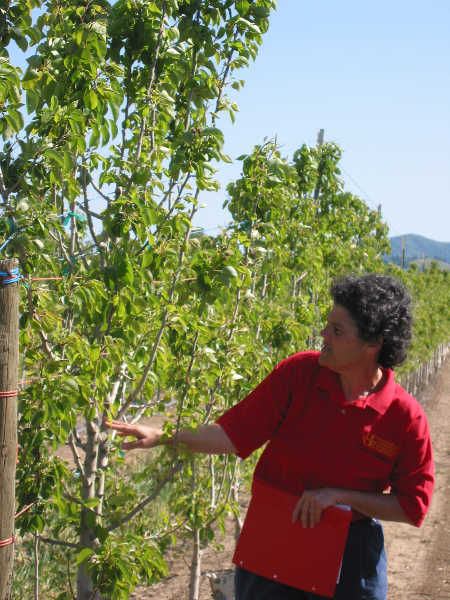
LAKE COUNTY, Calif. – Rachel Elkins, UC Cooperative Extension pomology farm advisor for Lake and Mendocino counties, retired July 1 after 36 years, 33 years in her current position.
“Rachel has been invaluable to the pear industry in Mendocino and Lake counties,” said Bob McClain, California Pear Advisory Board’s field and research director.
The Richmond native’s first UC job was as a typist at UC Berkeley.
Elkins was introduced to UC Agriculture and Natural Resources after earning a bachelor’s degree in international studies at University of the Pacific and bachelor’s degree in agricultural pest management at UC Berkeley, then landing an internship with UCCE integrated pest management advisor Bill Barnett in Fresno County in 1982.
After earning two master’s degrees in pomology and plant protection and pest management at UC Davis, Elkins joined UC Cooperative Extension as a farm advisor intern in 1986 and was hired as a farm advisor in Lake and Mendocino counties in 1987.
“I began with zero knowledge about pear production, my main assigned crop,” Elkins said. “From this beginning, I dived in; I am still learning every day. I am fortunate to have developed close working relationships with UC, industry and colleagues in Oregon and Washington, as well as other states and countries where pears are grown.”
She co-edited and co-authored the 2007 UC Pear Production and Handling Manual, 1999 UC Integrated Pest Management for Apple and Pear, and UC IPM Pear Pest Management Guidelines.
Her most recent co-authored article on predatory phytoseiid mites, detailing work completed in 2008 was just published in the California Agriculture journal.
Elkins is well-known for her research to control codling moth populations by interfering with the insect’s sex life instead of using insecticides.
In 1996, she worked with UC Riverside researcher Harry Shorey to introduce the pheromone “puffer,” fashioned after the devices in public restrooms that intermittently emit a fragrance. Releasing pheromones confuses male moths seeking mates. The method proved successful and ideal in large-scale management because as acreage increases the number of units needed per acre decreases. As a result, organophosphate insecticide use for codling moth control in many pear orchards has almost entirely ceased.
“She was instrumental in developing pheromone puffers for codling moth control,” McClain said, noting that pheromones distributed in orchards on plastic ties were hung by hand 200 per acre. “With the puffer, you needed two per acre, which saved on labor costs.”
A 2003 UC cost study showed that the pheromone puffers saved growers $9 per ton or nearly $200 per acre, based on 20 tons per acre.
The cost savings came from reduced insecticide use – due to fewer outbreaks of secondary pests such as mites and pear psylla – and less need to operate spray equipment, which was becoming increasingly expensive.
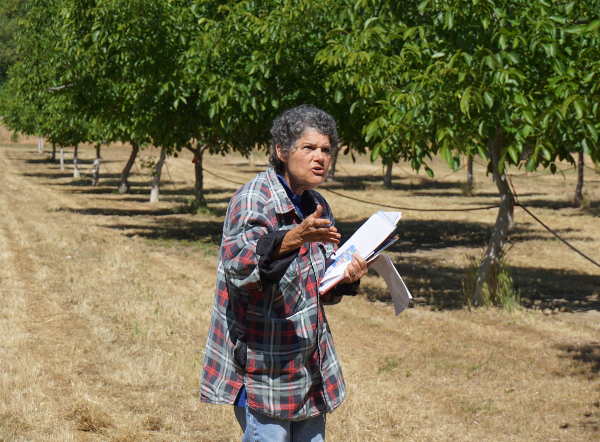
The California Department of Pesticide Regulation honored the pheromone puffer project with its 2000 IPM Innovator Award. The puffer is now used on nearly all the pear acreage in Lake County. This success in pears led to its use in apple and walnut orchards.
“The most gratifying part of the puffers’ success is that I put myself out of the codling moth control business and was able to devote more time to horticulture,” she said. “For example, developing modern orchard systems amenable to mechanization, finding alternatives to antibiotics for fire blight control, and joining multistate efforts toward breeding size-controlling rootstocks.”
In 2002, Elkins was named Agriculture Person of the Year by the Lake County Farm Bureau.
Although pears are her specialty, she has worked with growers on more than 25 fruit and nut crops, mainly walnuts, but also apples, kiwifruit, olives and wine grapes.
“My walnut research program has greatly increased in the past decade as higher prices and organic markets have led to new Lake County plantings,” she said. “I established four long-term rootstock trials in 2011-2012, which are providing local growers with important data to decide whether to replace seedling Paradox with newer clonal selections.”
In 2015, she received the American Society for Horticultural Science award for Outstanding Extension Education Materials for producing the video “Budding, Grafting and Planting Walnut Trees in the Field,” a labor of love honoring renowned Lake County nurseryman Alex Suchan.
She has also covered environmental horticulture and, in 1993, started the UC Master Gardeners Program in Lake County, which is still going strong today.
In addition to her research, Elkins has served as UCCE director in Lake County, from 2002 to 2006 and again from 2018 to the present, maintaining excellent relationships with local government officials and partnering with county departments.
Elkins has been granted emeritus status by UC ANR and will continue ongoing research trials. She will return part-time funded by the California Pear Advisory Board and Pear Pest Management Research Fund to continue assisting the statewide pear industry, including as UC ANR commodity liaison.
“I am very glad to work part-time doing pure farm advisor work, which is what I love and why I entered this profession,” Elkins said.
Pam Kan-Rice writes for UC Agriculture and Natural Resources News.
LAKE COUNTY, Calif. – Lake County Public Health has released the latest demographics data about the county’s COVID-19 cases.
The county released this second round of demographics data on Monday evening. The information is updated weekly.
The demographics breakdowns are based on the 96 cases Public Health reported on Monday.
Public Health Officer Dr. Gary Pace told Lake County News that the county is having “a steady flow of new cases,” some of them from contacts with people connected to a farmworker outbreak, although he added those numbers are decreasing.
“There are some other cases emerging that don’t seem to be connected to that outbreak, most of these do seem connected to other cases that have been identified either locally or others from out of the area,” Pace said. “We don’t seem to have widespread community transmission, but there have been several cases that we have not been able to identify the source case.”
The new data shows that the majority of Lake County’s COVID-19 cases continue to be traced to close contacts to a known case, including households, family and friends with a recognized significant contact.
Close contacts account for 55 of the current cases, followed by out of county contacts to a known case or travel, 15; under investigation, 15; other/unknown, five; presumed occupational contact, four; and congregate living situations – in this case, the Lake County Jail – two.
Regarding case locations, the information is not broken down by cities and towns, but by supervisorial districts.
The largest number of cases continues to be in District 2, which covers Clearlake, where 42 cases have been reported. District 3, which covers the Northshore, has 21 cases; District 4, which covers the greater Lakeport and north Lakeport areas, has 14; District 5, which includes the greater Kelseyville area, as well as Loch Lomond and Cobb, has 12 cases; five are in District 1, which covers the south county; and two cases are listed as “unknown.”
The leading age range continues to be the 18 to 49 group, with 62 cases, followed by the 50 to 64 group, with 17 cases; birth to 17, 11 cases; and age 65 and above, six cases.
There continue to be more cases in males than females, which follows the statewide trend. Fifty-one of Lake County’s COVID-19 cases are males, while 45 are females.
The next set of data will be released on Tuesday, July 14, Public Health reported.
Email Elizabeth Larson atThis email address is being protected from spambots. You need JavaScript enabled to view it. . Follow her on Twitter, @ERLarson, or Lake County News, @LakeCoNews.
The county released this second round of demographics data on Monday evening. The information is updated weekly.
The demographics breakdowns are based on the 96 cases Public Health reported on Monday.
Public Health Officer Dr. Gary Pace told Lake County News that the county is having “a steady flow of new cases,” some of them from contacts with people connected to a farmworker outbreak, although he added those numbers are decreasing.
“There are some other cases emerging that don’t seem to be connected to that outbreak, most of these do seem connected to other cases that have been identified either locally or others from out of the area,” Pace said. “We don’t seem to have widespread community transmission, but there have been several cases that we have not been able to identify the source case.”
The new data shows that the majority of Lake County’s COVID-19 cases continue to be traced to close contacts to a known case, including households, family and friends with a recognized significant contact.
Close contacts account for 55 of the current cases, followed by out of county contacts to a known case or travel, 15; under investigation, 15; other/unknown, five; presumed occupational contact, four; and congregate living situations – in this case, the Lake County Jail – two.
Regarding case locations, the information is not broken down by cities and towns, but by supervisorial districts.
The largest number of cases continues to be in District 2, which covers Clearlake, where 42 cases have been reported. District 3, which covers the Northshore, has 21 cases; District 4, which covers the greater Lakeport and north Lakeport areas, has 14; District 5, which includes the greater Kelseyville area, as well as Loch Lomond and Cobb, has 12 cases; five are in District 1, which covers the south county; and two cases are listed as “unknown.”
The leading age range continues to be the 18 to 49 group, with 62 cases, followed by the 50 to 64 group, with 17 cases; birth to 17, 11 cases; and age 65 and above, six cases.
There continue to be more cases in males than females, which follows the statewide trend. Fifty-one of Lake County’s COVID-19 cases are males, while 45 are females.
The next set of data will be released on Tuesday, July 14, Public Health reported.
Email Elizabeth Larson at
MIDDLETOWN, Calif. – The Middletown Area Town Hall will hold a virtual meeting this week to get the district supervisor’s updates and hear the latest about a major south county development project.
MATH will meet at 7 p.m. Thursday, July 9, via Zoom. The meeting is open to the public.
To join the Zoom meeting click on this link; the meeting ID is 872 2935 2332 or call in at 888-788-0099.
Chair Tom Darms said the meetings will be held via Zoom until further notice.
On the agenda, scheduled for 7:30 p.m., is the update from District 1 Supervisor Moke Simon.
At 7:50 p.m., Kirsty Shelton of MAHA Developments will offer the latest on the Guenoc Project, a major resort and residential development set to go before the Board of Supervisors on Tuesday.
At 8:25 p.m., the group will discuss August agenda items, including changing MATH to a town hall format, which would result in no county oversight.
The MATH Board includes Chair Tom Darms, Vice Chair Sally Peterson, Secretary Paul Baker, and at-large members Rosemary Cordova and Lisa Kaplan.
MATH – established by resolution of the Lake County Board of Supervisors on Dec. 12, 2006 – is a municipal advisory council serving the residents of Anderson Springs, Cobb, Coyote Valley (including Hidden Valley Lake), Long Valley and Middletown.
Meetings are subject to videotaping.
For more information emailThis email address is being protected from spambots. You need JavaScript enabled to view it. .
Email Elizabeth Larson atThis email address is being protected from spambots. You need JavaScript enabled to view it. . Follow her on Twitter, @ERLarson, or Lake County News, @LakeCoNews.
MATH will meet at 7 p.m. Thursday, July 9, via Zoom. The meeting is open to the public.
To join the Zoom meeting click on this link; the meeting ID is 872 2935 2332 or call in at 888-788-0099.
Chair Tom Darms said the meetings will be held via Zoom until further notice.
On the agenda, scheduled for 7:30 p.m., is the update from District 1 Supervisor Moke Simon.
At 7:50 p.m., Kirsty Shelton of MAHA Developments will offer the latest on the Guenoc Project, a major resort and residential development set to go before the Board of Supervisors on Tuesday.
At 8:25 p.m., the group will discuss August agenda items, including changing MATH to a town hall format, which would result in no county oversight.
The MATH Board includes Chair Tom Darms, Vice Chair Sally Peterson, Secretary Paul Baker, and at-large members Rosemary Cordova and Lisa Kaplan.
MATH – established by resolution of the Lake County Board of Supervisors on Dec. 12, 2006 – is a municipal advisory council serving the residents of Anderson Springs, Cobb, Coyote Valley (including Hidden Valley Lake), Long Valley and Middletown.
Meetings are subject to videotaping.
For more information email
Email Elizabeth Larson at
LAKEPORT, Calif. – The Lakeport Economic Development Advisory Committee will get updates on the latest city projects when it meets this week.
The committee, or LEDAC, will meet telephonically from 7:30 to 9 a.m. Wednesday, July 8.
The meeting is open to the public.
If you would like to speak on an agenda item, you can access the meeting remotely by joining from a PC, Mac, iPad, iPhone, or Android device. Please register here. After registering, you will receive a confirmation email containing information about joining the Webinar.
If you prefer to use your phone, you must select "Use Telephone" after joining the webinar and call in using these numbers: United States (toll-free): 877-568-4108; United States: +1 (213) 929-4221; Access Code: 579-521-917.
On the agenda is an update on city projects and activities from city staff, including the new lakefront park, waterfront parking rehabilitation, Second Street rehabilitation and an update on the work of Retail Coach, the city’s retail recruitment consulting firm.
Dennis Rollins, chair of the Westside Community Park Committee, will present information about park development, current and future.
There also will be member reports from the Lakeport Main Street Association, Lake County Chamber of Commerce, CareerPoint Lake, Mendocino College/Lake Center and Lake Economic Development Corp./BARC, and citizen input.
The group’s next quarterly meeting will take place on Sept. 9, in a format that’s to be announced.
LEDAC advocates for a strong and positive Lakeport business community and acts as a conduit between the city and the community for communicating the goals, activities and progress of Lakeport’s economic and business programs.
Members are Chair Wilda Shock and Vice Chair Denise Combs, Secretary Terre Logsdon, Maureen Brasier, Candy De Los Santos, Bill Eaton, Melissa Fulton, Pam Harpster, Andy Lucas, Laura Sammel and Amanda Xu. City staff who are members include City Manager Margaret Silveira and Community Development Director Kevin Ingram.
Email Elizabeth Larson atThis email address is being protected from spambots. You need JavaScript enabled to view it. . Follow her on Twitter, @ERLarson, or Lake County News, @LakeCoNews.
The committee, or LEDAC, will meet telephonically from 7:30 to 9 a.m. Wednesday, July 8.
The meeting is open to the public.
If you would like to speak on an agenda item, you can access the meeting remotely by joining from a PC, Mac, iPad, iPhone, or Android device. Please register here. After registering, you will receive a confirmation email containing information about joining the Webinar.
If you prefer to use your phone, you must select "Use Telephone" after joining the webinar and call in using these numbers: United States (toll-free): 877-568-4108; United States: +1 (213) 929-4221; Access Code: 579-521-917.
On the agenda is an update on city projects and activities from city staff, including the new lakefront park, waterfront parking rehabilitation, Second Street rehabilitation and an update on the work of Retail Coach, the city’s retail recruitment consulting firm.
Dennis Rollins, chair of the Westside Community Park Committee, will present information about park development, current and future.
There also will be member reports from the Lakeport Main Street Association, Lake County Chamber of Commerce, CareerPoint Lake, Mendocino College/Lake Center and Lake Economic Development Corp./BARC, and citizen input.
The group’s next quarterly meeting will take place on Sept. 9, in a format that’s to be announced.
LEDAC advocates for a strong and positive Lakeport business community and acts as a conduit between the city and the community for communicating the goals, activities and progress of Lakeport’s economic and business programs.
Members are Chair Wilda Shock and Vice Chair Denise Combs, Secretary Terre Logsdon, Maureen Brasier, Candy De Los Santos, Bill Eaton, Melissa Fulton, Pam Harpster, Andy Lucas, Laura Sammel and Amanda Xu. City staff who are members include City Manager Margaret Silveira and Community Development Director Kevin Ingram.
Email Elizabeth Larson at
LAKE COUNTY, Calif. – Several new cases of COVID-19 have been confirmed in Lake County due to testing results officials reported on Monday.
Lake County’s COVID-19 cases totaled 96 on Monday morning, up from 87 reported on Saturday, according to Lake County Public Health.
Public Health Officer Dr. Gary Pace did not immediately respond to a request from Lake County News for more information about the newly reported cases.
Of Lake County’s 96 cases, 18 are active, of which four are hospitalized, Public Health reported.
Public Health said 77 local cases are recovered. The agency reported Lake County’s first death attributed to the virus last week.
To date, 5,184 COVID-19 tests have been conducted in Lake County, with the results of 491 of those cases pending, Public Health said.
On Monday, the California Department of Public Health reported that California has 271,684 confirmed cases to date, with 6,337 COVID-19 deaths since the start of the pandemic.
As of July 5, local health departments have reported 16,175 confirmed positive cases in health care workers and 94 deaths statewide, the California Department of Public Health said.
The agency also said that California's positivity rate – a key indicator of community spread – is trending upward in the 14-day average, as are hospitalization rates.
In a Monday afternoon briefing, Gov. Gavin Newsom said California is seeing infection rates similar to those at the start of the pandemic.
While death rates appear to be lower, Newsom cautioned that hospitalizations, ICU numbers and mortality are lagging indicators.
The California Department of Public Health reported on Monday that more than 4,793,353 tests have been conducted statewide for the virus.
“As testing capacity continues to increase across the state, an increase in the number of positive cases has been expected – increasing the importance of positivity rates to find signs of community spread,” the state reported.
Over the weekend, California Health and Human Services Secretary Dr. Mark Ghaly urged laboratories in California to prioritize testing turnaround for individuals who are most at risk of spreading the virus to others.
Ghaly said the state, working with public and private partners, has increased access to diagnostic testing over the past six months, with the capacity rising from 2,000 tests per day to 100,000 per day in a few months’ time.
However, Ghaly said that, as more states begin to scale their testing capabilities, new constraints are materializing within the supply chain. “Simultaneously laboratories are becoming overwhelmed with high numbers of specimens, slowing down processing timelines.”
Those delays, said Ghaley, will present “significant challenges” in the ability to care for people in the hospital where testing helps make appropriate treatment decisions and in the ability to appropriately isolate those who are sick in order to box in the virus and cut transmission rates.
Due to these new limitations, Ghaly said California is recommending that laboratories prioritize the processing of specimens of individuals who are COVID-19 symptomatic and those who are hospitalized or in long-term care facilities, including skilled nursing facilities such as veterans homes, assisted living facilities such as residential care facilities for the elderly, and for specimens of patients in institutional settings, including prisons and jails, in order to timely implement appropriate interventions to mitigate the spread of the virus within the facility.
Email Elizabeth Larson atThis email address is being protected from spambots. You need JavaScript enabled to view it. . Follow her on Twitter, @ERLarson, or Lake County News, @LakeCoNews.
Lake County’s COVID-19 cases totaled 96 on Monday morning, up from 87 reported on Saturday, according to Lake County Public Health.
Public Health Officer Dr. Gary Pace did not immediately respond to a request from Lake County News for more information about the newly reported cases.
Of Lake County’s 96 cases, 18 are active, of which four are hospitalized, Public Health reported.
Public Health said 77 local cases are recovered. The agency reported Lake County’s first death attributed to the virus last week.
To date, 5,184 COVID-19 tests have been conducted in Lake County, with the results of 491 of those cases pending, Public Health said.
On Monday, the California Department of Public Health reported that California has 271,684 confirmed cases to date, with 6,337 COVID-19 deaths since the start of the pandemic.
As of July 5, local health departments have reported 16,175 confirmed positive cases in health care workers and 94 deaths statewide, the California Department of Public Health said.
The agency also said that California's positivity rate – a key indicator of community spread – is trending upward in the 14-day average, as are hospitalization rates.
In a Monday afternoon briefing, Gov. Gavin Newsom said California is seeing infection rates similar to those at the start of the pandemic.
While death rates appear to be lower, Newsom cautioned that hospitalizations, ICU numbers and mortality are lagging indicators.
The California Department of Public Health reported on Monday that more than 4,793,353 tests have been conducted statewide for the virus.
“As testing capacity continues to increase across the state, an increase in the number of positive cases has been expected – increasing the importance of positivity rates to find signs of community spread,” the state reported.
Over the weekend, California Health and Human Services Secretary Dr. Mark Ghaly urged laboratories in California to prioritize testing turnaround for individuals who are most at risk of spreading the virus to others.
Ghaly said the state, working with public and private partners, has increased access to diagnostic testing over the past six months, with the capacity rising from 2,000 tests per day to 100,000 per day in a few months’ time.
However, Ghaly said that, as more states begin to scale their testing capabilities, new constraints are materializing within the supply chain. “Simultaneously laboratories are becoming overwhelmed with high numbers of specimens, slowing down processing timelines.”
Those delays, said Ghaley, will present “significant challenges” in the ability to care for people in the hospital where testing helps make appropriate treatment decisions and in the ability to appropriately isolate those who are sick in order to box in the virus and cut transmission rates.
Due to these new limitations, Ghaly said California is recommending that laboratories prioritize the processing of specimens of individuals who are COVID-19 symptomatic and those who are hospitalized or in long-term care facilities, including skilled nursing facilities such as veterans homes, assisted living facilities such as residential care facilities for the elderly, and for specimens of patients in institutional settings, including prisons and jails, in order to timely implement appropriate interventions to mitigate the spread of the virus within the facility.
Email Elizabeth Larson at