NORTHERN CALIFORNIA – Officials are planning a virtual community meeting to discuss their work to contain the Glass fire, while to the north on the August Complex’s South Zone efforts continue to strengthen lines protecting communities around Lake Pillsbury.
Dry, hot weather conditions have continued to drive the Glass fire, but firefighters kept its growth to 1,090 acres during the course of the day on Saturday, for a total of 63,450 acres by nightfall, with containment rising to 15 percent, Cal Fire said.
The fire has been burning for a week in Napa and Sonoma counties.
At 6 p.m. Sunday, Cal Fire will host a virtual community meeting to give an update on the Glass fire. The meeting will be live-streamed on the Cal Fire Sonoma-Lake-Napa Unit Facebook page.
Cal Fire said there are 2,773 firefighting personnel assigned to the incident, along with 408 engines, 49 water tenders, 23 helicopters, 27 hand crews, 66 dozers and nine masticators.
So far, no injuries to firefighters have been reported.
Critically low fuel moisture,very warm and dry weather conditions are contributing to very active fire behavior, Cal Fire said.
Aggressive mop up and tactical patrol continues in areas where the fire’s forward progress has stopped. Crews are working aggressively to construct and reinforce existing control lines, officials said.
Cal Fire said it is threatening 21,613 structures, down by several thousand since Saturday morning.
The fire has so far destroyed a total of 826 buildings, 561 in Napa, 265 in Sonoma. Another 163 buildings – 91 in Sonoma, 72 in Napa – have been damaged.
The August Complex – burning since Aug. 17 – grew by nearly 15,000 acres since Friday, reaching 984,804 acres and 51-percent containment by Saturday evening, officials reported.
On the complex’s South Zone, which includes the Mendocino National Forest in northern Lake County, the US Forest Service said that hard work on Friday in the Lake Pillsbury region resulted in high confidence in the integrity of the containment lines built to protect property and resources.
All hose, fixtures, pumps and other fire apparatus have been pulled and reset for potential use in the northwestern corner of the August Complex. Patrol status has been achieved at Lake Pillsbury, Rice Creek and adjacent areas, officials said.
The Forest Service said Sunday will be a transitional day, with Pacific Northwest Team 2 migrating resources and strategy to the northwestern corner of the August Complex. In upcoming shifts, the team will further join forces with Cal Fire and the Alaska IMT1.
Along with that movement, task forces consisting of multiple fire engines and water tenders will continue patrolling the long containment lines from Lake Pillsbury to the west up to Eel River, and east and north to Paskenta, officials said.
Email Elizabeth Larson at This email address is being protected from spambots. You need JavaScript enabled to view it.. Follow her on Twitter, @ERLarson, or Lake County News, @LakeCoNews.
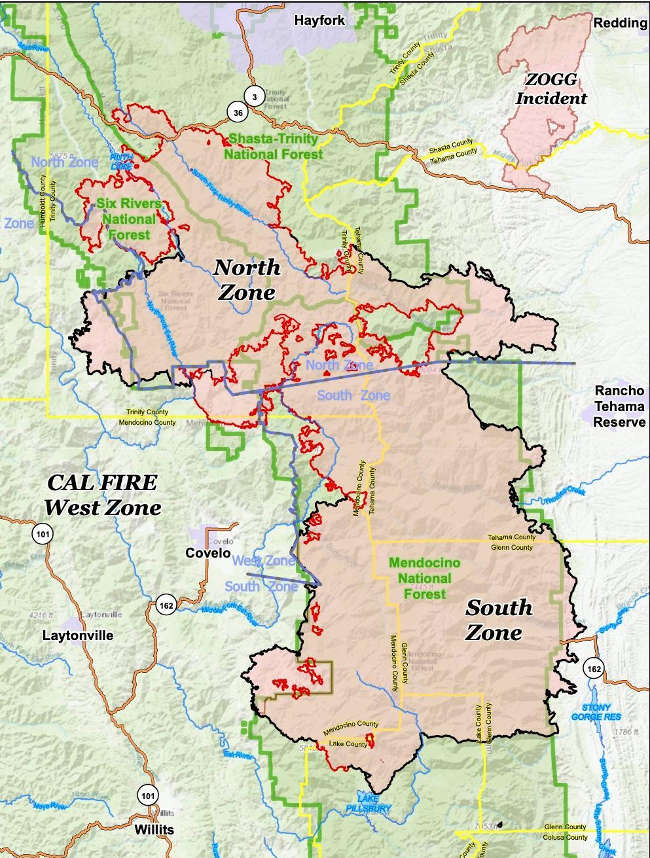
The August Complex as mapped on Saturday, October 3, 2020. Map courtesy of the US Forest Service.
NORTHERN CALIFORNIA – Officials said assessment work is now underway on the South Zone of the August Complex on the Mendocino National Forest.
A Forest Service Burned Area Emergency Response, or BAER, team was established by the Mendocino National Forest to begin burned area assessments of the August Complex South Zone.
The BAER team is being led by Forest Service Hydrologist Luke Rutten, Natural Resource and Planning Staff Officer Kendal Young and Fishery Biologist Dan Teater.
Another Forest Service BAER team is tentatively scheduled to begin its assessment of the North Zone of the August Complex in a couple of weeks.
The Forest Service said both teams will coordinate with the USDA Natural Resources Conservation Service; National Weather Service; US Geological Survey; the counties of Lake, Mendocino, Glenn, Tehama and, Trinity; and other federal, state and local agencies as they assess potential post-fire impacts to the burned watersheds.
BAER surveys are rapid assessments that evaluate the burned area to identify watersheds having increased potential for post-fire flooding, sediment flows and rock slides, the Forest Service said.
Since the BAER survey is a rapid assessment to assist land managers prepare the burned area for rainstorms, officials said the team focuses on potential emergency impacts to life, and safety on National Forest System land and share the findings with the responsible downstream agencies.
The Forest Service said BAER teams may consist of scientists and specialists including hydrologists, geologists, soil scientists, road engineers, botanists, wildlife biologists, recreation specialists, archeologists and geographic information specialists.
The teams collect data during their burned area surveys to analyze through GIS and computer models and present their findings along with recommended BAER emergency response actions in a BAER assessment report, forest officials reported.
BAER teams utilize satellite imagery and specialist data to analyze and produce a map that shows the levels of burn severity on the watersheds. The Forest Service said this is the first step in assessing potential watershed impacts from wildfires to any National Forest System values that may be at-risk from potential increased flooding, sedimentation, debris flows and rock slides.
Based on their work, the Forest Service said BAER teams produce a report that describes threats associated with the burned area’s post-fire conditions along with recommended emergency stabilization measures and actions.
BAER emergency response efforts are focused on the protection of human life, safety and property, as well as critical cultural and natural resource values such as the water quality of streams and wetlands on National Forest System lands, officials said.
The resulting BAER reports are shared with interagency cooperators who work with downstream private homeowners and landowners to prepare for potential post-fire flooding and debris flow impacts, the Forest Service reported.
Homes or businesses that could be impacted by flooding from federal land that resulted from wildfires may be eligible for flood insurance coverage. Visit https://www.floodsmart.gov/.
LAKE COUNTY, Calif. – Lake County Animal Care and Control has six dogs waiting for new homes this week.
Dogs available for adoption this week include mixes of border collie, Chihuahua, Labrador Retriever and pit bull.
Dogs that are adopted from Lake County Animal Care and Control are either neutered or spayed, microchipped and, if old enough, given a rabies shot and county license before being released to their new owner. License fees do not apply to residents of the cities of Lakeport or Clearlake.
The following dogs at the Lake County Animal Care and Control shelter have been cleared for adoption (additional dogs on the animal control Web site not listed are still “on hold”).
Call Lake County Animal Care and Control at 707-263-0278 or visit the shelter online at http://www.co.lake.ca.us/Government/Directory/Animal_Care_And_Control.htm for information on visiting or adopting.
This female Labrador Retriever is in kennel No. 8, ID No. 14073. Photo courtesy of Lake County Animal Care and Control. Female Labrador Retriever
This female Labrador Retriever has a short black coat with white markings.
She is in kennel No. 8, ID No. 14073.
This female Labrador Retriever mix is in kennel No. 9, ID No. 13989. Photo courtesy of Lake County Animal Care and Control. Female Labrador Retriever
This female Labrador Retriever mix has a short black coat with white markings.
She is in kennel No. 9, ID No. 13989.
“Ruby” is a young female Chihuahua in kennel No. 19, ID No. 14055. Photo courtesy of Lake County Animal Care and Control. ‘Ruby’
“Ruby” is a young female Chihuahua with a short tan coat.
She has been spayed.
She’s in kennel No. 19, ID No. 14055.
This male pit bull is in kennel No. 20, ID No. 14058. Photo courtesy of Lake County Animal Care and Control. Male pit bull
This male pit bull has a short white and brindle coat.
He is in kennel No. 20, ID No. 14058.
This male pit bull is in kennel No. 22, ID No. 14066. Photo courtesy of Lake County Animal Care and Control. Male pit bull
This male pit bull has a short brown coat.
He is in kennel No. 22, ID No. 14066.
This young male border collie is in kennel No. 27, ID No. 14052. Photo courtesy of Lake County Animal Care and Control. Male border collie
This young male border collie has a short black and white coat.
He is in kennel No. 27, ID No. 14052.
Email Elizabeth Larson at This email address is being protected from spambots. You need JavaScript enabled to view it.. Follow her on Twitter, @ERLarson, or Lake County News, @LakeCoNews.
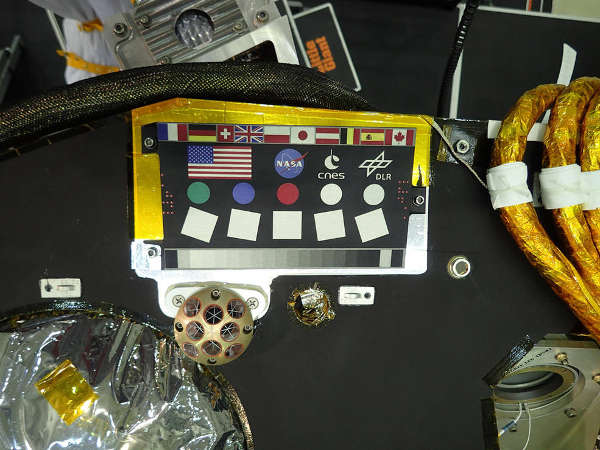
Visible both in the inset photograph on the upper left and near the center of NASA's Perseverance Mars rover in this illustration is the palm-size dome called the Laser Retroreflector Array. In the distant future, laser-equipped Mars orbiters could use such a reflector for scientific studies. Credits: NASA/JPL-Caltech.
Perseverance is one of a few Mars spacecraft carrying laser retroreflectors. The devices could provide new science and safer Mars landings in the future.
When the Apollo astronauts landed on the Moon, they brought devices with them called retroreflectors, which are essentially small arrays of mirrors. The plan was for scientists on Earth to aim lasers at them and calculate the time it took for the beams to return. This provided exceptionally precise measurements of the Moon's orbit and shape, including how it changed slightly based on Earth's gravitational pull.
Research with these Apollo-era lunar retroreflectors continues to this day, and scientists want to perform similar experiments on Mars. NASA's Perseverance rover – scheduled to land on the Red Planet on Feb. 18, 2021 – carries the palm-size Laser Retroreflector Array (LaRA). There's also a small one aboard the agency's InSight lander, called Laser Retroreflector for InSight (LaRRI). And a retroreflector will be aboard the ESA (European Space Agency) ExoMars rover that launches in 2022.
While there is currently no laser in the works for this sort of Mars research, the devices are geared toward the future: Reflectors like these could one day enable scientists conducting what is called laser-ranging research to measure the position of a rover on the Martian surface, test Einstein's theory of general relativity, and help make future landings on the Red Planet more precise.
"Laser retroreflectors are shiny, pointlike position markers," said Simone Dell'Agnello, who led development of all three retroreflectors at Italy's National Institute for Nuclear Physics, which built the devices on behalf of the Italian Space Agency. "Because they're simple and maintenance-free, they can work for decades."
Laser Retroreflector for InSight (LaRRI) is the copper-colored half-dome on the deck of NASA's InSight lander. This image shows LaRRI's location below InSight's calibration target. Credits: NASA/JPL-Caltech. A box of mirrors
The devices work a lot like a bike reflector, bouncing light back in the direction of its source. Perseverance's LaRA, for example, is a 2-inch-wide (5-centimeter-wide) dome speckled with half-inch holes containing glass cells. In each cell, three mirrored faces are positioned at 90-degree angles from one another so that light entering the holes is directed back out at exactly the same direction it came from.
LaRA is much smaller than the retroreflectors on the Moon. The earliest ones, delivered by the Apollo 11 and 14 missions, are about the size of a typical computer monitor and embedded with 100 reflectors; the ones delivered by Apollo 15 are even larger and embedded with 300 reflectors. That's because the lasers have to travel as much as 478,000 miles (770,000 kilometers) to the Moon and back. By the return trip, the beams are so faint, they can't be detected by the human eye.
The beams that Perseverance's LaRA and InSight's LaRRI were built to reflect would actually have a far shorter journey, despite Mars being some 249 million miles (401 million kilometers) away at its farthest point from Earth. Rather than traveling back and forth from Earth, which would require enormous retroreflectors, the laser beams would just need to travel back and forth from a future Mars orbiter equipped with an appropriate laser.
Illuminating science
Such an orbiter could determine the precise position of a retroreflector on the Martian surface. And since Perseverance will be mobile, it could provide multiple points of reference. Meanwhile, the orbiter's position would also be tracked from Earth. This would allow scientists to test Einstein's theory of general relativity, as they have with retroreflectors on the Moon. Each planet's orbit is greatly influenced by the bend in space-time created by the Sun's large mass.
"This kind of science is important for understanding how gravity shapes our solar system, the whole universe, and ultimately the roles of dark matter and dark energy," Dell'Agnello noted.
In the case of the InSight lander, which touched down on Nov. 26, 2018, laser-ranging science could also aid the spacecraft's core mission of studying Mars' deep interior. InSight relies on a radio instrument to detect subtle differences in the planet's rotation. In learning from the instrument how the planet wobbles over time, scientists may finally determine whether Mars' core is liquid or solid.
And if the science team were able to use the lander's retroreflector, they could get even more precise positioning data than InSight's radio provides. LaRRI could also detect how the terrain InSight sits on shifts over time and in what direction, revealing how the Martian crust expands or contracts.
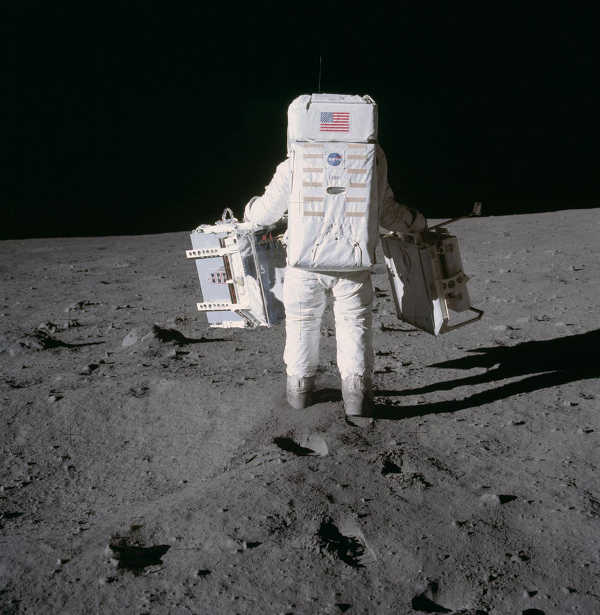
Apollo 11 astronaut Buzz Aldrin carries two components of the Early Apollo Scientific Experiments Package (EASEP) on the surface of the Moon. The Passive Seismic Experiments Package (PSEP) is in his left hand; and in his right hand is the Laser Ranging Retro-Reflector (LR3). Credits: NASA. Better landings on Mars
Mars landings are hard. To help get Perseverance safely to the surface, the mission will rely on Terrain-Relative Navigation, a new technology that compares images taken during descent to an onboard map. If the spacecraft sees itself getting too close to danger (like a cliffside or sand dunes), it can veer away.
But in such a mission-critical event, you can never have too many backups. Future missions barreling toward the surface of the Red Planet could use the series of reference points from laser retroreflectors as a check on the performance of their Terrain Relative Navigation systems – and perhaps even boost their accuracy down to a few centimeters. When the difference between successfully landing near an enticing geological formation or slipping down the steep slope of a crater wall can be measured in mere feet, retroreflectors might be critical.
"Laser ranging could open up new kinds of Mars exploration," Dell'Agnello said.
More about the mission
A key objective for Perseverance's mission on Mars is astrobiology, including the search for signs of ancient microbial life. The rover will also characterize the planet's climate and geology, pave the way for human exploration of the Red Planet, and be the first planetary mission to collect and cache Martian rock and regolith (broken rock and dust).
Subsequent missions, currently under consideration by NASA in cooperation with the European Space Agency, would send spacecraft to Mars to collect these cached samples from the surface and return them to Earth for in-depth analysis.
Managed for NASA by JPL, a division of Caltech in Pasadena, California, the Mars 2020 Perseverance rover is part of a larger program that includes missions to the Moon as a way to prepare for human exploration of the Red Planet.
Charged with returning astronauts to the Moon by 2024, NASA will establish a sustained human presence on and around the Moon by 2028 through NASA's Artemis lunar exploration plans.
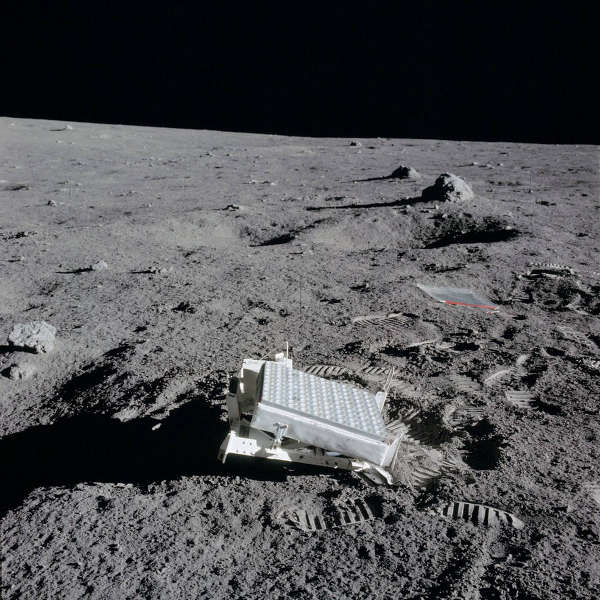
A close-up view, taken on Feb. 5, 1971, of the Laser Ranging Retro-Reflector (LR3), which the Apollo 14 astronauts deployed on the Moon during their lunar surface extravehicular activity. Credits: NASA.
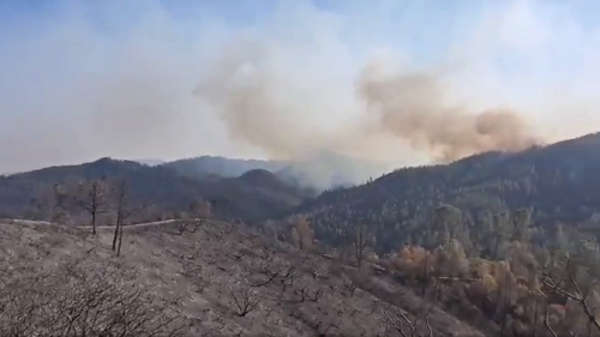
The Glass fire as seen from the Oat Hill area in northern Napa County, California, on Saturday, October 3, 2020. Photo courtesy of Angela Carter. NORTHERN CALIFORNIA – Cal Fire said Saturday that it’s making progress against the destructive Glass fire, but a red flag warning in effect through Sunday morning could create challenging conditions for firefighters.
The more than 2,600 firefighters assigned to the Glass five have continued to prevent it from the kind of explosive growth it saw in its earliest day while continuing to strengthen containment numbers.
On Saturday, Cal Fire said the incident was up to 62,360 acres, an increase of just over 2,200 acres since Friday morning. Containment on Saturday was reported to be 10 percent, an increase of 4 percent over the previous 24 hours.
It continues to threaten 28,835 structures, Cal Fire said.
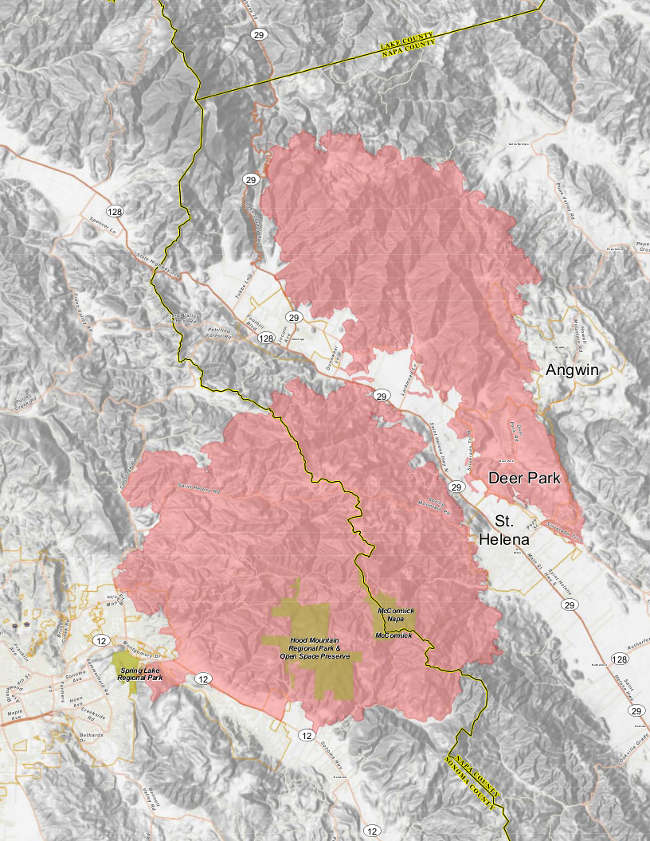
The incident continues to burn in Napa and Sonoma counties. However, the latest mapping released by Cal Fire on Saturday showed the fire is burning about two miles south of the Lake and Napa County line.
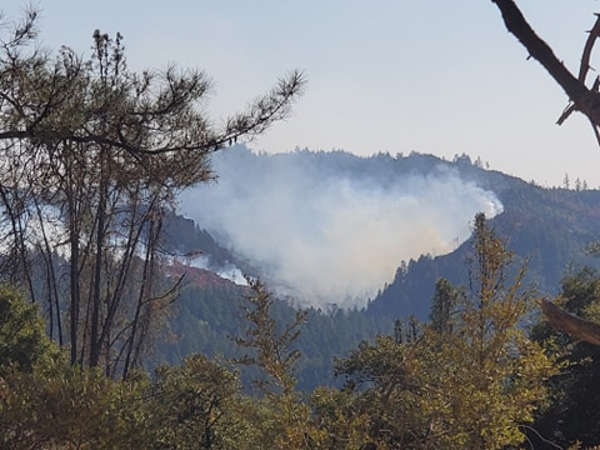
The Glass fire as seen from above Calistoga Ranch in northern Napa County, California, on Saturday, October 3, 2020. Photo courtesy of Angela Carter.
Cal Fire said Saturday afternoon that Smoke and flames from the Glass fire may be visible from Middletown.
Officials said there are currently no evacuation warnings or evacuation orders for Lake County. However, they added that south county residents are reminded to remain vigilant and be prepared to evacuate in the event that fire activity changes.
Highway 29 south of Middletown, closed earlier this week, remains shut down due to the fire. Caltrans said there is no estimated time of reopening.
A red flag warning is in effect in parts of the fire area through Sunday morning, with reports on Saturday afternoon of winds picking up across the south county.
The red flag warning was issued due to high winds, hot temperatures and low humidity, which can create increased fire danger.
Email Elizabeth Larson at This email address is being protected from spambots. You need JavaScript enabled to view it.. Follow her on Twitter, @ERLarson, or Lake County News, @LakeCoNews.
The Glass fire as mapped by Cal Fire on Saturday, October 3, 2020.
Mark Greydon Tolson, 44, of Hidden Valley Lake, California, was arrested on Wednesday, September 30, 2020, for oral copulation and sexual battery. Lake County Jail photo. LAKE COUNTY, Calif. – The Lake County Sheriff’s Office said it has arrested a Hidden Valley Lake man for sexually assaulting an 18-year-old woman to whom he provided alcohol during a party at his home this summer.
Mark Greydon Tolson, 44, was arrested on Wednesday, Lt. Corey Paulich said.
On July 16, the female victim contacted the Lake County Sheriff’s Office and reported she had been sexually assaulted by Tolson, Paulich said.
Paulich said the victim reported that on July 15 Tolson provided alcohol to her and other adults under age 21 at his residence. The victim reported that later in the night she woke up to Tolson sexually assaulting her.
Sheriff’s Major Crimes Unit detectives continued the investigation. On Wednesday, detectives served a search warrant at Tolson’s residence, Paulich said.
Tolson subsequently was arrested on charges of oral copulation and sexual battery and transported to the Lake County Jail, where he was booked on the charges. Paulich said Tolson later was released after posting bail.
The Sheriff’s Office asks anyone who may have further information regarding Tolson to please contact Det. Jeff Mora at 707-262-4224 or by email at This email address is being protected from spambots. You need JavaScript enabled to view it..
 How to resolve AdBlock issue?