 How to resolve AdBlock issue?
News
LAKE COUNTY, Calif. – A second COVID-19 outbreak in a skilled nursing facility in Lakeport has resulted in the county’s 13th death related to the virus, while the county’s Public Health officer also reported more than two dozen new confirmed cases across the county.
On Friday, Lake County Public Health Officer Dr. Gary Pace reported that 28 new cases of COVID-19 had been reported countywide, bringing the total to 628.
That’s the second-largest single-day increase in cases reported in Lake County since cases began to be confirmed locally in April, based on a review of data publicly reported by Lake County Public Health.
Pace said late this week Public Health also received word of the county’s 13th COVID-19-related death.
“The individual was over 65 years old and had longstanding health issues,” he said.
This most recent death is connected to an outbreak at a second skilled nursing facility where there are 27 residents who have been infected along with nine staff, Pace said.
Pace did not name the facility, but the California Department of Public Health’s COVID-19 dashboard for skilled nursing facilities indicated the second facility is Rocky Point Care Center in Lakeport.
A previous outbreak at Lakeport Post Acute resulted in 37 residents getting the virus and 22 staff, with seven residents dying, according to state and local reports.
That initial outbreak, along with community spread, coincided with – and contributed to – a surge in new cases in Lake County, peaking at 78 during the week of Sept. 13 to 19. Pace said evacuations from the LNU Complex fires and Labor Day weekend activities were additional complicating factors.
Pace said the outbreak at Lakeport Post Acute is now under control, with no new cases in 10 days.
Meadowood Nursing Center in Clearlake has no reported cases in residents, and less than 11 in health care workers, the state reported.
On Friday, CDPH said 26,456 residents of California’s 1,223 skilled nursing facilities had tested positive for COVID-19 and 4,557 had died, while 19,989 health care workers in those facilities had contracted the virus, with 152 of them dying.
Statewide, county Public Health departments reported more than 849,000 total cases and just over 16,500 deaths due to COVID-19 as of Friday night.
The state said local health departments have reported 40,758 positive cases in health care workers and 191 deaths statewide.
As of Friday, 15,736,497 tests have been conducted in California, an increase of 112,874 over the prior 24-hour reporting period, the state said.
Pace said it’s predicted that COVID-19 infections will increase in the coming months, due to flu season, colder weather and indoor activities. He is urging community members to get flu shots.
As for when a COVID-19 vaccine would realistically be available, Pace said, “Likely after the first of the year.”
He added, “Initial supplies will be limited, and probably directed to hospital workers and others at highest risk.”
Once supplies increase – possibly in early spring – the vaccine will start to reach the general public, Pace said.
“There is great hope for some sort of normalcy by summertime 2021; the promise of a vaccine is driving those hopes,” he said.
Email Elizabeth Larson atThis email address is being protected from spambots. You need JavaScript enabled to view it. . Follow her on Twitter, @ERLarson, or Lake County News, @LakeCoNews.
On Friday, Lake County Public Health Officer Dr. Gary Pace reported that 28 new cases of COVID-19 had been reported countywide, bringing the total to 628.
That’s the second-largest single-day increase in cases reported in Lake County since cases began to be confirmed locally in April, based on a review of data publicly reported by Lake County Public Health.
Pace said late this week Public Health also received word of the county’s 13th COVID-19-related death.
“The individual was over 65 years old and had longstanding health issues,” he said.
This most recent death is connected to an outbreak at a second skilled nursing facility where there are 27 residents who have been infected along with nine staff, Pace said.
Pace did not name the facility, but the California Department of Public Health’s COVID-19 dashboard for skilled nursing facilities indicated the second facility is Rocky Point Care Center in Lakeport.
A previous outbreak at Lakeport Post Acute resulted in 37 residents getting the virus and 22 staff, with seven residents dying, according to state and local reports.
That initial outbreak, along with community spread, coincided with – and contributed to – a surge in new cases in Lake County, peaking at 78 during the week of Sept. 13 to 19. Pace said evacuations from the LNU Complex fires and Labor Day weekend activities were additional complicating factors.
Pace said the outbreak at Lakeport Post Acute is now under control, with no new cases in 10 days.
Meadowood Nursing Center in Clearlake has no reported cases in residents, and less than 11 in health care workers, the state reported.
On Friday, CDPH said 26,456 residents of California’s 1,223 skilled nursing facilities had tested positive for COVID-19 and 4,557 had died, while 19,989 health care workers in those facilities had contracted the virus, with 152 of them dying.
Statewide, county Public Health departments reported more than 849,000 total cases and just over 16,500 deaths due to COVID-19 as of Friday night.
The state said local health departments have reported 40,758 positive cases in health care workers and 191 deaths statewide.
As of Friday, 15,736,497 tests have been conducted in California, an increase of 112,874 over the prior 24-hour reporting period, the state said.
Pace said it’s predicted that COVID-19 infections will increase in the coming months, due to flu season, colder weather and indoor activities. He is urging community members to get flu shots.
As for when a COVID-19 vaccine would realistically be available, Pace said, “Likely after the first of the year.”
He added, “Initial supplies will be limited, and probably directed to hospital workers and others at highest risk.”
Once supplies increase – possibly in early spring – the vaccine will start to reach the general public, Pace said.
“There is great hope for some sort of normalcy by summertime 2021; the promise of a vaccine is driving those hopes,” he said.
Email Elizabeth Larson at
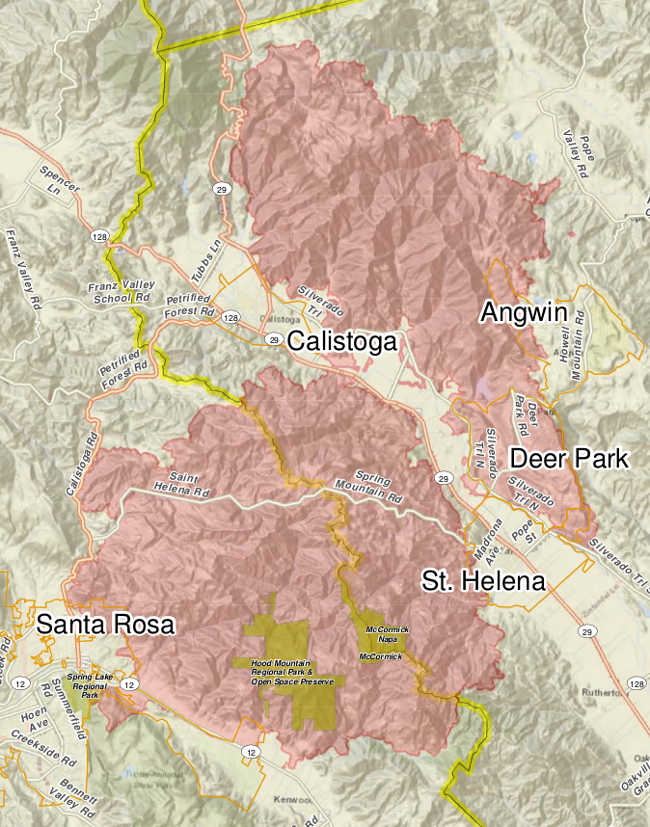
NORTHERN CALIFORNIA – The growth of the Glass fire has stopped while cooler conditions are helping firefighters on the massive August Complex to continue to increase containment.
Cal Fire said the Glass fire remained at 67,484 acres on Friday night, marking the first day of no growth on the incident since it began on Sept. 27 in Napa and Sonoma counties.
Containment also grew several percentage points to 78 percent, Cal Fire said.
Officials said activity on the fire line on Friday was limited to scattered heat signatures and isolated smoldering heavy fuels across the fire area.
With conditions improving, on Friday the evacuation warnings for two areas south of Middletown in Lake County were lifted and a portion of Highway 29 from Middletown to Tubbs Lane was reopened.
Resources continue to be reduced on the fire. On Friday evening, 1,437 personnel remained assigned to the fire, along with 162 engines, 20 water tenders, 10 helicopters, 23 hand crews, 11 dozers and two masticators, Cal Fire reported.
On Friday night, Cal Fire said 2,560 structures remained threatened by the fire.
Cal Fire said the damage inspection has been completed. The final assessment showed that 638 structures have been destroyed in Sonoma County, including 334 single-family homes, while 917 buildings have been destroyed in Napa County, with 308 of them being homes. In addition, 132 structures were damaged in Sonoma County and 150 in Napa County.
Cal Fire continues to anticipate the fire will be fully contained on Oct. 20.
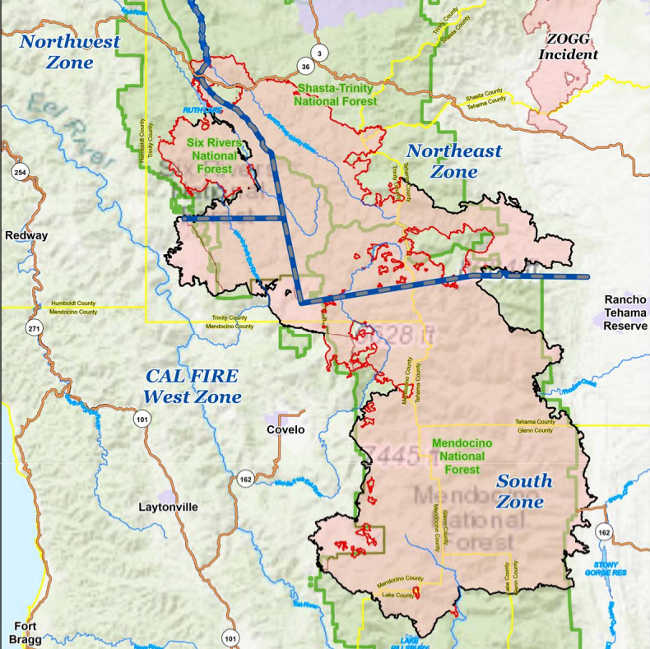
New team takes over August Complex South Zone
On Friday, the Southwest Area Type 1 Incident Management Team No. 1 assumed command of the August Complex South Zone, one of four zones on the complex. The other zones are the Northwest, Northeast and West.
The complex was up to 1,023,629 acres and 67-percent containment on Friday night, Cal Fire said. Approximately 4,524 personnel are assigned.
The US Forest Service said that on Thursday, a helicopter dropped water to support dozers and ground crews as they continued to secure the perimeter and mop-up around a 300-acre slop-over northeast of Lake Pillsbury, over the M6 Road near Bloody Rock.
Cooler temperatures and increased humidity are helping reduce fire activity, officials said. Pockets of heat within the fire’s perimeter are expected to continue to smolder. Firefighters will continue to mop up, monitor and patrol along the firelines.
The Forest Service said firefighters are currently assessing suppression repair needs. Suppression repair is a series of immediate post-fire actions taken to repair damages and minimize potential soil erosion and impacts resulting from fire suppression activities.
This work repairs the hand and dozer fire lines, roads, trails, staging areas, safety zones, and drop points used during fire suppression efforts.
For more information on the three phases of wildfire recovery visit this page.
Officials said the No. 1 priority remains firefighter and public safety. They asked that weekend travelers please be cautious while traveling on roads and highways as firefighters and equipment are working in the area.
The August Complex is expected to be fully contained Nov. 15, the Forest Service reported.
Email Elizabeth Larson at
NORTHERN CALIFORNIA – The Yuba Community College District is reporting on its efforts to use renewable energy on its campuses.
The district said it has installed 4 megawatts of solar power and roughly half a megawatt of battery energy storage across five sites since 2012.
Installations include single-axis tracking systems in fields that track the sun throughout the day as well as fixed-tilt carports that provide shade in parking lots.
In fiscal year 2020, the district consumed 6,583,671 kWh of electricity with 92 percent of that total generated by the district’s solar projects.
The last system was commissioned in April 2020 and the district will now generate more than 100 percent of its overall electricity needs from the onsite solar projects.
Generating 100 percent of the annual electricity consumption means the Yuba Community College District is net-zero in its energy consumption.
The district said it has taken a proactive role managing and analyzing the systems and continues to work in partnership with the energy consulting firm ARC Alternatives to help understand the technical and financial performance of the systems.
Through the implementation of ARC Alternative’s Energy Performance Management service, the district is actively tracking each system’s performance, proactively working with operations and maintenance vendors to maximize energy production and receives regular reporting of the realized financial benefits of the solar projects.
“The YCCD Governing Board and leadership is committed to reducing our campuses’ carbon footprint for our students and our communities. Achieving ‘net zero’ with these solar and energy storage projects is not only environmentally responsible, it will continue to result in substantial financial benefit and lowered operating costs so that we can redirect those savings into programs and our students,” said Chancellor Dr. Douglas Houston. “Additionally, YCCD’s use of Clean Renewable Energy Bonds to finance these projects allows the District to apply General Obligation Bonds funds such as Measures J and Q to other important and needed facilities projects that directly impact student success.”
Over the entire life of the solar and storage projects, by the year 2040, it is anticipated that the district see a cumulative net benefit of approximately $19 million assuming an annual utility escalation rate of 3.5 percent.
The district’s leadership commitment to sustainability and investments in renewable energy have positioned the Yuba Community College District to be less reliant on continually escalating and expensive traditional power sources.
These direct investments in on-site renewable generation will continue to generate significant financial savings on utility costs and ultimately result in a positive net benefit to the district with reduced operating costs, officials said.
District officials said they recognize the positive environmental impacts from renewable energy sources and are proud to have taken a large step forward in reducing its carbon footprint.
According to the Environmental Protection Agency’s “Greenhouse Gas Equivalencies” calculation tool the district’s renewable energy projects will avoid roughly 4,500 metric tons of carbon dioxide from traditional power sources.
This is the equivalent greenhouse gas and carbon dioxide emissions from approximately:
– 900 passenger vehicles driven for one year;
– 500,000 gallons of gasoline consumed;
– 700 homes’ electricity use for one year.
The Yuba Community College District spans eight counties and nearly 4,192 square miles of territory in rural, north-central California. Yuba College and Woodland Community College, offer degrees, certificates, and transfer curricula at college campuses in Marysville and Woodland, educational centers in Clearlake and Yuba City, and through outreach operations in Williams and on Beale Air Force Base. The two colleges in Yolo County and Yuba County and the campuses in Clearlake, Colusa and Sutter counties, serve 13,000 students across the northern Sacramento Valley.
The district said it has installed 4 megawatts of solar power and roughly half a megawatt of battery energy storage across five sites since 2012.
Installations include single-axis tracking systems in fields that track the sun throughout the day as well as fixed-tilt carports that provide shade in parking lots.
In fiscal year 2020, the district consumed 6,583,671 kWh of electricity with 92 percent of that total generated by the district’s solar projects.
The last system was commissioned in April 2020 and the district will now generate more than 100 percent of its overall electricity needs from the onsite solar projects.
Generating 100 percent of the annual electricity consumption means the Yuba Community College District is net-zero in its energy consumption.
The district said it has taken a proactive role managing and analyzing the systems and continues to work in partnership with the energy consulting firm ARC Alternatives to help understand the technical and financial performance of the systems.
Through the implementation of ARC Alternative’s Energy Performance Management service, the district is actively tracking each system’s performance, proactively working with operations and maintenance vendors to maximize energy production and receives regular reporting of the realized financial benefits of the solar projects.
“The YCCD Governing Board and leadership is committed to reducing our campuses’ carbon footprint for our students and our communities. Achieving ‘net zero’ with these solar and energy storage projects is not only environmentally responsible, it will continue to result in substantial financial benefit and lowered operating costs so that we can redirect those savings into programs and our students,” said Chancellor Dr. Douglas Houston. “Additionally, YCCD’s use of Clean Renewable Energy Bonds to finance these projects allows the District to apply General Obligation Bonds funds such as Measures J and Q to other important and needed facilities projects that directly impact student success.”
Over the entire life of the solar and storage projects, by the year 2040, it is anticipated that the district see a cumulative net benefit of approximately $19 million assuming an annual utility escalation rate of 3.5 percent.
The district’s leadership commitment to sustainability and investments in renewable energy have positioned the Yuba Community College District to be less reliant on continually escalating and expensive traditional power sources.
These direct investments in on-site renewable generation will continue to generate significant financial savings on utility costs and ultimately result in a positive net benefit to the district with reduced operating costs, officials said.
District officials said they recognize the positive environmental impacts from renewable energy sources and are proud to have taken a large step forward in reducing its carbon footprint.
According to the Environmental Protection Agency’s “Greenhouse Gas Equivalencies” calculation tool the district’s renewable energy projects will avoid roughly 4,500 metric tons of carbon dioxide from traditional power sources.
This is the equivalent greenhouse gas and carbon dioxide emissions from approximately:
– 900 passenger vehicles driven for one year;
– 500,000 gallons of gasoline consumed;
– 700 homes’ electricity use for one year.
The Yuba Community College District spans eight counties and nearly 4,192 square miles of territory in rural, north-central California. Yuba College and Woodland Community College, offer degrees, certificates, and transfer curricula at college campuses in Marysville and Woodland, educational centers in Clearlake and Yuba City, and through outreach operations in Williams and on Beale Air Force Base. The two colleges in Yolo County and Yuba County and the campuses in Clearlake, Colusa and Sutter counties, serve 13,000 students across the northern Sacramento Valley.
What is the legal remedy when one person tortiously (wrongfully) interferes with another person’s estate planning so that an intended beneficiary receives either no or a lesser inheritance?
Since 2012 California has recognized the tort [i.e., a civil wrongdoing] of “Intentional Interference with Expected Inheritance” (Beckwith v. Dahl (2012) 205 Cal.App.4th 1039, 1050-1056.).
This tort applies when someone, “ ‘… by fraud, duress or other tortious means intentionally prevents another from receiving from a third person an inheritance or gift that he [or she] would otherwise have received is subject to liability to the other for loss of the inheritance or gift.’ ” (Beckwith v. Dahl, supra, 205 Cal.App.4th at p. 1050.)
On Sept. 22, 2020, the California’s Third Appellate Department (Shasta) issued its appellate opinion in Louise A. Gomez v. Tammy J. Smith involving the Estate of Frank Gomez (deceased).
The decedent Frank Gomez’s daughter Tammy Smith had prevented him from seeing his own attorney to review and sign a new trust in his deathbed. Smith did not want her father to leave his new wife Louise Gomez a life estate in the father’s residence; it would have delayed Smith’s own inheritance until Louise Gomez died. After Frank Gomez died, his wife Louise sued his daughter.
To win, Louise Gomez had to prove each of these six elements: (1) That she had an expectancy of an inheritance; (2) that the bequest or devise would have been in effect at the time of the death of the testator if there had been no such interference; (3) that the defendant had knowledge of the plaintiff’s expectancy of inheritance and took deliberate action to interfere with it; (4) that the interference involved underlying conduct that was itself wrong other than the fact of the interference; (5) that the interference resulted in damages (i.e., no or a lesser inheritance); (6) that the interference was directed at someone (Frank Gomez) other than the plaintiff (Louise Gomez).
Deciding the case involved a detailed facts and circumstances analysis. Three of the six elements are easy to understand, but the second, third, and fourth elements deserve discussion.
That is, Louise Gomez proved the second element because the bequest would have been in effect because had Tammy Smith not prevented Frank Gomez’s attorney from seeing him at his deathbed then Frank Gomez would have signed a new trust giving Louise Gomez lifetime benefits. Smith would then have had to prove that Frank Gomez lacked capacity or was subject to undue influence to overcome the presumption of the trust’s validity.
Next, Louise Gomez proved the third element because Smith knew her father’s intention to take care of his wife and Smith deliberately interfered by preventing Frank Gomez’s attorney from entering into the residence to have him sign the documents.
Lastly, let’s discuss the fourth element that the underlying conduct was wrong in itself. The court’s opinion said that, “[t]he usual case is that in which the third person has been induced to make or not to make a bequest or a gift by fraud, duress, defamation or tortious abuse of fiduciary duty, or has forged, altered or suppressed a will or a document making a gift. Thus one who by legitimate means merely persuades a person to disinherit a child and to leave the estate to the persuader instead is not liable to the child.” (Rest.2d Torts, § 774B, com. c, pp. 58-59.)
Here the court found that, “Tammy indisputably ‘knew of [Frank’s] physical weakness and distress and took actions whereby [she] physically separated [his] attorney from [him] intentionally preventing [Frank] from confirming an estate plan that he had been trying to put in place for months.’ Frank’s will was overborne by Tammy because he was bedridden and unable to intervene when Tammy precluded [Frank’s attorney] Aanestad from entering the home.”
Deathbed estate planning is fraught with risk. It becomes even riskier with deep family divisions that sometimes exist in second marriages between stepchildren and stepparents. It is even more important not to wait to get one’s affairs in order.
Dennis A. Fordham, attorney, is a State Bar-Certified Specialist in estate planning, probate and trust law. His office is at 870 S. Main St., Lakeport, California. He can be reached at
Americans exercise their right to vote from all over the world, and for November’s election, few ballots will have traveled as far as those cast by NASA astronauts living and working aboard the International Space Station.
During earlier days of human spaceflight, astronauts would only visit space for days, or maybe weeks, at a time.
Today, astronauts typically stay in space for six-month missions on the space station, increasing the odds of a spacefarer off the planet during an election. So how does one vote from space?
How it works
Like other forms of absentee voting, voting from space starts with a Federal Postcard Application, or FPCA. It’s the same form military members and their families fill out while serving outside of the U.S.
By completing it ahead of their launch, space station crew members signal their intent to participate in an election from space.
Because astronauts move to Houston for their training, most opt to vote as Texas residents. Of course, NASA’s astronauts come from all over, so those wishing to vote as residents of their home states can work with their counties to make special arrangements to vote from space.
Once their FPCA is approved, the astronaut is almost ready to vote. Like many great things in space, voting starts with an experiment. The county clerk who manages elections in the astronaut’s home county sends a test ballot to a team at NASA’s Johnson Space Center in Houston.
Then they use a space station training computer to test whether they’re able to fill it out and send it back to the county clerk.
After a successful test, a secure electronic ballot generated by the Clerk’s office of Harris County and surrounding counties in Texas is uplinked by Johnson’s Mission Control Center to the voting crew member. An email with crew member-specific credentials is sent from the County Clerk to the astronaut. These credentials allow the crew member to access the secure ballot.
The astronaut will then cast their vote, and the secure, completed ballot is downlinked and delivered back to the County Clerk’s Office by email to be officially recorded. The clerk has their own password to ensure they are the only one who can open the ballot.
It’s a quick process, and the astronaut must be sure to submit it by 7 p.m. local time on Election Day if voting as a Texas resident.
Will astronauts vote in this election?
Expedition 63/64 crew member Kate Rubins is assigned to a six-month mission launching Oct. 14, and will vote from space. It won’t be her first time – Rubins also cast her vote from the International Space Station during the 2016 election.
With a SpaceX Crew Dragon scheduled to carry three additional U.S. crew members to the space station on Oct. 31 as part of the Crew-1 mission, Mike Hopkins, Victor Glover and Shannon Walker will make it to the space station just in time to cast their ballots there, as well. All three have filled out the paperwork and are ready to do so.
Voting in space has been possible since 1997 when a bill passed to legally allow voting from space in Texas.
Since then, several NASA astronauts have exercised this civic duty from orbit. As NASA works toward sending astronauts to the Moon in 2024 and eventually on to Mars, the agency plans to continue to ensure astronauts who want to vote in space are able to, no matter where in the solar system they may be.
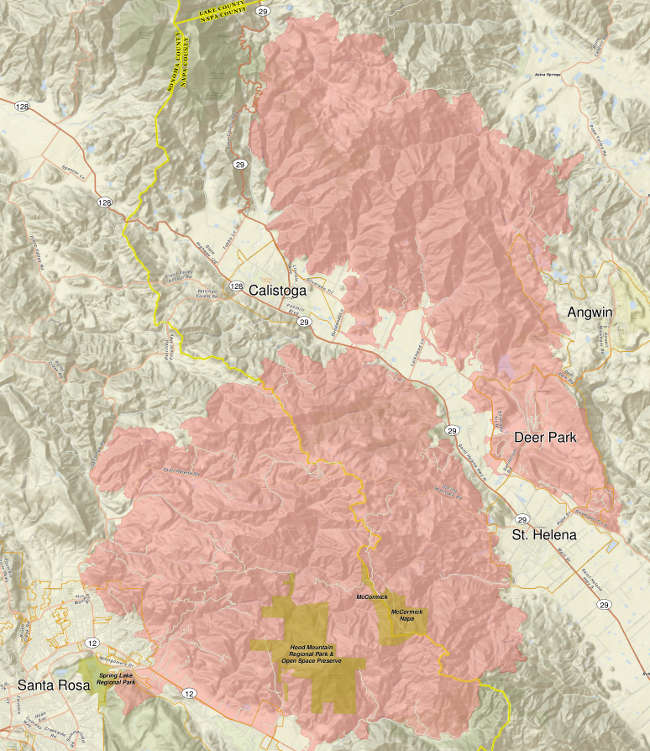
LAKE COUNTY, Calif. – As firefighters continue to push the Glass fire in Napa and Sonoma counties closer to full containment, on Friday evacuation warnings for areas south of Middletown in Lake County were lifted and a stretch of Highway 29 in the fire area was reopened.
Cal Fire said the Glass fire remained at 67,484 acres on Friday, having shown no growth overnight, with containment up by 4 percent to 74 percent.
At 3 p.m. Friday, the Lake County Sheriff’s Office issued an update reporting that, in conjunction with the Glass Fire Incident Management Team, it had rescinded the evacuation warnings for two areas south of Middletown at the Lake-Napa County line.
Those specifically are:
– South of Rancheria Road, east of the Lake-Sonoma County line, north of the Lake-Napa County line and west of Highway 29; and
– South of Mirabel Road, east of Highway 29, north of the Lake-Napa County line, and west of McGuire and Three Peaks ridgeline.
The evacuation warnings for those areas had been issued on Oct. 4 due to the Glass fire approaching Lake County.
The most recent mapping of the fire shows it is less than a mile from the south county border.
Also on Friday, officials said Highway 29 from Bradford Road near Middletown to Tubbs Lane in Napa County has been reopened. It also had been closed due to the fire’s close proximity.
Officials reminded the public to stay vigilant on current fire conditions.
They asked people to drive slowly and yield to emergency personnel in the area.
There also will be smoke in the area as firefighters continue firefighting operations, the sheriff’s office reported.
Email Elizabeth Larson at