 How to resolve AdBlock issue?
News

LAKE COUNTY, Calif. – Here’s a nice Dr. Feelgood read for you. We have quite yet another star in the Lake County constellation.
She is a singer/songwriter who went on the road with Dick Clark’s Rock & Roll Road Show. Her first record was produced by Sly Stone. She worked her way up the ranks of Ike & Tina Turner’s review as an Ikette. Tina Turner mentions her in her acclaimed biography.
She signed with Barry White’s Soul Unlimited label and has recorded an album produced by him.
With an underground following in Europe since one of her recordings was re-released in London, she had played the acclaimed Baltic Soul Weekender for 14 consecutive years until the dread COVID-19 stopped that festival in its tracks this year
Gloria Scott lives in Nice, California, and is still making music. She recently shared her story with Lake County News.
Of course, the first question was how did she come to land in Lake County?
“I lived and entertained in Guam for a while. I became good friends with Dianne, wife of the bass player, George Rawls, in the band I was singing in. We stayed in touch and a couple of years ago I was looking for a place and Dianne started helping me look. Suddenly, her rental property became available and that’s where I’m staying now. Dianne is one of my best friends,” Scott explained.
Like Janis Joplin, Gloria Scott was born in Port Arthur, Texas. At 9 months of age, she was moved to Houston where her first musical memories of being in church happened.
“My mom was very musical,” she said. “As a matter of fact, we’d have to go to church all day long. I would fall asleep and hear my mother sing and wake up. When she would finish singing, I would fall back to sleep. Later in life, she told me she once sang on a Gospel show with Sam Cooke & the Soul Stirrers. But she decided to have a family and married very young. So her work with Sam Cooke was before she was married.”
The piano lessons the young Gloria started at the age of 10 were curtailed early on when they became too expensive for the household.

“I did learn a little bit though, and later on started teaching myself chords. So that’s how I started writing songs. I still dabble a little bit. In fact, I currently play for a little church in Lucerne,” she said.
Gloria and her family moved to California in 1960, initially East Palo Alto then Sunnyvale. It was in Sunnyvale where she met Sly Stone.
“The first time I saw him was through my aunt when we first moved to East Palo Alto,” Scott said. “We stayed with her until we found our own place. My aunt, Centranella Boulding, had a rehearsal of her Gospel group at her place. The group consisted of Sly, his sister Rose, their cousin, and my Aunt Centranella. I was 14 years old at the time. The next time I saw Sly was at a school dance during summer school. Sly and his group at the time, The Mojo Men, were playing. My friend got Sly’s attention, pointed to me and told him, ‘She can sing.’
“‘Well, come on up here and sing then,’ he said. So I got up there and sang Gee Whiz. I must’ve impressed him because he started taking me around to sing at their gigs in the Bay Area. I don’t know that I put two and two together about the first time we met or not. It became clearer later,” she said.
“Sly became the first person to take me into the studio and produce me when I recorded ‘I Taught Him’ and ‘Don’t Say I Didn’t Warn You’ as Gloria Scott & the Tonettes. When we played one of many Rock & Roll shows at the Cow Palace, the Tonettes were Sly, his Sister Rose, and their cousin La Tonya. I met Marvin Gaye and Betty Everett at the Cow Palace show. When San Francisco-based Bobby Freeman, who was also being produced by Sly, heard ‘Don’t Say I Didn’t Warn You,’ he told Sly, ‘I want you to write me a song like that.’ That’s when they came up with ‘The Swim.’ Bobby Freeman was a gifted singer and performer. We shared the bill at many dances and sock hops during that time. Sly looked out for me and didn’t want anybody messin’ with me,” Scott said.
After working with Sly Stone, and other Bay Area artists including John Turk and Clifford Coulter, Scott worked jobs and sang at night and on weekends.
“Eventually, I met Charles Sullivan, whose nickname was the ‘Mayor of Fillmore.’ He was the most successful independent booking agent on the West Coast. He had the lease on the Fillmore Auditorium before Bill Graham. He heard me sing and told me that he wanted to introduce me to some people. One night I got a call from him asking me to come down to the Fillmore Auditorium. When I got there, I auditioned for Ike & Tina Turner. They hired me and took me to L.A. immediately,” Scott said.
“I worked with them for about nine months. It was really a good experience despite my not having the stomach for Ike Turner’s shenanigans. I think he was kind of demonic, actually. I can probably tell some stories that have never been told,” she explained.
“I didn’t start working with them right away. I hung around for a few weeks and said, ‘I wanna go home.’ I wasn’t on the show. I was only singing at auditions which Ike Turner held frequently. I went back to the Bay Area and got another call from Ike who wanted to send me and another group of women as the Ikettes out on a Dick Clark Tour. Ike had four or five sets of Ikettes of which I was in one set. I remember Ike and Tina came to our show after I had moved back to the Bay Area. Later, when I moved to L.A. again, Ike came over one day and said, ‘You wanna be an Ikette?’ And with as much excitement as I could muster I replied, ‘Yes, I wanna be an Ikette!’ What happened was the girls on the Dick Clark tour were making more money than the real Ikettes which made them so mad they quit,” Scott recalled.

“Tina really liked me and eventually she let me sing lead on most of the Ikettes songs because I had found the other girls. She even mentions me in her book. I had my own place when I worked with them, but before I was an Ikette, I stayed at their house. My mom had a café in the Bay Area and I took Tina there when we played the Bay. As an Ikette I did a lot of gigs. We were always going somewhere. The final straw for me came when we missed the bus when we were flying to Houston. Ike said, we would have to fly ourselves and be fined one night’s pay. We already weren’t making much money and I said, ‘If he fines me, I’m gonna quit,’” she said.
“I remember Tina recounting to me that she said to Ike, ‘Gloria said if you fine them, she’s going to quit.’ Ike’s response was, ‘Let the bitch quit then.’ And that’s just what I did. I went back to the Bay Area and worked in retail. A friend of mine convinced me to move back to Southern California. I met my songwriting partner, Herman Chaney, in L.A. and after we wrote a few songs, I got a gig doing entertainment for the Job Corps.
“As I went on the road, Herman said he wanted to introduce me to this guy who was interested in a song of ours. We did about 60 shows in 30 days. When I got back home we went right down to Soul Unlimited on Sunset Boulevard. I met Barry White there and played my songs for him and right then and there he said, ‘I’m gonna sign you as an artist. He signed me to a seven-year artist’s contract.
“And though we didn’t do any of my songs, he did put a lot of arranging and orchestration work on the album he produced and arranged for me which was called, ‘What Am I Gonna Do.’ It made a big splash in Germany though it didn’t do so much here. It was on the Casablanca record label. It was only the second album they ever released. The first was by the shock rockers, Kiss. I was at Casablanca before Donna Summer and the P-Funk group Parliament.
“While I was under contract to Barry White, he kind of left me on the shelf. I was working with this guy at Motown and he introduced me to Mary Wilson of the Supremes. I auditioned for her show and she said, ‘Well, we like your singing but you have to lose some weight because we can’t afford to buy more gowns.’ So, I lost about 30 pounds and worked with her about two years; recording and performing. Interestingly, Barry frowned on me working in clubs.
“Meanwhile though, they were playing my album in Europe and I didn’t know. Years passed before I found out. I was living and working in Guam and I met the owner of a club called the Underground and he said, ‘Your name sounds familiar.’ The next time I saw him he had printed out a list of songs that were charting in London and a single of mine titled ‘A Case of Too Much Lovemakin’ from the ‘What Am I Gonna Do’ album had been re-released,” Scott said.
Before COVID-19, Scott had been singing at various music events in Lake County, sitting in with top-shelf locals like Rob Watson and Howard Reggie Dawkins.
“I’m still hoping to get booked at the casinos if the restrictions on live performing ever get lifted,” she said. “Meanwhile, I’m staying busy by creating a line of designer face masks which people have expressed an interest in.”
For booking, Ms. Gloria Scott can be reached at
T. Watts is a music journalist who lives in Lake County, California.


LAKE COUNTY, Calif. – Who knew that ants were such fascinating creatures?
I enjoyed a Zoom talk hosted by the Santa Clara Valley Open Space Authority's Merav Vonstak, PhD recently, who related that there are 12,000 to 15,000 ant species worldwide.
When I think of the masses of ants that had silently invaded my home during an extended vacation years ago, it looked as if every one of the 15,000 ant species had congregated in my kitchen!
They had chosen a houseplant as their home base where their ant excavations were taking place in the planter's soil. Needless to say, that plant now lives far away from the kitchen!
Dr. Vonstak pointed the Zoom class towards an ant data website called www.antmaps.org.
If you hover the cursor over California it shows that we have 281 native ant species in our state; and by moving the cursor “around the world” it gives you an idea of the diversity of ant critters worldwide.
Ants are highly organized in their social structure, or “eusocial.” They display cooperative brood care and they have an organized division of labor where some ants “empty the trash” that may have accumulated in the nest, while some ants are fighters and will defend their domain.
The life cycle of the ant includes egg, larva, pupa then adult metamorphosis. Each colony contains at least one queen who is distinguished by her large eyes and large thorax and abdomen.
The queen may live up to two years unless it's a harvester or carpenter ant, then she may reach the ripe old age of 30 years. Male ants also possess large eyes which enable him to find a mate.
Worker ants are sterile; they cannot lay eggs. The workers, who may live only weeks, vary in size since there are minors, medians and majors.
Most ant species are omnivores, however, some species specialize, and prefer fruit, nectar or seeds. Some ant species are a boon to the garden as they dine on pesky aphids.
If you want to sneak a peek at ant life, they can easily be found in most habitats, nesting under rocks or downed tree limbs.
Harvester ants will be busily gathering seeds near grasslands, while big carpenter ants live inside decomposing logs or in dead trees.
The ants around my deck will want to watch out for fence lizards that I've seen gobbling them up like Pacman!
Kathleen Scavone, M.A., is a retired educator, potter, freelance writer and author of “Anderson Marsh State Historic Park: A Walking History, Prehistory, Flora, and Fauna Tour of a California State Park” and “Native Americans of Lake County.”
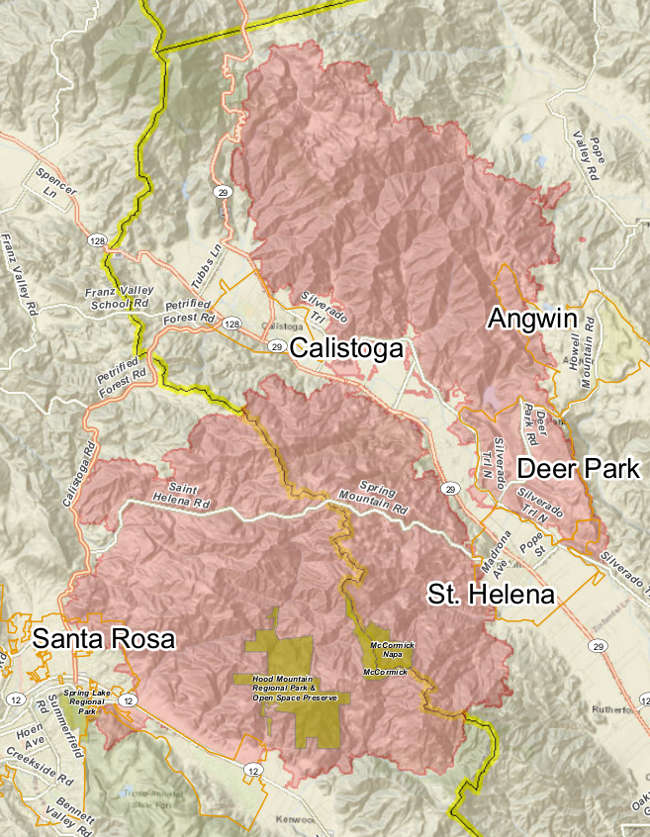
NORTHERN CALIFORNIA – Firefighters on the Glass fire had another day of significant containment gains on Saturday while the August Complex continued to add more acreage.
Cal Fire said the Glass fire, burning for two weeks in Napa and Sonoma counties, stayed at 67,484 acres for the second day, with containment up to 86 percent by Saturday night.
The fire has destroyed 1,555 structures and damaged 282 others, Cal Fire said.
Officials said the fire continues to threaten 2,560 structures.
On Saturday there was smoldering heavy fuels and minimal activity over the entire Glass fire
Area, Cal Fire said.
The demobilization of resources continues, Cal Fire said, with resources anticipated to be released based on the current fire and weather situation. These measures ensure that the number and type of resources assigned to the incident match the current operational needs.
As a result, Cal Fire said the number of personnel on Saturday was reduced to 1,135, along with 130 engines, 16 water tenders, seven helicopters, 17 hand crews, 11 dozers and two masticators.
The fire remains on track to be fully contained by Oct. 20.
August Complex adds 3,000 more acres
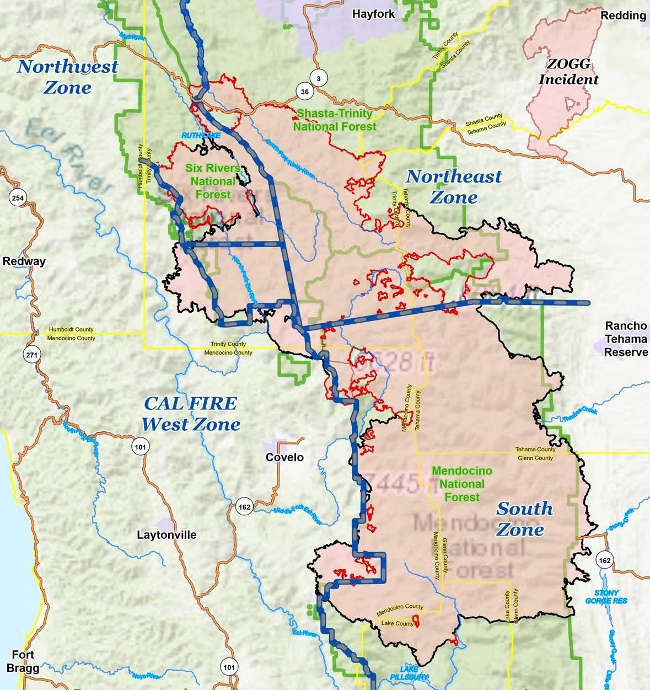
Elsewhere around the region, the August Complex grew by about 3,000 acres to a total of 1,026,947 acres on Saturday night, with containment at 69 percent, the US Forest Service said.
The lightning-caused complex, which began on Aug. 17, is burning on the Mendocino, Shasta-Trinity and Six Rivers National Forests.
The Forest Service said firefighters are continuing mop up along a slopover area northeast of Lake Pillsbury, near Bloody Rock.
On the west side of the South Zone, fire continues to back out of the Yolla Bolly-Middle Eel Wilderness onto Cal Fire Direct Protection Area. The Southwest Area Incident Management Team is engaged in a coordinated and collaborative response with Cal Fire to support suppression actions to protect local communities at risk, officials said.
The Forest Service said firefighters are patrolling the eastern side of the South Zone with aircraft. Fire crews and engines are patrolling the southern and western perimeter of the South Zone.
Minimal fire behavior is expected as cooler temperatures and increased relative humidity continue through the weekend. However, officials said some smoke is expected to remain visible in areas as heavier fuels like logs and stumps continue to hold heat and the fire burns through pockets of previously unburned vegetation within the fire’s perimeter.
Firefighters are evaluating areas across the South Zone to identify and prioritize suppression repair needs. The Forest Service said crews have begun ordering equipment and personnel to support suppression repair efforts in the coming days.
The complex is expected to be fully contained on Nov. 15.
Email Elizabeth Larson at

The battle over the replacement of Justice Ruth Bader Ginsburg has refocused American attention on the future of the Affordable Care Act. The Supreme Court is scheduled to hear oral arguments Nov. 10 in a case seeking to overturn the law that brought insurance coverage to millions of Americans.
Meanwhile, Trump recently released his “America-First Healthcare Plan.” In it, the president claims significant achievements. He also outlines broad principles of his vision for the future of health care in America.
Over the past three years, the Trump administration has taken a number of steps to dismantle pieces of the ACA. And his recently introduced executive order lacks a number of key details and the legal grounds for enacting much of the proposal.
The two factors leave me – a health policy and politics scholar who has closely followed the Affordable Care Act – skeptical about the emergence of a meaningful replacement to the ACA that would expand insurance access should the Supreme Court invalidate the Obama administration’s signature achievement.
Trump’s moves on health care
President Trump campaigned and entered office with the pledge to “repeal and replace” the ACA. In his own words, there would be a “really great HealthCare Plan with far lower premiums (costs) & deductibles” right after the election.
Since 2016, Congress has made little headway besides eliminating the ACA’s penalty for not carrying insurance. This is the basis for the current lawsuit to be heard before the Supreme Court in November. The argument is that because Congress did away with the penalty, the individual mandate can no longer be constitutionally justified as a tax. As a result, the entire law should fall.
While Republicans have been unable to repeal the law, the Trump administration has taken a number of executive actions to limit its reach. In combination, these efforts have contributed to bringing the uninsured rate to 14% by 2019 from a low of 11% in 2016. This leaves millions of Americans without coverage and exposed to medical bills should they fall ill.

One of the major targets of the Trump administration has been reducing enrollment through the ACA’s marketplaces. Here, the administration shortened the periods in which people are allowed to purchase insurance and drastically reduced funding for individuals who help consumers enroll in coverage as well as advertising. It also withheld subsidies to support low-income individuals with out-of-pocket costs, which also caused problems to insurers offering plans to those people.
The administration has also worked to expand alternative insurance plans like so-called short-term, limited-duration health plans and association health plans. While these plans have lower premiums, they do not carry the consumer protections of the ACA like preexisting condition coverage. They also do not pay for prescription drugs or hospital stays. And unlike the ACA, they also require consumers to undergo a medical assessment before enrollment. Consumers may be charged higher premiums or rejected entirely based on their medical condition and age.
Regulations issued by the Trump administration have reduced access to reproductive care for women. The administration has also pushed states to implement work requirements for Medicaid beneficiaries and discourage immigrants from enrolling in Medicaid for fear of being denied permanent residency. As a result, thousands of individuals have become uninsured.
Even on one of the president’s favorite topics, reducing the cost of prescription drugs, numerous initiatives regarding generic drugs, drug importation and capping insulin prices for Medicare beneficiaries have done very little to reduce cost or improve access.
On one of the president’s other priorities, eliminating surprise bills for medical services that patients unexpectedly receive for care that they reasonably thought would be covered by their insurance, the administration’s actions have yet to have a meaningful effect.
Executive order
When it comes to Trump’s executive order, the topic that received the most public attention – the guarantee that “Americans with pre-existing conditions can obtain the insurance of their choice at affordable rates” – carries no legal weight nor clear explanation of how it would be achieved or funded.
[Deep knowledge, daily. Sign up for The Conversation’s newsletter.]
More generally, after years of promising a detailed plan, the America-First Healthcare Plan focuses primarily on past actions. It also spends just 491 words on laying out a set of objectives – lower costs, better care and more choice – yet does not provide a mechanism or road map for how to implement them.
All this leads me to believe that if the ACA is overturned before the Supreme Court, the prospect of substantive replacement that seeks to expand care to more Americans is unlikely.
Simon F. Haeder, Assistant Professor of Public Policy, Pennsylvania State University
This article is republished from The Conversation under a Creative Commons license. Read the original article.
Dogs available for adoption this week include mixes of border collie, Chihuahua, German Shepherd, Great Pyrenees, husky, Labrador Retriever, Papillon and pit bull.
Dogs that are adopted from Lake County Animal Care and Control are either neutered or spayed, microchipped and, if old enough, given a rabies shot and county license before being released to their new owner. License fees do not apply to residents of the cities of Lakeport or Clearlake.
The following dogs at the Lake County Animal Care and Control shelter have been cleared for adoption (additional dogs on the animal control Web site not listed are still “on hold”).
Call Lake County Animal Care and Control at 707-263-0278 or visit the shelter online at http://www.co.lake.ca.us/Government/Directory/Animal_Care_And_Control.htm for information on visiting or adopting.

Female Labrador Retriever
This female Labrador Retriever has a short black coat with white markings.
She is in kennel No. 8, ID No. 14073.

Male Chihuahua
This male Chihuahua has a short tan coat.
He is in kennel No. 11, ID No. 14094.

Male Papillon-Chihuahua
This male Papillon-Chihuahua mix has a medium-length tan and white coat.
He is in kennel No. 19, ID No. 14084.

German Shepherd Dog-Labrador Retriever mix
This young male German Shepherd Dog-Labrador Retriever mix has a short tan coat.
He is in kennel No. 21, ID No. 14085.

Male pit bull
This male pit bull has a short brown coat.
He is in kennel No. 22, ID No. 14066.

Male Great Pyrenees
This male Great Pyrenees has a long white coat.
He is in kennel No. 24, ID No. 14077.

Male border collie
This young male border collie has a short black and white coat.
He is in kennel No. 27, ID No. 14052.

Male husky-German Shepherd Dog
This young male husky-German Shepherd Dog has a medium-length cream and black coat.
He is in kennel No. 29, ID No. 14097.

‘Layla’
“Layla” is a female Labrador Retriever-pit bull mix.
She has a short black and white coat and has been spayed.
She’s in kennel No. 30, ID No. 14079.

‘Max’
“Max” is a male pit bull terrier mix with a short tan coat.
He has been neutered.
He’s in kennel No. 31, ID No. 14078.
Email Elizabeth Larson at
Familiar stars shine, nebulae glow, and nearby galaxies tantalize in a new panorama of the northern sky assembled from 208 pictures captured by NASA’s Transiting Exoplanet Survey Satellite, or TESS.
The planet hunter imaged about 75 percent of the sky in a two-year-long survey and is still going strong.
TESS has discovered 74 exoplanets, or worlds beyond our solar system. Astronomers are sifting through some 1,200 additional exoplanet candidates, where potential new worlds await confirmation. More than 600 of these candidates lie in the northern sky.
TESS locates planets by simultaneously monitoring many stars over large regions of the sky and watching for tiny changes in their brightness.
When a planet passes in front of its host star from our perspective, it blocks some of the star’s light, causing it to temporarily dim. This event is called a transit, and it repeats with every orbit of the planet around the star. This technique has proven to be the most successful planet-finding strategy so far, accounting for about three-quarters of the nearly 4,300 exoplanets now known.
The data collected also allow for the study of other phenomena such as stellar variations and supernova explosions in unprecedented detail.
The northern mosaic covers less of the sky than its southern counterpart, which was imaged during the mission’s first year of operations.
For about half of the northern sectors, the team decided to angle the cameras further north to minimize the impact of scattered light from Earth and the Moon. This results in a prominent gap in coverage.
TESS map of the northern sky
The northern panorama represents only a glimpse of the data TESS has returned. The mission splits each celestial hemisphere into 13 sectors. TESS imaged each sector for nearly a month using four cameras, which carry a total of 16 sensors called charge-coupled devices, or CCDs.
During its primary mission, the cameras captured a full sector of the sky every 30 minutes. This means each CCD acquired nearly 30,800 full science images.
Adding in other measurements, TESS has beamed back more than 40 terabytes so far – equivalent to streaming some 12,000 high-definition movies.
Remarkably, these numbers will rise sharply over the next year. TESS has now begun its extended mission, during which it will spend another year imaging the southern sky. The satellite will revisit planets discovered in its first year, find new ones, and fill in coverage gaps from its initial survey.
Improvements to the satellite’s data collection and processing now allow TESS to return full sector images every 10 minutes and measure the brightness of thousands of stars every 20 seconds – all while continuing its previous strategy of measuring the brightness of tens of thousands of stars every two minutes.
“These changes promise to make TESS’s extended mission even more fruitful,” said Padi Boyd, the mission’s project scientist at NASA’s Goddard Space Flight Center in Greenbelt, Maryland. “Making high-precision measurements of stellar brightness at these frequencies makes TESS an extraordinary new resource for studying flaring and pulsating stars and other transient phenomena, as well as for exploring the science of transiting exoplanets.”
TESS is a NASA Astrophysics Explorer mission led and operated by MIT in Cambridge, Massachusetts, and managed by NASA's Goddard Space Flight Center. Additional partners include Northrop Grumman, based in Falls Church, Virginia; NASA’s Ames Research Center in California’s Silicon Valley; the Harvard-Smithsonian Center for Astrophysics in Cambridge, Massachusetts; MIT’s Lincoln Laboratory; and the Space Telescope Science Institute in Baltimore. More than a dozen universities, research institutes, and observatories worldwide are participants in the mission.
Francis Reddy works for NASA’s Goddard Space Flight Center in Greenbelt, Maryland.