LAKE COUNTY, Calif. – Public safety dispatchers, often the first assistance people reach in an emergency, provide a crucial link between the California Highway Patrol and the public.
In recognition of their service, the CHP joins other law enforcement agencies to recognize National Public Safety Telecommunicators Week on April 11 to 17.
California legislation enacted in 2020 reclassified public safety dispatchers as “first responders.” The new classification acknowledges their vital role in the state’s emergency response chain.
“As recognized first responders in California, our CHP public safety dispatchers and operators remain resilient in times of crisis,” CHP Commissioner Amanda Ray said. “They are devoted professionals who provide the timely handling of all calls for services and are the lifeline between the public and emergency services.”
The CHP employs more than 700 dispatchers who provide critical services to communities throughout California.
In 2020, these dispatchers who work out of one of the 24 CHP communications centers statewide handled more than 4.9 million 911 calls from the public.
In emergency situations, dispatchers must instantly determine the correct response to ensure the safety of all parties involved.
They are also in constant communication with patrol officers, looking up license plates, driver license numbers, and running criminal record checks on wanted subjects.
Those interested in a rewarding career as a CHP public safety dispatcher are encouraged to apply for one of the more than 175 positions available statewide. Details are available at www.chp.ca.gov/chp-careers.
LAKE COUNTY, Calif. – Lake County Animal Care and Control has four dogs ready to go home with new families this week.
Dogs available for adoption this week include mixes of boxer, husky, shepherd, terrier and pit bull.
Dogs that are adopted from Lake County Animal Care and Control are either neutered or spayed, microchipped and, if old enough, given a rabies shot and county license before being released to their new owner. License fees do not apply to residents of the cities of Lakeport or Clearlake.
The following dogs at the Lake County Animal Care and Control shelter have been cleared for adoption (additional dogs on the animal control Web site not listed are still “on hold”).
“Sophie” is a female boxer-pit bull mix in kennel No. 18, ID No. 14356. Photo courtesy of Lake County Animal Care and Control. ‘Sophie’
“Sophie” is a female boxer-pit bull mix with a short red coat.
She is in kennel No. 18, ID No. 14356.
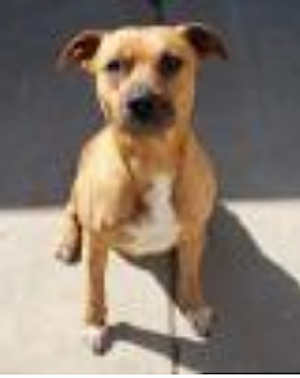
This female pit bull terrier mix is in kennel No. 19, ID No. 14459. Photo courtesy of Lake County Animal Care and Control. Pit bull terrier mix
This female pit bull terrier mix has a short brown coat.
She is in kennel No. 19, ID No. 14459.
“Lobo” is a male husky in kennel No. 25, ID No. 14453. Photo courtesy of Lake County Animal Care and Control. ‘Lobo’
“Lobo” is a male husky with a medium-length fawn and white coat.
He is in kennel No. 25, ID No. 14453.
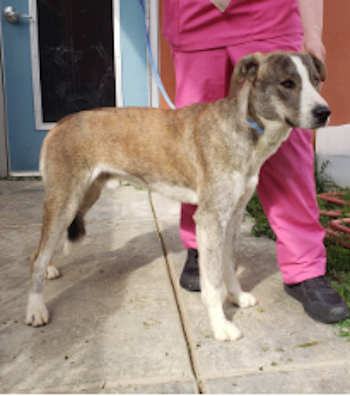
This young male husky-pit bull terrier mix is in kennel No. 26, ID No. 14437. Photo courtesy of Lake County Animal Care and Control. Husky-pit bull terrier
This young male husky-pit bull terrier mix has a short blue and white coat.
He’s in kennel No. 26, ID No. 14437.
Email Elizabeth Larson at This email address is being protected from spambots. You need JavaScript enabled to view it.. Follow her on Twitter, @ERLarson, or Lake County News, @LakeCoNews.
NASA’s Nancy Grace Roman Space Telescope will create enormous cosmic panoramas, helping us answer questions about the evolution of our universe.
Astronomers also expect the mission to find thousands of planets using two different techniques as it surveys a wide range of stars in the Milky Way.
Roman will locate these potential new worlds, or exoplanets, by tracking the amount of light coming from distant stars over time. In a technique called gravitational microlensing, a spike in light signals that a planet may be present.
On the other hand, if the light from a star dims periodically, it could be because there is a planet crossing the face of a star as it completes an orbit. This technique is called the transit method.
By employing these two methods to find new worlds, astronomers will capture an unprecedented view of the composition and arrangement of planetary systems across our galaxy.
Scheduled for launch in the mid-2020s, Roman will be one of NASA’s most prolific planet hunters.
The mission’s large field of view, exquisite resolution, and incredible stability will provide a unique observational platform for discovering the tiny changes in light required to find other worlds via microlensing. This detection method takes advantage of the gravitational light-bending effects of massive objects predicted by Einstein's general theory of relativity.
It occurs when a foreground star, the lens, randomly aligns with a distant background star, the source, as seen from Earth. As the stars drift along in their orbits around the galaxy, the alignment shifts over days to weeks, changing the apparent brightness of the source star. The precise pattern of these changes provides astronomers with clues about the nature of the lensing star in the foreground, including the presence of planets around it.
Many of the stars Roman will already be looking at for the microlensing survey may harbor transiting planets.
“Microlensing events are rare and occur quickly, so you need to look at a lot of stars repeatedly and precisely measure brightness changes to detect them,” said astrophysicist Benjamin Montet, a Scientia Lecturer at the University of New South Wales in Sydney. “Those are exactly the same things you need to do to find transiting planets, so by creating a robust microlensing survey, Roman will produce a nice transit survey as well.”
In a 2017 paper, Montet and his colleagues showed that Roman – formerly known as WFIRST – could catch more than 100,000 planets passing in front of, or transiting, their host stars. Periodic dimming as a planet repeatedly crosses in front of its star provides strong evidence of its presence, something astronomers typically have to confirm through follow-up observations.
The transit approach to finding exoplanets has been wildly successful for NASA's Kepler and K2 missions, which have discovered about 2,800 confirmed planets to date, and is currently used by NASA’s Transiting Exoplanet Survey Satellite, or TESS.
Since Roman will find planets orbiting more distant, fainter stars, scientists will often have to rely on the mission’s expansive data set to verify the planets. For example, Roman might see secondary eclipses – small brightness dips when a planetary candidate passes behind its host star, which could help confirm its presence.
The twin detection methods of microlensing and transits complement each other, allowing Roman to find a diverse array of planets. The transit method works best for planets orbiting very close to their star.
Microlensing, on the other hand, can detect planets orbiting far from their host stars. This technique can also find so-called rogue planets, which are not gravitationally bound to a star at all. These worlds can range from rocky planets smaller than Mars to gas giants.
Roughly three quarters of the transiting planets Roman will find are expected to be gas giants like Jupiter and Saturn, or ice giants like Uranus and Neptune. Most of the remainder will likely be planets that are between four and eight times as massive as Earth, known as mini-Neptunes. These worlds are particularly interesting since there are no planets like them in our solar system.
Some of the transiting worlds Roman captures are expected to lie within their star’s habitable zone, or the range of orbital distances where a planet may host liquid water on its surface. The location of this region varies depending on how large and hot the host star is – the smaller and cooler the star, the closer in its habitable zone will be. Roman’s sensitivity to infrared light makes it a powerful tool for finding planets around these dimmer orange stars.
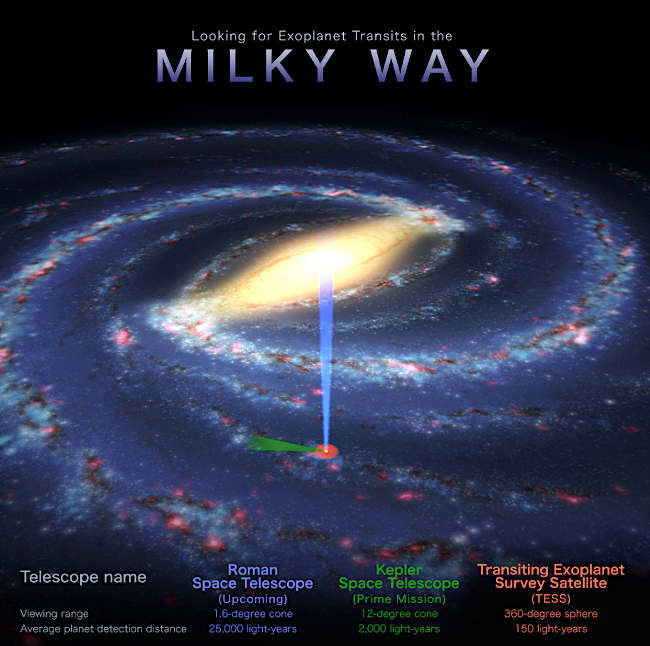
Roman will also look farther out from Earth than previous planet-hunting missions. Kepler’s original survey monitored stars at an average distance of around 2,000 light-years. It viewed a modest region of the sky, totaling about 115 square degrees.
TESS scans nearly the entire sky, however it aims to find worlds that are closer to Earth, with typical distances of around 150 light-years. Roman will use both the microlensing and transit detection methods to find planets up to 26,000 light-years away.
Combining the results from Roman’s microlensing and transiting planet searches will help provide a more complete planet census by revealing worlds with a wide range of sizes and orbits.
The mission will offer the first opportunity to find large numbers of transiting planets located thousands of light-years away, helping astronomers learn more about the demographics of planets in different regions of the galaxy.
“The fact that we’ll be able to detect thousands of transiting planets just by looking at microlensing data that’s already been taken is exciting,” said study co-author Jennifer Yee, an astrophysicist at the Center for Astrophysics | Harvard & Smithsonian in Cambridge, Massachusetts. “It’s free science.”
The Nancy Grace Roman Space Telescope is managed at NASA’s Goddard Space Flight Center in Greenbelt, Maryland, with participation by NASA's Jet Propulsion Laboratory and Caltech/IPAC in Southern California, the Space Telescope Science Institute in Baltimore, and a science team comprising scientists from various research institutions. The primary industrial partners are Ball Aerospace and Technologies Corporation in Boulder, Colorado, L3Harris Technologies in Melbourne, Florida, and Teledyne Scientific & Imaging in Thousand Oaks, California.
Nest boxes can attract a variety of birds to your yard as long as they are properly installed and monitored. Photo courtesy of the Redbud Audubon Society. LAKE COUNTY, Calif. – Lake County is home to an amazing number of bird species.
As of December 2019, 321 species of birds have been identified in Lake County.
No matter where you live in the county – whether in one of our towns, along the lake shoreline, or out in the country – it is possible to create a bird-friendly yard or habitat. Even apartments with balconies can be a place to attract birds.
One of the first things to look at when embarking on creating a bird-friendly yard is to think about what birds need: food and water, shelter and safety.
If you want to start providing the very basics for birds, simply provide a bird bath. A bird bath is simple. It isn’t necessary to buy an expensive one (although they are usually very pretty) but simply putting out a shallow saucer, like those used underneath potted plants is fine.
Birds don’t require or like deep water, just a few inches is needed, and they usually prefer sloping sides. Just remember to change or refresh the water every other day at least. Soon you will be seeing birds visit your yard or your apartment balcony to take advantage of fresh water.
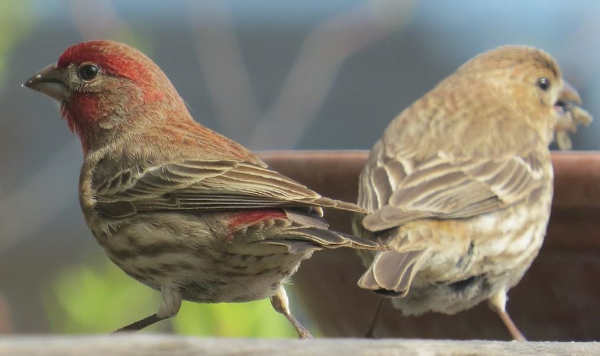
These little house finches are a common sighting around homes and will use both water and seed. Photo courtesy of the Redbud Audubon Society. There are a variety of different seed types that birds will eat. Observant nature watchers know that birds migrate during the winter and so the birds in your yard will vary depending on the time of year.
In fall and winter you will be seeing white-crowned and golden-crowned sparrows and Oregon Juncos that won’t be here in the summer. These birds are generally ground feeders, but will eat at a hanging feeder too. Millet, safflower and black-oiled sunflower seeds are usually the main ingredients of premium bird seed that can be purchased at local feed stores.
Lake County’s year-round birds like the California quail and mourning dove enjoy ground feeding and will appreciate the millet or mixed bird seed too. Black-oiled sunflower seeds are popular among many birds like oak titmice, scrub jays, woodpeckers, doves, grosbeaks and nuthatches. Suet is very popular too, especially during the winter months.
Thistle seed is a good choice for finches. Insects are essential dietary components for almost 96 percent of North American terrestrial bird species. This is one of the reasons the mixed seed and suet blocks are excellent.
Even better are the native insects that live in the trees and on the shrubbery in your yard. Please avoid spraying your trees and shrubs if at all possible. Birds need bugs and if you give them a chance, birds will help establish a balance in your yard so you can avoid the use of insecticide.
Some of the main things to remember when feeding birds is to avoid overcrowding at feeders and to keep the feeders clean. Occasionally people will be encouraged to take their feeders down if there is a disease outbreak, such as Salmonella, which occurred recently when pine siskins were unusually abundant and were bringing the illness to bird feeding locations. Fortunately, that seems to have passed and we can once again resume feeding the birds.
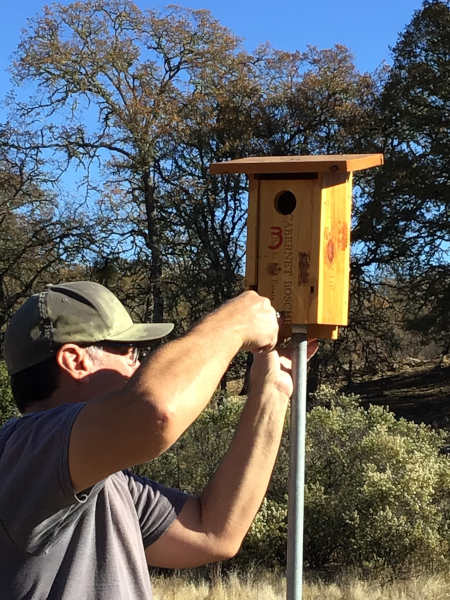
Placing a nest box is Redbud Audubon Society volunteer Richard Mackiewicz. Photo courtesy of the Redbud Audubon Society. Birds need shelter and homes. If your property is large enough, place bird houses for cavity-nesting birds like swallows, bluebirds, titmice and woodpeckers. Contact Redbud Audubon Society at This email address is being protected from spambots. You need JavaScript enabled to view it. for advice on the proper placement of birdhouses, or visit www.NestWatch.org.
Creating a predator-safe location for your birdhouse is important, otherwise you will be setting up the nesting bird pair for their eggs and chicks to become prey. It is also important to clean out the birdhouses every year.
Try to provide as much shelter for birds as you safely can. With the high fire danger now present here, this needs to be carefully thought out. Shelter and nesting habitat should be a distance from the home and can consist of native less-flammable shrubbery. Birds need places such as dense thickets for nesting, perching, and for escaping predators like raptors or cats.
Planting native plants and shrubs is especially valuable for birds. Toyon and elderberry are excellent examples of two native shrubs that produce berries for birds to eat, but all shrubs do not have to be a native plant although they tend to do better in Lake County’s dry climate.
Safety is also an issue for songbirds. If you have free-roaming cats, consider enclosing an area for them or simply keep them inside. Windows, especially large plate-glass windows can be another hazard. Try not to place your feeders in direct flight line with a large window.
There are also techniques to prevent birds from hitting windows. These “bird strikes,” kill millions of birds every year.
In recognition of Bird Appreciation Month in Lake County, the Redbud Audubon Society is providing articles suggesting ways to improve the life of birds here.
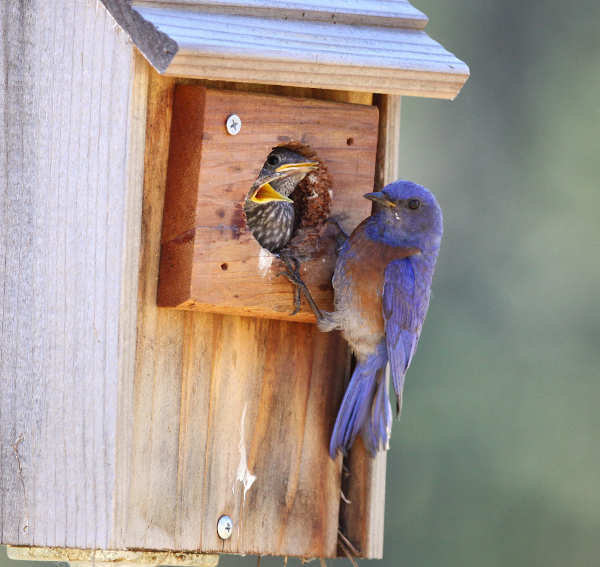
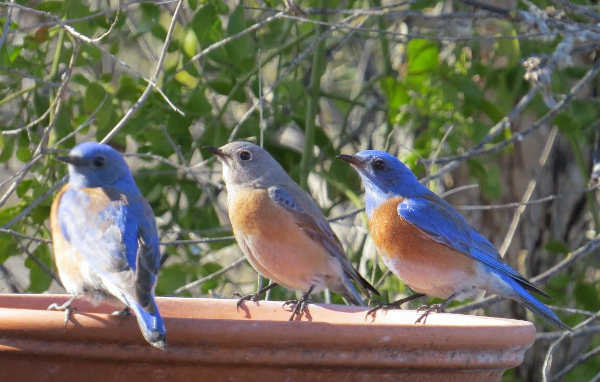
A water supply is crucial to songbirds of all kinds, including these Western Bluebirds. Photo courtesy of the Redbud Audubon Society.
NICE, Calif. – The Robinson Rancheria of Pomo Indians has received $10,000 from the First Nations Development Institute of Longmont, Colorado.
This award will support the efforts of the Tribes Kudi Ta’Weno – Eastern Pomo name for “Good Earth Medicine” – Garden Collective.
The goals of this project are to provide the Robinson Rancheria Tribal Elders Sheecome with healthy nutritious organic vegetables and fruit, and to provide a scaffold to food security.
The garden will be primarily maintained and managed by the Elders Sheecome, although all tribal members are encouraged to participate.
The Tribe’s Education Department will be key partners with the Elders Sheecome, providing the tribal youth an opportunity to learn from and work alongside the elders.
There will be a blessing ceremony at both the beginning of the planting season in the spring and at fall harvest. The fall season will culminate in a harvest feast for the tribal community, featuring food grown in the garden.
The garden design will incorporate not only the growing of crops, but also a modest walking trail for viewing and exercise purposes.
As one tribal member, Marion Quitiquit, said, “We need to develop a wellness program for a healthier life and growing a garden will help us.”
A one-acre site of farmland, groundwater and a small tractor is already available to get this project off the ground.
The tribe has established partnerships with the local Tribal Health Clinic and North Coast Opportunities, who will continue and expand their existing support of the tribe’s health goals in this project, with activities such as nutritional trainings, gardening classes and potential supply donations.
This project is supported by the six-member tribal council and signed off by our Tribal Chairman Beniakem Cromwell.
Robinson Rancheria is located in Nice, California and comprises 40 acres of trust land and an estimated 790 acres in fee land.
Historically, this area was the center of the traditional homeland of the Eastern Pomos, descendants of who represent the significant majority of our present-day tribal membership.
The mission of Robinson Rancheria is “Honoring our ancestors by preserving and practicing culture, asserting tribal sovereignty through economic development while improving the lives of all tribal members.”
This project supports the mission by creating a collective garden, which will improve the lives of the tribe’s membership by providing a healthy food source and strengthening food sovereignty.
The project will be administered through the Robinson Rancheria Environmental Department and will work closely with the Elders Sheecome in ensuring all project tasks are reported and completed.
With this funding the Kudi Ta’ Weno Garden Collective infrastructure will be established and become sustainable for decades to come.
Each season will provide new opportunities for learning about healthy living, both physically and spiritually.
Robert Quitiquit, Garden Consultant and Elder Tribal Member will be coordinating and working with volunteers to plant the garden. For further questions, please contact Temashio Anderson, environmental director, at This email address is being protected from spambots. You need JavaScript enabled to view it..
Dennis Fordham. Courtesy photo. Over time, people may change their testamentary intentions and revoke prior wills and execute new wills.
Such revocations may be either partially or wholly effective in invalidating a prior will.
Let us discuss revocation of wills and how even a revoked will may sometimes be revived.
In California, a will can be revoked by a testator (“person making the will”) so long as he or she is of sound mind (Estate of Lang (1884) 65 Cal 19) and acts intentionally and voluntarily, i.e., without any duress, menace, fraud, or undue influence (Section 6104 Probate Code).
A testator can revoke his or her own will, in whole or in part, by physical acts or by, “[a] subsequent will which revokes the prior will or part expressly or by inconsistency” (section 6120(a) Probate Code).
In California, under section 6120 of the Probate Code, a will can be revoked by, “[b]eing burned, torn, canceled, obliterated, or destroyed with the intent and for the purpose of revoking it, by either the (1) testator or (2) another person in the testator’s presence and by the testator’s direction.” Depending on the facts and circumstances, physical revocation can either wholly or partially revoke the will.
Under section 6124 of the Probate Code, a “lost will” is presumed to have been destroyed by the testator with the intention to revoke the will, “[i]f the testator’s will was last in the testator’s possession, the testator was competent until death, and neither the will nor the duplicate original of the will can be found after the testator’s death, … . This is a presumption affecting the burden of producing evidence.”
The “lost will” presumption can be overcome by producing substantial evidence contrary to the decedent destroying the will. For example, producing evidence that other persons besides the decedent had access to and motive to destroy the decedent’s will.
California allows a lost will to be probated in certain circumstances. Under section 8223 of the Probate Code, “[t]he petition for probate of a lost or destroyed will shall include a written statement of the testamentary words or their substance.” A photocopy of the will can be attached to the petition and otherwise a statement of will’s contents. If a duplicate original will can be found, then the will is not lost and the duplicate original can be probated.
Next, a revoked will can be restored or revived under special circumstances. Under section 6123(a) of the Probate Code, if a will is revoked by a later will the revoked will can be revived if the testator subsequently revokes the later will with the intention to revive the earlier will.
Also, under the Doctrine of Dependent Relative Revocation, a will that is revoked in connection with the execution of a newer will is presumed to be revoked on the condition that the newer will is valid and effective (Estate of Marx (1917), 174 Cal. 762). When applicable, the earlier revoked will becomes effective at least to the extent that the provisions of the later will are invalid or ineffective (Estate of Kaufman (1945) 25 Cal 2d 854).
People who execute handwritten (holographic) wills may unintentionally create a situation where an earlier will is probated because the holographic will is inadequate. Consider a handwritten will that makes specific gifts, but does not distribute the decedent’s entire estate.
Depending on the facts and circumstances an earlier will may be revived to avoid a partial intestacy of the decedent’s estate, i.e., where assets are distributed to heirs instead of to beneficiaries under the decedent’s will(s).
Having an attorney draft one’s will and revoke any earlier wills may provide better peace of mind that unintended outcomes are avoided.
Dennis A. Fordham, attorney, is a State Bar-Certified Specialist in estate planning, probate and trust law. His office is at 870 S. Main St., Lakeport, Calif. He can be reached at This email address is being protected from spambots. You need JavaScript enabled to view it. and 707-263-3235.
 How to resolve AdBlock issue?