 How to resolve AdBlock issue?
News
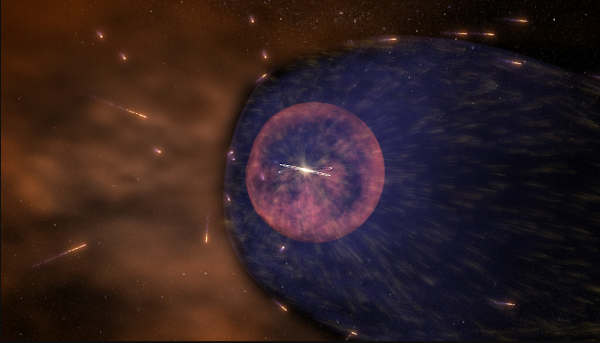
Eleven billion miles away – more than four times the distance from us to Pluto – lies the boundary of our solar system’s magnetic bubble, the heliopause. Here the Sun’s magnetic field, stretching through space like an invisible cobweb, fizzles to nothing. Interstellar space begins.
“It's really the largest boundary of its kind we can study,” said Walt Harris, space physicist at the University of Arizona in Tucson.
We still know little about what lies beyond this boundary. Fortunately, bits of interstellar space can come to us, passing right through this border and making their way into the solar system.
A new NASA mission will study light from interstellar particles that have drifted into our solar system to learn about the closest reaches of interstellar space.
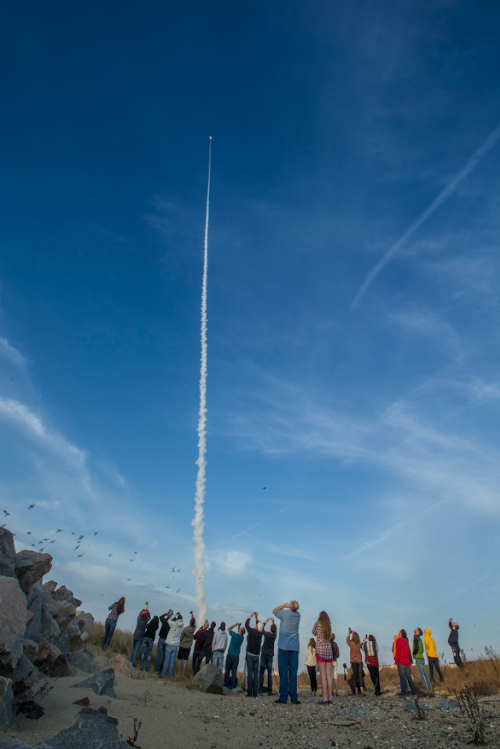
The mission, called the Spatial Heterodyne Interferometric Emission Line Dynamics Spectrometer, or SHIELDS, will have its first opportunity to launch aboard a suborbital rocket from the White Sands Missile Range in New Mexico on April 19, 2021.
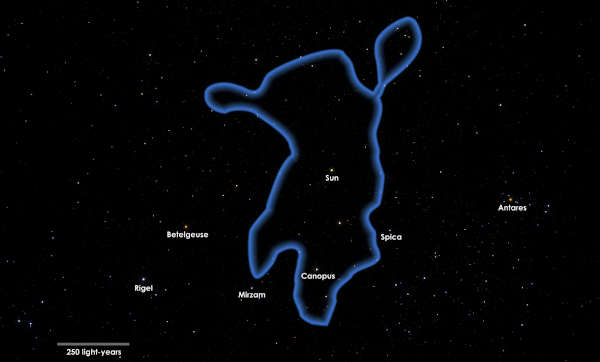
Our entire solar system is adrift in a cluster of clouds, an area cleared by ancient supernova blasts. Astronomers call this region the Local Bubble, an oblong plot of space about 300 light-years long within the spiraling Orion arm of our Milky Way galaxy. It contains hundreds of stars, including our own Sun.
We fare this interstellar sea is our trusty vessel, the heliosphere, a much smaller (though still gigantic) magnetic bubble blown up by the Sun. As we orbit the Sun, the solar system itself, encased in the heliosphere, hurtles through the Local Bubble at about 52,000 miles per hour (23 kilometers per second). Interstellar particles pelt the nose of our heliosphere like rain against a windshield.
Our heliosphere is more like a rubber raft than a wooden sailboat: Its surroundings mold its shape. It compresses at points of pressure, expands where it gives way. Exactly how and where our heliosphere’s lining deforms gives us clues about the nature of the interstellar space outside it. This boundary – and any deformities in it – are what Walt Harris, principal investigator for the SHIELDS mission, is after.
SHIELDS is a telescope that will launch aboard a sounding rocket, a small vehicle that flies to space for a few minutes of observing time before falling back to Earth. Harris’ team launched an earlier iteration of the telescope as part of the HYPE mission in 2014, and after modifying the design, they’re ready to launch again.
SHIELDS will measure light from a special population of hydrogen atoms originally from interstellar space. These atoms are neutral, with a balanced number of protons and electrons. Neutral atoms can cross magnetic field lines, so they seep through the heliopause and into our solar system nearly unfazed – but not completely.
The small effects of this boundary crossing are key to SHIELDS’s technique. Charged particles flow around the heliopause, forming a barrier. Neutral particles from interstellar space must pass through this gauntlet, which alters their paths. SHIELDS was designed to reconstruct the trajectories of the neutral particles to determine where they came from and what they saw along the way.
A few minutes after launch, SHIELDS will reach its peak altitude of about 186 miles (300 kilometers) from the ground, far above the absorbing effect of Earth’s atmosphere. Pointing its telescope towards the nose of the heliosphere, it will detect light from arriving hydrogen atoms. Measuring how that light’s wavelength stretches or contracts reveals the particles’ speed. All told, SHIELDS will produce a map to reconstruct the shape and varying density of matter at the heliopause.
The data, Harris hopes, will help answer tantalizing questions about what interstellar space is like.
For instance, astronomers think the Local Bubble as a whole is about 1/10th as dense as most of the rest of the galaxy’s main disk. But we don’t know the details – for instance, is matter in the Local Bubble is distributed evenly, or bunched up in dense pockets surrounded by nothingness?
“There's a lot of uncertainty about the fine structure of the interstellar medium – our maps are kind of crude,” Harris said. “We know the general outlines of these clouds, but we don't know what's happening inside them.”
Astronomers also don’t know much about the galaxy’s magnetic field. But it should leave a mark on our heliosphere that SHIELDS can detect, compressing the heliopause in a specific way based on its strength and orientation.
Finally, learning what our current plot of interstellar space is like could be a helpful guide for the (distant) future. Our solar system is just passing through our current patch of space. In some 50,000 years, we’ll be on our way out of the Local Bubble and on to who knows what.
“We don't really know what that other cloud is like, and we don't know what happens when you cross a boundary into that cloud,” Harris said. “There's a lot of interest in understanding what we're likely to experience as our solar system makes that transition.”
Not that our solar system hasn’t done it before. Over the last four billion years, Harris explains, Earth has passed through a variety of interstellar environments. It’s just that now we’re around, with the scientific tools to document it.
“We're just trying to understand our place in the galaxy, and where we're headed in the future,” Harris said.
Miles Hatfield works for NASA’s Goddard Space Flight Center in Greenbelt, Maryland.
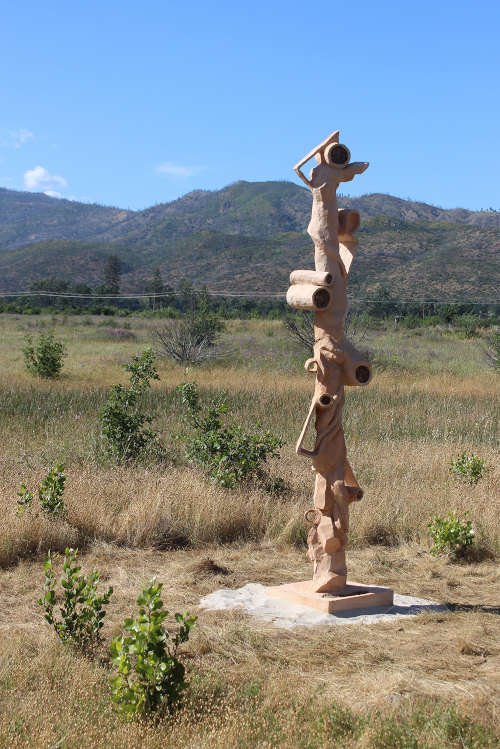
MIDDLETOWN, Calif. – Artists and community members interested in participating in the EcoArts Sculpture Walk at Trailside Park in Middletown are encouraged to submit proposals by Tuesday, April 20.
For this 15th year of the Sculpture Walk, the primary purpose remains supporting revitalization of the land, and mending of damaged ecosystems within a local natural preserve that was damaged in the 2015 Valley fire.
Work should relate to the natural environment and integrate the spirit and materials of the park and of Lake County. Trees and flora are coming back with vitality.
All proposals will be juried. Artists may request to lead a workshop at the park to help with creation of new work. Some stipends are available.
Artwork will remain in the park through the duration of the exhibit through November and may not damage the park environment in any way.
Work that has restorative effects on the environment and is not susceptible to extreme weather changes may be selected to remain on view beyond the regular season.
An in-person or google-satellite visit to the park prior to submitting an application is encouraged.
Trailside Park is open from dawn to dusk daily and located at 21435 Dry Creek Cutoff. Videos of work from 2019 and an application are available at www.MiddletownArtCenter.org/ecoarts
The application fee $20; no one is turned away for lack of funds.
Submissions are due by April 20; installation is May 14 through May 29.
A public opening reception will be held June 12.
Those with questions or needing a little more time, are requested to email
Find out more about exhibits, opportunities, events, classes and all the good things happening at Middletown Art Center at www.middletownartcenter.org.
Editor’s note: This is part of a series of articles on creating a bird-friendly community in Lake County as part of Bird Appreciation Month.
LAKE COUNTY, Calif. – Predation by domestic cats is the No. 1 direct, human-caused threat to birds in the United States and Canada.
In the United States alone, outdoor cats kill approximately 2.4 billion birds every year.
Although this number may seem unbelievable, it represents the combined impact of tens of millions of outdoor cats.
Seven thousand years ago, the European and African wild cat was domesticated to reduce the number of rats and mice that resided in settlements.
Over time, the process of domestication changed the wild cat into a separate species: domestic or house cat (Felis catus).
Today’s domestic cats have four classifications: Indoor, limited-range, free-range or community and feral. Feral cats have no owners.
In Lake County all dogs and cats should have attached to its body a current license tag. And if someone feeds community or feral cats it is unlawful unless that person first obtains from the director of Animal Control a cat colony permit (free roaming and/or confined cats) and agrees to three conditions: 1) water/feed 2) spayed, neutered, rabies vaccinated all 8 weeks and up and ear clipped 3) testing for FIV/FELV and take action for the infected cats.
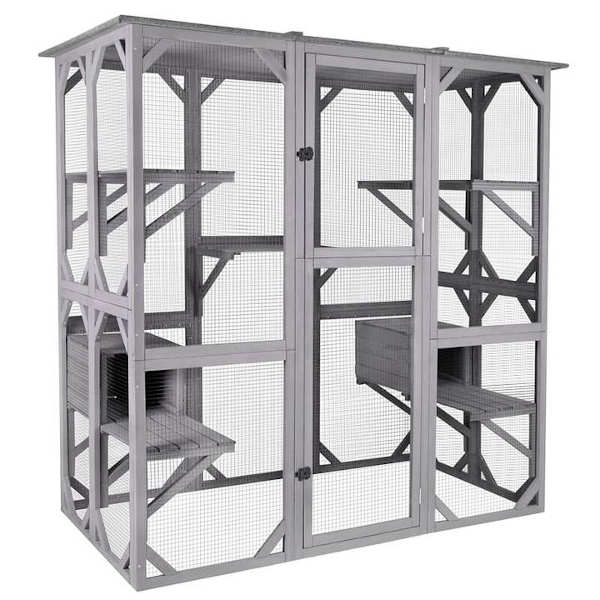
Show your cat how much it is loved, and at the same time protect birds and wildlife, by providing fresh air and outdoor enrichment in a “catio” or cat enclosure/patio. Life expectancy for an indoor cat can reach 15 years compared to a feral cat’s three to five years.
A catio, or cat patio, allows your cat to explore the sights, sounds and smells of the great outdoors.
Anyone with a window can have a catio. The window box catio is a good choice for single-cat homes and for owners just beginning to dip their toes into the world of catio living.
A balcony catio, porch catio or an outdoor run all could be exciting for your favorite feline. There are even pop-up and portable catios.
You can find ideas in so many styles – simple to unbelievably extravagant at retailers and on-line.
Here are a few sites you might enjoy:
How to build a catio plans: https://spca.bc.ca/news/how-to-build-a-catio, www.catiospaces.com, www.homedepot.com, www.habitathaven.com and www.purrfectfence.com.
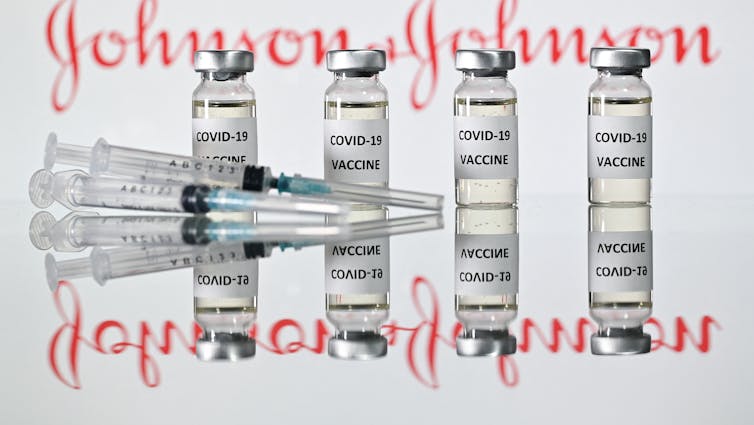
A panel of experts met on April 14, 2021, to review evidence on blood clots that have been reported in seven people after they received the one-dose Johnson & Johnson COVID-19 vaccine. The panel, the Advisory Committee on Immunization Practices, or ACIP, advises the Centers for Disease Control and Prevention on immunization. It delayed voting on a recommendation to the CDC so that members can further evaluate risk and data. The clotting, which resulted in one woman’s death, led the CDC and FDA on April 13, 2021, to pause use of the J&J vaccine. Dr. William Petri, an infectious disease physician and immunologist at the University of Virginia School of Medicine, answers questions to help put this development in context.
What is this potential side effect of the J&J vaccine for COVID-19?
The potential side effect is a blood clot in the veins that drain blood from the brain. This is called central venous sinus thrombosis. In the vaccine-associated cases of this, platelets in blood, which are important for making clots, have been lower than normal. This same side effect has been seen in the AstraZeneca COVID-19 vaccine that also uses an adenovirus to deliver the coronavirus spike glycoprotein. In the case of the AstraZeneca vaccine, the clotting disorder has been linked to antibodies against platelet factor 4 (PF4) that are apparently induced by the adenovirus backbone of the vaccine. This antibody causes the clotting disorder by activating platelets to clot.
It is important to note that this disorder, called vaccine-induced immune thrombotic thrombocytopenia, is not a problem with the mRNA-based Pfizer and Moderna COVID-19 vaccines.
How many people have experienced this possible reaction?
As of April 13, 2021, about one in a million: Six cases out of the 6.8 million doses of the J&J vaccine administered in the U.S. These six cases all occurred in women ages 18-48, and from 6 to 13 days after vaccination. That’s about half as likely as getting struck by lightning in a year. A seventh case was included in the ACIP review on April 14.
What do I do if I got the J&J shot?
The CDC and FDA are recommending that people who have received the J&J vaccine within the last 3 weeks who develop severe headache, abdominal pain, leg pain or shortness of breath should contact their health care provider.
This type of blood clot is treatable with the use of blood thinners or anticoagulants. If a patient has low platelets, however, a doctor would not prescribe the widely used anticoagulant heparin but instead another kind of blood thinner. Untreated, these blood clots can be fatal.
What are the CDC and FDA specifically recommending for the J&J vaccine?
Because of this rare occurrence, even though it has not been shown to be due to the vaccine, the CDC and FDA have recommended a pause in use of the J&J vaccine until these cases can be further reviewed.
What are the next steps?
The CDC convened a meeting of the Advisory Committee on Immunization Practices on April 14, 2021. The ACIP is an independent board of 15 scientific and medical experts selected by the health and human services secretary that advises the CDC on vaccines for children and adults. People with ties to vaccine manufacturers are excluded from the ACIP membership because of potential conflict of interest.
On April 14, ACIP reviewed the available evidence but did not vote on recommendations because panel members expressed concern that the panel needs more time to evaluate data and risks. The vaccine has been given to 3.8 million people in the past two weeks. Therefore, not enough time has passed to see whether other people might also experience these serious clots. The panel is expected to meet again within a week to 10 days.
Is this similar to what happened with the AstraZeneca vaccine in Europe?
A similar rare problem of blood clotting with low platelets in the cerebral venous sinus and also in the abdominal veins and arteries has been seen in connection with the use of the AstraZeneca COVID-19 vaccine used in Europe. There, 182 cases were reported in 190 million doses – again, roughly 1 in 1 million people vaccinated. The European Medicines Agency investigated this and concluded that central venous sinus thrombosis with low platelets should be listed as a possible “very rare side effect” of the AstraZeneca vaccine.
On April 13, 2021, Johnson & Johnson announced it was delaying the rollout of its vaccine in Europe in response to the U.S. review.
What is the take-home message?
The U.S. has a total of three vaccines authorized under emergency use authorization for COVID-19, and this side effect has not been observed in the other two vaccines, developed by Moderna and Pfizer. The Moderna and Pfizer vaccines do not use the same technology used in the J&J and AstraZeneca vaccines. So vaccination against COVID-19 can continue, while efforts are made to determine if the clotting disorder is related by chance or a true, but extremely rare, side effect of the J&J vaccine.
I believe it is a testament to the emphasis by the CDC and FDA on vaccine safety that J&J vaccinations have been paused while this is studied by independent scientists and medical experts.
This article was updated on April 14, 2021 to add additional research and the ACIP committee meeting.
William Petri, Professor of Medicine, University of Virginia
This article is republished from The Conversation under a Creative Commons license. Read the original article.
Like boot prints on the Moon, NASA's OSIRIS-REx spacecraft left its mark on asteroid Bennu. Now, new images — taken during the spacecraft's final fly-over on April 7 — reveal the aftermath of its historic encounter with the asteroid.
The spacecraft flew within 2.3 miles of the asteroid — the closest it has been since the Touch-and-Go, or TAG, sample collection event on Oct. 20, 2020.
During TAG, the spacecraft's sampling head sunk 1.6 feet into the asteroid's surface and simultaneously fired a pressurized charge of nitrogen gas, churning up surface material and driving some into the collection chamber.
The spacecraft's thrusters also launched rocks and dust during the maneuver to reverse course and safely back away from the asteroid.
Comparing the two images reveals obvious signs of surface disturbance. At the sample collection point, there appears to be a depression, with several large boulders evident at the bottom, suggesting that they were exposed by sampling.
There is a noticeable increase in the amount of highly reflective material near the TAG point against the generally dark background of the surface, and many rocks were moved around.
Where thrusters fired against the surface, substantial mass movement is apparent. Multiple sub-meter boulders were mobilized by the plumes into a campfire ring–like shape — similar to rings of boulders seen around small craters pocking the surface.
Jason Dworkin, the mission's project scientist at NASA’s Goddard Space Flight Center in Greenbelt, Maryland, noticed that one boulder measuring 4 feet across on the edge of the sampling site seemed to appear only in the post-TAG image. “The rock probably weighs around a ton, with a mass somewhere between a cow and a car.”
Dante Lauretta, of the University of Arizona and the mission's principal investigator, later pointed out that this boulder is likely one of those present in the pre-TAG image, but much nearer the sampling location, and estimates it was thrown a distance of 40 feet (about 12 meters) by the sample collection event.
In order to compare the before and after images, the team had to meticulously plan this final flyover.
"Bennu is rough and rocky, so if you look at it from a different angle or capture it at a time when the sun is not directly overhead, that dramatically changes what the surface looks like. These images were deliberately taken close to noon, with the Sun shining straight down, when there's not as many shadows,” said Dathon Golish, a member of the OSIRIS-REx image processing working group, headquartered at the University of Arizona.
"These observations were not in the original mission plan, so we were excited to go back and document what we did," Golish said. "The team really pulled together for this one last hurrah."
The spacecraft will remain in Bennu's vicinity until departure on May 10, when the mission will begin its two-year return cruise back to Earth. As it approaches Earth, the spacecraft will jettison the Sample Return Capsule, or SRC, that contains the sample from Bennu.
The SRC will then travel through Earth’s atmosphere and land under parachutes at the Utah Test and Training Range on Sept. 24, 2023.
Once recovered, the capsule will be transported to the curation facility at NASA’s Johnson Space Center in Houston, where the sample will be removed for distribution to laboratories worldwide, enabling scientists to study the formation of our solar system and Earth as a habitable planet. NASA will set 75% of the sample aside for future generations to study with technologies not invented yet.
The OSIRIS-REx mission is the first NASA mission to visit a near-Earth asteroid, survey the surface, and collect a sample to deliver to Earth.
NASA's Goddard Space Flight Center in Greenbelt, Maryland, provides overall mission management, systems engineering, and the safety and mission assurance for OSIRIS-REx. Dante Lauretta of the University of Arizona, Tucson, is the principal investigator, and the University of Arizona also leads the science team and the mission's science observation planning and data processing.
Lockheed Martin Space in Denver built the spacecraft and provides flight operations. Goddard and KinetX Aerospace are responsible for navigating the OSIRIS-REx spacecraft. OSIRIS-REx is the third mission in NASA's New Frontiers Program, which is managed by NASA’s Marshall Space Flight Center in Huntsville, Alabama, for the agency’s Science Mission Directorate in Washington, D.C.
For more information about OSIRIS-REx visit https://www.nasa.gov/osiris-rex.
Mikayla Mace Kelley works for the University of Arizona, Tucson, and Rani Gran for NASA’s Goddard Space Flight Center in Greenbelt, Maryland.
The state has increasingly loosened restrictions on who can get the vaccine thanks to increasing supply and more vaccines coming on the market.
California previously expanded COVID-19 vaccine eligibility to individuals aged 50 and older starting April 1.
Officials said the eligibility expansion comes as California reaches major milestones in its vaccine rollout: Nearly half of all residents in the 16 and older population have already received at least one dose, including 73.9 percent of seniors aged 65 and older.
As of Thursday, more than 24 million doses have been administered in California, with 4.9 million doses administered in the hardest hit communities.
The statewide provider network now has the capacity to administer up to six million vaccine doses a week, according to its third-party administrator Blue Shield of California.
“Thanks to the hard work of Californians who followed public health guidelines, our case rates and hospitalizations are among the lowest they’ve been since the start of the pandemic,” said Gov. Gavin Newsom.
However, Newsom said the work is far from over. “California will need all hands on deck to keep up this progress, and I encourage everyone to get vaccinated as soon as possible. Vaccinating all of those who are eligible will take time, but our statewide providers are ready to meet the increased demand and we are excited to get this vaccine into the arms of all Californians who want them, especially those in the hardest hit communities.”
California’s eligibility expansion meets a nationwide deadline set by President Joe Biden that all adults in the U.S. be eligible to receive the COVID-19 vaccine by April 19.
“As these life-saving vaccines put the worst behind us, it is important to not let our guard down, even after being fully vaccinated,” said Director of the California Department of Public Health and State Public Health Officer Dr. Tomás Aragón. “We urge Californians to continue wearing face coverings, practice physical distancing, limit extended indoor activities with others, and follow all the best practices to stop the spread of COVID-19 to help protect your friends, family and neighbors.”
Officials have been focusing on allocating COVID-19 vaccines to ensure equitable distribution.
Last month, the state began directing 40 percent of vaccine doses to the hardest-hit areas of the state based on the lowest quartile of the Public Health Alliance of Southern California’s Healthy Places Index.
Six of Lake County’s zip codes – for the communities of Clearlake, Clearlake Oaks, Finley, Lucerne, Nice and Upper Lake – are among 446 that were targeted for increased vaccine supply due to being in the Healthy Places Index’s lowest-performing quartile, as Lake County News has reported.
This week, the state said it reached the 4.9 million mark in doses administered in those hard-hit communities across California.
The local picture
Sarah Marikos, Lake County’s epidemiologist, said this week that 43 percent of Lake County residents aged 16 and older are partially vaccinated, with more than 22,000 people having received at least one dose.
On Thursday, the California Department of Public Health gave a precise number of doses administered by county of residence, totaling 34,259 for Lake County.
Dr. Evan Bloom, who is interim Public Health officer while Dr. Gary Pace is on vacation, told the Board of Supervisors on Tuesday that new case numbers locally are on a downward trajectory,
While there are viral variants circulating in Lake County – a fact state and local health officials first confirmed earlier this year – Bloom said the immunity that is derived from the vaccines that are being administered still holds against the variants.
Bloom said the positive COVID-19 cases now being reported in Lake County are in people who are not fully vaccinated, which is why health officials continue to focus on vaccinating residents.
“This is the best way forward to protect our residents of Lake County against COVID-19,” Bloom said.
Individuals seeking an opportunity to get vaccinated may still need to wait for an appointment. Eligible residents can visit https://myturn.ca.gov/ – which is available in 12 languages – to find and schedule available appointments or call the COVID-19 hotline at 833-422-4255; assistance is available in more than 250 languages.
All COVID-19 vaccines are free regardless of immigration or health insurance status. Residents with questions about the vaccines can visit https://www.vaccinateall58.com/ to learn more.
In addition to being vaccinated through the state signup process, Adventist Health and Sutter Health are hosting vaccine clinics for all eligible community members, not just their registered patients. Contact Adventist Health at 707-995-4500 or Sutter Health at 844-987-6115 or https://www.sutterhealth.org/for-patients/health-alerts/covid-19-vaccine for more information.
Lake County Tribal Health Consortium continues to vaccinate its patients. For information, visit http://www.lcthc.com/ or call 707-263-8382.
Email Elizabeth Larson at