Mark Andrew Nielsen, 33, of Nice, California, was arrested on Saturday, April 17, 2021, for a high-speed chase that occurred 10 days before in UKiah, California. Mendocino County Jail photo. NORTH COAST, Calif. – The Mendocino County Sheriff’s Office said it has arrested a Lake County man wanted for a high-speed chase earlier this month.
Mark Andrew Nielsen, 33, of Nice, was arrested early Friday morning near Calpella, according to a report from Sgt. Jay Vanoven.
Vanoven said a vehicle pursuit in the Redwood Valley area on the evening of April 7 led to a large-scale search of the area for the suspect, who was later identified as Nielsen.
At that time, Nielsen, riding a motorcycle, led deputies on a chase with speeds exceeding 90 miles per hour, authorities said.
Nielsen was not located on that date. Vanoven said a be-on-the-lookout was issued requesting law enforcement arrest Nielsen for multiple felony offenses if located.
Throughout the following days, continuous followup and attempts to locate and arrest Nielsen were conducted, Vanyoven said.
That incident was nearly two weeks after a Mendocino County Sheriff’s deputy arrested Nielsen, who was driving a stolen vehicle and in possession of counterfeit prescription pills containing fentanyl, as Lake County News has reported.
On Saturday at 2:20 a.m., a deputy observed a vehicle known to be associated with Nielsen in the area of Calpella, Vanoven said.
Vanoven said the deputy noticed the male driver and solo occupant of the vehicle ducked down, possibly attempting to conceal his identity. The deputy noticed several lighting equipment violations on the vehicle as it drove past his patrol vehicle.
The deputy conducted a traffic stop on the vehicle and contacted the male, who was positively identified as Nielsen, Vanoven said.
Nielsen was taken into custody without incident and he was booked into the Mendocino County Jail on the following charges for reckless driving while evading a peace officer, driving in the opposite lane of traffic while evading a peace officer, being armed in the commission of a felony, carrying an unregistered and loaded handgun, possession of a firearm by a prohibited person, possession of ammunition by a prohibited person, carrying a concealed weapon and violation of probation, Vanoven said.
Due to the severity of the crimes and risk posed to the community, a bail enhancement was requested by sheriff's deputies, Vanoven said. The request was granted and Nielsen was to be held at the Mendocino County Jail in lieu of $125,000 bail.
“The positive identification and ultimate apprehension of Nielsen was the direct result of cooperative effort between the community and the Sheriff's Office. This type of teamwork is vital to the continued protection of our community against violence and disorder,” Vanoven said.
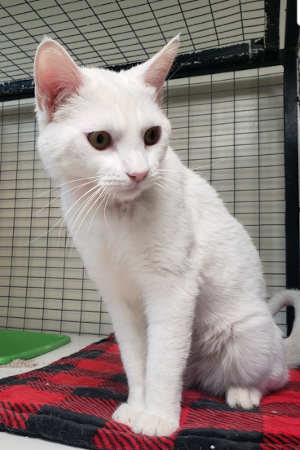
This male domestic short hair cat in cat room kennel No. 58, ID No. 14471. Photo courtesy of Lake County Animal Care and Control. Male domestic short hair
This male domestic short hair cat has a white coat and gold eyes.
He is in cat room kennel No. 58, ID No. 14471.
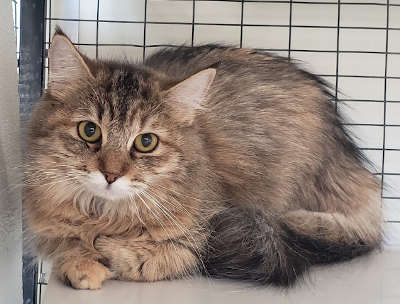
“Ruby” is a female domestic long hair in cat room kennel No. 120, ID No. 14475. Photo courtesy of Lake County Animal Care and Control. ‘Ruby’
“Ruby” is a female domestic long hair with a brown coat and gold eyes.
She is in cat room kennel No. 120, ID No. 14475.
“Moxi” is a female domestic longhair in cat room kennel No. 133, ID No. 14483. Photo courtesy of Lake County Animal Care and Control. ‘Moxi’
“Moxi” is a female domestic longhair with a calico coat and blue eyes.
She is in cat room kennel No. 133, ID No. 14483.
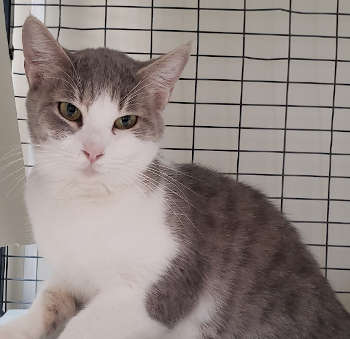
“Chick-a-dee’ is a female domestic short hair cat in cat room kennel No. 138, ID No. 14474. Photo courtesy of Lake County Animal Care and Control. ‘Chick-a-dee’
“Chick-a-dee’ is a female domestic short hair cat with a gray and white coat and gold eyes.
She is in cat room kennel No. 138, ID No. 14474.
Email Elizabeth Larson at This email address is being protected from spambots. You need JavaScript enabled to view it.. Follow her on Twitter, @ERLarson, or Lake County News, @LakeCoNews.
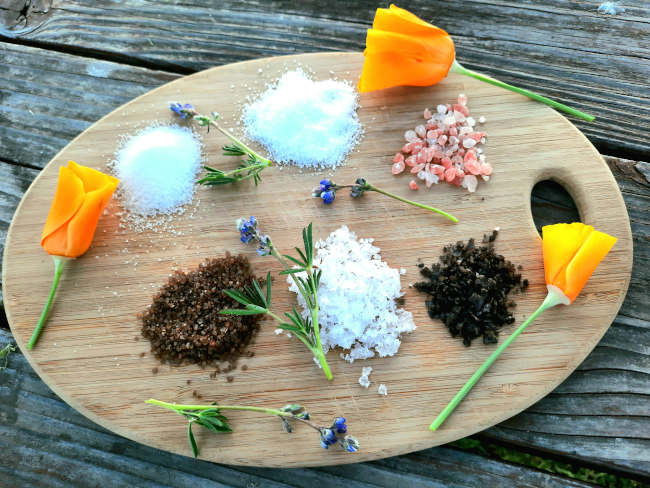
On the top from left to right are table salt, kosher salt, and Himalayan pink salt. On the bottom from left to right are coarse sea salt smoked with cherry wood, flaked salt harvested from caves on the Mendocino coast, and the same Mendocino coast salt that’s been smoked. Photo by Esther Oertel. Studies have shown that the more salt one eats, the more one craves it. And no wonder – salt is the most powerful flavor enhancer on Earth.
The salting of food predates even cooking. By the time humans had developed language, the use of salt was already commonplace.
Not only does salt flavor our food, sodium intake through salt is necessary for life. Salt stimulates nerve impulses and maintains a balance of electrolytes and fluids. Sodium ions are crucial for heart activity and other metabolic functions, like helping the small intestine absorb nutrients.
Our bodies can’t produce salt so throughout history we’ve had to seek it out in the environment.
We have to be careful, though, as too much salt can lead to high blood pressure and cardiovascular disease.
Salt is one of the most used materials by volume in all the world, and not just for cuisine. Other uses include deicing roadways, manufacturing plastics and PVC pipe, removing contaminants when making aluminum, tanning hides, and even soapmaking (a bit of salt is added to increase hardness).
Whether mined from the ground or harvested from the sea, all salt shares the same chemical makeup – a one-to-one ratio of sodium and chloride – but there is great variety in terms of texture, color, taste and even saltiness.
To help you sort through the differences, below is a primer on some of the most common types of salt and their uses.
Kosher salt: This salt is a great choice for cooking and is a favorite of chefs. It dissolves easily and its light texture adds a more delicate flavor than traditional table salt. It’s about half as salty as the latter, which makes it harder to oversalt a dish. It also means that more must be added to salt the cooking water for pasta or vegetables. (Remember: Julia Child recommends that cooking water be “as salty as the Mediterranean Sea.”)
Be aware that there are brand differences in kosher salts; my preferred brand is Diamond for its larger crystals (which makes it less dense) and lack of additives.
Sea salt: As its name implies, this salt is the result of evaporated sea water. There are many types of sea salt – it’s a huge category – and the texture and brininess vary depending on where it’s harvested. Many of the salts noted on this list fall under the sea salt umbrella. In general, sea salt is sold in coarse or finely ground form. Most finishing salts come from the sea.
Table salt: Table salt is mined from the extensive underground beds of salt that exist in wide swaths of the U.S. and Canada, as well as in other parts of the world. The deposits are left from the drying up of ancient seas or salty lakes. The largest underground salt mine is under Lake Huron in Ontario, Canada. Table salt is mined from these deposits and most brands are iodized to aid in the prevention of iodine deficiency. Trace minerals are removed in the refining process and anticaking agents are added.
Rock salt: Also known as halite, it’s salt in its natural form, that is, the mineral form of sodium chloride. The crystals are typically colorless or white but can be imbued with a variety of different hues depending on the inclusion of other materials, impurities or anomalies in the crystals. Rock salt can be found in varying shades of blue, pink, red, yellow or gray.
Himalayan pink salt: Mined in Pakistan, this salt is reputed to contain all 84 minerals found in the human body. The presence of these minerals gives the salt more flavor complexity than the average table salt. Its characteristic pink color can vary from a faint blush to brightly vivid. This is the salt that I use when I want to add flavor directly to food at the table; a grinder filled with its coarse crystals is always on hand. Slabs of Himalayan salt have become a popular medium for cooking foods as it can hold heat for hours.
Flake salt: This category of salt is identified by the structure of its crystals, which form as thin and flattened out with a large surface area and a low mass. This gives it a crunchy texture which makes for a good finishing salt, adding bursts of flavor to foods such as grilled meats, roasted vegetables or even crusty sourdough bread dipped in olive oil. The crystal structure can be formed naturally or can be achieved through a variety of artificial methods.
Fleur de sel: Harvested from the surface of tidal pools in Brittany, France, fleur de sel (literally “flower of salt”) is considered one of the world’s best salts. Special wooden rakes are used to harvest the salt by hand and harvesting is only done in perfect weather conditions. Delicate and aromatic (with subtle floral tones and notes of the ocean), it’s typically used as a finishing salt and pairs well with meats, fresh vegetables (radishes, for example, or a green salad), and sweets such as caramels. In addition to its pleasant flavor, fleur de sel is prized for the texture it imparts to foods.
Celtic sea salt: Also known as sel gris (literally “gray salt”), this salt in varying shades of gray is coarse, granular and moist. Like fleur de sel, it’s harvested by hand on the French coast but in a different manner. The salt is removed from the bottom of the salt pan (typically lined with clay), rather than from the top as with fleur de sel. This contact with the bottom gives it its characteristic gray color. Sel gris can be used as both a cooking and a finishing salt because of its coarse grain size and mineral complexity. It’s much denser than kosher or table salt, with more salt in an equivalent volume. Because of its dampness, it doesn’t suck moisture out of foods as some salts do. It’s typically paired with heartier foods like steak and root vegetables.
Black salt: Also known as Indian or Himalayan black salt, kala namak, sulemani namak, or kala loon, this is Indian volcanic rock salt which has been heated to extremely high temperatures and mixed with Indian spices and herbs. The seeds of the harad fruit, which contain sulfur, are included in the mixture and contribute to its sulfur-laced umami flavor. Some varieties are black in color, but others can vary from brownish pink to deep purple. Egg-free vegan recipes benefit from its flavor, which can mimic eggs due to the sulfur. This salt is a component of Ayurvedic medicine and is commonly used as a flavoring in India, Pakistan and other Asian countries.
Hawaiian salt: Salt from Hawaii can be red, composed of unrefined sea salt combined with red volcanic clay (making it high in iron), or black, made from volcanic sea salt blended with activated charcoal. When used as a finishing salt, both varieties impart a salty crunch to dishes. Since it dissolves more slowly than other salts, it can be successfully used in dishes such as ceviche, which contains some liquid. This salt is typically used on seafood and all types of meat (chicken, lamb, pork, beef), especially those that are barbecued, and is especially good with tomatoes.
Smoked salt: To achieve a smoky flavor, salt is slow-smoked (typically for about two weeks) over a burning wood such as hickory, applewood, mesquite or even grape vines such as Chardonnay. Each wood imparts its own unique flavor to the salt. I especially enjoy using smoked salt in bean dishes and hearty soups, and I understand it’s wonderful for brining meats for grilling or barbecuing.
Maldon sea salt: This high-end finishing salt is from a company in Maldon, Essex, England and is known for its pyramid-shaped crystals. The salt brine is drawn from clay-lined salt pans dating back to Roman times on the high-salinity banks of the Blackwater Estuary. The brine is dried over brick flues, and this process renders the shape of the crystals. Maldon sea salt is known for being particularly briny without bitterness. Because of its strong salty taste, less is needed.
Pickling salt: This is a pure salt specific to pickling which is free of iodine, anticaking agents and trace minerals. This allows the true taste of whatever is being pickled to shine through without the influence of flavor from the salt.
In addition, salts may be enhanced in a wide variety of ways through flavoring. Some popular examples include Japanese salt, which contains ground seaweed, truffle salt (great on popcorn!), and vanilla salt, which is nice for using as a finishing salt on desserts.
Flavored salts can be easily created at home using one of three methods – the reduction method for liquids, the wet method for condiments, and the dry method for things such as herbs or vanilla beans.
The combinations are seemingly endless and only limited by the imagination. Think Sriracha or whiskey, candied ginger or lime, chili or sage.
Choosing the salt – coarse, fine or flake, sea salt or mined – can be almost as important as finding unique flavor combinations. When in doubt, kosher salt is a good fallback.
Today’s recipe is for a salt flavored with chili and lime, wonderful for flavoring fajitas or tacos. Enjoy!
Chili-lime salt
¼ cup kosher salt 1 teaspoon crushed red pepper flakes 1 ½ teaspoons lime zest
Use a zester or the fine side of a cheese grater to remove the outer zest of the lime. Be careful not to include the bitter white pith. (Note: Rinse and pat the lime dry before zesting. Using an organic lime is preferred.)
Set the zest aside on a plate or paper towel and allow it to air dry for a few hours.
Combine the lime zest, red pepper flakes and salt in an airtight jar and enjoy!
Esther Oertel is a writer and passionate home cook from a family of chefs. She grew up in a restaurant, where she began creating recipes from a young age. She’s taught culinary classes in a variety of venues in Lake County and previously wrote “The Veggie Girl” column for Lake County News. Most recently she’s taught culinary classes at Sur La Table in Santa Rosa. She lives in Middletown, California.
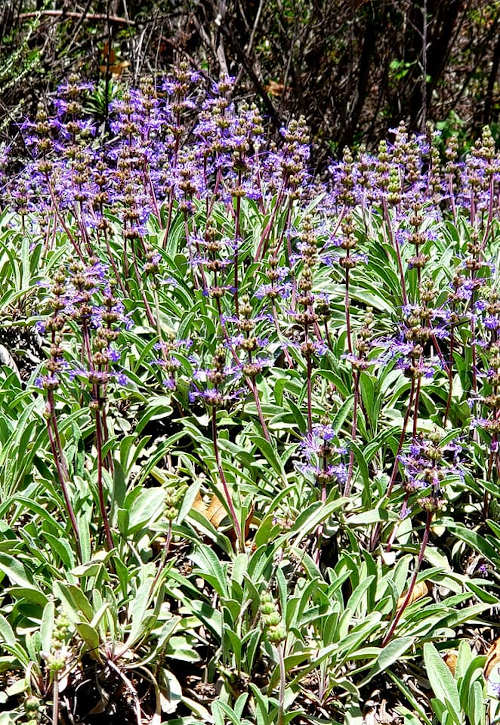
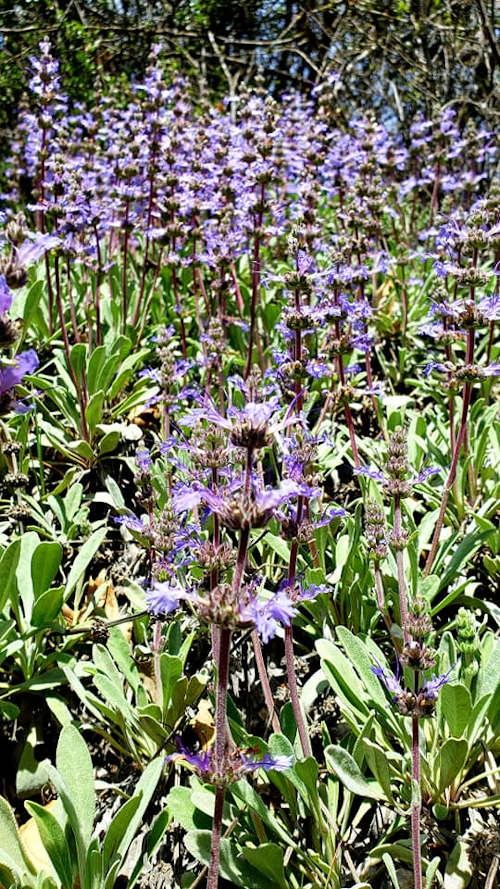
Sonoma Creeping Sage. Photo by Kim Riley. LAKE COUNTY, Calif. – What native wildflower can take hold on banks and prevent erosion, is fire retardant, drought tolerant, fast-growing, won’t need to be pruned, hummingbird pollinated, attracts bees, and suppresses weeds and invasive grasses, and like most plants in this genus, is deer resistant and needs no water once established?
If you guessed Sonoma Creeping Sage, you are correct!
Found predominantly in the Red Hills soils around the slopes of Mt. Konocti, salvia sonomensis, or Sonoma Creeping Safe, is in bloom April through May and is extremely drought, heat and cold tolerant, can grow on serpentine soils that we mentioned in a previous column, and will take watering in your landscaping for other plants if the soils have good drainage.
This creeping (which means it grows close to the ground thus making an excellent groundcover) Sonoma sage is an evergreen perennial found in full sun on rocky slopes to partial shade under pines.
“Many sages grow throughout California, but this one has a distinct natural range. It can be found in coastal areas from Santa Barbara to San Diego. It’s also found in the Sonoma County region,” including parts of Lake and Napa Counties, according to Epic Gardening.
The largest habitat for this plant is along the Sierra Nevada mountain range where it grows on southwest-facing slopes below 6000 feet, in foothills and slopes above the central valley region because these all share similar climates: hot arid summer days, cooler and more humid nights - just like Lake County.
With silvery grey and fragrant leaves you may wonder (because they do look similar and are a salvia as well) if the leaves of Sonoma creeping sage can be used in cooking?
Although not poisonous, creeping sage (Salvia sonomensis) does not taste at all like culinary sage (or common sage, Salvia officinalis) so it is recommended to leave it for the bees.
The flower spikes range from a soft lilac to a bicolor blue and create a gorgeous pop of color against the sage green leaves while in bloom April through May.
Terre Logsdon is an environmentalist, certified master composter, and advocate for agroecology solutions to farming. An avid fan and protector of California wildflowers, plants, natural resources, and the environment, she seeks collaborative solutions to mitigate the effects of climate change. Kim Riley is retired, an avid hiker at Highland Springs, and has lived in Lake County since 1985. After 15 years of trail recovery and maintenance on the Highland Springs trails, she is now focused on native plants, including a native plant and pollinator garden on her property as well as promoting and preserving the beauty of the Highland Springs Recreation Area. Karen Sullivan has operated two nurseries to propagate and cultivate native plants and wildflowers, has lived in Kelseyville for the past 30 years, rides horses far and wide to see as many flowers as possible, and offers native plants and wildflowers for sale to the public. You can check her nursery stock here. They are collaborating on a book, Highland Springs Recreation Area: A Field Guide, which will be published in the future. In the meanwhile, please visit https://www.facebook.com/HighlandSpringsNaturalists and https://www.facebook.com/HighlandSpringsRecreationArea.
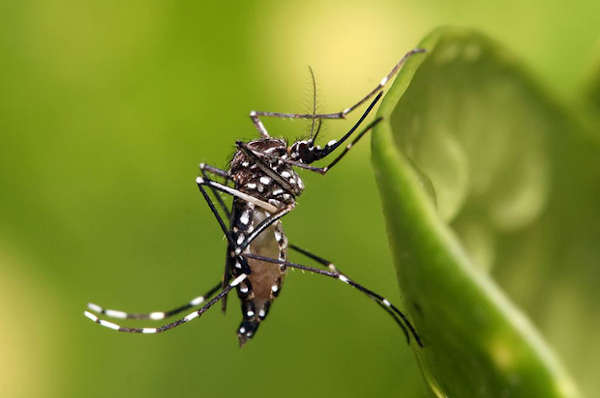
As winters become warmer, tropical mosquitoes like Aedes aegypti move northward, possibly increasing the spread of diseases such as dengue, yellow fever and Zika. Photo by Muhammad Mahdi Karim photo. Notwithstanding February's cold snap in Texas and Louisiana, climate change is leading to warmer winter weather throughout the southern U.S., creating a golden opportunity for many tropical plants and animals to move north, according to a new study in the journal Global Change Biology.
Some of these species may be welcomed, such as sea turtles and the Florida manatee, which are expanding their ranges northward along the Atlantic Coast.
Others, like the invasive Burmese python — in the Florida Everglades, the largest measured 18 feet, end-to-end – maybe less so.
Equally unwelcome, and among the quickest to spread into warming areas, are the insects, including mosquitoes that carry diseases such as West Nile virus, Zika, dengue and yellow fever, and beetles that destroy native trees.
"Quite a few mosquito species are expanding northward, as well as a lot of forestry pests: bark beetles, the southern mountain pine beetle," said Caroline Williams, associate professor of integrative biology at the University of California, Berkeley, and a co-author of the paper. "In our study, we were really focusing on that boundary in the U.S. where we get that quick tropical-temperate transition. Changes in winter conditions are one of the major, if not the major, drivers of shifting distributions."
That transition zone, northward of which freezes occur every winter, has always been a barrier to species that evolved in more stable temperatures, said Williams, who specializes in insect metabolism — in particular, how winter freezes and snow affect the survival of species.
"For the vast majority of organisms, if they freeze, they die," she said. "Cold snaps like the recent one in Texas might not happen for 30 or 50 or even 100 years, and then you see these widespread mortality events where tropical species that have been creeping northward are suddenly knocked back. But as the return times become longer and longer for these extreme cold events, it enables tropical species to get more and more of a foothold, and even maybe for populations to adapt in situ to allow them to tolerate more cold extremes in the future."
The study, conducted by a team of 16 scientists led by the U.S. Geological Survey, or USGS, focused on the effects warming winters will have on the movement of a broad range of cold-sensitive tropical plants and animals into the Southern U.S., especially into the eight subtropical U.S. mainland states: Florida, Alabama, Mississippi, Louisiana, Texas, New Mexico, Arizona and California. Williams and Katie Marshall of the University of British Columbia in Vancouver co-wrote the section on insects for the study.
The team found that a number of tropical species, including insects, fish, reptiles, amphibians, mammals, grasses, shrubs and trees, are enlarging their ranges to the north. Among them are species native to the U.S., such as mangroves, which are tropical salt-tolerant trees; and snook, a warm water coastal sport fish; and invasive species such as Burmese pythons, Cuban tree frogs, Brazilian pepper trees and buffelgrass.
“We don’t expect it to be a continuous process,” said USGS research ecologist Michael Osland, the study’s lead author. “There’s going to be northward expansion, then contraction with extreme cold events, like the one that just occurred in Texas, and then movement again. But by the end of this century, we are expecting tropicalization to occur.”
The authors document several decades’ worth of changes in the frequency and intensity of extreme cold snaps in San Francisco, Tucson, New Orleans and Tampa – all cities with temperature records stretching back to at least 1948. In each city, they found, mean winter temperatures have risen over time, winter’s coldest temperatures have gotten warmer, and there are fewer days each winter when the mercury falls below freezing.
Temperature records from San Francisco International Airport, for example, show that before 1980, each winter would typically see several sub-freezing days. For the past 20 years, there has been only one day with sub-freezing temperatures.
Changes already underway or anticipated in the home ranges of 22 plant and animal species from California to Florida include:
– Continuing displacement of temperate salt marsh plants by cold-sensitive mangrove forests along the Gulf and southern Atlantic coasts. While this encroachment has been happening over the last 30 years, with sea-level rise, mangroves may also move inland, displacing temperate and freshwater forests. – Buffelgrass and other annual grasses moving into Southwestern deserts, fueling wildfire in native plant communities that have not evolved in conjunction with frequent fire. – The likelihood that tropical mosquitos that can transmit encephalitis, West Nile virus and other diseases will further expand their ranges, putting millions of people and wildlife species at risk of these diseases. – Probable northward movement, with warming winters, of the southern pine beetle, a pest that can damage commercially valuable pine forests in the Southeast. – Recreational and commercial fisheries’ disruption by changing migration patterns and the northward movement of coastal fishes.
The changes are expected to result in some temperate zone plant and animal communities found today across the southern U.S. being replaced by tropical communities.
"Unfortunately, the general story is that the species that are going to do really well are the more generalist species — their host plants or food sources are quite varied or widely distributed, and they have relatively wide thermal tolerance, so they can tolerate a wide range of conditions," Williams said. "And, by definition, these tend to be the pest species — that is why they are pests: They are adaptable, widespread and relatively unbothered by changes in conditions, whereas, the more specialized or boutique species are tending to decline as they get displaced from their relatively narrow niche."
She cautioned that insect populations overall are falling worldwide.
"We are seeing an alarming decrease in total numbers in natural areas, managed areas, national parks, tropical rain forests — globally," she said. " So, although we are seeing some widespread pest species increasing, the overall pattern is that insects are declining extremely rapidly."
The authors suggest in-depth laboratory studies to learn how tropical species can adapt to extreme conditions and modeling to show how lengthening intervals between cold snaps will affect plant and animal communities.
"On a hopeful note, it is not that we are heading for extinction of absolutely everything, but we need to prepare for widespread shifts in the distribution of biodiversity as climate, including winter climate, changes," Williams said. "The actions that we take over the next 20 years are going to be critical in determining our trajectory. In addition to obvious shifts, like reducing our carbon footprint, we need to protect and restore habitat for insects. Individuals can create habitat in their own backyards for insects by cultivating native plants that support pollinators and other native insects. Those are little things that people can do and that can be important in providing corridors for species to move through our very fragmented habitats."
Robert Sanders writes for the UC Berkeley News Center.
LAKE COUNTY, Calif. – Lake County Animal Care and Control has four dogs prepared to go to new homes this week.
Dogs available for adoption this week include mixes of boxer, hound, Maltese, terrier and pit bull.
Dogs that are adopted from Lake County Animal Care and Control are either neutered or spayed, microchipped and, if old enough, given a rabies shot and county license before being released to their new owner. License fees do not apply to residents of the cities of Lakeport or Clearlake.
The following dogs at the Lake County Animal Care and Control shelter have been cleared for adoption (additional dogs on the animal control Web site not listed are still “on hold”).
Call Lake County Animal Care and Control at 707-263-0278 or visit the shelter online at http://www.co.lake.ca.us/Government/Directory/Animal_Care_And_Control.htm for information on visiting or adopting.
“Sophie” is a female boxer-pit bull mix in kennel No. 18, ID No. 14356. Photo courtesy of Lake County Animal Care and Control. ‘Sophie’
“Sophie” is a female boxer-pit bull mix with a short red coat.
She is in kennel No. 18, ID No. 14356.
This young male terrier is in kennel No. 20, ID No. 14487. Photo courtesy of Lake County Animal Care and Control. Male terrier
This young male terrier has a coarse white coat with brown markings.
He is in kennel No. 20, ID No. 14487.
This senior male Maltese is in kennel No. 24, ID No. 14489. Photo courtesy of Lake County Animal Care and Control. Male Maltese
This senior male Maltese has a long white coat.
He is in kennel No. 24, ID No. 14489.
“Sanders” is a young male hound mix in kennel No. 26, ID No. 14497. Photo courtesy of Lake County Animal Care and Control. ‘Sanders’
“Sanders” is a young male hound mix with a short black and white coat.
He is in kennel No. 26, ID No. 14497.
Email Elizabeth Larson at This email address is being protected from spambots. You need JavaScript enabled to view it.. Follow her on Twitter, @ERLarson, or Lake County News, @LakeCoNews.
 How to resolve AdBlock issue?