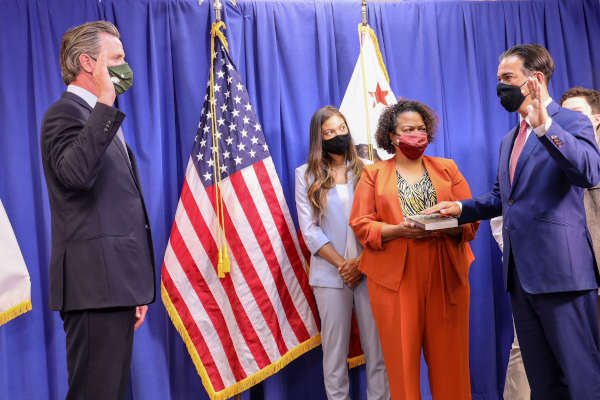
At left, Gov. Gavin Newsom is shown administering the oath of office to new California Attorney General Rob Bonta on Friday, April 23, 2021. Photo courtesy of the California Governor’s Office. Gov. Gavin Newsom on Friday swore in Assemblymember Rob Bonta as California’s 34th attorney general.
A national leader in the fight to reform our justice system and stand up to the forces of hate, Bonta is the first Filipino American in the state’s history to serve in the role.
“California and the nation need leaders like Rob Bonta to meet this pivotal moment in our history with the courage, energy and tenacity it will take to shape a society more reflective of our values,” said Gov. Newsom.
“Carrying the lessons of his remarkable upbringing at the center of historic social justice movements, Rob has been at the forefront of courageous fights for racial, economic and environmental justice from day one,” Newsom said. “As attorney general, Rob brings to bear the legal and moral authority to effectively engage a broad array of groups – community leaders, law enforcement, the Legislature and more – in a meaningful dialogue, so that California continues to build bridges and advance together in a direction that does justice to all our communities.”
Confirmed by the Legislature on Thursday, Bonta was selected by Gov. Newsom to fill the position vacated by Xavier Becerra, who was recently sworn in as secretary of the U.S. Department of Health and Human Services.
The governor announced the nomination last month at the historic International Hotel in San Francisco, a site where Asian and Pacific Islander Californians famously rallied in 1977 to save the homes of elderly residents and preserve their community.
“Thank you, Gov. Newsom for the faith and trust you have placed in me. Serving as California’s attorney general is the honor of a lifetime,” said Bonta. “There are a lot of challenges we face across America today. People see institutions that work well for those with wealth and power – at the expense of everyone else. We see hate on the rise. And too often, justice and accountability for those who harm others feel out of reach. As The People’s Attorney, I won’t back down when I see Californians hurt. Together, we will get justice for families cheated by multinational corporations. We will defend communities ravaged by big polluters. We will work to repair our justice system, and we will attack the forces of hate and white supremacy. I'm excited to get to work!”
Labor, environmental and criminal justice reform advocates welcomed the appointment.
“We congratulate Gov. Gavin Newsom on the appointment of Rob Bonta as attorney general of California, the first Filipino American in the state’s history to serve in this role. At an early age, Bonta learned about the values of social justice from his parents who worked for Civil Rights in the South and joined Cesar Chavez and myself as full-time volunteer organizers for the United Farm Workers,” said labor leader Dolores Huerta. “Rob Bonta has fought diligently throughout his career to correct the injustices affecting working families and Communities of Color. We are confident that Rob Bonta will work passionately to ensure our justice system protects all Californians. Si Se Puede!”
California Environmental Justice Alliance Executive Director Gladys Limon said the group celebrates Bonta’s appointment. “We know he will be a strong ally for all environmental justice communities that have been harmed by pollution and often poverty. We have worked closely with Mr. Bonta and consider him a leader and friend, and trust that he will fight tirelessly on behalf of all Californians and not be afraid to hold polluters accountable."
“This is a historic day for California. I’m so proud to see Rob Bonta sworn-in as California’s new Attorney General,” said REFORM Alliance Board Member and award-winning journalist Van Jones. “Rob is a lifelong leader in the fight to restore justice in California. I’ve known Rob for decades and he’s demonstrated time and again the commitment and capacity to reform critical elements of our criminal justice system including providing key support for the REFORM Alliance’s major probation legislation. I have every confidence that Rob will make a phenomenal California Attorney General.”
The son of activists, Bonta grew up in a trailer in La Paz, where his parents served at the headquarters of the United Farm Workers movement.
Inspired to pursue justice through the law, Bonta studied at Yale Law School and went on to work pro-bono protecting vulnerable Californians from exploitation and racial profiling.
He served nine years as a deputy city attorney in the San Francisco City Attorney’s Office before running for local office in Alameda County.
In 2012, Bonta became the first Filipino American in California history to win election to the Legislature, representing Assembly District 18 in the cities of Oakland, Alameda and San Leandro.
Bonta has passed major reforms that reversed long-standing injustices, including legislation that outlawed for-profit prisons in California, overhauled sentencing structure to automatically expunge and modify criminal records for people convicted of minor marijuana charges, took on big polluters, offered protections for renters, strengthened hate crime laws and protect communities, protected immigrant families from deceptive tactics by US Immigration and Customs Enforcement, reformed the bail system and required an independent investigation when there is a death of an unarmed civilian by law enforcement.
A SpaceX Falcon 9 rocket carrying the company's Crew Dragon spacecraft is launched on NASA’s SpaceX Crew-2 mission to the International Space Station with NASA astronauts Shane Kimbrough and Megan McArthur, European Space Agency astronaut Thomas Pesquet, and Japan Aerospace Exploration Agency astronaut Akihiko Hoshide onboard, Friday, April 23, 2021, at NASA’s Kennedy Space Center in Florida. Credits: NASA. NASA’s SpaceX Crew-2 astronauts are in orbit following their early morning launch bound for the International Space Station for the second commercial crew rotation mission aboard the microgravity laboratory.
The international crew of astronauts lifted off at 2:49 a.m. Pacific Time on Friday from Launch Complex 39A at NASA’s Kennedy Space Center in Florida.
The SpaceX Falcon 9 rocket propelled the Crew Dragon spacecraft with NASA astronauts Shane Kimbrough and Megan McArthur, along with Japan Aerospace Exploration Agency, or JAXA, astronaut Akihiko Hoshide and European Space Agency, or ESA, astronaut Thomas Pesquet, into orbit to begin a six-month science mission on the space station.
During Crew Dragon’s flight, SpaceX will command the spacecraft from its mission control center in Hawthorne, California, and NASA teams will monitor space station operations throughout the flight from Mission Control Center at the agency’s Johnson Space Center in Houston.
“It has been an incredible year for NASA and our Commercial Crew Program, with three crewed launches to the space station since last May,” said NASA Acting Administrator Steve Jurczyk. “This is another important milestone for NASA, SpaceX, and our international partners at ESA and JAXA, and for the future of scientific research on board the space station. It will be an exciting moment to see our crews greet one another on station for our first crew handover under the Commercial Crew Program.”
The Crew Dragon spacecraft, named Endeavour, will dock autonomously to the forward port of the station’s Harmony module about 2:10 a.m. Pacific Time Saturday, April 24. NASA Television, the NASA App, and the agency’s website are providing ongoing live coverage through docking, hatch opening, and the ceremony to welcome the crew aboard the orbital outpost.
“I’m really proud of the SpaceX team and honored to be partnered with NASA and helping JAXA and ESA as well,” said Elon Musk, Chief Engineer at SpaceX. “We’re thrilled to be a part of advancing human spaceflight and looking forward to going beyond Earth orbit to the Moon and Mars and helping make humanity a space-faring civilization and a multi-planet species one day.”
The Crew-2 mission is the second of six crewed missions NASA and SpaceX will fly as part of the agency’s Commercial Crew Program. This mission has several firsts, including:
– First commercial crew mission to fly two international partners; – First commercial crew handover between astronauts on the space station as Crew-1 and Crew-2 astronauts will spend about five days together on station before Crew-1 returns to Earth; – First reuse of the Crew Dragon spacecraft and Falcon 9 rocket on a crew mission – Crew Dragon Endeavour flew the historic Demo-2 mission and the Falcon 9 flew astronauts on the Crew-1 mission; and, – First time two commercial crew spacecraft will be docked to the station at the same time.
“When I see a launch I immediately think of what it took to reach this milestone and the dedication of all the people who made it happen,” said Steve Stich, manager of NASA’s Commercial Crew Program. “There’s obviously a long way to go, but now we can celebrate the Crew-2 launch and look forward to seeing them join their other Expedition 65 colleagues as we prepare to bring Crew-1 home next week.”
Kimbrough, McArthur, Hoshide, and Pesquet will join the Expedition 65 crew of Shannon Walker, Michael Hopkins, Victor Glover and Mark Vande Hei of NASA, as well as Soichi Noguchi of JAXA and Roscosmos cosmonauts Oleg Novitskiy and Pyotr Dubrov.
For a short time, the number of crew on the space station will increase to 11 people until Crew-1 astronauts Walker, Hopkins, Glover, and Noguchi return a few days later.
This is the second commercial crew mission to fly a JAXA astronaut. When Hoshide joins astronaut Noguchi during the commercial crew handover period, it will mark the first time two JAXA astronauts are on station at the same time.
“I am extremely honored to witness the successful launch today. It is my utmost pleasure and also for Japan that Japanese astronauts Soichi Noguchi and Aki Hoshide boarded the operational spacecraft of Crew Dragon twice in a row,” said Hiroshi Sasaki, vice president for Human Spaceflight and Space Exploration. “I believe this is brought by the many years of close cooperation cultivated amongst the international partners, especially between the U.S. and Japan through the ISS program. I hope Aki will play an integral role as the second Japanese ISS commander along with his colleague astronauts, creating fruitful outcomes and expanding the human frontier to the Lunar Gateway, the surface of the Moon and even beyond.”
Crew-2 also is the first commercial crew mission to fly an ESA astronaut. Pesquet is the first of three ESA crew members assigned to fly to the station on commercial crew spacecraft, kicking off a continuous stay of ESA astronauts on the space station for about a year and a half – in total – for the first time in more than 20 years.
"This is a thrilling time for human spaceflight and this new success of the Commercial Crew Program embodies it – congratulations once again to NASA and SpaceX,” said David Parker, director of human and robotic exploration at ESA. “Starting with astronaut Thomas Pesquet, ESA is delighted to join this new space station chapter, paving the way to the future of exploration side by side with diverse partners. Six months of excellent science and state-of-the-art technology demonstrations now await him, and we know he cannot wait to start working."
Crew-2 astronauts
Shane Kimbrough is commander of the Crew Dragon spacecraft and the Crew-2 mission. Kimbrough is responsible for all phases of flight, from launch to re-entry. He also will serve as an Expedition 65 flight engineer aboard the station. Selected as a NASA astronaut in 2004, Kimbrough first launched aboard space shuttle Endeavour for a visit to the station on the STS-126 mission in 2008, and then aboard a Russian Soyuz spacecraft for his first long-duration mission for Expedition 49/50 in 2016. He has spent a total of 189 days in space and performed six spacewalks. Kimbrough also is a retired U.S. Army colonel and earned a bachelor’s degree in aerospace engineering from the United States Military Academy at West Point, New York, and a master’s degree in operations research from the Georgia Institute of Technology in Atlanta.
Megan McArthur is the pilot of the Crew Dragon spacecraft and second-in-command for the mission. McArthur is responsible for spacecraft systems and performance. She also will be a long-duration space station crew member, making her first trip to the space station. Selected as an astronaut in 2000, McArthur launched on space shuttle Atlantis as a mission specialist on STS-125, the final Hubble Space Telescope servicing mission, in 2009. McArthur operated the shuttle’s robotic arm over the course of the 12 days, 21 hours she spent in space, capturing the telescope and moving crew members during the five spacewalks needed to repair and upgrade it. She holds a bachelor’s degree in aerospace engineering from the University of California, Los Angeles and a doctorate in oceanography from the University of California, San Diego.
Akihiko Hoshide is a mission specialist for Crew-2. As a mission specialist, he will work closely with the commander and pilot to monitor the spacecraft during the dynamic launch and re-entry phases of flight. Once aboard the station, Hoshide will become a flight engineer for Expedition 65. Hoshide joined the National Space Development Agency of Japan (NASDA, currently JAXA) in 1992 and was selected as an astronaut candidate in February 1999. Hoshide is a veteran of two spaceflights. In June 2008, he flew to the International Space Station on the STS-124 mission to deliver the Japanese Experiment Module "Kibo" to the station. From July to November 2012, he stayed on the space station for 124 days as a flight engineer for the Expedition 32/33 mission. The Crew Dragon will be the third spacecraft that Noguchi has flown to the orbiting laboratory.
Thomas Pesquet also will be a mission specialist for Crew-2, working with the commander and pilot to monitor the spacecraft during the dynamic launch and re-entry phases of flight. Pesquet also will become a long-duration crew member aboard the space station. He was selected as an astronaut candidate by ESA in May 2009 and worked as a Eurocom, communicating with astronauts during spaceflights from the mission control center. He previously flew as part of Expeditions 50 and 51, launching aboard a Russian Soyuz spacecraft in October 2016 and spending 196 days in space, returning to Earth in June 2017. His mission also included two spacewalks to maintain the station: one to replace batteries on an electrical channel, and one to detect a cooling leak and service the robotic arm.
Mission objectives
The Crew-2 members will conduct science and maintenance during a six-month stay aboard the orbiting laboratory and will return no earlier than Oct. 31. The Crew Dragon spacecraft can stay in orbit for at least 210 days, which is a NASA requirement.
Adding more crew members aboard the microgravity laboratory increases the time available for scientific activities.
The November 2020 arrival of the Crew-1 astronauts more than doubled crew hours spent on scientific research and support activities, and Crew-2 will continue the important investigations and technology demonstrations that are preparing for future Artemis missions to the Moon, helping us improve our understanding of Earth’s climate, and improving life on our home planet. An important scientific focus on this expedition is continuing a series of Tissue Chips in Space studies.
Tissue chips are small models of human organs containing multiple cell types that behave much the same as they do in the body. Another important element of Crew-2’s mission is augmenting the station’s solar power system by installing the first pair of six new ISS Roll-out Solar Arrays.
Crew Dragon also is delivering almost 250 pounds of cargo, new science hardware, and experiments, including a university student-led investigation to study possible causes for suppressed immune response in microgravity.
During their stay on the orbiting laboratory, Crew-2 astronauts expect to see a range of U.S. commercial spacecraft, including the Northrop Grumman Cygnus; SpaceX cargo Dragon; Boeing CST-100 Starliner, on its uncrewed flight to station; and NASA’s SpaceX Crew-3 Dragon; which is targeted for launch no earlier than Oct. 23. During Crew-2, astronauts also will conduct a variety of spacewalks outside the space station, including the solar array installation.
At the conclusion of the mission, the Crew-2 astronauts will board Crew Dragon, which will then autonomously undock, depart the space station, and re-enter Earth’s atmosphere. Crew Dragon also will return to Earth important and time-sensitive research. NASA and SpaceX are capable of supporting seven splashdown sites located off Florida's east coast and in the Gulf of Mexico. Upon splashdown, the SpaceX recovery ship will pick up the crew and return to shore.
NASA’s Commercial Crew Program is delivering on its goal of safe, reliable, and cost-effective transportation to and from the International Space Station from the United States through partnership with American private industry.
This partnership is changing the arc of human spaceflight history by opening access to low-Earth orbit and the International Space Station to more people, more science, and more commercial opportunities.
The space station remains the springboard to NASA's next great leap in space exploration, including future missions to the Moon and, eventually, to Mars.
For more than 20 years, humans have lived and worked continuously aboard the International Space Station, advancing scientific knowledge and demonstrating new technologies, making research breakthroughs not possible on Earth.
As a global endeavor, 243 people from 19 countries have visited the unique microgravity laboratory that has hosted more than 3,000 research and educational investigations from researchers in 108 countries and areas.
LAKE COUNTY, Calif. – The Lake County Planning Commission on Thursday approved a large cannabis growing operation adjacent to the Hidden Valley Lake subdivision over the objections of numerous neighbors.
Zarina Otchkova, owner of WeGrow LLC, is planning a project on a portion of a 309-acre property she purchased early last year at 16750 Herrington Road, 17610 Sandy Road and 19678 Stinson Road in Middletown.
Otchkova went to the commission seeking approval of numerous cannabis-related licenses, a mitigated negative declaration and a use permit for the project, which includes 35 greenhouses, which during the meeting was described by a neighbor, Dan Levine, as an area equaling the size of 13 football fields.
Other aspects of the project include four 50-foot by 100-foot drying buildings, a 200-square-foot shed, four 2,500-gallon water tanks and fencing. The total cultivation area will cover nine acres.
During his report to the commission, Associate Planner Eric Porter said there has been a lot of public interest in the project, with 80 letters and comments submitted.
They also had gotten a letter from a law firm against the project and comments submitted by the Redwood Valley Pomo objecting due to aquifer usage. Porter said there was no way of doing an aquifer adequacy test.
After a comprehensive review and reviewing comments, Porter said he couldn't find a reason to recommend anything other than approval.
Otchkova and her consultant, Sufyan Hamouda of Lake County Planning Consultants – who also worked as an associate planner for a year for the county of Lake – attended virtually to answer questions.
“I do understand that this project has had a lot of public comments,” said Otchkova, explaining she and Hamouda had tried to read through each of the comments.
“We have considered all of these concerns in great detail,” she said.
Otchkova added, “A business cannot run without the support of its community.”
In a letter Otchkova submitted to the commission ahead of the meeting, she said she chose the property because it meets all of the qualifications for a major use permit for commercial cannabis cultivation.
“I am fully aware that this property will need modifications to continue to meet the requirements for a commercial cannabis business and I will implement those at every stage. At no point do I want to infringe upon anyone’s rights within the community, so if there are conditions that can be put in place to mitigate for any impacts this project may have upon the community, I will put those in immediately. I am not only here to mitigate, but I would like to be a positively contributing member of the community, so all comments are appreciated,” she wrote.
The letter can be read below.
Commissioner John Hess said there has been an enormous amount of community concern about stolen or unauthorized equipment found on the property, which reportedly resulted in a California Highway Patrol case.
Hamouda said the property was purchased early last year and since then none of Otchkova's team had been on the property regularly. He said he had contacted the CHP and the case didn’t pertain to Otchkova or her project.
Separately, Lake County News reached out to the CHP about the allegations of stolen farm equipment being recovered from the property but didn’t receive a response by the time of publication.
Hess said the stolen equipment was observed on the property in February 2020 after Otchkova purchased the land.
Hamouda said the CHP has not given him information on what occurred. “We are unsure of that situation to be completely honest with you.”
Water a main concern for neighbors
Nearly 20 community members provided comment to the commission, each raising concerns about the project which ran the gamut from traffic, safety, visual impact, smell, quality of life impacts, environmental damage and negative impacts on wildlife.
One of the key issues related to water, especially as Lake County faces a drought year.
Dan Levine said that, contrary to the findings in the initial study, many who live in the area will have a view of the project. He questioned how many generators would need to run it to support it if the power goes out.
Misha Grothe, who lives near the project area, said her biggest concern is the aquifers.
“I cannot understand how the county is willing to consider allowing such a massive consumption of water at this time,” Grothe said.
She said it’s close to other homes, not in a neighborhood area, and will decrease home values.
Mary Sullivan, who lives in the nearby Rim Rock Ranch Vineyards Estate, said she opposed the project, noting they are already having well failure in their community.
“We feel like it’s an imminent threat to our livelihood given what we’ve already experienced,” Sullivan said. “We could lose everything because of this development.”
Carly Swatosh-Sherman also was concerned about the millions of gallons of water the project would require, and said that it violates requirements of the Middletown Area Plan relating to protection of scenic ridges, oaks and quality of life.
“The proposal needs to be denied for countless reasons,” Swatosh-Sherman said.
Commissioner Lance Williams said the greenhouses would have to have blackout systems otherwise it wouldn’t be acceptable.
Hess said he understood there are strong feelings about the project and that he lives nearby. He said he’s looked high and low for a way to oppose it but didn’t find anything.
Porter noted that the greenhouses would have to have blackout screening before cultivation can occur. The project requires 20,000 gallons of onsite water storage, with an additional 5,000-gallon tank for water suppression. The commission also agreed to require an 8-foot-tall fence to screen it.
Hess moved to find the major use permit won’t have a significant effect, will Williams seconding and the commission approving the vote 4-0. Chair Batsulwin Brown had to leave the meeting before the vote.
Hess also moved to find the major use permit meets the requirements of the county zoning ordinance and grant it subject to conditions. Williams also seconded and the vote passed, 4-0.
The commission noted that the zoning ordinance provides for a seven calendar day appeal period.
Levine told Lake County News afterward that he expects an appeal will be filed.
Email Elizabeth Larson at This email address is being protected from spambots. You need JavaScript enabled to view it.. Follow her on Twitter, @ERLarson, or Lake County News, @LakeCoNews.
The meeting ID is 932 5558 1208, passcode is 439064. The meeting also can be accessed via phone at 1-669-900-6833.
Under old business, the group will discuss site visits with the US Department of Agriculture’s Natural Resources Conservation Service, the bridge approach over Scotts Creek at Scotts Valley Road and Hendricks, and applications being due for the advisory council applications.
Under new business, they will discuss use permits, management and monitoring of the Scotts Valley Water Basin and the Adopt a Road program.
During the meeting, community members also will be able to share their concerns with District 4 Supervisor Tina Scott.
CLEARLAKE, Calif. – Clearlake Animal Control has seven dogs waiting to be adopted this week.
The following dogs are ready for adoption or foster.
“Bear.” Photo courtesy of Clearlake Animal Control. ‘Bear’
“Bear” is a male American Pit Bull Terrier mix with a short brown coat.
He is dog No. 3476.
“Dorito.” Photo courtesy of Clearlake Animal Control. ‘Dorito’
“Dorito” is a male American Staffordshire Terrier mix with a short white and gray coat.
He has been neutered.
He is dog No. 4576.
“Dusty.” Photo courtesy of Clearlake Animal Control. ‘Dusty’
“Dusty” is a male American Pit Bull Terrier with a tan and white coat.
He is dog No. 4750.
“Hector.” Photo courtesy of Clearlake Animal Control. ‘Hector’
“Hector” is a male American Pit Bull Terrier mix with a short brindle coat.
He is dog No. 4697.
“Inky.” Photo courtesy of Clearlake Animal Control. ‘Inky’
“Inky” is a male German Shepherd mix with a long black coat.
He has been neutered.
He is dog No. 4324.
“Sassy.” Photo courtesy of Clearlake Animal Control. ‘Sassy’
“Sassy” is a female American Bully with a short black with white markings.
She is dog No. 4602.
“Toby.” Photo courtesy of Clearlake Animal Control. ‘Toby’
“Toby” is a friendly senior male boxer mix.
He has a short tan and white coat.
He is dog No. 4389.
Call the Clearlake Animal Control shelter at 707-273-9440, or email This email address is being protected from spambots. You need JavaScript enabled to view it. to inquire about adoptions and schedule a visit to the shelter.
Visit Clearlake Animal Control on Facebook or on the city’s website.
Email Elizabeth Larson at This email address is being protected from spambots. You need JavaScript enabled to view it.. Follow her on Twitter, @ERLarson, or Lake County News, @LakeCoNews.
Wildfire smoke can trigger a host of respiratory and cardiovascular symptoms, ranging from runny nose and cough to a potentially life-threatening heart attack or stroke.
A new study suggests that the dangers posed by wildfire smoke may also extend to the largest organ in the human body, and our first line of defense against outside threat: the skin.
During the two weeks in November 2018 when wildfire smoke from the Camp Fire choked the San Francisco Bay Area, health clinics in San Francisco saw an uptick in the number of patients visiting with concerns of eczema, also known as atopic dermatitis, and general itch, compared to the same time of the year in 2015 and 2016, the study found.
The findings suggest that even short-term exposure to hazardous air quality from wildfire smoke can be damaging to skin health.
The report, carried out by physician researchers at the UC San Francisco, in collaboration with researchers at the UC Berkeley, appears on April 21 in the journal JAMA Dermatology.
“Existing research on air pollution and health outcomes has focused primarily on cardiac and respiratory health outcomes, and understandably so. But there is a gap in the research connecting air pollution and skin health,” said study lead author Raj Fadadu, a student in the UC Berkeley-UCSF Joint Medical Program. “Skin is the largest organ of the human body, and it's in constant interaction with the external environment. So, it makes sense that changes in the external environment, such as increases or decreases in air pollution, could affect our skin health.”
Air pollutants can slip through skin barriers
Air pollution from wildfires, which consists of fine particulate matter, or PM2.5, polycyclic aromatic hydrocarbons, or PAHs, and gases, can impact both normal and eczema-prone skin in a variety of ways.
These pollutants often contain chemical compounds that act like keys, allowing them to slip past the skin’s outer barrier and penetrate into cells, where they can disrupt gene transcription, trigger oxidative stress or cause inflammation.
Eczema, or atopic dermatitis, is a chronic condition which affects the skin’s ability to serve as an effective barrier against environmental factors. Because the skin’s barrier has been compromised, people with this condition are prone to flare-ups of red, itchy skin in response to irritants, and may be even more prone to harm from air pollution.
“Skin is a very excellent physical barrier that separates us and protects us from the environment,” said study senior author Maria Wei, MD, PhD, a dermatologist and melanoma specialist at UCSF. “However, there are certain skin disorders, such as atopic dermatitis, in which the barrier is not fully functional. It's not normal even when you don't have a rash. So, it would make sense that when exposed to significant air pollution, people with this condition might see an effect on the skin.”
Even short burst of air pollution harms skin health
Earlier studies have found a link between atopic dermatitis and air pollution in cities with high background levels of air pollution from cars and industry. However, this is the first study to examine the impacts of a very short burst of extremely hazardous air from wildfires.
Despite being located 175 miles away from the Camp Fire, San Francisco saw an approximately nine-fold increase in baseline PM2.5 levels during the time of the blaze.
To conduct the study, the team examined data from more than 8,000 visits to dermatology clinics by both adults and children between October of 2015, 2016 and 2018, and February of the following year. They found that, during the Camp Fire, clinic visits for atopic dermatitis and general itch increased significantly in both adult and pediatric patients.
“Fully 89 percent of the patients that had itch during the time of the Camp Fire did not have a known diagnosis of atopic dermatitis, suggesting that folks with normal skin also experienced irritation and/or absorption of toxins within a very short period of time,” Wei said.
While skin conditions like eczema and itch may not be as life-threatening as the respiratory and cardiovascular impacts of wildfire smoke, they can still severely impact people’s lives, the researchers say.
The study also documented increased rates of prescribed medications, such as steroids, during times of high air pollution, suggesting that patients can experience severe symptoms.
Individuals can protect their skin during wildfire season by staying indoors, wearing clothing that covers the skin if they do go outside, and using emollients, which can strengthen the skin’s barrier function. A new medication to treat eczema, called Tapinarof, is now in clinical trials and could also be a useful tool during times of bad air.
“A lot of the conversations about the health implications of climate change and air pollution don’t focus on skin health, but it’s important to recognize that skin conditions do affect people's quality of life, their social interactions and how they feel psychologically,” Fadadu said. “I hope that these health impacts can be more integrated into policies and discussions about the wide-ranging health effects of climate change and air pollution.”
Co-authors of the paper from UCSF are Barbara Grimes, PhD and Albert T. Young, a MD candidate. From UCB: Nicholas P. Jewell, PhD. Co-authors also include Katrina Abuabara, MD and John R. Balmes, MD, who both have a dual appointment at UCSF and UC Berkeley; and Jason Vargo, PhD of the California Department of Public Health.
The study was supported by the UCSF Summer Explore Fellowship, the Alameda-Contra Costa Medical Association Summer Fellowship, and the UC Berkeley-UCSF Joint Medical Program Thesis Grant. For more funding details, please see the paper.
Elizabeth Fernandez writes for the University of California, San Francisco.
 How to resolve AdBlock issue?