 How to resolve AdBlock issue?
News
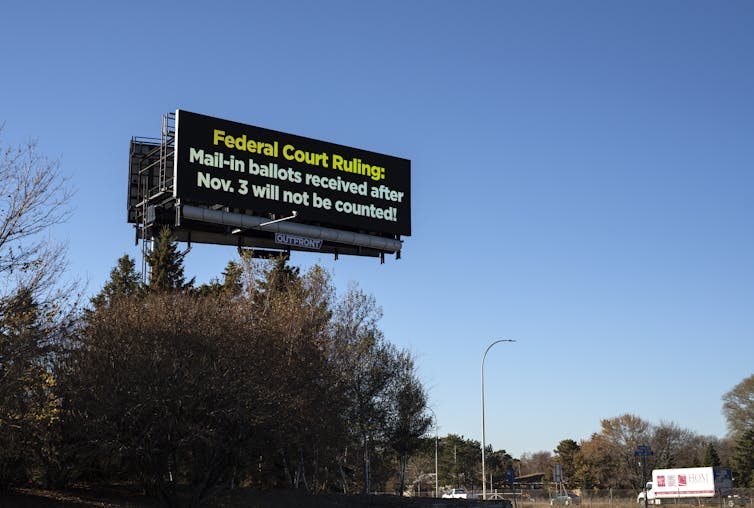
One of the most heavily contested voting-policy issues in the 2020 election, in both the courts and the political arena, was the deadline for returning absentee ballots.
Going into the election, the policy in a majority of states was that ballots had to be received by election night to be valid. Lawsuits seeking an extension of these deadlines were brought around the country for two reasons: First, because of the pandemic, the fall election would see a massive surge in absentee ballots; and second, there were concerns about the competence and integrity of the U.S. Postal Service, particularly after President Trump appointed a major GOP donor as the new postmaster general.
The issue produced the Supreme Court’s most controversial decision during the general election, which prohibited federal courts from extending the ballot-receipt deadlines in state election codes. Now that the data are available, a post-election audit provides perspective on what the actual effects of these deadlines turned out to be.
Perhaps surprisingly, the number of ballots that came in too late to be valid was extremely small, regardless of what deadline states used, or how much that deadline shifted back and forth in the months before the election. The numbers were nowhere close to the number of votes that could have changed the outcome of any significant race.
Changing deadlines in Wisconsin
Take Wisconsin and Minnesota, two important states that were the site of two major court controversies over these issues. In both, voters might be predicted to be the most confused about the deadline for returning absentee ballots, because those deadlines kept changing.
In Wisconsin, state law required absentee ballots to be returned by Election Night. The federal district court ordered that deadline extended by six days. But the Supreme Court, in a 5-3 decision, blocked the district’s court order and required the deadline in the state’s election code to be respected.
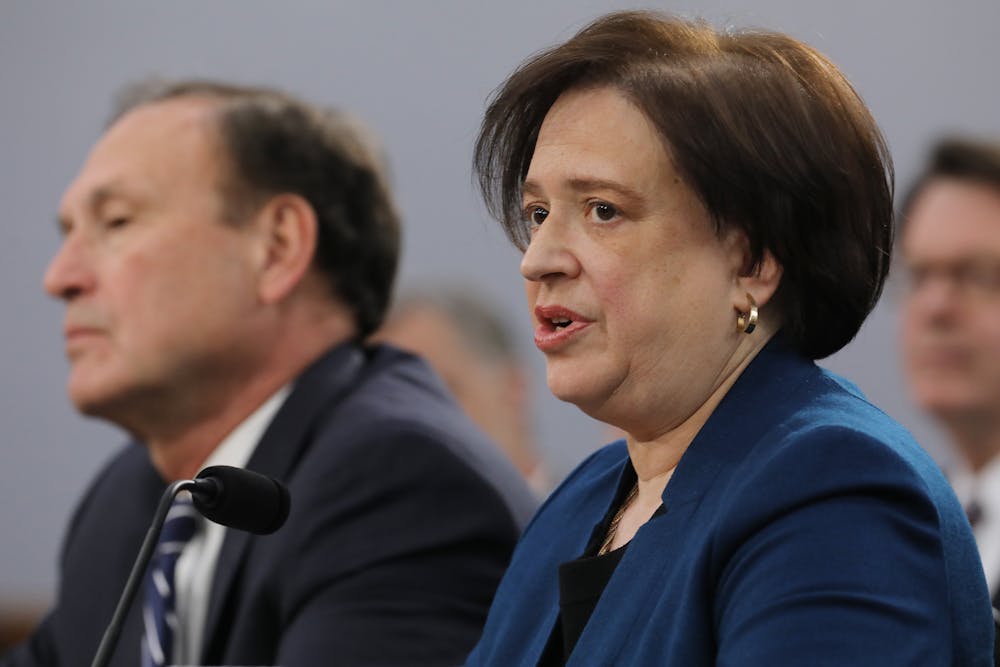
Writing for the three dissenters, Justice Elena Kagan invoked the district court’s prediction that as many as 100,000 voters would lose their right to vote, through no fault of their own, as a result of the majority’s ruling that the normal state-law deadline had to be followed. Commentators called this a “disastrous ruling” that “would likely disenfranchise tens of thousands” of voters in this key state.
The post-election audit now provides perspective on this controversy that sharply divided the court. Ultimately, only 1,045 absentee ballots were rejected in Wisconsin for failing to meet the Election Night deadline. That amounts to 0.05% ballots out of 1,969,274 valid absentee votes cast, or 0.03% of the total vote in Wisconsin.
If we put this in partisan terms and take Biden as having won roughly 70% of the absentee vote nationwide, that means he would have added 418 more votes to his margin of victory had these late-arriving ballots been valid.
Changing deadlines in Minnesota
The fight over ballot deadlines in Minnesota was even more convoluted. If voters were going to be confused anywhere about these deadlines, with lots of ballots coming in too late as a result, it might have been expected to be here.
State law required valid ballots to be returned by Election Night, but as a result of litigation challenging that deadline, the secretary of state had agreed in early August that ballots would be valid if they were received up to seven days later.
But a mere five days before the election, a federal court pulled the rug out from under Minnesota voters. On Oct. 29, it held that Minnesota’s secretary of state had violated the federal Constitution and had no power to extend the deadline. The original Election Night deadline thus snapped back into effect at the very last minute.
Yet it turns out that only 802 ballots, out of 1,929,945 absentees cast (0.04%), were rejected for coming in too late.
Even though voting-rights plaintiffs lost their battles close to Election Day in both Wisconsin and Minnesota, with the deadlines shifting back and forth, only a tiny number of ballots arrived too late.
Where deadlines didn’t change
What happened in states that had a consistent policy throughout the run-up to the election that required ballots to be returned by Election Night?
Among battleground states, Michigan provides an example. Only 3,328 ballots arrived after Election Day, too late to be counted, which was 0.09% of the total votes cast there.
Finally, Pennsylvania and North Carolina were two states in which litigation did succeed in generating decisions that overrode the state election code and pushed ballot-receipt deadlines back – in Pennsylvania by three days, in North Carolina by six days.
These decisions provoked intense political firestorms in some quarters, particularly regarding Pennsylvania. The Pennsylvania Supreme Court’s three-day extension of the deadline became the primary justification that some Republican senators and representatives offered on Jan. 6 for objecting to counting the state’s Electoral College votes.
How many voters took advantage of these extended deadlines? In North Carolina, according to information that the state Board of Elections provided to me, 2,484 ballots came in during the additional six days after Election Day that the judicial consent decree added. That comes to 0.04% of the total valid votes cast in the state.
In Pennsylvania, about 10,000 ballots came in during the extended deadline window, out of the 2,637,065 valid absentee ballots. That’s 0.14% of the total votes cast there. These 10,000 ballots were not counted in the state’s certified vote total, but had they been, Biden would likely have added around 5,000 votes to his margin of victory, given that he won about 75% of the state’s absentee vote.
These are not the numbers of ballots, of course, that would have come in late had the courts refused to extend the deadline in these two states. They show the maximum number that arrived after Election Day when voters had every right to return their ballots this late. Even so, those numbers are still far lower than the 100,000 that had been predicted in Wisconsin.
But had the statutory deadlines remained in place in Pennsylvania and North Carolina, there is no reason to think the number of late absentees would have been much different from those in similar swing states like Michigan, where the statutory deadlines remained fixed and 0.09% of ballots arrived too late.
Highly engaged voters
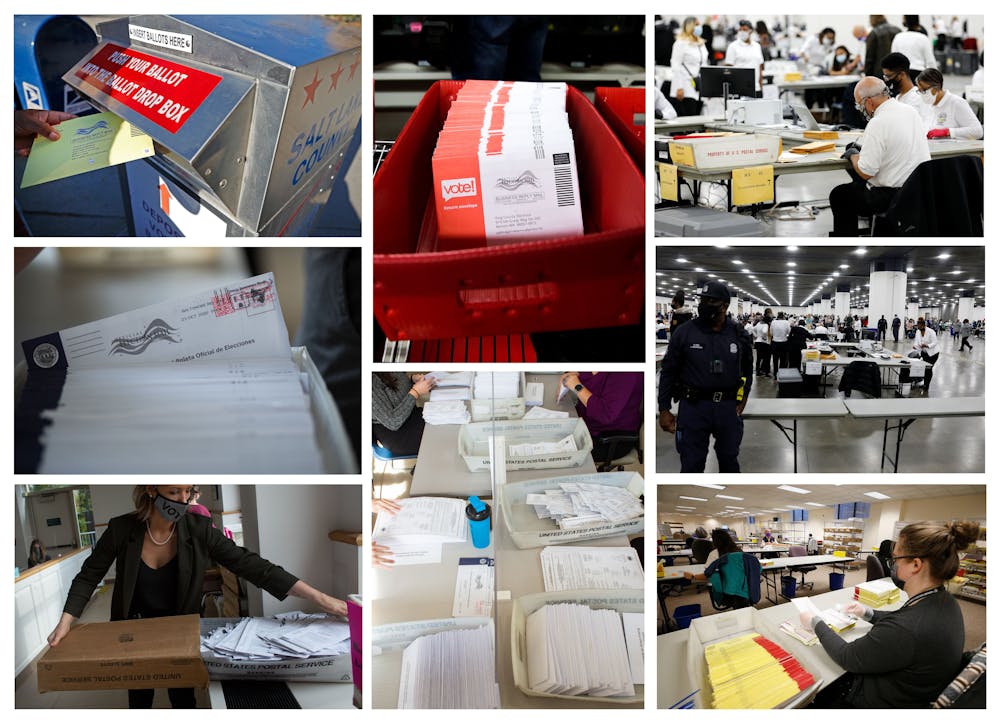
The small number of absentee ballots that came in after the legal deadlines occurred despite a massive surge in absentee voting in nearly all states. What explains that?
Voters were highly engaged, as the turnout rate showed. They were particularly attuned to the risk of delays in the mail from seeing this problem occur in the primaries. Throughout the weeks before the election, voters were consistently returning absentee ballots at higher rates than in previous elections.
The communications efforts of the Biden campaign and the state Democratic parties, whose voters cast most of these absentee votes, got the message across about these state deadlines. Election officials did a good job of communicating these deadlines to voters. In some states, drop boxes that permitted absentee ballots to be returned without using the mail might have helped minimize the number of late arriving ballots, though we don’t have any empirical analysis on that.
In a highly mobilized electorate, it turns out that the specific ballot-return deadlines, and whether they shifted even late in the day, did not lead to large numbers of ballots coming in too late.
That’s a tribute to voters, election officials, grassroots groups – and to the campaigns.
Richard Pildes, Professor of Constitutional Law, New York University
This article is republished from The Conversation under a Creative Commons license. Read the original article.
What's up for April? Morning planets, a sunset arch and finding Leo the lion.
April 22 is Earth Day – an annual opportunity to collectively appreciate the wonder and beauty of our home planet. So it seems appropriate to feature an Earth-related sight you can see any time of the year when you have clear skies. It's a twilight phenomenon that you might have noticed just after sunset.
If you can pull your gaze away from the sunset in the west, and spin yourself around to face east, you'll often notice a band of pink- or orange-colored sky with a darker, bluish band beneath. These bands move upward over the minutes following sunset to form an arch across the sky that slowly fades as night sets in. The dark band is Earth's shadow rising. Above it, the rosy-hued band is known as the Belt of Venus.
We observe this sight for a short time after sunset when the sun is just below the horizon, but some of its light rays are still making their way through the atmosphere before nightfall. The redder, or longer wavelengths, of sunlight are able to travel the longest distance through the atmosphere. And at the point opposite to the sunset, this reddish light is scattered off the atmosphere and back toward your eyes.
The Belt of Venus is named not for the planet, but for the mythical goddess. Together with Earth's shadow, these sights form the "anti-twilight arch." This arch rises like a curtain on the night, slowly fading as Earth's shadow eventually fills the sky, allowing us to gaze outward into the stars.
You can see this sight in morning twilight as well, by looking in the direction opposite the rising sun – that is, toward the west. As the sky begins to lighten, Earth's shadow becomes noticeable with the Belt of Venus above it, and these bands slowly sink to the horizon as day breaks.
April is a great time to look for Leo, that is, the constellation Leo. Leo is the Latin word for "lion," and this well-known grouping of stars is named for a super-powered lion vanquished by the mythical hero Hercules. It's a pretty easy constellation to locate, because it sort of looks like a lion reclining in the sky, and has this recognizable curving shape, called the Sickle, that represents the lion's head.
In April, you can find Leo high overhead in the south in the first few hours after sunset. In addition to the sickle shape of the lion's head, look for the lion's heart – the brilliant bluish-white star Regulus, which is one of the brightest stars in the sky.
Astronomers think most stars have a family of planets orbiting them. And these two bright stars in Leo – named Algieba (which is actually a double star!) and Rasalas – each have a confirmed planet larger than Jupiter orbiting around them. So step out after dark in April to look for Leo, with its sickle-shaped lion's mane, and blazing bluish heart.
Preston Dyches works for NASA's Jet Propulsion Laboratory.
At 11:22 a.m. Friday, the agency posted an update on its Facebook page saying that 14-year-old Ocean Smith was safely located.
He had gone missing on Thursday night after 10:30 p.m. after a dispute with family.

LAKE COUNTY, Calif. – The Clearlake Police Department said early Friday that it is trying to locate a missing at-risk 14-year-old boy.
The department is trying to find Ocean Smith.
At 10:30 p.m. Thursday, Ocean Smith was in a dispute with family at his residence located in the area of the 14500 block of Lakeshore Drive, police said.
After the dispute, police said Ocean left the residence in an unknown direction.
Ocean is described by family as having special needs and this behavior is out of character for him, police said.
Ocean is a black male juvenile, standing 6 feet tall and weighing 300 pounds, with black hair and hazel eyes. Police said he was last seen wearing a t-shirt and blue shorts.
If you see Ocean, please contact the Clearlake Police Department at 707-994-8251.
LAKE COUNTY, Calif. – A long-disputed building project at Hidden Valley Lake received a unanimous vote from the Lake County Planning Commission on Thursday that will allow construction to move forward.
The Hidden Valley Lake Homeowners Association’s Hartmann Complex received a 4-0 vote approving a mitigated negative declaration and the granting of a major use permit during a discussion that ran less than 45 minutes on Thursday morning.
The discussion can be viewed in the video above, starting at the 2:08:20 mark.
The association plans to build the new 12,483 square foot Hartmann Complex at 19210 Hartmann Road, a short distance away from the 7,200 square foot building that currently houses the Greenview Restaurant and pro shop.
Once the new building is completed, it will house the restaurant and pro shop. The older building will then be demolished.
Planning documents said the new building will have expanded banquet facilities and a 3,180 square foot covered patio, with its proximity to the golfing facilities requiring new netting on driving range tees, the relocation of practice greens and repositioning of the first hole golf tees, more parking, a dedicated drop-off area and new sidewalk, curb and gutter.
Associate Planner Eric Porter said the county received a lot of feedback on the project in 2015 not long after it was initially proposed, and on Thursday morning received a petition with 28 property owners objecting to it, along with about 10 other letters raising concerns.
“My job is to look at it in terms of compliance with the code, the general plan and the area plan that applies,” Porter said, adding that’s what he did.
He reviewed the plan with the commission, and explained construction of the new building and demolition of the old one should take a total of four to six months.
An environmental review was conducted and Porter said the county didn’t receive any adverse comments from local or state agencies. The Middletown Rancheria expressed interest and has entered into a contractual agreement with the homeowners association, with the tribe notifying Porter of its support for the project proceeding.
“I couldn't find a reason to recommend anything but approval” of the mitigated negative declaration and use permit, Porter said.
Despite Porter’s stated expectation during the meeting of receiving a large amount of public comment, only four community members spoke about the project, in addition to Hidden Valley Lake Association General Manager Randy Murphy.
“The project is a long time coming. It’s been in the works over 10 years,” said Murphy.
He said there is a “small but vocal contingent” that has stalled it and delayed it through recalls and other actions. Murphy blamed those delays for costing the association several million more dollars to build the complex than it would have cost to build it five or six years ago.
Murphy said the current building was designed and built in the late 1960s when the community was much smaller. “The new project will be the crown jewel for our association.”
He said the demand for property in Hidden Valley Lake is higher than it’s been in years, and he asserted that new residents are very supportive of the project.
Commissioner Lance Williams asked how many people live in the community. Murphy said the most recent population estimate is between 6,000 and 6,500 residents. There are just under 3,300 lots, of which about 2,400 are developed.
Residents raise concerns
Hidden Valley Lake homeowner Elizabeth Montgomery told the commission she opposes the project, which she said the homeowners association can’t afford.
“We are struggling financially already,” and don’t have the $8 million to $10 million to build the complex, Montgomery said. She suggested the building could start and then not be completed.
“Urgent wildfire safety needs are being neglected in my neighborhood, they are being neglected in favor of this project,” said Montgomery, who also raised issues about the building being located in a flood zone, the need to consider climate change and inadequate stormwater drainage infrastructure.
Resident Lisa Kaplan told the commission that the community is “pretty much divided” over the project. She said that after 10 years – with a wildfire in the middle – people are exhausted due to the fight.
“When it comes to our pocketbooks, this is a real problem,” she said, adding, “All of our real public spaces are being neglected in favor of this building.”
Lakeport resident Bobby Dutcher said he’s served on boards and they never get 100-percent approval on issues. He suggested giving the association the benefit of the doubt and supporting the project, allowing the association to upgrade itself.
In response to objections raised during public comment, Murphy said none of the concerns about flooding or the homeowners association’s financial status are real. He said they’re ready to break ground as soon as they get the permit.
Commissioner John Hess, who lives in Hidden Valley Lake, asked if the current building is in the floodplain. Staff said it is.
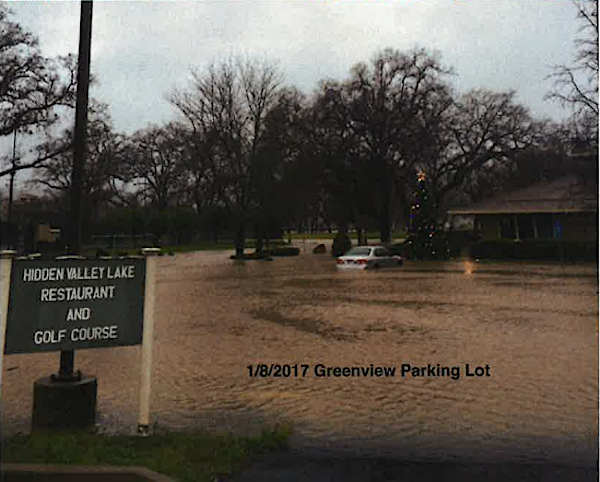
He referred to a picture of the Greenview Restaurant parking lot in 2017 – which was included in public comment documents – that showed it flooded and asked how to avoid such a situation for the new facility.
Murphy said it was his understanding that the 2017 flooding was the result of a tree blocking a culvert under Hartmann Road. He said the final finished floor elevation for the existing building is a couple of feet above flood elevation and the new building will be 3 feet higher than the old one.
Hess asked about the parking lot. Murphy said the design has drainage improvements but he said “all bets are off” if the creek is blocked off due to a tree.
When Hess asked if that issue had been fixed with the tree, Murphy said the tree was removed but added it could happen again.
Williams, who said he’d also seen the flooded parking lot picture, understood there were to be mitigations, but Murphy said mitigations aren’t part of the project.
“To me, mitigating it would be improving the drainage,” Williams said.
Hess, noting he had lived through the 2017 flood and the 2015 Valley fire evacuation, said, “I don’t see a strong enough reason to oppose the entire major use permit.”
He said he’s well aware of a number of recall elections and the criticisms targeting the homeowners association board and management, as well as subsidies for the restaurant and golf shop.
However, “Those are not part of our purview,” Hess said, explaining that he wanted to make that distinction in his own mind and for the public.
Commissioner Christina Price said she appreciated Hess sharing that.
Community Development Deputy Director Toccarra Thomas told the commission that there are further mitigations that can go along with the parking lot and staff can work with the applicant on those. She said there are some cool innovations for dispersing water quickly.
In reading through the mitigations, Williams said the drainage is adequately sized for the proposed site runoff. “I don’t know if we can ask for it to go bigger.”
Price offered separate motions for the commission to approve the mitigated negative declaration and the major use permit, with the commission approving both motions 4-0. Commissioner Everardo Chavez Perez had to leave the meeting before the votes.
Commission Chair Batsulwin Brown said there is a seven calendar day appeal period.
Porter told Lake County News later on Thursday that if the project isn’t appealed, and he said that’s “a very big ‘if,’” it is eligible for its permit seven days following the appeal period.
Lake County News reached out to the leadership of one local group that has voiced opposition to the project, HVL Now, to ask if there are plans to appeal, but did not receive a response.
Email Elizabeth Larson at
LAKE COUNTY, Calif. – The Lakeport Unified School District Board of Trustees on Thursday night selected its newest member.
During its regular meeting, held at the Marge Alakszay Center on the district campus, the board selected Jennifer Williams-Richardson to fill a board vacancy created last month when Trustee Jeannie Markham moved to Oregon.
Williams-Richardson was one of two community members who submitted a letter of interest to Superintendent Jill Falconer. The second was Wendy Mondfrans.
However, Falconer told the board on Thursday night that since the agenda had been posted earlier in the week, Mondfrans had withdrawn from consideration.
Board Chair Dan Buffalo said that in filling a board vacancy, the board can choose either to go to a special election or to appoint.
Noting that three of the board members – including Buffalo himself, Markham and Phil Kirby – had been reelected in the fall with no opposition, Buffalo said he was comfortable with appointing a new member.
With only one candidate to interview, the board reduced the number of questions they had planned to ask from 10 to six and took turns asking Williams-Richardson about her background, interests, experience and goals.
Williams-Richardson and her family moved from Santa Rosa to Lakeport in May. She has two children who attend school in the district.
She was the parent teacher association president at her children’s previous school, has served on a school site council and also said she has a wealth of knowledge about safety. She is employed as a bookkeeper.
So far, COVID-19 has prevented her from doing the kind of volunteer work she wants to do in the district, and she said she’s looking forward to helping in a classroom as soon as possible.
Asked about her experience in public schools, Williams-Richardson said there are a lot of things to be gained in public schools, noting that being around diverse groups prepares students to be more compassionate and open to other cultures. She added that she is mixed race herself.
Buffalo asked her about what she believes are the district’s biggest challenges. Williams-Richardson said she thought the district is doing an excellent job in its response to COVID-19. “Nobody knew what to expect.”
In response to another question from Buffalo, Williams-Richardson said her goal for her first year on the board is to find out the goals of other board members and discover where she can fit in.
Kirby said being a board member takes a lot of dedication, and after reading Williams-Richardson’s letter and hearing her responses, he was confident that she would be a valued board member.
Kirby then moved to approve Williams-Richardson’s provisional appointment to the board, which Carly Alvord seconded.
Before the vote, Buffalo noted that one of the most important things the board does is hire and fire the superintendent, and they’re now in the middle of hiring the successor for Falconer, who retires this summer.
Kirby asked if Williams-Richardson could be part of the superintendent candidate interviews the board has scheduled for all day Friday at the district office. Falconer said yes, if she’s available, adding that she had understood Williams-Richardson had to work that day.
In the roll call vote, the board unanimously voted for Williams-Richardson’s appointment.
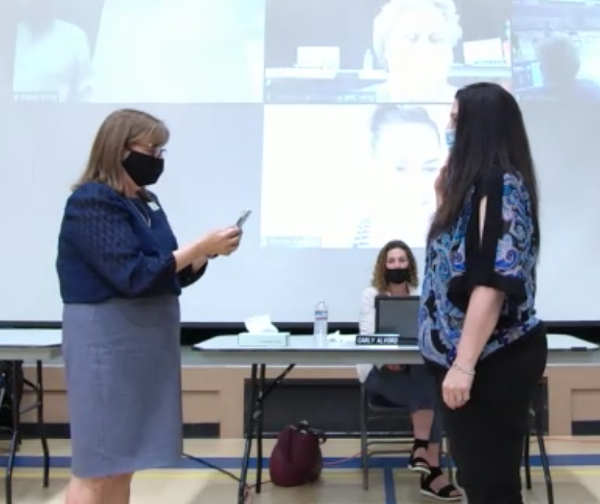
Falconer then administered the oath of office to Williams-Richardson before she took a socially distanced seat next to Kirby.
The board finished up business in open session shortly before 7:30 p.m. and adjourned into closed session. Board members reemerged at 7:45 p.m. to announce they had voted to hire the candidates for several jobs and then Buffalo adjourned the meeting.
On Friday morning, the board will convene in closed session at 8 a.m. to interview superintendent candidates, discuss salary and benefits for the new superintendent, as well as the contract with that individual.
Email Elizabeth Larson at