 How to resolve AdBlock issue?
News
Lower Lake Daze will take place in downtown Lower Lake from 10 a.m. to 3 p.m. Sunday, May 30.
Mike Dean and Kelley Slater, president and treasurer, respectively, of the nine-member Lower Lake Community Action Group Board, said they made the decision sometime in February or March to hold Lower Lake Daze this year.
“We want people to come and play,” Slater said. “Come join us in Lower Lake.”
Masks and social distancing will be recommended.
The parade will take place beginning at 11 a.m. This year’s Grand Marshal is longtime Lake County resident Judy Mullens. The Jago Bay resident is a volunteer firefighter, Lower Lake Museum board member, Soroptimist and community volunteer.
Retired firefighter Charlie Diener will bring an old fire truck for one of the parade’s highlights — a water fight with firefighters that also gets the crowd in on the action, the Deans said.
The annual celebration was one of the first big Lake County events to be canceled last year in response to the COVID-19 pandemic.
Now, it’s one of the first to come back.
Slater said she doesn’t know if the parade had ever been canceled before in the 100 years of it taking place.
The Lower Lake Community Action Group has been hard at work getting Lower Lake Daze together ever since it decided to move forward with the event earlier this year.
Dean said he’s been going to all the necessary state and county agencies to get the required permits.
They said the response has been positive, with support for the event to go forward. Lake County Public Works staff told them they were the No. 1 application for an event permit this year.
On Friday, they got the final permit from the California Highway Patrol, which Dean said will impact the county and Caltrans permits.
Those agencies are involved due to the parade’s impacts on the intersection at Highway 53 and Main Street.
The CHP, sheriff’s office and city of Clearlake will be offering assistance once more with traffic control. “We appreciate their ongoing support,” Slater said.
As the event makes its big return, it’s offering something brand-new — a street fair.
“We are having a street fair in lieu of having the barbecue in the park,” Dean said.
The organizers decided to offer the street fair — which will run from the post office down to Mill Street — rather than having hundreds of people crowd into the town’s little park. That will allow for more spacing.
“It’s a more cautious approach,” Slater said.
After the parade, the street will remain closed so the fair can take place for the rest of the event.
On Monday, Dean will be picking up 30 wine barrels donated by Bogle Vineyards, which will be used for placing umbrellas purchased by Redwood Credit Union in the downtown for the street fair.
He said if the street fair is well-received, they may start having more of them throughout the year, not just on Memorial Day weekend.
Already, they have more than 50 vendors lined up, with Jessica Chernoh and Rachelle Sapeta coordinating the street fair.
Slater said the offerings will be a mix of, “food, crafts and causes.” The Lions also will have a beer booth.
“So many people are looking forward to it,” she said.
They know they’re also a test case for big events. “We’re just on the cusp of everything,” Slater said, noting the event will be about two weeks ahead of the state’s planned reopening on June 15.
However, they’ve already gotten a lot of feedback from community members who are looking forward to Lower Lake Daze. “It should be an absolutely wonderful event,” she said.
Another new offering this year is that rather than doing the parade program, Dean said they’ve asked people to donate to advertise. Chernow and Sapeta went to businesses and received those support commitments.
In honor of those supporters, after school is out in June, when the banners featuring Konocti Unified’s seniors are taken down, new banners honoring the supporters will be placed on the light poles in downtown, Slater said.
“We so appreciate those people because we couldn’t do the parade without them,” she said. “It’s truly a community effort.”
The parade promises to once again be filled with classic cars, along with horses, pets and fire engines, she said.
To participate in the parade, pick up an application at locations including Rainbow Ag in Middletown, Main Street Tire and Small Town Ceramics. Those who want to participate also can arrive a little early on the day of the event and fill out the application there.
“People are really looking to enjoy community,” said Slater, noting the chance to connect with people after the past year of lockdown.
“Let’s find fun again,” she said.
For information on becoming a vendor, call Rachelle Sapeta at 707-349-0155 or Jessica Chernoh at 707-272-8823, or for the parade call Lonne Sloan at 707-995-2515.
For updates, follow the Lower Lake Community Action Group on Facebook.
A previous version of this story incorrectly gave Kelley Slater’s last name as Dean. We regret the error.
Email Elizabeth Larson at
The meeting will begin at 9 a.m. Tuesday, May 25, in the board chambers on the first floor of the Lake County Courthouse, 255 N. Forbes St., Lakeport.
The meeting can be watched live on Channel 8, online at https://countyoflake.legistar.com/Calendar.aspx and on the county’s Facebook page. Accompanying board documents, the agenda and archived board meeting videos also are available at that link.
To participate in real-time, join the Zoom meeting by clicking this link.
The meeting ID is 956 2259 9850, pass code 647639. The meeting also can be accessed via one tap mobile at +16699006833,,95622599850#,,,,*647639#.
All interested members of the public that do not have internet access or a Mediacom cable subscription are encouraged to call 669-900-6833, and enter the Zoom meeting ID and pass code information above.
To submit a written comment on any agenda item visit https://countyoflake.legistar.com/Calendar.aspx and click on the eComment feature linked to the meeting date. If a comment is submitted after the meeting begins, it may not be read during the meeting but will become a part of the record.
At 9:06 a.m., the board will get an update on COVID-19 from Public Health staff.
At 9:30 a.m., the board will consider a progress report on the Middle Creek Flood Damage Reduction and Ecosystem Restoration Project along with a letter of intent for the project for the Army Corps of Engineers.
The board is scheduled to hold a public hearing at 10 a.m. regarding a resolution amending the master fee schedule for departmental services rendered by the county.
At 10:15 a.m., the board will get a report and consider direction to staff concerning the future work of the Economic Development Task Force.
Also on Tuesday, a public hearing is scheduled for 10:45 a.m. for the appeal of a vicious animal abatement case involving three dogs in Lower Lake belonging to Brandon Strausser that county officials said killed a miniature horse and two goats while loose, and also attacked and killed baby deer.
Neighbors who have submitted letters in the case said the three canines — identified as “wolfdogs” — also killed sheep and chased horses.
The full agenda follows.
CONSENT AGENDA
5.1: Ratify U.S. Department of the Treasury Coronavirus State and Local Fiscal Recovery Funds and Assurances of Compliance with Civil Rights Recovery Funds, as necessary for release of American Rescue Plan Act (ARPA) of 2021 funding to Lake County.
5.2: Approve letter of support to opt-in and support Golden State Financing Authority to submit an application on behalf of Rural County Representatives of California and authorize chair to sign.
5.3: Approve leave of absence request for Social Services employee Alexis Bassham from June 10, 2021, through Oct. 1, 2021 and authorize the chair to sign.
5.4: Adopt resolution approving Agreement # 20-1108-000-SG with California Department of Food and Agriculture for Noxious Weed Program for the period of May 1, 2021, through March 31, 2023, in the amount of $32,000.
5.5: Adopt resolution adopting Agreement No. 20-1036-019-SF with California Department of Food and Agriculture for compliance with the European Grapevine Moth Detection Program and authorization for execution thereof.
5.6: Approve the agreement between the county of Lake and Tri-Cities Answering Service & Call Center Inc. for telephone answering and related services until May 2022 in the amount of $8,000 and authorize the board chair to sign the agreement.
5.7: Approve waiver of the 900 hour limitation for Animal Control employee Collette Hall.
5.8: Approve agreement between the county of Lake and CliftonLarsonAllen LLP for Audit Services for fiscal years ending June 30, 2021 for $74,400, June 30, 2022 for $75,900 and June 30, 2023, for $77,400 with option to extend two additional years at not more than 2.5% per year and authorize the chair to sign.
5.9: Adopt resolution approving county of Lake application to the California Department of Housing and Community Development for Emergency Solutions Grant Program CARES Act Funding.
5.10: (a) Waive the formal bidding process, pursuant to the Lake County Code Section 38.2, as it is not in the public interest due to the unique nature of goods or services; and (b) approve the agreement between the county of Lake and Hardeep Singh, MD to fulfill the responsibilities of the Behavioral Health Services medical director for Fiscal Year 2021-22 for a contract maximum of $90,000 and authorize the board chair to sign.
5.11: (a) Waive the formal bidding process, pursuant to the Lake County Code Section 38.2, as it is not in the public interest due to the unique nature of goods or services; and (b) approve the agreement between the county of Lake and Hardeep Singh, MD to fulfill the responsibilities of the substance use disorder medical director for Fiscal Year 2021-22 for a contract maximum of $90,000 and authorize the board chair to sign.
5.12: Adopt resolution authorizing the standard agreement between the county of Lake and the California Association of DUI Treatment Programs for the period beginning March 1, 2021, through Sept. 30, 2022, and authorize the Behavioral Health Services director to sign the standard agreement.
5.13: (a) Waive the formal bidding process, pursuant to Lake County Code Section 38.2, as it is not in the public interest due to the unique nature of goods or services; and (b) approve the agreement between the county of Lake and Ever Well Health Systems for adult residential support services and specialty mental health services for Fiscal Year 2021-22 for a contract maximum of $75,700 and authorize the board chair to sign the agreement.
5.14: Approve minutes of the Board of Supervisors meetings on April 27 and May 4.
5.15: Approve amendment four to the agreement between the county of Lake and Evan Bloom, MD, MPH, to assist the Lake County Public Health officer during the COVID-19 crisis response and authorize the board chair to sign.
5.16: Approve the continuation of a local health emergency related to the 2019 Coronavirus (COVID-19) as proclaimed by the Lake County Public Health officer.
5.17: Approve the continuation of a local health emergency and order prohibiting the endangerment of the community through the unsafe removal, transport, and disposal of fire debris for the LNU Complex wildfire.
5.18: Approve contract between the county of Lake Health Services and Trina Maia for physical therapy services in support of the California Children’s Services Program and the Medical Therapy Program for a term starting July 1, 2021, through June 30, 2022, and a maximum amount of $135,408; and authorize the board chair to sign.
5.19: Approve contract between the county of Lake Health Services and Sheila McCarthy for occupational therapy services in support of the California Children’s Services Program and the Medical Therapy Program for a term starting July 1, 2021, through June 30, 2022, and a maximum amount of $33,436.80; and authorize the board chair to sign.
5.20: Adopt resolution expressing support for the Middletown Days Parade and events, and temporarily authorizing a road closure, prohibiting parking and authorizing removal of vehicles and ordering the Department of Public Works to post signs.
5.21: (a) Approve agreement between the Lake County Sheriff's Office and U.S. Forest Service for FY 20/21 annual operating and financial plan, in the amount of $20,000 for Pillsbury patrol; and (b) approve agreement between the Lake County Sheriff’s Office and U.S. Forest Service for FY20/21 annual operating and financial plan, in the amount of $19,000 for controlled substance operations, and (c) authorize the sheriff and the chairman to sign.
5.22: (a) Approve the purchase of kitchen equipment from Cook’s Supply in the amount of $22,980.39 and (b) authorize the sheriff to issue a purchase order.
5.23: Approve the continuation of a local emergency due to the Mendocino Complex fire incident (River and Ranch fires).
5.24: Approve the continuation of a local emergency due to COVID-19.
5.25: Approve the continuation of a local emergency in Lake County in response to the LNU Lightning Complex wildfire event.
5.26: Approve the continuation of a local emergency due to the Pawnee Fire incident.
5.27: Approve the continuation of an emergency declaration for drought conditions.
5.28: a) Approve second amendment to the lease agreement between county of Lake and Ronn and Montie Westhart for unit No. 1 located at 15890 Kugelman St. in Lower Lake, from July 1, 2021, to June 30, 2024, and authorize the chair to sign; and b) approve second amendment to the lease agreement between county of Lake and Ronn and Montie Westhart for unit D located at 15890 Kugelman St. in Lower Lake, from July 1, 2021, to June 30, 2024, and authorize the chair to sign.
5.29: Approve memorandum of understanding between Social Services and Behavioral Health Services for residential treatment payments for child welfare services clients, beginning July 1, 2020, in the amount of $120,000 per fiscal year, and authorize the chair to sign.
TIMED ITEMS
6.2, 9:06 a.m.: Consideration of update on COVID-19.
6.3, 9:30 a.m.: a) Consideration of a progress report on the Middle Creek Flood Damage Reduction and Ecosystem Restoration Project; and b) consideration of letter of intent for Middle Creek Flood Damage Reduction and Ecosystem Restoration Project for the Army Corps of Engineers.
6.4, 10 a.m.: Public hearing, consideration of a resolution amending the master fee schedule for departmental services rendered by the county.
6.5, 10:15 a.m.: Report and possible direction to staff concerning the future work of the Economic Development Task Force.
6.6: 10:45 a.m.: Public hearing, appeal of vicious animal abatement case No. 859, located at 21852 Jerusalem Grade Lower Lake (Brandon Strausser).
CLOSED SESSION
8.1: Conference with labor negotiator: (a) Chief negotiator: M. Long; County negotiators: C. Huchingson and P. Samac; and (b) employee organizations: LCDDAA, LCDSA, LCCOA, LCEA, LCSEA and LCSMA.
8.2: Conference with (a) temporary representatives designated to meet with county department heads regarding salary and benefits and (b) unrepresented management employees.
Email Elizabeth Larson at
Complete MFS 5.25 by LakeCoNews on Scribd

As vaccinations and relaxed health guidelines make returning to the office a reality for more companies, there seems to be a disconnect between managers and their workers over remote work.
A good example of this is a recent op-ed written by the CEO of a Washington, D.C., magazine that suggested workers could lose benefits like health care if they insist on continuing to work remotely as the COVID-19 pandemic recedes. The staff reacted by refusing to publish for a day.
While the CEO later apologized, she isn’t alone in appearing to bungle the transition back to the office after over a year in which tens of millions of employees were forced to work from home. A recent survey of full-time corporate or government employees found that two-thirds say their employers either have not communicated a post-pandemic office strategy or have only vaguely done so.
As workforce scholars, we are interested in teasing out how workers are dealing with this situation. Our recent research found that this failure to communicate clearly is hurting morale, culture and retention.
Workers relocating
We first began investigating workers’ pandemic experiences in July 2020 as shelter-in-place orders shuttered offices and remote work was widespread. At the time, we wanted to know how workers were using their newfound freedom to potentially work virtually from anywhere.
We analyzed a dataset that a business and technology newsletter attained from surveying its 585,000 active readers. It asked them whether they planned to relocate during the next six months and to share their story about why and where from and to.
After a review, we had just under 3,000 responses, including 1,361 people who were planning to relocate or had recently done so. We systematically coded these responses to understand their motives and, based on distances moved, the degree of ongoing remote-work policy they would likely need.
We found that a segment of these employees would require a full remote-work arrangement based on the distance moved from their office, and another portion would face a longer commute. Woven throughout this was the explicit or implicit expectation of some degree of ongoing remote work among many of the workers who moved during the pandemic.
In other words, many of these workers were moving on the assumption – or promise – that they’d be able to keep working remotely at least some of the time after the pandemic ended. Or they seemed willing to quit if their employer didn’t oblige.
We wanted to see how these expectations were being met as the pandemic started to wind down in March 2021. So we searched online communities in Reddit to see what workers were saying. One forum proved particularly useful. A member asked, “Has your employer made remote work permanent yet or is it still in the air?” and went on to share his own experience. This post generated 101 responses with a good amount of detail on what their respective individual companies were doing.
While this qualitative data is only a small sample that is not necessarily representative of the U.S. population at large, these posts allowed us to delve into a richer understanding of how workers feel, which a simple stat can’t provide.
We found a disconnect between workers and management that starts with but goes beyond the issue of the remote-work policy itself. Broadly speaking, we found three recurring themes in these anonymous posts.
1. Broken remote-work promises
Others have also found that people are taking advantage of pandemic-related remote work to relocate to a city at a distance large enough that it would require partial or full-time remote work after people return to the office.
A recent survey by consulting firm PwC found that almost a quarter of workers were considering or planning to move more than 50 miles from one of their employer’s main offices. The survey also found 12% have already made such a move during the pandemic without getting a new job.
Our early findings suggested some workers would quit their current job rather than give up their new location if required by their employer, and we saw this actually start to occur in March.
One worker planned a move from Phoenix to Tulsa with her fiancé to get a bigger place with cheaper rent after her company went remote. She later had to leave her job for the move, even though “they told me they would allow me to work from home, then said never mind about it.”
Another worker indicated the promise to work remotely was only implicit, but he still had his hopes up when leaders “gassed us up for months saying we’d likely be able to keep working from home and come in occasionally” and then changed their minds and demanded employees return to the office once vaccinated.
2. Confused remote-work policies
Another constant refrain we read in the worker comments was disappointment in their company’s remote-work policy – or lack thereof.
Whether workers said they were staying remote for now, returning to the office or still unsure, we found that nearly a quarter of the people in our sample said their leaders were not giving them meaningful explanations of what was driving the policy. Even worse, the explanations sometimes felt confusing or insulting.
One worker complained that the manager “wanted butts in seats because we couldn’t be trusted to [work from home] even though we’d been doing it since last March,” adding: “I’m giving my notice on Monday.”
Another, whose company issued a two-week timeline for all to return to the office, griped: “Our leadership felt people weren’t as productive at home. While as a company we’ve hit most of our goals for the year. … Makes no sense.”
After a long period of office shutterings, it stands to reason workers would need time to readjust to office life, a point expressed in recent survey results. Employers that quickly flip the switch in calling workers back and do so with poor clarifying rationale risk appearing tone-deaf.
It suggests a lack of trust in productivity at a time when many workers report putting in more effort than ever and being strained by the increased digital intensity of their job – that is, the growing number of online meetings and chats.
And even when companies said they wouldn’t require a return to the office, workers still faulted them for their motives, which many employees described as financially motivated.
“We are going hybrid,” one worker wrote. “I personally don’t think the company is doing it for us. … I think they realized how efficient and how much money they are saving.”
Only a small minority of workers in our sample said their company asked for input on what employees actually want from a future remote work policy. Given that leaders are rightly concerned about company culture, we believe they are missing a key opportunity to engage with workers on the issue and show their policy rationales aren’t only about dollars and cents.
3. Corporate culture ‘BS’
Management gurus such as Peter Drucker and other scholars have found that corporate culture is very important to binding together workers in an organization, especially in times of stress.
A company’s culture is essentially its values and beliefs shared among its members. That’s harder to foster when everyone is working remotely.
That’s likely why corporate human resource executives rank maintaining organizational culture as their top workforce priority for 2021.
But many of the forum posts we reviewed suggested that employer efforts to do that during the pandemic by orchestrating team outings and other get-togethers were actually pushing workers away, and that this type of “culture building” was not welcome.
[Like what you’ve read? Want more? Sign up for The Conversation’s daily newsletter.]
One worker’s company “had everyone come into the office for an outdoor luncheon a week ago,” according to a post, adding: “Idiots.”
Surveys have found that what workers want most from management, on the issue of corporate culture, are more remote-work resources, updated policies on flexibility and more communication from leadership.
As another worker put it, “I can tell you, most people really don’t give 2 flips about ‘company culture’ and think it’s BS.”
Kimberly Merriman, Professor of Management, Manning School of Business, University of Massachusetts Lowell; David Greenway, Doctoral Candidate in Leadership/Organization Studies, University of Massachusetts Lowell, and Tamara Montag-Smit, Assistant Professor of Business, University of Massachusetts Lowell
This article is republished from The Conversation under a Creative Commons license. Read the original article.


The first lunar eclipse of 2021 is going to happen during the early hours of May 26. But this is going to be an especially super lunar event, as it will be a supermoon, a lunar eclipse and a red blood moon all at once. So what does this all mean?


What’s a super moon?
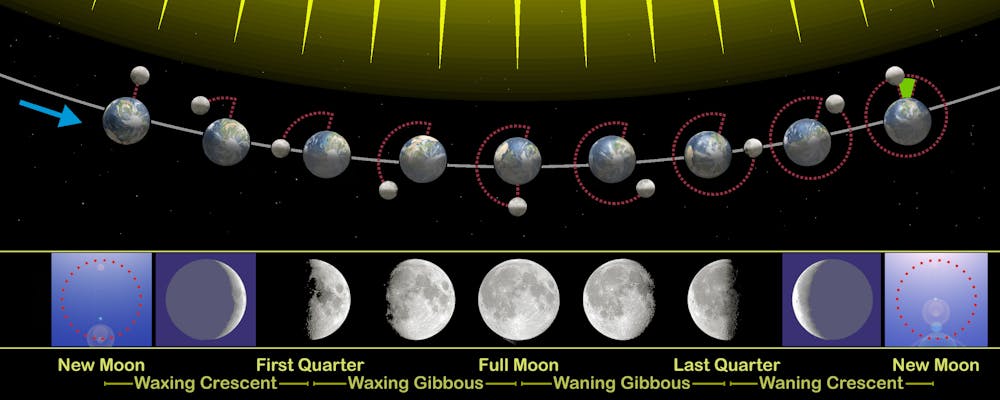
A supermoon occurs when a full or new moon coincides with the Moon’s closest approach to the Earth.


The Moon’s orbit around Earth is not perfectly circular. This means the Moon’s distance from Earth varies as it goes around the planet. The closest point in the orbit, called the perigee, is roughly 28,000 miles closer to Earth than the farthest point of the orbit. A full moon that happens near the perigee is called a supermoon.
So why is it super? The relatively close proximity of the Moon makes it seem a little bit bigger and brighter than usual, though the difference between a supermoon and a normal moon is usually hard to notice unless you’re looking at two pictures side by side.

How does a lunar eclipse work?
A lunar eclipse happens when the Earth’s shadow covers all or part of the Moon. This can only happen during a full moon, so first, it helps to understand what makes a full moon.
Like the Earth, half of the Moon is illuminated by the sun at any one time. A full moon happens when the Moon and the Sun are on opposite sides of the Earth. This allows you see the entire lit-up side, which looks like a round disc in the night sky.
If the Moon had a totally flat orbit, every full moon would be a lunar eclipse. But the Moon’s orbit is tilted by about 5 degrees relative to Earth’s orbit. So, most of the time a full moon ends up a little above or below the shadow cast by the Earth.


But twice in each lunar orbit, the Moon is on the same horizontal plane as both the Earth and Sun. If this corresponds to a full moon, the Sun, the Earth and the Moon will form a straight line and the Moon will pass through the Earth’s shadow. This results in a total lunar eclipse.
To see a lunar eclipse, you need to be on the night side of the Earth while the Moon passes through the shadow. The best place to see the eclipse on May 26, 2021, will be the middle of the Pacific Ocean, Australia, the East Coast of Asia and the West Coast of the Americas. It will be visible on the eastern half of the U.S., but only the very earliest stages before the Moon sets.


Why does the moon look red?
When the Moon is completely covered by Earth’s shadow it will darken, but doesn’t go completely black. Instead, it takes on a red color, which is why total lunar eclipses are sometimes called red or blood moons.
[Like what you’ve read? Want more? Sign up for The Conversation’s daily newsletter.]
Sunlight contains all colors of visible light. The particles of gas that make up Earth’s atmosphere are more likely to scatter blue wavelengths of light while redder wavelengths pass through. This is called Rayleigh scattering, and it’s why the sky is blue and sunrises and sunsets are often red.
In the case of a lunar eclipse, red light can pass through the Earth’s atmosphere and is refracted – or bent – toward the Moon, while blue light is filtered out. This leaves the moon with a pale reddish hue during an eclipse.
Hopefully you will be able to go see this super lunar eclipse. When you do, now you will know exactly what makes for such a special sight.
Portions of this story originally appeared in a previous article published on Jan. 24, 2018.
Shannon Schmoll, Director, Abrams Planetarium, Department of Physics and Astronomy, Michigan State University
This article is republished from The Conversation under a Creative Commons license. Read the original article.

LAKE COUNTY, Calif. — Diminutive in size, but complex in structure and saturated in colors are the calochortus with a variety of common names such as fairy lanterns, star tulips, globe lilies and mariposas, and there are 10 different species to delight the eyes that can be found in Lake County in the forests, grasslands and chaparral areas.
“Calo,” derived from the Greek “kalos,” which means beautiful, and “chortus,” meaning grass, calochortus have a well-deserved reputation for their beauty and diversity.
According to the Pacific Bulb Society, calochortus have a reputation for being difficult to grow in your home garden. While these flowers are bulbs like nonnative daffodils, that reputation is well-deserved as it can take up to six years for seed-grown calochortus bulbs to flower — but if you love them, it can be worth the wait.

However, according to Mary E. Gerritsen and Ron Parsons in their book, “Calochortus: Mariposa Lilies and their Relatives” (2007), “With their graceful stance, brilliant colors, and intricate markings, members of the North American genus calochortus are among the most dazzling bulbous plants in the world. Yet their mostly undeserved reputation for being difficult to grow has kept them from being known and appreciated by the vast majority of gardeners,” and we agree!
Mariposa, which means “butterfly” in Spanish, have petals that resemble the wings of butterflies which dance and wave in the breeze, attracting all manner of insects to pollinate them.
Growing in grasslands and some open forest floors primarily in the central Coast Ranges and Sierra foothills, mariposas can be found with other varieties like fairy lanterns which are also found in our areas of chaparral.
To see and learn more about the species of calochortus in Lake County, visit CalFlora.

Nurseries where you can purchase calochortus:
Yellow mariposa lily: https://calscape.org/nurseries.php?id=668&showmap=1
Blue star tulip: https://calscape.org/nurseries.php?id=659&showmap=1
Large flowered star tulip: https://calscape.org/nurseries.php?id=687&showmap=1
Golden fairy lantern or globe lily: https://calscape.org/nurseries.php?id=649&showmap=1
Terre Logsdon is an environmentalist, certified master composter, and advocate for agroecology solutions to farming. An avid fan and protector of California wildflowers, plants, natural resources, and the environment, she seeks collaborative solutions to mitigate the effects of climate change. Kim Riley is retired, an avid hiker at Highland Springs, and has lived in Lake County since 1985. After 15 years of trail recovery and maintenance on the Highland Springs trails, she is now focused on native plants, including a native plant and pollinator garden on her property as well as promoting and preserving the beauty of the Highland Springs Recreation Area. Karen Sullivan has operated two nurseries to propagate and cultivate native plants and wildflowers, has lived in Kelseyville for the past 30 years, rides horses far and wide to see as many flowers as possible, and offers native plants and wildflowers for sale to the public. You can check her nursery stock here. They are collaborating on a book, Highland Springs Recreation Area: A Field Guide, which will be published in the future. In the meanwhile, please visit https://www.facebook.com/HighlandSpringsNaturalists and https://www.facebook.com/HighlandSpringsRecreationArea.

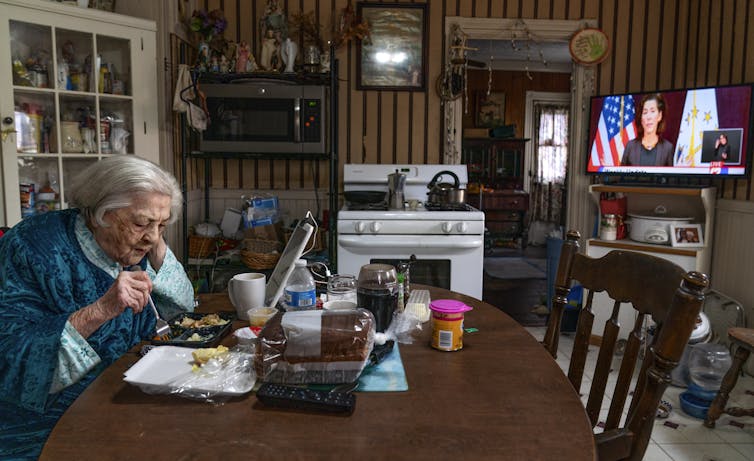

More than 2.4 million older adults are supported each year by Meals on Wheels, a program through which seniors and people with disabilities receive healthy and tasty meals for free from a network of volunteers. These efforts are usually organized through local senior centers and other community organizations across the U.S. that encourage the people who receive meals to make voluntary donations to cover at least part of the cost if that’s within their means.
Services like this nonprofit meal delivery program, for which eligibility begins at age 60, are becoming more important than ever before. About 5.3 million people 60 and up, 7.3% of all Americans in that age group, experienced food insecurity in 2018 – meaning that their households couldn’t acquire adequate food because they lacked enough money and other resources.
What’s more, the U.S. population is aging. The number of Americans who are 65 and up grew by one-third over the past decade, to 54 million people.
And, a growing share of the 1 in 6 Americans who are in that demographic group wish to age in place. That is, regardless of how ill or frail they are, they want to stay in their own homes, instead of going to a nursing home or assisted living facility.
No matter where folks live as they age, ailments and physical challenges will almost surely crop up. Those health problems will make getting out and about more difficult, and it will be increasingly hard for them to shop for food, cook meals and even feed themselves.
Daily Meals on Wheels deliveries also make a difference in ways unrelated to nutrition. According to gerontology and health services research Kali Thomas conducted and Meals on Wheels America commissioned, seniors who got hot meals delivered became less concerned about being able to continue living in their own homes. They also felt less isolated and lonely compared to those who received frozen meals, delivered once a week in bulk, or people who received none at all.
Despite those findings, as the COVID-19 pandemic set in, Meals on Wheels volunteers made needed adjustments. They began to drop off more meals at a time, sometimes in multi-week bundles. Rather than speaking with the people receiving food and companionship in person, some agency volunteers made phone calls to connect with them.
In some parts of the country, such as Rowan, North Carolina and Longmont, Colorado, Meals on Wheels saw demand for its deliveries rise. This probably occurred because even older adults who are able to do their own errands were newly homebound due to concerns about the coronavirus, which disproportionately kills elderly people.
Often, volunteer visits are the only in-person interaction a program participant will have that day.
With the majority of older adults in the U.S. now vaccinated against COVID-19, Meals on Wheels volunteers are resuming their traditional social contact. In my view, this is welcome news.
[You’re smart and curious about the world. So are The Conversation’s authors and editors. You can read us daily by subscribing to our newsletter.]
David R. Buys, Associate Professor of Food Science, Nutrition, and Health Promotion; State Health Specialist, MSU Extension, Mississippi State University
This article is republished from The Conversation under a Creative Commons license. Read the original article.