 How to resolve AdBlock issue?
News
Dogs available for adoption this week include mixes of chihuahua, corgi, dachshund, German shepherd, husky, pit bull and Rottweiler.
Dogs that are adopted from Lake County Animal Care and Control are either neutered or spayed, microchipped and, if old enough, given a rabies shot and county license before being released to their new owner. License fees do not apply to residents of the cities of Lakeport or Clearlake.
The following dogs at the Lake County Animal Care and Control shelter have been cleared for adoption (additional dogs on the animal control website not listed are still “on hold”).
Call Lake County Animal Care and Control at 707-263-0278 or visit the shelter online at http://www.co.lake.ca.us/Government/Directory/Animal_Care_And_Control.htm for information on visiting or adopting.

Female Rottweiler-shepherd
This female Rottweiler-shepherd mix has a medium-length black and red coat.
She is in kennel No. 12, ID No. 14575.

Male Chihuahua
This male Chihuahua has a short red coat.
He is in kennel No. 13, ID No. 14572.

Female German shepherd
This female German shepherd has a medium-length black and tan coat.
She is in kennel No. 17, ID No. 14566.

Female pit bull terrier
This female pit bull terrier has a short blue and white coat.
She is in kennel No. 22, ID No. 14486.

Female pit bull terrier
This female pit bull terrier has a short red and white coat.
She is in kennel No. 26, ID No. 14550.

Rottweiler-pit bull mix
This female Rottweiler-pit bull mix has a short black coat.
She has been spayed.
She is in kennel No. 27, ID No. 14551.

‘Brutus’
“Brutus” is a male pit bull terrier with a short gray and white coat.
He is in kennel No. 28, ID No. 14507.

‘Apollo’
“Apollo” is a male husky mix with a medium-length red and white coat and blue eyes.
He is in kennel No. 31, ID No. 14569.

‘Ghost’
“Ghost” is as male husky mix with a white coat and blue eyes.
He has been neutered.
He’s in kennel No. 32, ID No. 14563.
Email Elizabeth Larson at
A NASA team has found that organic salts are likely present on Mars.
Like shards of ancient pottery, these salts are the chemical remnants of organic compounds, such as those previously detected by NASA’s Curiosity rover.
Organic compounds and salts on Mars could have formed by geologic processes or be remnants of ancient microbial life.
Besides adding more evidence to the idea that there once was organic matter on Mars, directly detecting organic salts would also support modern-day Martian habitability, given that on Earth, some organisms can use organic salts, such as oxalates and acetates, for energy.
“If we determine that there are organic salts concentrated anywhere on Mars, we’ll want to investigate those regions further, and ideally drill deeper below the surface where organic matter could be better preserved,” said James M.T. Lewis, an organic geochemist who led the research, published on March 30 in the Journal of Geophysical Research: Planets. Lewis is based at NASA’s Goddard Space Flight Center in Greenbelt, Maryland.
Lewis’s lab experiments and analysis of data from the Sample Analysis at Mars, or SAM, a portable chemistry lab inside Curiosity’s belly, indirectly point to the presence of organic salts.
But directly identifying them on Mars is hard to do with instruments like SAM, which heats Martian soil and rocks to release gases that reveal the composition of these samples.
The challenge is that heating organic salts produces only simple gases that could be released by other ingredients in Martian soil.
However, Lewis and his team propose that another Curiosity instrument that uses a different technique to peer at Martian soil, the Chemistry and Mineralogy instrument, or CheMin for short, could detect certain organic salts if they are present in sufficient amounts. So far, CheMin has not detected organic salts.
Finding organic molecules, or their organic salt remnants, is essential in NASA’s search for life on other worlds. But this is a challenging task on the surface of Mars, where billions of years of radiation have erased or broken apart organic matter.
Like an archaeologist digging up pieces of pottery, Curiosity collects Martian soil and rocks, which may contain tiny chunks of organic compounds, and then SAM and other instruments identify their chemical structure.
Using data that Curiosity beams down to Earth, scientists like Lewis and his team try to piece together these broken organic pieces. Their goal is to infer what type of larger molecules they may once have belonged to and what those molecules could reveal about the ancient environment and potential biology on Mars.
“We’re trying to unravel billions of years of organic chemistry,” Lewis said, “and in that organic record there could be the ultimate prize: evidence that life once existed on the Red Planet.”
While some experts have predicted for decades that ancient organic compounds are preserved on Mars, it took experiments by Curiosity’s SAM to confirm this.
For example, in 2018, NASA Goddard astrobiologist Jennifer L. Eigenbrode led an international team of Curiosity mission scientists who reported the detection of myriad molecules containing an essential element of life as we know it: carbon. Scientists identify most carbon-containing molecules as “organic.”
“The fact that there’s organic matter preserved in 3-billion-year-old rocks, and we found it at the surface, is a very promising sign that we might be able to tap more information from better preserved samples below the surface,” Eigenbrode said. She worked with Lewis on this new study.

Analyzing organic salts in the lab
Decades ago, scientists predicted that organic compounds on Mars could be breaking down into salts. These salts, they argued, would be more likely to persist on the Martian surface than big, complex molecules, such as the ones that are associated with the functioning of living things.
If there were organic salts present in Martian samples, Lewis and his team wanted to find out how getting heated in the SAM oven could affect what types of gases they would release. SAM works by heating samples to upward of 1,800 degrees Fahrenheit (1,000 degrees Celsius). The heat breaks apart molecules, releasing some of them as gases. Different molecules release different gases at specific temperatures; thus, by looking at which temperatures release which gases, scientists can infer what the sample is made of.
“When heating Martian samples, there are many interactions that can happen between minerals and organic matter that could make it more difficult to draw conclusions from our experiments, so the work we’re doing is trying to pick apart those interactions so that scientists doing analyses on Mars can use this information,” Lewis said.
Lewis analyzed a range of organic salts mixed with an inert silica powder to replicate a Martian rock. He also investigated the impact of adding perchlorates to the silica mixtures. Perchlorates are salts containing chlorine and oxygen, and they are common on Mars. Scientists have long worried that they could interfere with experiments seeking signs of organic matter.
Indeed, researchers found that perchlorates did interfere with their experiments, and they pinpointed how. But they also found that the results they collected from perchlorate-containing samples better matched SAM data than when perchlorates were absent, bolstering the likelihood that organic salts are present on Mars.
Additionally, Lewis and his team reported that organic salts could be detected by Curiosity’s instrument CheMin. To determine the composition of a sample, CheMin shoots X-rays at it and measures the angle at which the X-rays are diffracted toward the detector.
Curiosity’s SAM and CheMin teams will continue to search for signals of organic salts as the rover moves into a new region on Mount Sharp in Gale Crater.
Soon, scientists will also have an opportunity to study better-preserved soil below the Martian surface. The European Space Agency’s forthcoming ExoMars rover, which is equipped to drill down to 6.5 feet, or 2 meters, will carry a Goddard instrument that will analyze the chemistry of these deeper Martian layers.
NASA’s Perseverance rover doesn’t have an instrument that can detect organic salts, but the rover is collecting samples for future return to Earth, where scientists can use sophisticated lab machines to look for organic compounds.
Lonnie Shekhtman works for NASA’s Goddard Space Flight Center in Greenbelt, Maryland.
Lake County’s testing positivity and case rates have recently trended in the minimal-moderate range.
Public Health said Lake County remains in the orange tier of the State’s Blueprint for a Safer Economy.
State Public Health officials expect California’s economy to fully reopen June 15. Read Friday’s detailed announcement here.
With COVID-19 transmission relatively stable in Lake County, the last daily update of the Health Services Department’s data pages will occur Thursday, May 27.
Starting the week of May 31, updates will occur Mondays and Thursdays before 3 p.m.
“Now is the time to help us all move forward in our lives; to safely return to community events and gatherings, to safely patronize our business and get our children to school, and ultimately to get back to normalcy,” said Evan Bloom, MD, MPH, Lake County’s acting Public Health officer. “Getting vaccinated is the single greatest action you can take to protect yourself against this virus, as well as to protect your loved ones and all those living and working in Lake County. Seventy percent vaccination coverage among residents remains our goal. We can do it together.”
Bloom added, “To those who have received their vaccinations: a heartfelt thank you. For the half of the county who have not yet received their COVID vaccination: please help us all breathe easier!
Vaccination appointments can be scheduled at https://myturn.ca.gov/. Lake County-focused information and resources are available at http://health.co.lake.ca.us/Coronavirus/Vaccines.htm.
If you want to be vaccinated, and need assistance overcoming barriers, call 707-263-8174.
State masking mandate expected to remain in place until June 15
State officials expect to align California’s masking guidance with the CDC’s June 15.
Until that time, the requirement to wear face coverings in most indoor settings remains in place.
State guidelines — updated on May 3 — are available at https://www.cdph.ca.gov/Programs/CID/DCDC/Pages/COVID-19/guidance-for-face-coverings.aspx.
Dr. Bloom said he appreciates all people have sacrificed to keep others safe.
“I know this hasn't been easy,” he said. “Thank you to all Lake County residents and others in our communities for taking COVID-19 so seriously. Thank you for changing your lives to protect yourselves and your loved ones from the serious effects of this highly communicable disease. From my work in clinical settings and with the Health Services Department, I know the steps you have taken have made a difference.”
Actualización de COVID-19: Ayúdenos a todos a respirar mejor y a volver a la normalidad - Vacúnese
La página de datos de COVID-19 del condado de Lake se actualizará los lunes y jueves antes de las 3 de la tarde a partir del 31 de mayo
Condado de Lake, CA (21 de mayo de 2021) — La Positividad de las Pruebas y las Tasas de Casos del Condado de Lake recientemente han tendido al rango mínimo-moderado. Permanecemos en el Nivel Naranja del plan estatal para una economía más segura. Los funcionarios estatales de salud pública esperan que la economía de California se reabra más completamente el 15 de junio. Lea el anuncio detallado de hoy aquí: https://www.cdph.ca.gov/Programs/CID/DCDC/Pages/COVID-19/Beyond-Blueprint-Framework.aspx .
Con la transmisión de COVID-19 relativamente estable en el condado de Lake, la última actualización diaria de las páginas de datos del Departamento de Servicios de Salud ocurrirá el jueves 27 de mayo. A partir de la semana del 31 de mayo, las actualizaciones ocurrirán los lunes y jueves antes de las 3:00 pm: http://health.co.lake.ca.us/Coronavirus/COVID-19_Data.htm
El 50% de los residentes elegibles del condado están ahora vacunados; juntos, podemos alcanzar nuestra meta del 70%
“Ahora es el momento de ayudarnos a todos a avanzar en nuestras vidas; para regresar de manera segura a los eventos y reuniones de la comunidad, para patrocinar de manera segura nuestro negocio y llevar a nuestros hijos a la escuela y, en última instancia, ¡volver a la normalidad! " enfatiza Evan Bloom, MD, MPH, Oficial Interino de Salud Pública del Condado de Lake. “Vacunarse es la mejor acción que puede tomar para protegerse contra este virus, y para protegerse así como contra sus seres queridos todos los que viven y trabajan en el condado de Lake. La cobertura de vacunación del 70% entre los residentes sigue siendo nuestro objetivo: ¡podemos hacerlo juntos!"
“Para aquellos que han recibido sus vacunas: un sincero agradecimiento”, continúa Bloom. "Para la mitad del condado que aún no ha recibido la vacuna COVID: ¡ayúdenos a respirar mejor!"
Las citas de vacunación se pueden programar en https://myturn.ca.gov/. La información y los recursos centrados en el condado de Lake están disponibles en http://health.co.lake.ca.us/Coronavirus/Vaccines.htm .
Si desea vacunarse y necesita ayuda para superar las barreras, llame al 707-263-8174.
Se espera que el mandato estatal de enmascaramiento permanezca en vigor hasta el 15 de junio.
Los funcionarios estatales esperan alinear la guía de enmascaramiento de California con el 15 de junio de los CDC. Hasta ese momento, el requisito de usar revestimientos faciales en la mayoría de los ambientes interiores permanece vigente. Las pautas estatales (actualizadas 5/3) están disponibles en https://www.cdph.ca.gov/Programs/CID/DCDC/Pages/COVID-19/guidance-for-face-coverings.aspx .
El Dr. Bloom agradece que todas las personas se hayan sacrificado para mantener a los demás a salvo:
“Sé que esto no ha sido fácil. Gracias a todos los residentes del condado de Lake y a otras personas en nuestras comunidades por tomar COVID-19 tan en serio. Gracias por cambiar sus vidas para protegerse y proteger a sus seres queridos de los graves efectos de esta enfermedad altamente contagiosa. Por mi trabajo en otros lugares clínicos y con el Departamento de Servicios de Salud, sé que los pasos que ha tomado han marcado la diferencia.”
This yearly campaign is to remind boaters to always boat responsibly, to follow safety guidelines while on the water and for all boaters and passengers to have life jackets and to wear them.
This week, the city councils for Clearlake and Lakeport and the Board of Supervisors separately approved proclamations declaring National Safe Boating Week.
On Thursday, Flotilla 88 representative Dorothy De Lope told the Clearlake City Council that the group will be out doing patrols this weekend on Clear Lake.
“We’re back in action again,” De Lope said.
In the United States, 613 people died in boating-related accidents as reported in the United States Coast Guard recreational statistics for 2019.
Of these 613 fatalities, 439 were due to drowning and 362 of these boaters would be alive today had they worn their life jackets.
The summer months of June, July and August are the most active boating months with 308 of nationwide fatal boating accidents occurring in these months.
Use of alcohol while boating was the leading contributing factor with 113 fatalities followed by operator inattention, inexperience, excessive speed and machine failure.
As the COVID-19 restrictions which were ordered for all flotillas by the United States Coast Guard begin to lift, Lake County Flotilla will resume free vessel inspections, offer safe boating classes and once again resume safety patrols on Clear Lake.
Flotilla 88 of Lake County urges all boaters to join the nation in observing National Safe Boating Week by boating responsibly throughout the boating season and to always wear your life jackets.
For information regarding the safety classes, vessel exams and joining Flotilla 88, email
Beginning on June 15, all industry and business sectors listed in the current Blueprint Activities and Business Tiers Chart may return to usual operations with no capacity limits or physical distancing requirements, with limited exceptions for mega events.
“Californians should be proud of the work we’ve done together to get through the worst of this pandemic,” said Dr. Tomás Aragón, State Public Health officer and director of the California Department of Public Health. “Relaxing many of our public health measures is possible because we’ve chosen to get vaccinated against COVID-19, worn masks and kept our distance. We urge Californians who are eligible to get vaccinated and continue taking common sense prevention steps so we can keep our forward progress in defeating this virus.”
Employers will be subject to the Cal/OSHA COVID-19 Prevention Emergency Temporary Standards, if applicable to them, and CDPH will continue to provide updated guidance for youth, healthcare, and high-risk congregate settings.

.jpg#/media/File:New_shot_of_Proxima_Centauri,_our_nearest_neighbour_(10581847073).jpg)
The Sun isn’t the only star to produce stellar flares. On April 21, 2021, a team of astronomers published new research describing the brightest flare ever measured from Proxima Centauri in ultraviolet light. To learn about this extraordinary event – and what it might mean for any life on the planets orbiting Earth’s closest neighboring star – The Conversation spoke with Parke Loyd, an astrophysicist at Arizona State University and co-author of the paper. Excerpts from our conversation are below and have been edited for length and clarity.
Why were you looking at Proxima Centauri?
Proxima Centauri is the closest star to this solar system. A couple of years ago, a team discovered that there is a planet – called Proxima b – orbiting the star. It’s just a little bit bigger than Earth, it’s probably rocky and it is in what is called the habitable zone, or the Goldilocks zone. This means that Proxima b is about the right distance from the star so that it could have liquid water on its surface.
But this star system differs from the Sun in a pretty key way. Proxima Centauri is a small star called a red dwarf – it’s around 15% of the radius of our Sun, and it’s substantially cooler. So Proxima b, in order for it to be in that Goldilocks zone, actually is a lot closer to Proxima Centauri than Earth is to the Sun.
You might think that a smaller star would be a tamer star, but that’s actually not the case at all – red dwarfs produce stellar flares a lot more frequently than the Sun does. So Proxima b, the closest planet in another solar system with a chance for having life, is subject to space weather that is a lot more violent than the space weather in Earth’s solar system.
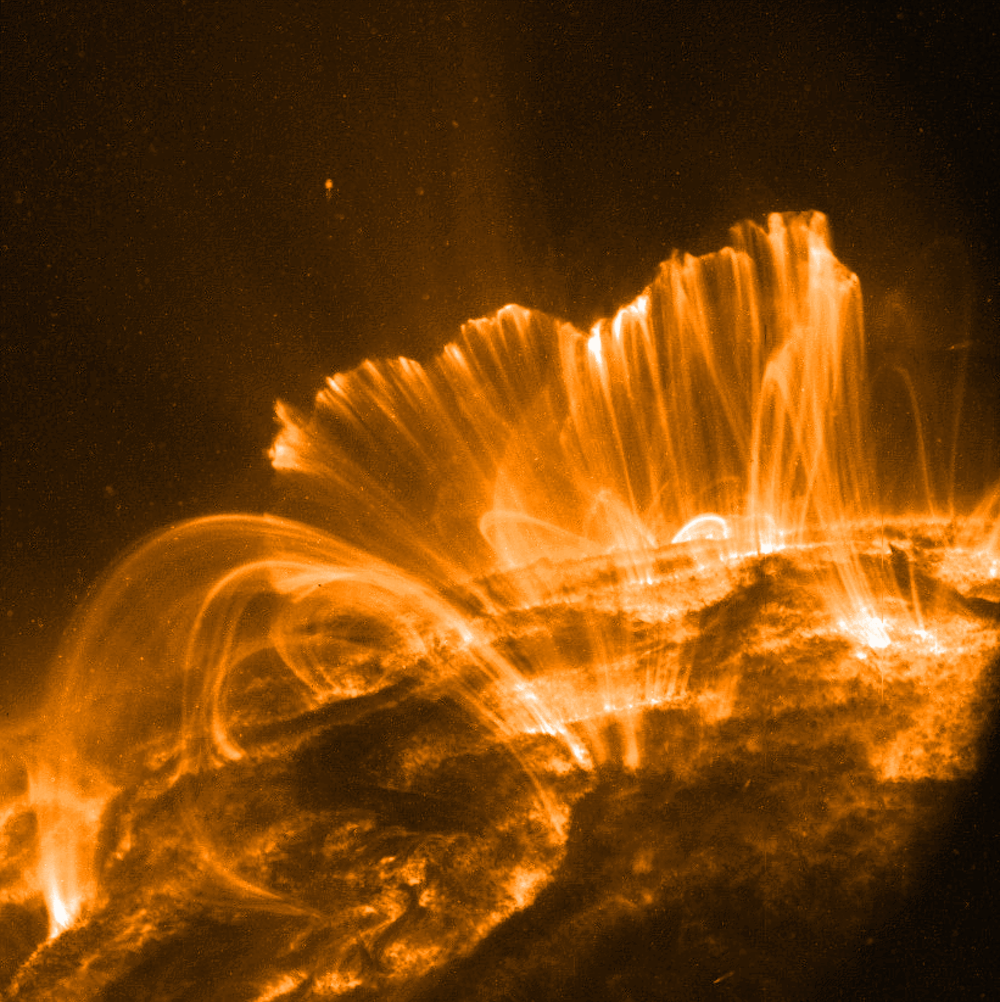
.gif#/media/File:Solar_flare_(TRACE).gif)
What did you find?
In 2018, my colleague Meredith MacGregor discovered flashes of light coming from Proxima Centauri that looked very different from solar flares. She was using a telescope that detects light at millimeter wavelengths to monitor Proxima Centauri and saw a big of flash of light in this wavelength. Astronomers had never seen a stellar flare in millimeter wavelengths of light.
My colleagues and I wanted to learn more about these unusual brightenings in the millimeter light coming from the star and see whether they were actually flares or some other phenomenon. We used nine telescopes on Earth, as well as a satellite observatory, to get the longest set of observations – about two days’ worth – of Proxima Centauri with the most wavelength coverage that had ever been obtained.
Immediately we discovered a really strong flare. The ultraviolet light of the star increased by over 10,000 times in just a fraction of a second. If humans could see ultraviolet light, it would be like being blinded by the flash of a camera. Proxima Centauri got bright really fast. This increase lasted for only a couple of seconds, and then there was a gradual decline.
This discovery confirmed that indeed, these weird millimeter emissions are flares.
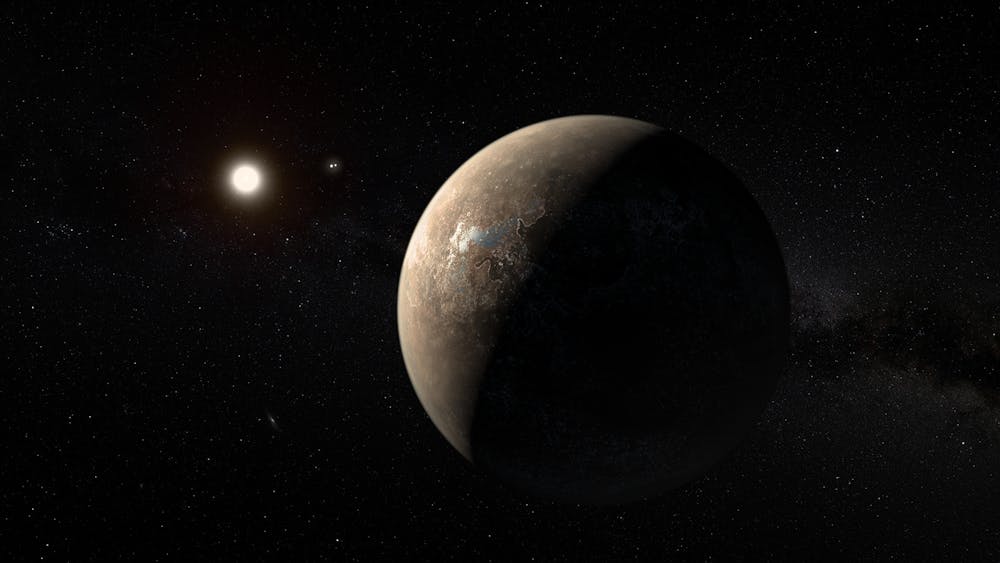
What does that mean for chances of life on the planet?
Astronomers are actively exploring this question at the moment because it can kind of go in either direction. When you hear ultraviolet radiation, you’re probably thinking about the fact that people wear sunscreen to try to protect ourselves from ultraviolet radiation here on Earth. Ultraviolet radiation can damage proteins and DNA in human cells, and this results in sunburns and can cause cancer. That would potentially be true for life on another planet as well.
On the flip side, messing with the chemistry of biological molecules can have its advantages – it could help spark life on another planet. Even though it might be a more challenging environment for life to sustain itself, it might be a better environment for life to be generated to begin with.
[Deep knowledge, daily. Sign up for The Conversation’s newsletter.]
But the thing that astronomers and astrobiologists are most concerned about is that every time one of these huge flares occurs, it basically erodes away a bit of the atmosphere of any planets orbiting that star – including this potentially Earth-like planet. And if you don’t have an atmosphere left on your planet, then you definitely have a pretty hostile environment to life – there would be huge amounts of radiation, massive temperature fluctuations and little or no air to breathe. It’s not that life would be impossible, but having the surface of a planet basically directly exposed to space would be an environment totally different than anything on Earth.
Is there any atmosphere left on Proxima b?
That’s anybody’s guess at the moment. The fact that these flares are happening doesn’t bode well for that atmosphere being intact – especially if they’re associated with explosions of plasma like what happens on the Sun. But that’s why we’re doing this work. We hope the folks who build models of planetary atmospheres can take what our team has learned about these flares and try to figure out the odds for an atmosphere being sustained on this planet.
R. O. Parke Loyd, Post-Doctoral Researcher in Astrophysics, Arizona State University
This article is republished from The Conversation under a Creative Commons license. Read the original article.