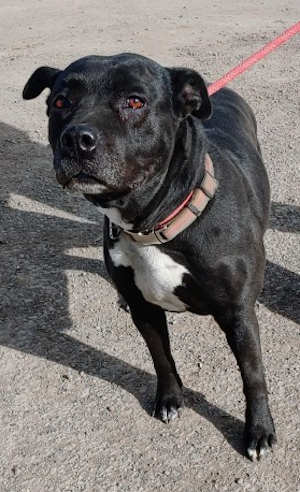
CLEARLAKE, Calif. — Clearlake Animal Control has numerous dogs waiting to be adopted into new and loving homes.
The City of Clearlake Animal Association also is seeking fosters for the animals waiting to be adopted.
Another way to help is through donations. A wish list has been posted on Amazon and on Chewy. For those who wish to shop local and drop off items, call 707-273-9440 to schedule a delivery or donate at the association’s Facebook page.
Here are this week’s adoptable dogs.
“Bear.” Photo courtesy of Clearlake Animal Control. ‘Bear’
“Bear” is a male American Staffordshire terrier mix with a short brown coat.
“Mara.” Photo courtesy of Clearlake Animal Control. ‘Mara’
“Mara” is a female Rottweiler mix.
She has a short black and tan coat.
He is house-trained.
She is dog No. 4628.
“Mary J.” Photo courtesy of Clearlake Animal Control. ‘Mary J’
“Mary J” is a female pit bull terrier mix.
She has a white and tan coat.
She is house-trained.
She is dog No. 4927.
“Mitzy.” Photo courtesy of Clearlake Animal Control. ‘Mitzy’
“Mitzy” is a female shepherd mix with a medium-length black and white coat.
She is dog No. 4648.
“Sassy.” Photo courtesy of Clearlake Animal Control. ‘Sassy’
“Sassy” is a female American bully mix with a short black coat.
She has been spayed.
She is dog No. 4602.
“Sissy.” Photo courtesy of Clearlake Animal Control. ‘Sissy’
“Sissy” is a female American Staffordshire terrier mix with a black coat.
She is dog No. 4964.
“Tanisha.” Photo courtesy of Clearlake Animal Control. ‘Tanisha’
“Tanisha” is a female shepherd mix with a short orange and white coat.
She is dog No. 4647.
“Terry.” Photo courtesy of Clearlake Animal Control. ‘Terry’
“Terry” is a male Dutch shepherd mix with a smooth brindle coat.
He is dog No. 4880.
“Yule.” Photo courtesy of Clearlake Animal Control. ‘Yule’
“Yule” is a male husky with a medium-length black and white coat.
He is dog No. 4432.
Call the Clearlake Animal Control shelter at 707-273-9440, or email This email address is being protected from spambots. You need JavaScript enabled to view it. to inquire about adoptions and schedule a visit to the shelter.
Visit Clearlake Animal Control on Facebook or on the city’s website.
Email Elizabeth Larson at This email address is being protected from spambots. You need JavaScript enabled to view it.. Follow her on Twitter, @ERLarson, or Lake County News, @LakeCoNews.
LAKE COUNTY, Calif. — With chances of thunderstorms on Thursday evening, the National Weather Service has issued a fire weather watch for Lake County.
The fire weather watch is in effect from 5 p.m. Thursday until 5 a.m. Friday, the National Weather Service reported.
The agency said a fire weather watch means that critical fire weather conditions are forecast to occur.
In this case, that includes isolated dry thunderstorms that could occur and lead to fire starts, along with gusty and erratic winds of up to 40 miles per hour.
Forecasters expect showers and thunderstorms to develop across the interior mountains of northwest California Thursday evening and night.
A mix of dry and wet storm activity is expected, with dry storms posing a threat for fire starts, according to the forecast.
The specific Lake County forecast calls for a 20% chance of showers and thunderstorms after 11 p.m. Thursday, with conditions clearing by Friday morning.
Daytime temperatures will range into the high 90s in the south county on Thursday, with slightly cooler conditions elsewhere, reaching the high 80s and low 90s into early next week, with nighttime temperatures hovering in the mid 50s to low 60s, based on the forecast.
Light winds of up to about 10 miles per hour also are forecast through Friday, forecasters said.
Email Elizabeth Larson at This email address is being protected from spambots. You need JavaScript enabled to view it.. Follow her on Twitter, @ERLarson, or Lake County News, @LakeCoNews.
NORTH COAST, Calif. — A Chico woman has been arrested after authorities said she sexually assaulted a Hidden Valley Lake girl.
Lexie Brooke Thompson, 21, was arrested by the Mendocino County Sheriff’s Office based on that agency’s investigation into the case, which came to light late in August.
A report from Det. Sgt. Luis Espinoza explained that on Aug. 25 Mendocino County Sheriff's Office deputies were dispatched on the report of a suspected sexual abuse of a 12-year-old female from Hidden Valley Lake.
Sheriff's office detectives were later dispatched to conduct further investigations, Espinoza said.
Through the investigation, Espinoza said authorities learned that near the end of July, Thompson engaged in multiple sexual acts with the girl — who she knew — over the course of a single day at a residence in Potter Valley.
On Aug. 27, investigators contacted and interviewed Thompson, who Espinoza said they subsequently arrested on charges of lewd sexual acts with a minor under 14 years old, oral copulation of a minor under 14 years old and sexual penetration with a foreign object of a minor under 14 years old.
Espinoza said Thompson was also identified as being on summary probation and arrested for violation of probation and she was booked into the Mendocino County Jail.
Investigators contacted a Mendocino Superior Court judge and requested a bail enhancement, which resulted in Thompson being held on a no bail status, Espinoza said.
On Wednesday, she remained in custody, according to jail records.
Espinoza said the investigation remains ongoing and anyone with information related to Lexie Thompson is asked to contact the Mendocino County Sheriff's Office Investigations Bureau Tip-Line at 707-234-2100 or contact Mendocino County Sheriff's Office Dispatch Center at 707-463-4086.
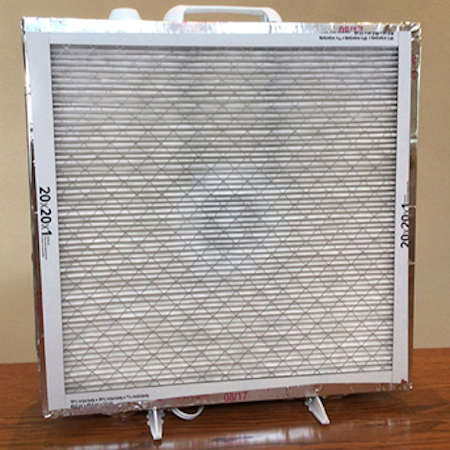
This simple and inexpensive DIY air filter, constructed from a box fan and a MERV-rated furnace filter, can help reduce the amount of particulate matter in the home. Courtesy Allen Goldstein. Though overall air quality in the U.S. has improved dramatically in recent decades, smoke from catastrophic wildfires is now creating spells of extremely hazardous air pollution in the Western U.S.
And, while many people have learned to reduce their exposure by staying inside, keeping windows closed and running air filtration systems on smoky days, data remains limited on how well these efforts are paying off.
In a new study, scientists from the University of California, Berkeley, used data from 1,400 indoor air sensors and even more outdoor air sensors included on the crowdsourced PurpleAir network to find out how well residents of the San Francisco and Los Angeles metropolitan areas were able to protect the air inside their homes on days when the air outside was hazardous.
They found that, by taking steps like closing up their houses and using filtration indoors, people were able to cut the infiltration of PM2.5 particulate matter to their homes by half on wildfire days.
“While the particulate matter indoors was still three times higher on wildfire days than on non-wildfire days, it was much lower than it would be if people hadn’t closed up their buildings and added filtration,” said study senior author Allen Goldstein, a professor of environmental engineering and of environmental science, policy and management at UC Berkeley. “This shows that when people have information about the smoke coming their way, they are acting to protect themselves, and they are doing it effectively.”
While individuals can take steps to reduce smoke infiltration to their homes, the ability for air pollution to get inside can also depend heavily on the nature of the building itself. To study these effects, the researchers also used the real estate website Zillow to estimate the characteristics of buildings in the sensor network, including the structure’s relative age, the type of building and the socio-economic status of the neighborhood.
Not surprisingly, they found that newly constructed homes and those that were built with central air conditioning were significantly better at keeping wildfire smoke out.
“One of the things that makes this study exciting is it shows what you can learn with crowdsourced data that the government was never collecting before,” said study co-author Joshua Apte, an assistant professor of civil and environmental engineering and of public health at UC Berkeley. “The Environmental Protection Agency (EPA) has a mandate to measure outdoor air quality and not indoor air quality — that’s just how our air quality regulations are set up. So, these kinds of crowdsourced data sets allow us to learn about how populations are affected indoors, where they spend most of their time.”
Protecting the air of the great indoors
Like many residents of the Western U.S., both Goldstein and Apte regularly use websites like AirNow and PurpleAir to check how wildfire smoke is affecting the air quality where they live. Both have even installed their own PurpleAir sensors to track the concentrations of PM2.5 particulate matter inside their homes.
So, when UC Berkeley graduate student Yutong Liang wrote a term paper using data from the PurpleAir network to study the impact of wildfire smoke on indoor air quality, Goldstein and Apte thought the work was worth expanding to a full research study.
“Our friends and neighbors and colleagues were all looking at this real-time data from PurpleAir to find out when smoke was affecting their area, and using that information to decide how to behave,” Goldstein said. “We wanted to use actual data from this network to find out how effective that behavior was at protecting them.”
The analysis compared indoor and outdoor sensor data collected during August and September of 2020, when both San Francisco and Los Angeles experienced a number of “fire days,” which the researchers defined as days when the average PM2.5 measured by the EPA exceeded 35ug/m3. This value corresponds to an Air Quality Index (AQI) of approximately 100, which represents the boundary between PM2.5 levels that the EPA considers “moderate” and those that are considered “unhealthy for sensitive groups.”
While scientists are still working to puzzle out just what types of chemical compounds are found in this particulate matter from wildfire smoke, a growing body of research now suggests that it may be even worse for human health than other types of PM2.5 air pollution.
“Wildfires create thousands of different organic chemicals as particulate matter and gases that can cause respiratory and cardiovascular problems in people,” said Liang, who is lead author of the study. “The Goldstein research group is trying to identify these unique compounds, as well as the ways that they react to transform the composition of wildfire smoke over time.”
To protect indoor air during fire season, the research team suggests closing up your home before smoke arrives in your area and investing in an air filtration system. If you can’t afford a commercial air filter — or they are all sold out — you can also build your own for less than $50 using a box fan, a MERV-rated furnace filter and some tape.
“There are lots of very informative Twitter threads about how to build a good DIY system, and if you are willing to go a little crazy – spend $90 instead of $50 – you can build an even better design,” Apte said. “Every air quality researcher I know has played around with these because they are so satisfying and simple and fun, and they work.”
Where you put the filters also matters. If you only have one, Apte suggests putting it in your bedroom and leaving the door closed while you sleep, to keep the air in your bedroom as clean as possible.
Finally, the researchers suggest cooking as little as possible during smoky days. Cooking can generate surprising amounts of both particulate matter and gases, neither of which can be easily ventilated out of the house without inviting wildfire smoke in.
“Air filters can help remove particulate matter from cooking, but running a kitchen or bathroom exhaust fan during smoke events can actually pull PM2.5 -laden air from outdoors to indoors,” Goldstein said.
In the future, the researchers hope to find ways to sample the indoor air quality of a more diverse array of households. Because PurpleAir sensors cost at least $200 apiece, households that contribute data to the network tend to be affluent, and the Zillow estimates show that the average price of homes in the network is about 20% higher than median property values in their areas.
“One thing that we’re deeply interested in is understanding what happens to people in indoor environments, because that’s where people spend most of their time, and there’s still an awful lot we don’t know about indoor pollution exposure,” Apte said. “I think that these new methods of sensing the indoor environment are going to allow us to grapple a lot more with questions of environmental justice and find out more about who gets to breathe cleaner air indoors.”
Co-authors of the paper include Deep Sengupta, Mark J. Campmier and David M. Lunderberg of UC Berkeley.
This work was supported by the National Oceanic and Atmospheric Administration Climate Program Office’s AC4 program (Award NA16OAR4310107) and the California Air Resources Board (Award 19RD008). This publication was also developed as part of the Center for Air, Climate and Energy Solutions, which was supported under the Assistance Agreement R835873 awarded by the U.S. EPA. It has not been formally reviewed by the EPA.
Kara Manke writes for the UC Berkeley News Center.
The California Independent System Operator, or ISO, has extended a statewide Flex Alert for a second day, issuing a call for voluntary electricity conservation on Thursday, Sept. 9, from 4 to 9 p.m., because of hot weather affecting much of California and the West, and tight energy supply margins in the market.
Thursday’s Flex Alert follows Wednesday’s conservation call, also due to above-normal temperatures in the Western states.
Consumers are urged to conserve electricity from 4 to 9 p.m. on both days by setting their thermostats to 78 degrees or higher, and deferring use of major appliances and unnecessary lights during that time.
The ISO also issued a system-wide restricted maintenance operations, or RMO, order for Wednesday and Thursday from noon to 9 p.m., delaying routine maintenance of generation and transmission equipment so that all available resources are online for the critical evening time.
The Flex Alerts have been issued due to above-normal temperatures leading to high electricity demand in California and parts of the western US, narrow margins of supply, and cloud cover creating uncertainty for renewable generation forecasts.
Temperatures in the Northern California inland region are forecast to be 3 to 10 degrees warmer than normal.
In Southern California, temperatures are expected to be 5 to 10 degrees warmer than normal through the weekend, primarily for the interior, although coastal regions are forecast to see some warming as well.
Above-normal temperatures throughout much of the interior western US are also expected this week, with some cities seeing a potential for record-breaking heat.
Widespread heat waves affecting other western states limits the California ISO’s ability to import energy from neighboring power grids.
The ISO is predicting an increase in electricity demand, primarily from air conditioning use. The increase can stretch electricity supplies thin and cause strain on our power grid, especially in the late afternoon and evening, when solar production goes offline and wind generation is uncertain, however, temperatures and electricity demand remains high.
Consumers are urged to conserve electricity, especially during the late afternoon and early evening, when the grid is most stressed due to higher demand and solar energy production falling.
Reducing energy use during a Flex Alert can help stabilize the power grid during a time of tight supply conditions, and prevent further emergency measures, including rotating power outages.
For information on Flex Alerts, and to get more electricity conservation tips, visit www.FlexAlert.org .
Conservation tips before a Flex Alert:
— Pre-cool home by setting the thermostat to as low as 72 degrees.
— Use major appliances: o Washer and dryer; o Dishwasher; o Oven and stove for pre-cooking and preparing meals.
— Adjust blinds and drapes to cover windows.
Tips during a Flex Alert from 4 p.m. to 9 p.m.:
— Set the thermostat to 78 degrees or higher, if health permits. — Avoid using major appliances. — Turn off all unnecessary lights.
LAKE COUNTY, Calif. — On Tuesday, Gov. Gavin Newsom proclaimed a state of emergency for Lake County in response to last month’s Cache fire in Clearlake, a step that will offer the city and impacted residents much-needed help in the recovery effort.
The Governor’s Office said the proclamation will help quicken removal of the resulting hazardous debris and ash, in addition to streamlining other public services for fire victims.
City officials were both surprised and delighted by the governor’s Tuesday evening action.
“I can’t believe it! Our indications since the night of the fire have been that there would be no state or federal declaration, because it didn’t meet the thresholds,” City Manager Alan Flora said in an email response to Lake County News’ request for comment on the news.
“This is great news for the city of Clearlake because we were really worried about the cost of cleanup,” Clearlake Mayor Dirk Slooten told Lake County News.
The fire began early on the afternoon of Aug. 18 in the area of Sixth Avenue at Cache Street, swiftly burning 83 acres, 56 homes and 81 outbuildings, and leaving hundreds of people evacuated for several days.
Despite how quickly the fire moved through the densely populated area, no fatalities have been reported.
The help from Newsom’s proclamation is critical for the city of Clearlake, which was facing the prospect of trying to cover millions of dollars in cleanup and recovery on its own.
Increasing the challenge is the fact that officials said many of the impacted homeowners, property owners and renters in the area are either uninsured or underinsured.
During last week’s Clearlake City Council meeting, Flora gave an initial estimate of $14.5 million in impacts to private property and cleanup efforts, of which $11 million is in cleanup and recovery costs.
On the night of the fire, Flora, in his capacity as the city’s emergency services director, declared a local emergency which the Clearlake City Council ratified at its meeting on Aug. 19.
On the morning of Aug. 19, the Lake County Fire Protection District Board held a special meeting during which it approved an emergency declaration in response to the fire — the first time it’s taken such an action in recent memory.
On Aug. 24, the Board of Supervisors ratified separate local emergencies declared by Sheriff Brian Martin and interim Public Health Officer Dr. Gary Pace in response to the Cache fire, steps needed to seek assistance from the state and federal governments.
Despite those actions, because of the smaller size of the incident, Flora said they hadn’t expected to be granted a state emergency proclamation.
“We had learned recently that we would receive state assistance in clean up efforts, but it was unlikely anything else,” he said. “We are so pleased that additional resources will now be available to those whose lives were devastated by the Cache fire. It took a vast array of lobbying efforts to plead our case.”
Flora said many individuals were involved, and he singled out for special recognition Sheriff Brian Martin, District 2 Supervisor Bruno Sabatier, Congressman John Garamendi and Congressman Mike Thompson for adding their voices to this request for assistance.
Additionally, Assemblymember Cecilia Aguiar-Curry and state Sen. Mike McGuire “have been fighting in our corner since the night of the fire,” Flora said.
“We are so fortunate to have such tireless advocates in the state Legislature representing us,” Flora said.
Flora said city department heads and staff have put in every effort to prepare a compelling case for state and federal declaration.
“We feel fortunate to be able to secure this win for those impacted by the Cache fire and offer our sincere appreciation to all those that have supported the city in this time of need,” Flora said.
Slooten said the governor's action will now open up an avenue to federal assistance for the recovery, “which is awesome.”
On Thursday, the city’s evacuation shelter at the senior and community center, run by the Red Cross, was closed, with displaced individuals and families moved into other short-term housing.
During the Clearlake City Council meeting, which also took place on Thursday, the council approved an agreement with North Coast Opportunities for short-term housing for Cache fire survivors, using $100,000 from the city’s low and moderate income housing fund to help house those individuals.
Thanks to the governor’s emergency proclamation, “Now we can move on to figuring out how to get permanent housing for these people and not worry about the cost of cleanup over there, and that is huge,” Slooten said Tuesday night.
Gov. Newsom previously proclaimed a state of emergency in counties impacted by the Caldor fire, McFarland and Monument fires, Antelope and River fires, Dixie, Fly and Tamarack fires and the Lava Fire and Beckwourth Complex fire. The governor has also signed executive orders to support impacted communities and bolster wildfire response and recovery efforts.
The Governor’s Office reported that Cal Fire and the California Governor’s Office of Emergency Service are responding in concert with other federal, state and local agencies to address emergency management and mutual aid needs for the fires.
The text of Gov. Newsom’s Tuesday proclamation is published below in its entirety.
EXECUTIVE DEPARTMENT
STATE OF CALIFORNIA
PROCLAMATION OF A STATE OF EMERGENCY
WHEREAS on August 18, 2021 , the Cache Fire began burning in Lake County; and
WHEREAS the Cache Fire destroyed or caused major damage to more than 100 structures, including dozens of homes, as well as nearly 200 vehicles, resulting in hazardous debris and ash that must be expeditiously removed to mitigate impacts to public health and safety; and
WHEREAS under the provisions of Government Code section 8558(b), I find that conditions of extreme peril to the safety of persons and property exist due to the Cache Fire in Lake County; and
WHEREAS under the provisions of Government Code section 8558(b), I find that the conditions caused by the Cache Fire, by reason of its magnitude, are or are likely to be beyond the control of the services, personnel, equipment, and facilities of any single local government and require the combined forces of a mutual aid region or regions to appropriately respond; and
WHEREAS under the provisions of Government Code section 8625( c), I find that local authority is inadequate to cope with the magnitude of the damage caused by the Cache Fire; and
WHEREAS under the provisions of Government Code section 8571, I find that strict compliance with various statutes and regulations specified in this Order would prevent, hinder, or delay the mitigation of the effects of the Cache Fire.
NOW, THEREFORE, I, GAVIN NEWSOM, Governor of the State of California, in accordance with the authority vested in me by the State Constitution and statutes, including the California Emergency Services Act, and in particular, Government Code section 8625, HEREBY PROCLAIM A STATE OF EMERGENCY to exist in Lake County due to the Cache Fire.
IT IS HEREBY ORDERED THAT:
l. All agencies of the state government utilize and employ state personnel, equipment, and facilities for the performance of any and all activities consistent with the direction of the Office of Emergency Services and the State Emergency Plan. Also, all residents are to obey the direction of emergency officials with regard to this emergency in order to protect their safety.
2. The Office of Emergency Services shall provide assistance to local governments, if appropriate, under the authority of the California Disaster Assistance Act, Government Code section 8680 et seq., and California Code of Regulations, Title 19, section 2900 et seq.
3. As necessary to assist local governments and for the protection of public health and the environment, state agencies shall enter into contracts to arrange for the procurement of materials, goods, and services necessary to quickly assist with the response to and recovery from the impacts of the Cache Fire. Applicable provisions of the Government Code and the Public Contract Code, including but not limited to travel, advertising, and competitive bidding requirements, are suspended to the extent necessary to address the effects of the Cache Fire.
4. The provisions of Unemployment Insurance Code section 1253 imposing a one-week waiting period for unemployment insurance applicants are suspended as to all applicants who are unemployed as a direct result of the Cache Fire who applied for unemployment insurance benefits during the time period beginning August 18, 2021, and ending on the close of business on February 18, 2022, and who are otherwise eligible for unemployment insurance benefits.
5. Vehicle Code sections 9265(a}, 9867, 14901, 14902, and 15255.2, requiring the imposition of fees, are suspended with regard to any request for replacement of o driver's identification card, vehicle registration certificate, or certificate of title, by any individual who lost such records as a result of the Cache Fire. Such records shall be replaced without charge.
6. The provisions of Vehicle Code sections 4602 and 5902, requiring the timely registration or transfer of title are suspended with regard to any registration or transfer of title by any resident of Lake County, who is unable to comply with those requirements as a result of the Cache Fire, respectively. The time covered by this suspension shall not be included in calculating any late penalty pursuant to Vehicle Code section 9554.
7. Health and Safety Code sections 103525.5 and 103625, and Penal Code section 14251, requiring the imposition of fees are hereby suspended with regard to any request for copies of certificates of birth, death, marriage, and dissolution of marriage records, by any individual who lost such records as a result of the Cache Fire. Such copies shall be provided without charge.
8. All provisions of Executive Orders N-13-21 and N-14-2 1 are hereby incorporated by reference into this proclamation and are applicable to Lake County due to the Cache Fire.
I FURTHER DIRECT that as soon as hereafter possible, this proclamation be filed in the Office of the Secretary of State and that widespread publicity and notice be given of this proclamation.
IN WITNESS WHEREOF I have hereunto set my hand and caused the Great Seal of the State of California to be affixed this 7th day of September 2021.
GAVIN NEWSOM Governor of California
ATTEST:
SHIRLEY WEBER, PH.D. Secretary of State
Email Elizabeth Larson at This email address is being protected from spambots. You need JavaScript enabled to view it.. Follow her on Twitter, @ERLarson, or Lake County News, @LakeCoNews.
 How to resolve AdBlock issue?