 How to resolve AdBlock issue?
News
On Wednesday, a bill to address liability in order to encourage more prescribed burning in California became law.
Gov. Gavin Newsom signed SB 332 by Sen. Bill Dodd (D-Napa).
“Today we take an important step toward protecting our state from the kinds of wildfires that have been so destructive over the past few years,” Dodd said, thanking Newsom for signing the bill into law.
SB passed the Assembly and Senate with unanimous, bipartisan support in September before being signed by the governor on Wednesday.
Dodd said SB 332 is meant to help prevent future loss of life and property by expanding the use of prescribed burning to control combustible fuels.
“We know control burning is one of the best ways to reduce combustible fuels in our tinder-dry forest. My bill, SB 332, will expand our use of this proven tool and make our state safer as we face ever-worsening conditions caused by drought and climate change. To do that we must raise the legal standard for seeking state suppression costs, requiring a showing of gross negligence rather than simple negligence,” Dodd said in a statement released Wednesday evening, within hours of the bill’s signing.
Newsom signed the legislation just over a week after he signed a complementary bill, AB 642 by Assembly member Laura Friedman (D-Glendale), which — among other things — calls for the creation of a prescribed fire training center, the appointment of a cultural burning liaison to serve on the State Board of Fire Services and development of Cal Fire’s prescribed burning crews, as Lake County News has reported.
Prescribed burning is the controlled application of fire to the land to reduce wildfire hazards, clear downed trees, control plant diseases and improve wildlife habitats.
It is conducted by trained professionals — called “burn bosses” — and is one of the most cost-effective tools to manage wildfire.
California’s tribes used the practice for centuries and, more recently, it was used by ranchers to keep landscapes more open. However, the state and federal governments began to discourage the practice by private landowners.
Recently, with so much of California beset by larger and more damaging wildland fires, the importance of the practice has once again begun to be recognized, with more landowners and agencies seeking to use it.
Rarely have prescribed burns caused unintended damage. However, Lenya Quinn-Davidson, fire adviser for the University of California Cooperative Extension and director of Northern California Prescribed Fire Council, told Lake County News that concern over being billed for wildfire suppression costs has hampered the practice’s use.
Dodd’s office said the liability concern’s impact on prescribed burns has caused a buildup in forests of brush and unhealthy trees, which is why SB 332 changed the legal standard for seeking state suppression costs.
“The passage of SB 332 is monumental,” said Quinn-Davidson. “Those of us who work on prescribed fire have felt the need for these changes for years, but we never thought we’d see them happen. We are so thankful to Sen. Dodd for his vision and leadership, which will effect real, positive change around prescribed burning and fire resiliency in California.”
Quinn-Davidson said the bill had the support of a broad coalition of groups, from ranchers to conservationists and tribal governments.
The bill builds on legislation Dodd advocated to create a $20 million insurance pilot program to encourage prescribed burning.
SB 170, the Budget Act of 2021, was signed Sept. 23. It included a $20 million prescribed fire claim fund in the state budget.
Email Elizabeth Larson atThis email address is being protected from spambots. You need JavaScript enabled to view it. . Follow her on Twitter, @ERLarson, or Lake County News, @LakeCoNews.
Gov. Gavin Newsom signed SB 332 by Sen. Bill Dodd (D-Napa).
“Today we take an important step toward protecting our state from the kinds of wildfires that have been so destructive over the past few years,” Dodd said, thanking Newsom for signing the bill into law.
SB passed the Assembly and Senate with unanimous, bipartisan support in September before being signed by the governor on Wednesday.
Dodd said SB 332 is meant to help prevent future loss of life and property by expanding the use of prescribed burning to control combustible fuels.
“We know control burning is one of the best ways to reduce combustible fuels in our tinder-dry forest. My bill, SB 332, will expand our use of this proven tool and make our state safer as we face ever-worsening conditions caused by drought and climate change. To do that we must raise the legal standard for seeking state suppression costs, requiring a showing of gross negligence rather than simple negligence,” Dodd said in a statement released Wednesday evening, within hours of the bill’s signing.
Newsom signed the legislation just over a week after he signed a complementary bill, AB 642 by Assembly member Laura Friedman (D-Glendale), which — among other things — calls for the creation of a prescribed fire training center, the appointment of a cultural burning liaison to serve on the State Board of Fire Services and development of Cal Fire’s prescribed burning crews, as Lake County News has reported.
Prescribed burning is the controlled application of fire to the land to reduce wildfire hazards, clear downed trees, control plant diseases and improve wildlife habitats.
It is conducted by trained professionals — called “burn bosses” — and is one of the most cost-effective tools to manage wildfire.
California’s tribes used the practice for centuries and, more recently, it was used by ranchers to keep landscapes more open. However, the state and federal governments began to discourage the practice by private landowners.
Recently, with so much of California beset by larger and more damaging wildland fires, the importance of the practice has once again begun to be recognized, with more landowners and agencies seeking to use it.
Rarely have prescribed burns caused unintended damage. However, Lenya Quinn-Davidson, fire adviser for the University of California Cooperative Extension and director of Northern California Prescribed Fire Council, told Lake County News that concern over being billed for wildfire suppression costs has hampered the practice’s use.
Dodd’s office said the liability concern’s impact on prescribed burns has caused a buildup in forests of brush and unhealthy trees, which is why SB 332 changed the legal standard for seeking state suppression costs.
“The passage of SB 332 is monumental,” said Quinn-Davidson. “Those of us who work on prescribed fire have felt the need for these changes for years, but we never thought we’d see them happen. We are so thankful to Sen. Dodd for his vision and leadership, which will effect real, positive change around prescribed burning and fire resiliency in California.”
Quinn-Davidson said the bill had the support of a broad coalition of groups, from ranchers to conservationists and tribal governments.
The bill builds on legislation Dodd advocated to create a $20 million insurance pilot program to encourage prescribed burning.
SB 170, the Budget Act of 2021, was signed Sept. 23. It included a $20 million prescribed fire claim fund in the state budget.
Email Elizabeth Larson at
LAKE COUNTY, Calif. — Lake County Behavioral Health Services, in partnership with the Lake County Office of Education, has been awarded a Mental Health Student Services Act grant through the California Mental Health Services Oversight and Accountability Commission.
This competitive grant is designed to incentivize partnerships between Behavioral Health and educational agencies, for the purpose of increasing access to mental health services in locations easily accessible to students and their families.
Importantly, this grant will support the mental health needs of Lake County students now returning to in-person school after over a year of shelter-in-place isolation.
Behavioral Health and LCOE have enjoyed a strong working relationship, serving youth in the community for many years. The organizations recognize how critical it is to identify and address mental health issues early on.
Mental, behavioral, and developmental disorders can begin early in childhood. According to the Centers for Disease Control, one in six children aged 2-8 years (17.4%) have a diagnosed condition.
Poverty is also a well-established risk factor for a variety of health issues, including mental health conditions. Overall, about 32% of children in Lake County live in poverty, and in the communities of Clearlake and Lower Lake, this percentage jumps to 48% and 51%, respectively. This is dramatically higher than the State average of 25%.
The Mental Health Student Services Act grant is designed to provide support services that include, at a minimum, mental health services on school campuses, suicide prevention services, drop-out prevention services, placement assistance and service plans for students in need of ongoing services.
The grant also includes outreach to high-risk youth, including foster youth, youth who identify as LGBTQ, and youth who have been expelled or suspended from school.
Behavioral Health and LCOE designed a proposal that would include additional mental health staff who will collaborate with teachers and other school staff to provide services and increase access to mental health interventions.
Grant activities will begin in October, and will continue through 2026.
This competitive grant is designed to incentivize partnerships between Behavioral Health and educational agencies, for the purpose of increasing access to mental health services in locations easily accessible to students and their families.
Importantly, this grant will support the mental health needs of Lake County students now returning to in-person school after over a year of shelter-in-place isolation.
Behavioral Health and LCOE have enjoyed a strong working relationship, serving youth in the community for many years. The organizations recognize how critical it is to identify and address mental health issues early on.
Mental, behavioral, and developmental disorders can begin early in childhood. According to the Centers for Disease Control, one in six children aged 2-8 years (17.4%) have a diagnosed condition.
Poverty is also a well-established risk factor for a variety of health issues, including mental health conditions. Overall, about 32% of children in Lake County live in poverty, and in the communities of Clearlake and Lower Lake, this percentage jumps to 48% and 51%, respectively. This is dramatically higher than the State average of 25%.
The Mental Health Student Services Act grant is designed to provide support services that include, at a minimum, mental health services on school campuses, suicide prevention services, drop-out prevention services, placement assistance and service plans for students in need of ongoing services.
The grant also includes outreach to high-risk youth, including foster youth, youth who identify as LGBTQ, and youth who have been expelled or suspended from school.
Behavioral Health and LCOE designed a proposal that would include additional mental health staff who will collaborate with teachers and other school staff to provide services and increase access to mental health interventions.
Grant activities will begin in October, and will continue through 2026.
State Controller Betty T. Yee has published the 2020 self-reported payroll data for University of California institutions and California Community College districts on the Government Compensation in California website.
The data cover more than 411,000 positions and approximately $22.77 billion in total wages.
All 11 UC institutions – including 10 campuses and the Office of the President – voluntarily filed compliant reports with the State Controller’s Office. UC data cover 293,024 employees and nearly $18.11 billion in total wages.
Forty-nine CCC districts voluntarily filed compliant reports with SCO. CCC data published cover 118,652 employees and nearly $4.67 billion in total wages.
Twelve CCC districts did not file a report with SCO, while another 11 filed reports that were not compliant.
Among those that did not file was the Mendocino-Lake Community College District. The other community college district serving Lake County, the Yuba Community College District, was noncompliant.
California law requires cities, counties, and special districts to annually report compensation data to the state controller.
The state controller also maintains and publishes state and CSU salary data. No such statutory requirement exists for UC, CCCs, superior courts, fairs and expositions, First 5 commissions, or K-12 education providers; their reporting is voluntary.
Users of the site can view compensation levels on maps and search by region; narrow results by name of the entity or by job title; and export raw data or custom reports.
Since the website launched in 2010, it has registered more than 13 million pageviews. The site contains pay and benefit information on more than two million government jobs in California, as reported annually by each entity.
The data cover more than 411,000 positions and approximately $22.77 billion in total wages.
All 11 UC institutions – including 10 campuses and the Office of the President – voluntarily filed compliant reports with the State Controller’s Office. UC data cover 293,024 employees and nearly $18.11 billion in total wages.
Forty-nine CCC districts voluntarily filed compliant reports with SCO. CCC data published cover 118,652 employees and nearly $4.67 billion in total wages.
Twelve CCC districts did not file a report with SCO, while another 11 filed reports that were not compliant.
Among those that did not file was the Mendocino-Lake Community College District. The other community college district serving Lake County, the Yuba Community College District, was noncompliant.
California law requires cities, counties, and special districts to annually report compensation data to the state controller.
The state controller also maintains and publishes state and CSU salary data. No such statutory requirement exists for UC, CCCs, superior courts, fairs and expositions, First 5 commissions, or K-12 education providers; their reporting is voluntary.
Users of the site can view compensation levels on maps and search by region; narrow results by name of the entity or by job title; and export raw data or custom reports.
Since the website launched in 2010, it has registered more than 13 million pageviews. The site contains pay and benefit information on more than two million government jobs in California, as reported annually by each entity.

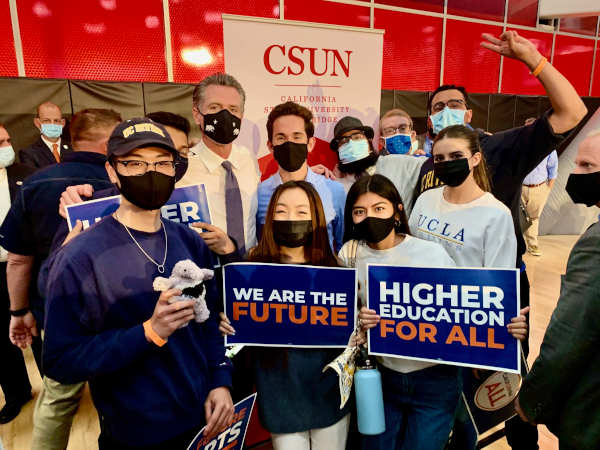
At California State University, Northridge on Wednesday, Gov. Gavin Newsom signed legislation to improve college affordability and increase access to higher education, and highlighted the historic $47.1 billion higher education package — the most ever invested in higher education in modern history.
“We’re turning commitments into reality by ensuring that our students have more access to high-quality educational opportunities, creating a change of course for generations to come and bolstering California’s innovation economy,” said Gov. Newsom. “Californians have thrived at our world class universities for decades, but not everyone has had similar access — today that’s changing. Everyone deserves a shot at the ‘California Dream’ — we’re eliminating equity gaps and increasing opportunities at our universities to make those dreams a reality for more California students.”
“Over the last five years I’ve held hearings across California to discuss higher education issues,” said Assemblymember Marc Berman, chair of the Assembly Select Committee on the Master Plan for Higher Education in California. “When students discussed their experience with the transfer process from community college to four-year university their message was loud and clear: transfer is too complex, confusing, and difficult to navigate. Instead of being a clear path, it’s a maze, and it’s costing students time and money that they can’t afford. Together, Assembly Bills 928 and 1111 will make it easier for students to achieve their educational goals. I am grateful that Gov. Newsom signed these historic bills, and for the advocates and students who inspired these reforms.”
“From historic investments in financial aid and student housing that will benefit students to a radical revamping of transfer, 2021 is a landmark year for public higher education in California,” said California State University Chancellor Joseph I. Castro. “We appreciate the bold vision demonstrated by Governor Newsom and his commitment to further improving education access and outcomes throughout the Golden State.”
Increasing transfer rates for underserved students
Gov. Newsom on Wednesday signed legislation to help facilitate access to the University of California, or UC, and California State University, CSU, systems for students to attain four-year degrees and help further prepare them for the economy of tomorrow:
— AB 928 by Assembly member Marc Berman (D-Menlo Park): Requires the CSU and UC to jointly establish a singular lower division general education pathway for transfer admission into both segments. Also requires California Community Colleges (CCC) to place students who declare a goal of transfer on an Associate Degree for Transfer (ADT) pathway for their intended major, and establishes the ADT intersegmental implementation committee as the primary oversight entity.
— AB 1111 by Assembly member Marc Berman (D-Menlo Park) - Requires, by July 1, 2024, the CCCs adopt a common course numbering system (C-ID) at all community colleges and for each community college campus catalog. This common course numbering system is required to be student-facing and ensures that comparable courses across all community colleges have the same course number.
Finding solutions to the student housing crisis
On top of the $2 billion investment to significantly increase affordable housing for students and help address the student housing crisis, Gov. Newsom signed legislation to create long-overdue housing plans at the UC and CSU systems:
— AB 1377 by Assembly member Kevin McCarty (D-Sacramento): Requires the CSU system, and requests the UC system, to conduct a student housing needs assessment for each campus, and create a student housing plan outlining how projected student housing needs will be met.
— SB 330 by Sen. María Elena Durazo (D-Los Angeles): Requires the Los Angeles Community College District (LACCD) to develop a pilot program to provide affordable housing to students or employees of LACCD. This bill also allows LACCD to enter into agreements with nonprofit or private entities to lease real property under certain conditions, in order to develop affordable housing.
Making financial aid more accessible
Governor Newsom’s California Comeback Plan requires all students to submit a Free Application for Federal Aid or California Dream Act application in order to significantly increase federal aid opportunities for California students, and on Wednesday he signed legislation to further expand such supports:
— AB 340 by Assembly member Chris Ward (D-San Diego): Conforms the state's 529 college savings plan statute to recent changes in federal tax law, expanding allowable withdrawals from 529 plans to include expenses associated with participation in a registered apprenticeship program and student loan repayment.
— AB 469 by Assemblymember Eloise Gómez Reyes (D-San Bernardino) - Requires, on or before Sept. 1, 2022, and each year thereafter, the California Student Aid Commission and the California Department of Education to facilitate the completion of the Free Application for Student Aid and the California Dream Act Application, through the sharing of specified data.
— SB 737 by Sen. Monique Limón (D- Santa Barbara): Modifies and expands criteria for which the California Student Aid Commission may apportion funds to support projects under the California Student Opportunity and Access program, and additionally expands the duties and responsibilities of funded projects.
Overall $47.1 billion higher education package
The budget’s unprecedented level of investment in higher education reflects a continued commitment to affordability, more accessible institutions, higher quality programs, equitable outcomes, and more efficient degree pathways — all of which are critical for driving upward mobility across the state.
The budget includes total funding of $47.1 billion ($25.7 billion General Fund and local property tax and $21.4 billion other funds) for all higher education entities in 2021-22.
The state’s three public segments — the University of California, the California State University (CSU), and the California Community Colleges, or CCC — receive substantial ongoing base augmentations, and the Budget includes significant investments to make postsecondary education more affordable, including expanding the state’s Cal Grant program to additional CCC students.
Also included are investments to make college savings accounts widely available to low-income children; provide grants to advance training and education for workers impacted by the COVID-19 Pandemic; promote learning-aligned, long-term career development opportunities; and support regional K-16 education collaboratives focused on streamlining educational pathways leading to in-demand jobs.
A full list of the bills signed by the Governor is below:
AB 245 by Assemby member David Chiu (D-San Francisco) — Educational equity: student records: name and gender changes.
AB 275 by Assembly member Jose Medina (D-Riverside) — Classified community college employees.
AB 340 by Assembly member Chris Ward (D-San Diego) — Golden State Scholarshare Trust: Personal Income Tax Law: gross income: deductions.
AB 417 by Assembly member Kevin McCarty (D-Sacramento) — Rising Scholars Network: justice-involved students.
AB 424 by Assembly member Mark Stone (D-Monterey Bay) — Private Student Loan Collections Reform Act: collection actions.
AB 469 by Assembly member Eloise Gómez Reyes (D-San Bernardino) — Pupil instruction: financial aid applications.
AB 543 by Assembly member Laurie Davies (R-Laguna Niguel) — Public postsecondary education: student orientation: CalFresh.
AB 576 by Assembly member Brian Maienschein (D-San Diego) — Community colleges: apportionments: waiver of open course provisions: military personnel.
AB 615 by Assemblymember Freddie Rodriguez (D-Pomona) — Higher Education Employer-Employee Relations Act: procedures relating to employee termination or discipline.
AB 914 by Assemblymember Akilah Weber (D-San Diego) — Public postsecondary education: California State University: proficiency level of entering students.
AB 927 by Assemblymember Jose Medina (D-Riverside) — Public postsecondary education: community colleges: statewide baccalaureate degree program.
AB 928 by Assemblymember Marc Berman (D-Menlo Park) — Student Transfer Achievement Reform Act of 2021: Associate Degree for Transfer Intersegmental Implementation Committee.
AB 1002 by Assemblymember Steven Choi (R-Irvine) — Postsecondary education: course credit for prior military education, training, and service.
AB 1111 by Assemblymember Marc Berman (D-Menlo Park) — Postsecondary education: common course numbering system.
AB 1113 by Assemblymember Jose Medina (D-Riverside) — Public postsecondary education: exemption from tuition and fees: qualifying survivors of persons providing medical or emergency services deceased during COVID-19 California state of emergency.
AB 1326 by Assemblymember Joaquin Arambula (D-Fresno) — Public social services: county liaison for higher education.
AB 1377 by Assemblymember Kevin McCarty (D-Sacramento) — Student housing plans.
SB 330 by Senator María Elena Durazo (D-Los Angeles) — Los Angeles Community College District Affordable Housing Pilot Program.
SB 436 by Senator Brian Dahle (R-Bieber) — Community colleges: nonresident tuition.
SB 512 by Senator Dave Min (D-Irvine) — Public postsecondary education: support services for foster youth: Cooperating Agencies Foster Youth Educational Support Program.
SB 737 by Senator Monique Limón (D-Santa Barbara) — California Student Opportunity and Access Program.
For full text of the bills, visit http://leginfo.legislature.ca.gov.
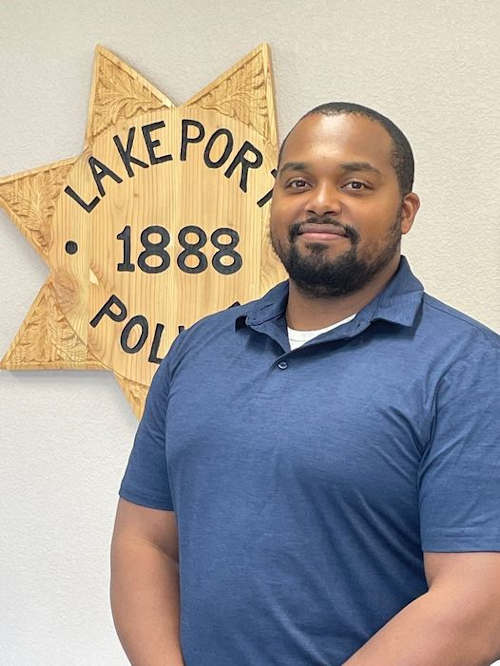
LAKEPORT, Calif. — The Lakeport Police Department on Tuesday introduced its newest police officer trainee.
Nicholas Steward, a Lake County resident and graduate of Lower Lake High School, is the department’s newest member, Police Chief Brad Rasmussen said.
Steward is the latest recruit in a special trainee program the department implemented several years ago that focuses on hiring county residents and sponsoring them in the police academy.
The goal is to retain officers and support the department’s community policing goals.
Rasmussen said Steward served in the California National Guard for seven years following high school.
That military service included a year overseas in support of Operation Enduring Freedom, Rasmussen said.
Rasmussen said Steward also has worked in the security and forestry industries.
On Tuesday evening, Rasmussen introduced Steward to the Lakeport City Council.
He said Steward will spend three months completing pre-academy training at the Lakeport Police station and then will begin his five-month-long police academy training in January.
Once he's completed the police academy, he’ll have another four months of field training on Lakeprt’s streets, Rasmussen said.
Rasmussen said it will be next October before Steward’s initial training is complete.
“It shows the massive amount of training we have to put into these positions,” Rasmussen said.
Rasmussen said the department is proud to have Steward join them.
Council members congratulated Steward, who said he was very happy to be there.
Councilman Michael Froio asked Steward what name he preferred to go by — Nicholas or Nick.
“Officer Steward,” said Councilwoman Stacey Mattina.
Email Elizabeth Larson at
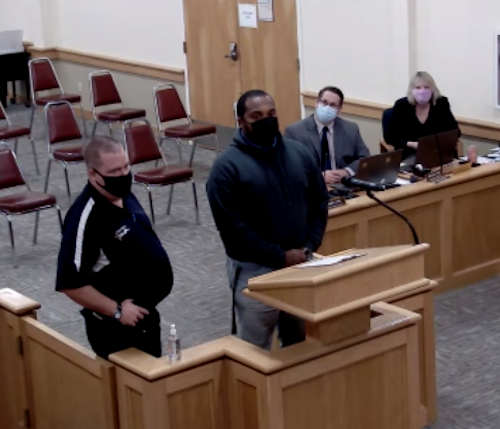
CLEARLAKE, Calif. — The Clearlake City Council will discuss this week the latest developments on the Cache fire recovery, and consider a proposed property purchase and new state rules for virtual meetings.
The council will meet at 6 p.m. Thursday, Oct. 7, in the council chambers at Clearlake City Hall, 14050 Olympic Drive.
The meeting will be broadcast live on the city's YouTube channel or the Lake County PEGTV YouTube Channel. Community members also can participate via Zoom or can attend in person.
The agenda can be found here.
Comments and questions can be submitted in writing for City Council consideration by sending them to City Clerk Melissa Swanson atThis email address is being protected from spambots. You need JavaScript enabled to view it. .
To give the council adequate time to review your questions and comments, please submit your written comments before 4 p.m. on Thursday, Oct. 7.
Each public comment emailed to the city clerk will be read aloud by the mayor or a member of staff for up to three minutes or will be displayed on a screen. Public comment emails and town hall public comment submissions that are received after the beginning of the meeting will not be included in the record.
At the beginning of the meeting, Police Chief Andrew White will hold a swearing-in for new and promoted employees, and the council will present proclamations declaring October as Domestic Violence Awareness Month and Breast Cancer Awareness Month.
Under council business, City Manager Alan Flora will give an update on the Cache fire, which destroyed 57 homes and 81 outbuildings on Aug. 18.
The city received a state of emergency proclamation from Gov. Gavin Newsom last month for the fire and is now working on housing for displaced families and the recovery process.
Also on Thursday, the council will consider a purchase agreement for 6388 Vallejo Ave. which is to be included as part of the future development of the retail center at the former Pearce Field.
The Vallejo Avenue property is located north of Pearce Field and is surrounded on three sides by other land the city owns, Flora said in his report.
“The current owners of the property inherited the parcel from their parents, live out of the area, and have no interest in developing the site. They contacted staff several weeks back inquiring about options for sale so they did not need to maintain the property into the future. Due to the surrounding property being already owned by the city, the acquisition would provide a more complete development footprint,” Flora wrote.
He said staff negotiated a $15,000 purchase price, with the city also to cover the $5,000 in closing costs.
In other business, staff will ask the council to authorize the implementation and use of teleconference accessibility to conduct public meetings pursuant to Assembly Bill 361.
Gov. Newsom signed the bill on Sept. 17. It allows local agencies to continue to conduct remote meetings during a declared state of emergency, provided local agencies comply with specified requirements. Without the legislation, local agencies would have had to return to traditional meetings beginning on Oct. 1, City Clerk/Administrative Services Director Melissa Swanson explained in her written report.
Starting Oct. 1, and running through the end of 2023, to participate in remote meetings, public agencies must comply with the requirements of new subsection (e) of Government Code section 54953, Swanson said.
To hold meetings remotely, Swanson said at least one of the following must be true: state or local officials have imposed or recommended measures to promote social distancing; the legislative body is holding a meeting for the purpose of determining whether as a result of the emergency, meeting in person would present imminent risks to the health or safety of attendees; and by majority vote, the legislative body determined that as a result of the emergency, meeting in person would present imminent risks to the health or safety of attendees.
On the meeting's consent agenda — items that are not considered controversial and are usually adopted on a single vote — are warrants; minutes of the August and September meetings; continuation of declaration of local emergency issued on Oct. 9, 2017, and ratified by council action on Oct. 12, 2017; and continuation of declaration of local emergency issued on March 14, 2020, and ratified by council action on March 19, 2020; accept the donation of property located at 16502 Fifth Ave; ratification of director of emergency services/city manager order (Directive #CACHE-01) restricting access to specified areas as a result of Cache fire; authorization of a senior account clerk position, Resolution No. 2021-50; and adoption of the second amendment to the FY 2021-22 Budget (Resolution No. 2021-33).
The council will hold a closed session after the public portion of the meeting to discuss negotiations with Cache Creek Partners regarding property at 16080 Dam Road.
Email Elizabeth Larson atThis email address is being protected from spambots. You need JavaScript enabled to view it. . Follow her on Twitter, @ERLarson, or Lake County News, @LakeCoNews.
The council will meet at 6 p.m. Thursday, Oct. 7, in the council chambers at Clearlake City Hall, 14050 Olympic Drive.
The meeting will be broadcast live on the city's YouTube channel or the Lake County PEGTV YouTube Channel. Community members also can participate via Zoom or can attend in person.
The agenda can be found here.
Comments and questions can be submitted in writing for City Council consideration by sending them to City Clerk Melissa Swanson at
To give the council adequate time to review your questions and comments, please submit your written comments before 4 p.m. on Thursday, Oct. 7.
Each public comment emailed to the city clerk will be read aloud by the mayor or a member of staff for up to three minutes or will be displayed on a screen. Public comment emails and town hall public comment submissions that are received after the beginning of the meeting will not be included in the record.
At the beginning of the meeting, Police Chief Andrew White will hold a swearing-in for new and promoted employees, and the council will present proclamations declaring October as Domestic Violence Awareness Month and Breast Cancer Awareness Month.
Under council business, City Manager Alan Flora will give an update on the Cache fire, which destroyed 57 homes and 81 outbuildings on Aug. 18.
The city received a state of emergency proclamation from Gov. Gavin Newsom last month for the fire and is now working on housing for displaced families and the recovery process.
Also on Thursday, the council will consider a purchase agreement for 6388 Vallejo Ave. which is to be included as part of the future development of the retail center at the former Pearce Field.
The Vallejo Avenue property is located north of Pearce Field and is surrounded on three sides by other land the city owns, Flora said in his report.
“The current owners of the property inherited the parcel from their parents, live out of the area, and have no interest in developing the site. They contacted staff several weeks back inquiring about options for sale so they did not need to maintain the property into the future. Due to the surrounding property being already owned by the city, the acquisition would provide a more complete development footprint,” Flora wrote.
He said staff negotiated a $15,000 purchase price, with the city also to cover the $5,000 in closing costs.
In other business, staff will ask the council to authorize the implementation and use of teleconference accessibility to conduct public meetings pursuant to Assembly Bill 361.
Gov. Newsom signed the bill on Sept. 17. It allows local agencies to continue to conduct remote meetings during a declared state of emergency, provided local agencies comply with specified requirements. Without the legislation, local agencies would have had to return to traditional meetings beginning on Oct. 1, City Clerk/Administrative Services Director Melissa Swanson explained in her written report.
Starting Oct. 1, and running through the end of 2023, to participate in remote meetings, public agencies must comply with the requirements of new subsection (e) of Government Code section 54953, Swanson said.
To hold meetings remotely, Swanson said at least one of the following must be true: state or local officials have imposed or recommended measures to promote social distancing; the legislative body is holding a meeting for the purpose of determining whether as a result of the emergency, meeting in person would present imminent risks to the health or safety of attendees; and by majority vote, the legislative body determined that as a result of the emergency, meeting in person would present imminent risks to the health or safety of attendees.
On the meeting's consent agenda — items that are not considered controversial and are usually adopted on a single vote — are warrants; minutes of the August and September meetings; continuation of declaration of local emergency issued on Oct. 9, 2017, and ratified by council action on Oct. 12, 2017; and continuation of declaration of local emergency issued on March 14, 2020, and ratified by council action on March 19, 2020; accept the donation of property located at 16502 Fifth Ave; ratification of director of emergency services/city manager order (Directive #CACHE-01) restricting access to specified areas as a result of Cache fire; authorization of a senior account clerk position, Resolution No. 2021-50; and adoption of the second amendment to the FY 2021-22 Budget (Resolution No. 2021-33).
The council will hold a closed session after the public portion of the meeting to discuss negotiations with Cache Creek Partners regarding property at 16080 Dam Road.
Email Elizabeth Larson at