LAKE COUNTY, Calif. — Lake County Animal Care and Control has more new dogs and puppies waiting to be adopted this week.
Dogs available for adoption this week include mixes of American bulldog, beagle, Belgian malinois, Doberman, German shepherd, husky, pit bull, pug, Rottweiler, shepherd and terrier.
Dogs that are adopted from Lake County Animal Care and Control are either neutered or spayed, microchipped and, if old enough, given a rabies shot and county license before being released to their new owner. License fees do not apply to residents of the cities of Lakeport or Clearlake.
The following dogs at the Lake County Animal Care and Control shelter have been cleared for adoption (additional dogs on the animal control website not listed are still “on hold”).
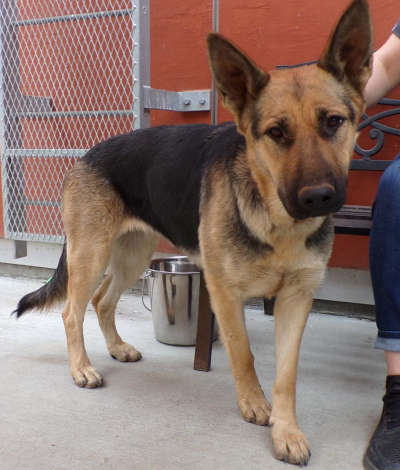
This 1-year-old female German shepherd is in kennel No. 4, ID No. LCAC-A-1767. Photo courtesy of Lake County Animal Care and Control. Female German shepherd
This 1-year-old female German shepherd has a short tan and black coat.
She is in kennel No. 4, ID No. LCAC-A-1767.
“Ace” is a 1-year-old male shepherd and Doberman mix in kennel No. 6, ID No. LCAC-A-1731. Photo courtesy of Lake County Animal Care and Control. ‘Ace’
“Ace” is a 1-year-old male shepherd and Doberman mix with a short black and tan coat.
He is in kennel No. 6, ID No. LCAC-A-1731.
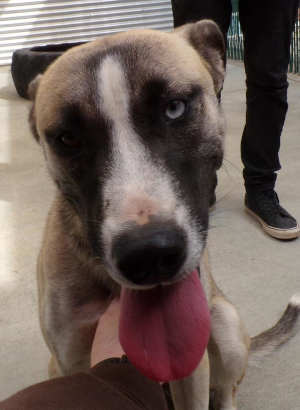
This female shepherd-husky is in kennel No. 9, ID No. LCAC-A-1745. Photo courtesy of Lake County Animal Care and Control. Female shepherd-husky
This female shepherd-husky has a short tan coat with black markings and blue eyes.
She is in kennel No. 9, ID No. LCAC-A-1745.
This 1-year-old female shepherd-husky mix is in kennel No. 10, ID No. LCAC-A-1746. Photo courtesy of Lake County Animal Care and Control. Female shepherd-husky
This 1-year-old female shepherd-husky mix has a short tricolor coat and blue eyes.
She’s in kennel No. 10, ID No. LCAC-A-1746.
This 6-month-old male Belgian malinois puppy is in kennel No. 15, ID No. LCAC-A-1710. Photo courtesy of Lake County Animal Care and Control. Belgian malinois puppy
This 6-month-old male Belgian malinois puppy has a short tan coat.
He is in kennel No. 15, ID No. LCAC-A-1710.
This 6-month-old male Belgian malinois puppy is in kennel No. 16, ID No. LCAC-A-1711. Photo courtesy of Lake County Animal Care and Control. Belgian malinois puppy
This 6-month-old male Belgian malinois puppy has a short tan coat.
He is in kennel No. 16, ID No. LCAC-A-1711.
“Rocky” is a 1-year-old female German shepherd mix in kennel No. 19, ID No. LCAC-A-1719. Photo courtesy of Lake County Animal Care and Control. ‘Rocky’
“Rocky” is a 1-year-old female German shepherd mix with a short black coat and tan markings.
She is in kennel No. 19, ID No. LCAC-A-1719.
This 2-year-old female German shepherd mix is in kennel No. 20, ID No. LCAC-A-1660. Photo courtesy of Lake County Animal Care and Control. Female German shepherd mix
This 2-year-old female German shepherd mix has a short black and tan coat.
She’s in kennel No. 20, ID No. LCAC-A-1660.
“Oscar” is a 6-year-old pug-beagle mix in kennel No. 21, ID No. LCAC-A-1709. Photo courtesy of Lake County Animal Care and Control. ‘Oscar’
“Oscar” is a 6-year-old pug-beagle mix — or a puggle — with a short tan coat.
He is in kennel No. 21, ID No. LCAC-A-1709.
“LuLu” is a 1-year-old female Rottweiler in kennel No. 27, ID No. LCAC-A-1658. Photo courtesy of Lake County Animal Care and Control. ‘LuLu’
“LuLu” is a 1-year-old female Rottweiler with a short black and tan coat.
She is in kennel No. 27, ID No. LCAC-A-1658.
This 2-year-old male shepherd mix is in kennel No. 28, ID No. LCAC-A-1743. Photo courtesy of Lake County Animal Care and Control. Male shepherd mix
This 2-year-old male shepherd mix has a short black and tan coat.
He is in kennel No. 28, ID No. LCAC-A-1743.
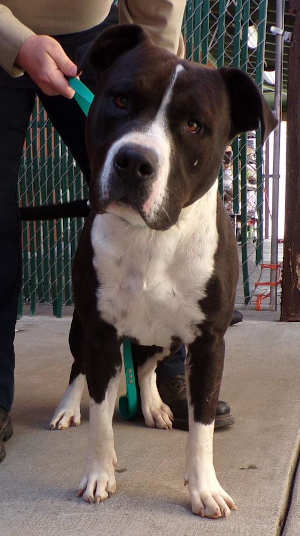
This young male pit bull is in kennel No. 29, ID No. LCAC-A-1699. Photo courtesy of Lake County Animal Care and Control. Male pit bull
This young male pit bull has a short black and white coat.
He is in kennel No. 29, ID No. LCAC-A-1699.
This 2-year-old female terrier mix is in kennel No. 30, ID No. LCAC-A-1739. Photo courtesy of Lake County Animal Care and Control. Female terrier mix
This 2-year-old female terrier mix has a short tan coat.
She is in kennel No. 30, ID No. LCAC-A-1739.
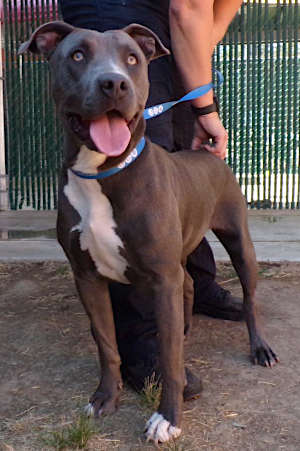
This 1-year-old female pit bull mix is in kennel No. 31, ID No. LCAC-A-1683. Photo courtesy of Lake County Animal Care and Control. Female pit bull
This 1-year-old female pit bull mix has a short gray coat with white markings.
She is in kennel No. 31, ID No. LCAC-A-1683.
“Dozer” is a 5-year-old American pit bull terrier mix in kennel No. 33, ID No. LCAC-A-1483. Photo courtesy of Lake County Animal Care and Control. ‘Dozer’
‘Dozer’ is a 5-year-old American pit bull terrier mix with a short brindle coat.
He is in kennel No. 33, ID No. LCAC-A-1483.
“Milo” is a 3-year-old male American bulldog-pit bull mix in kennel No. 34, ID No. LCAC-A-1657. Photo courtesy of Lake County Animal Care and Control. ‘Milo’
“Milo” is a 3-year-old male American bulldog-pit bull mix with a short white coat.
He is in kennel No. 34, ID No. LCAC-A-1657.
Email Elizabeth Larson at This email address is being protected from spambots. You need JavaScript enabled to view it.. Follow her on Twitter, @ERLarson, or Lake County News, @LakeCoNews.
This illustration shows a Jupiter-like planet alone in the dark of space, floating freely without a parent star. CLEoPATRA mission scientists hope to improve the mass estimates of such planets discovered through microlensing. Credit: NASA’s Goddard Space Flight Center Conceptual Image Lab. Exoplanet hunters have found thousands of planets, most orbiting close to their host stars, but relatively few alien worlds have been detected that float freely through the galaxy as so-called rogue planets, not bound to any star.
Many astronomers believe that these planets are more common than we know, but that our planet-finding techniques haven’t been up to the task of locating them.
Most exoplanets discovered to date were found because they produce slight dips in the observed light of their host stars as they pass across the star’s disk from our viewpoint. These events are called transits.
NASA’s Nancy Grace Roman Space Telescope will conduct a survey to discover many more exoplanets using powerful techniques available to a wide-field telescope. The stars in our Milky Way galaxy move, and chance alignments can help us find rogue planets. When a free-floating planet aligns precisely with a distant star, this can cause the star to brighten. During such events, the planet’s gravity acts as a lens that briefly magnifies the background star’s light. While Roman may find rogue planets through this technique, called gravitational microlensing, there’s one drawback – the distance to the lensing planet is poorly known.
Goddard scientist Dr. Richard K. Barry is developing a mission concept called the Contemporaneous LEnsing Parallax and Autonomous TRansient Assay, or CLEoPATRA, to exploit parallax effects to calculate these distances.
Parallax is the apparent shift in the position of a foreground object as seen by observers in slightly different locations. Our brains exploit the slightly different views of our eyes so we can see depth as well.
Astronomers in the 19th century first established the distances to nearby stars using the same effect, measuring how their positions shifted relative to background stars in photographs taken when Earth was on opposite sides of its orbit.
It works a little differently with microlensing, where the apparent alignment of the planet and distant background star greatly depends on the observer’s position. In this case, two well-separated observers, each equipped with a precise clock, would witness the same microlensing event at slightly different times. The time delay between the two detections allows scientists to determine the planet’s distance.
To maximize the parallax effect, CLEoPATRA would hitch a ride on a Mars-bound mission that launches around the same time as Roman, currently scheduled for late 2025. That would place it in its own orbit around the Sun that would achieve a sufficient distance from Earth to effectively measure the microlensing parallax signal and fill in this missing information.
The CLEoPATRA concept would also support the PRime-focus Infrared Microlensing Experiment (PRIME), a ground-based telescope currently being outfitted with a camera using four detectors developed by the Roman mission. Mass estimates for microlensing planets detected by both Roman and PRIME will be significantly improved by simultaneous parallax observations provided by CLEoPATRA.
“CLEoPATRA would be at a great distance from the principal observatory, either Roman or a telescope on Earth,” Barry said. “The parallax signal should then permit us to calculate quite precise masses for these objects, thereby increasing scientific return.”
Stela Ishitani Silva, a research assistant at Goddard and Ph.D. student at the Catholic University of America in Washington, said understanding these free-floating planets will help fill in some of the gaps in our knowledge of how planets form.
“We want to find multiple free-floating planets and try to obtain information about their masses, so we can understand what is common or not common at all,” Ishitani Silva said. “Obtaining the mass is important to understanding their planetary development.”
In order to efficiently find these planets, CLEoPATRA, which completed a Mission Planning Laboratory study at Wallops Flight Facility in early August, will use artificial intelligence. Dr. Greg Olmschenk, a postdoctoral researcher working with Barry, has developed an AI called RApid Machine learnEd Triage, or RAMjET, for the mission.
“I work with certain kinds of artificial intelligence called neural networks,” Olmschenk said. “It's a type of artificial intelligence that will learn through examples. So, you give it a bunch of examples of the thing you want to find, and the thing you want it to filter out, and then it will learn how to recognize patterns in that data to try to find the things that you want to keep and the things you want to throw away.”
Eventually, the AI learns what it needs to identify and will only send back important information. In filtering this information, RAMjET will help CLEoPATRA overcome an extremely limited data transmission rate.
CLEoPATRA will have to watch millions of stars every hour or so, and there’s no way to send all that data to Earth. Therefore, the spacecraft will have to analyze the data on-board and send back only the measurements for sources it detects to be microlensing events.
“CLEoPATRA will permit us to estimate many high-precision masses for new planets detected by Roman and PRIME,” Barry said. “And it may allow us to capture or estimate the actual mass of a free-floating planet for the first time — never been done before. So cool, and so exciting. Really, it's a new golden age for astronomy right now, and I'm just very excited about it.”
Julie Freijat works for NASA’s Goddard Space Flight Center in Greenbelt, Maryland.
LAKE COUNTY, Calif. — Pacific Gas and Electric Co. said it may conduct another public safety power shut-off beginning Monday morning due to a weather system that could bring dry, gusty offshore winds to portions of the northern, central and southern regions of the company’s service area.
Those winds, combined with the exceptional drought and extremely dry vegetation, caused PG&E on Saturday to begin sending two-day advance notifications to approximately 44,000 customers in targeted portions of 32 counties and seven tribes where it may implement the public safety power shut-off, or PSPS, to reduce the risk of wildfire from energized power lines.
Included in those initial notifications were 4,094 customers in Lake County, including 307 Medical Baseline customers, PG&E said.
The PG&E map of the planned outage showed areas that could be impacted in Lake County are some small pockets north and east of Clearlake Oaks, in and around Hidden Valley Lake, Cobb and Middletown.
As of Saturday night, a fire weather watch remained in effect for Lake County for Monday and Tuesday.
The potential shut-offs could begin Monday morning in portions of the North Valley, Sacramento and San Joaquin Foothills, PG&E said.
The company reported that potential shut-offs for the Northern Sierra Foothills, North Bay, North Coast regions, Bay Area hills and the Central Valley could begin Monday evening, depending on the timing of the windstorm.
Customers can also look up their address online to find out if their location is being monitored for the potential safety shut-off at www.pge.com/pspsupdates.
While there is the potential for rain, PG&E said it moved forward with notifying customers of the possible PSPS in case rain doesn’t materialize or forecast wind speeds still pose a wildfire risk.
PG&E also activated its Emergency Operations Center on Friday to support this weather event.
In addition to Lake, the potentially affected counties are:
Alameda: 134 customers, 10 Medical Baseline customers Butte: 769 customers, 69 Medical Baseline customers Calaveras: 2,536 customers, 188 Medical Baseline Colusa: 566 customers, 39 Medical Baseline customers Contra Costa: 601 customers, 40 Medical Baseline customers El Dorado: 303 customers, 20 Medical Baseline customers Fresno: 5,008 customers, 436 Medical Baseline customers Glenn: 377 customers, 22 Medical Baseline customers Kern: 7 customers, 0 Medical Baseline customers Kings: 10 customers, 0 Medical Baseline customers Madera: 2,884 customers, 225 Medical Baseline customers Mariposa: 778 customers, 73 Medical Baseline customers Merced: 20 customers, 0 Medical Baseline customers Monterey: 845 customers, 27 Medical Baseline customers Napa: 2,207 customers, 107 Medical Baseline customers Nevada: 3 customers, 0 Medical Baseline customers Placer: 5,975 customers, 388 Medical Baseline customers Plumas: 309 customers, 4 Medical Baseline customers San Benito: 84 customers, 2 Medical Baseline customers San Joaquin: 2 customers, 0 Medical Baseline customers San Luis Obispo: 205 customers, 2 Medical Baseline customers Santa Barbara:19 customers, 1 Medical Baseline customer Shasta: 2,557 customers, 197 Medical Baseline customers Sierra: 2 customers, 0 Medical Baseline customers Solano: 4,559 customers, 423 Medical Baseline customers Sonoma: 87 customers, 1 Medical Baseline customer Stanislaus: 145 customers, 5 Medical Baseline customers Tehama: 6,148 customers, 624 Medical Baseline customers Tuolumne: 673 customers, 68 Medical Baseline customers Yolo: 515 customers, 16 Medical Baseline customers Yuba: 1,226 customers, 114 Medical Baseline customers
Tribal areas that may be affected:
Big Sandy Rancheria: 61 customers Cold Springs Rancheria of Mono Indians: 54 customers Cortina Rancheria: 8 customers Grindstone Rancheria: 50 customers North Fork Rancheria: 25 customers Pit River Tribes: 8 customers United Auburn Indian Community: 1 customer
During a PSPS, PG&E offers support to customers by opening Community Resource Centers with snacks, water and other essential items, partnering with community-based organizations to assist customers with medical and independent living needs, and continuing to update our customers on power restoration status.
In Lake County, the Community Resource Centers slated to be open from 8 a.m. to 10 p.m. during the outage are as follows:
— Live Oaks Senior Center, 12502 Foothill Blvd., Clearlake Oaks; — Little Red Schoolhouse, 15780 Bottlerock Road, Cobb; — Hidden Valley Lake Association mailboxes, 18090 Hidden Valley Road, Hidden Valley Lake; and — Twin Pine Casino and Hotel, 22223 Highway 29, Middletown.
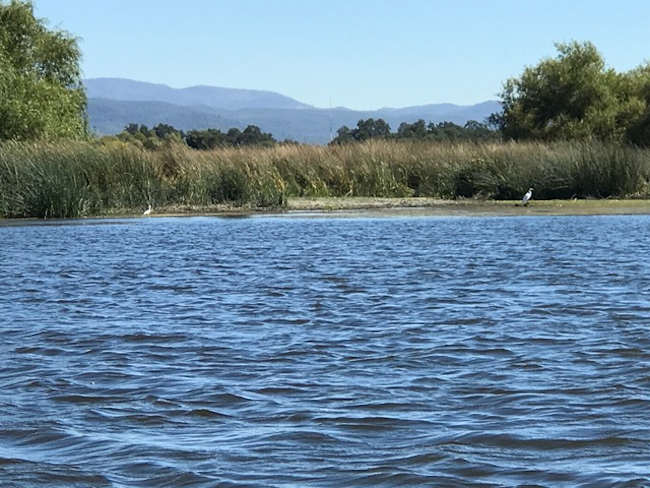
Clear Lake at the Wright Ranch in Lake County, California. Courtesy photo. LAKE COUNTY, Calif. — When the Lake County Land Trust, or LCLT, developed a set of long term priorities for future acquisitions and conservation easements nearly 15 years ago, preservation of the wetlands along the western Clear Lake shoreline from Clear Lake State Park to south Lakeport in what came to be called the Big Valley Wetlands project came out at the top of the list.
Over the years Clear Lake has lost about 80% of its natural shoreline to development.
The tules, willows, cattails, native shrubs and other riparian vegetation along the edge of the lake provided prime habitat for birds and mammals and the tule marshes supported native and nonnative fish, including crucial juvenile rearing grounds for the endangered Clear Lake Hitch.
Loss of this key habitat has had significant adverse consequences for numerous species, and loss of the natural filtration provided by wetlands has played a major role in the degradation of water quality.
The largest wetland areas remaining on the lake are Anderson Marsh State Historic Park in the south, Rodman Slough to the north and the Big Valley Shoreline.
Unlike Anderson Marsh and Rodman, most of the Big Valley area is privately held, putting its outstanding natural values at risk.
The Land Trust therefore decided to target the lands in this area as its top priority.
In the words of LCLT founder and board member Roberta Lyons, “Our objective is to preserve and restore these lands either through fee title purchase or conservation easements with the purpose of improving this vital habitat for animals and providing recreation opportunities for residents and visitors alike.”
The purchase of the 200-acre Wright Ranch near south Lakeport in 2020 was a major step forward in implementing this objective.
Besides preserving the land from future development in perpetuity, goals include restoration of a significant portion of the property to the wetland habitat that existed before berms and dikes were constructed in the 1940s to “reclaim” it for grazing.
UC McLaughlin Reserve Co-Manager Paul Aigner. Courtesy photo. The plan is to breach the berm in order to create an additional 32 acres of seasonal wetland and to restore the population of Valley Oaks beyond the remnant grove that exists there now: these huge trees provide habitat for many species of invertebrates, birds and mammals while sequestering immense amounts of carbon.
These major restoration projects will require review under the California Environmental Quality Act, or CEQA, and permits from federal, state, and county agencies, starting with a wetland delineation and botanical survey to be conducted by biologist Steve Zalusky.
To augment this professional analysis, Land Trust Board member Merry Jo Velasquez has also recruited volunteers from among Land Trust members, Lake County Master Gardeners, the California Native Plant Society and others to survey the property and catalog its populations of both native and nonnative plants.
Although at first glance the latter seem to predominate by a wide margin, which is not surprising on land that has been heavily grazed for many years, a number of native species also persist on the property.
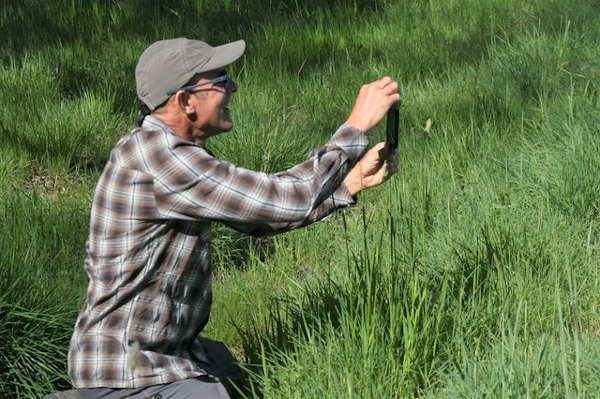
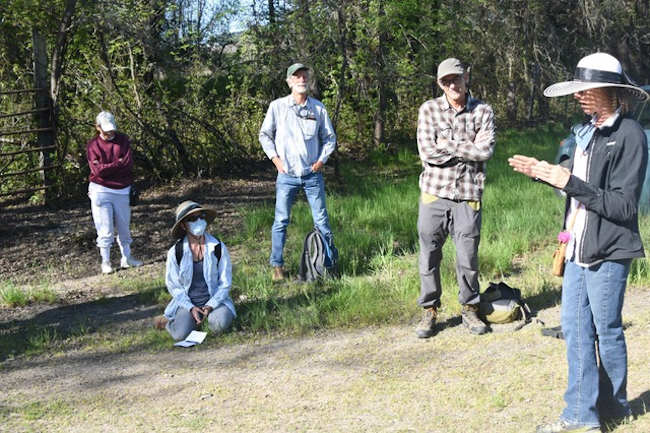
The first group of volunteers went out to the property on a sunny Saturday in April. After a crash course in the National Geographic Society’s iNaturalist App provided by UC McLaughlin Reserve Co-Managers Paul Aigner and Cathy Koehler, several dozen participants broke up into small groups and fanned out over the land, taking pictures and uploading them to an ever-increasing database.
According to Velasquez, “using iNaturalist as our main resource for identification has been an interesting and rewarding experience. I was intrigued by the common name of the flower Erodium circutarium, which is called Stork’s Bill even though this round pink flower looks nothing like the bill of a stork. A month later, after seed pods had formed, I discovered that Stork’s Bill perfectly describes them.”
Eventually the Land Trust hopes to be able to open the property for public use and enjoyment, but before this can happen a baseline management plan must be developed, trails delineated, and signage installed.
In the meantime, occasional field trips are being scheduled: to see this property before its transformation begins, contact Roberta Lyons at 707 994 2024 or This email address is being protected from spambots. You need JavaScript enabled to view it..
Victoria Brandon is a board member for the nonprofit Tuleyome, based in Woodland, California.
A group of volunteers met at the 200-acre Wright Ranch near south Lakeport, California, in April 2021. Courtesy photo.
LAKE COUNTY, Calif. — A forecast for gusty winds from the north coupled with low humidity has prompted the National Weather Service to issue a fire weather watch for Lake and many other counties around the region for Monday and Tuesday.
The watch, issued on Friday, will be in effect from 2 a.m. Monday until 5 p.m. Tuesday, the National Weather Service said.
A fire weather watch means that critical fire weather conditions are forecast to occur, the agency reported.
The National Weather Service said gusty northerly winds will increase through the day Monday in the wake of a dry cold front, with winds ramping up and poor humidity recoveries over the ridges of eastern Lake County late Sunday Night.
Forecasters said the strongest winds will be found over exposed high terrain and north to south oriented valleys Monday afternoon and evening.
Minimum humidity of 15 to 25% is expected on Monday; overnight, recoveries could range from 25 to 50%, and 60 to 70% in sheltered areas like valleys, the National Weather Service said.
During the fire weather watch, north winds are forecast to range from 15 to 25 miles per hour, with gusts of 30 to 40 miles per hour over exposed ridgetops.
Winds are expected to calm and humidity to recover on Tuesday morning, but the forecast said that the winds will remain brisk across mountain ridges over Lake County with poor recoveries. Those windy conditions will continue through Tuesday afternoon and evening.
The National Weather Service said it’s those breezy conditions combined with low humidity that could lead to critical fire conditions.
Ahead of the fire weather watch, the forecast expected the potential for scattered showers overnight Friday and into early Saturday.
The long range forecast also contains the potential for very light rain in the county on Wednesday.
During the coming week, the forecast expects daytime temperatures ranging from the low 60s early in the week to the high 70s late next week.
Nighttime conditions are forecast in the coming days to range from the high 30s to low 40s.
Email Elizabeth Larson at This email address is being protected from spambots. You need JavaScript enabled to view it.. Follow her on Twitter, @ERLarson, or Lake County News, @LakeCoNews.
New bills signed into law this week aim to modernize and expand the internet across California.
Assembly Bill 14, written by Assembly member Cecilia Aguiar-Curry (D-Winters), and Senate Bill 4 by Sen. Lena Gonzalez (D-Long Beach), were signed into law this week by Gov. Gavin Newsom.
AB 14 and SB 4 are meant to revolutionize the state’s broadband deployment program under the California Advanced Services Program, and provide increased funding to bring California into the technological 21st Century.
The ongoing COVID-19 pandemic has laid bare the massive gaps in internet connectivity at sufficient speeds for too many Californians.
As more Californians have struggled to conduct distance learning, virtual work, access telehealth services and safeguard small business participation in the virtual marketplace, the need to connect the State at sufficient speeds with adaptable technology has reached crisis proportions.
"Gov. Newsom’s approval of AB 14 and SB 4 is a historic development for California," Aguiar-Curry said Friday (D-Winters), whose district includes Lake County. "In partnership with my colleague Sen. Gonzalez, and two dozen of our colleague co-authors, we have highlighted the critical need to modernize our state’s broadband policy and programs, and a commitment to long-term funding to guarantee internet connectivity for all California communities, rural and urban.”
She added, “I am immensely proud that our efforts also contributed to a budget deal between Gov. Newsom, Pro Tem Atkins and Speaker Rendon that provided a generational $6 billion investment in broadband infrastructure. Modern, adaptable technology in every corner of our state will provide access to education and job training, health care, ag-tech, and small business participation in the digital economy. Today, Gov. Newsom’s signature has delivered on our commitment to Internet for All."
“This is huge news that will make a significant positive difference in the lives of Californians,” said Sen. Lena Gonzalez (D-Long Beach). “Enacting SB 4 and AB 14 means that children will no longer have to do their homework outside of fast-food restaurants. It means medically fragile individuals will have more access to care via telehealth, and small businesses and workers will have more access to online resources, greater upward mobility, and economic opportunity. The need for high-quality internet and future-proof infrastructure has never been more important than now and I am pleased that my colleagues in the Legislature and Gov. Newsom have taken this bold step to help us close the digital divide. Today, California leads stronger than ever toward digital equity and Broadband for All.”
The Internet for All Act of 2021 prioritizes the deployment of broadband infrastructure in California’s most vulnerable and unserved rural and urban communities by extending the ongoing collection of funds deposited into the California Advanced Services Fund to provide communities with grants necessary to bridge the digital divide.
AB 14 and SB 4 offer a vital pathway to connect California’s workforce to gainful employment, harness the lifesaving technology of telemedicine, democratize distance learning, enable precision agriculture, and sustain economic transactions in the 21st Century E-Marketplace.
These historic votes build upon the Governor’s $6 billion Broadband Trailer bill that extends eligibility for grants administered by the California Public Utilities Commission to local and tribal governments, who are willing and able to quickly and efficiently connect households, community anchor institutions (including educational institutions, fairgrounds for emergency response, and health care facilities), small businesses, and employers.
AB 14 and SB 4 are measured and meaningful approaches to building a statewide fiber middle-mile network that will provide higher speeds and access to connectivity to all those who are unserved along the path of deployment.
Aguiar-Curry represents the Fourth Assembly District, which includes all of Lake and Napa Counties, parts of Colusa, Solano and Sonoma counties, and all of Yolo County except West Sacramento.
 How to resolve AdBlock issue?