 How to resolve AdBlock issue?
News
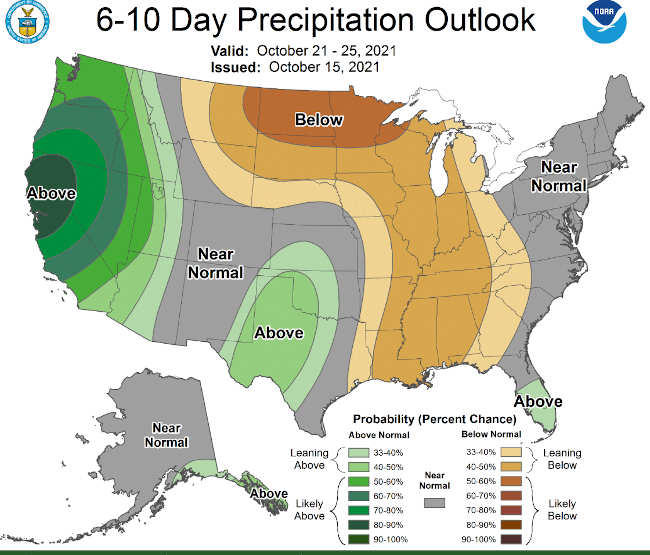
LAKE COUNTY, Calif. — The National Weather Service is forecasting chances of rain over the weekend and into next week.
The Climate Prediction Center’s precipitation outlook for Oct. 21 to 25, which was issued on Friday, calls for above-normal precipitation for areas of Northern California that include Lake County.
The center’s forecast estimates next week’s rainfall could be 90 to 100% above normal.
The National Weather Service’s Eureka office said the below-normal precipitation for the first half of October could be made up for in the last two weeks of the month if the Climate Prediction Center’s predictions hold true.
The Lake County forecast calls for chances of rain Sunday and into Sunday night, totaling a fifth of an inch.
Conditions are expected to clear on Monday and Tuesday, with rain likely beginning on Wednesday and continuing through Friday, the forecast said.
On Saturday, temperatures are expected to range from the high 70s to low 80s before dropping into the 60s on Sunday, when rain is expected.
Through Friday, daytime temperatures are expected to range from the high 50s and 60s along the Northshore to the 70s in the south county. Nighttime conditions will be in the high 30s to the high 40s.
Email Elizabeth Larson at
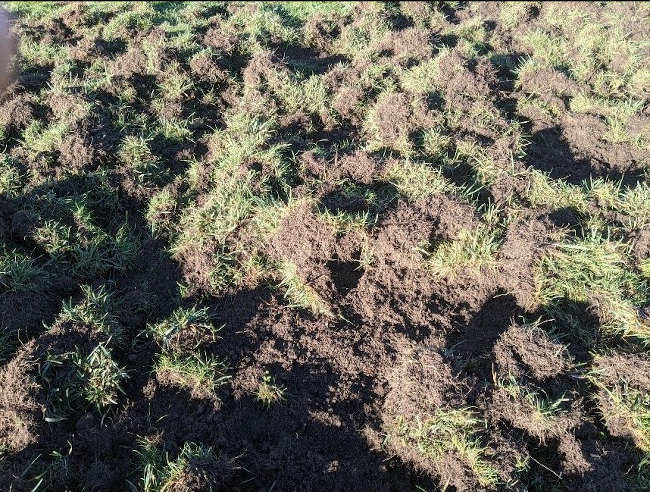
LAKEPORT, Calif. — The city of Lakeport closed Westside Community Park on Thursday and Friday in order to address damage done by feral pigs and to work on a plan to deal with the animals.
Officials reported that over the past several weeks, large packs of feral pigs have seriously damaged the soccer fields at the park on multiple occasions.
Lakeport Public Works Department staff spent several hours on Thursday repairing the most recent damage.
City officials said the destruction of the soccer fields and other areas of Westside Community Park has resulted in significant repair costs.
In response, the city of Lakeport is working with local law enforcement and state and federal wildlife management agencies to develop and implement a plan to haze and trap the feral pigs to eliminate this ongoing problem.
The operation began on Thursday, necessitating a closure of the park.
The park also was closed on Friday evening, and slated to reopen at 6 a.m. Saturday, the city said.
The most powerful space telescope ever built will look back in time to the Dark Ages of the universe
Some have called NASA’s James Webb Space Telescope the “telescope that ate astronomy.” It is the most powerful space telescope ever built and a complex piece of mechanical origami that has pushed the limits of human engineering. On Dec. 18, 2021, after years of delays and billions of dollars in cost overruns, the telescope is scheduled to launch into orbit and usher in the next era of astronomy.
I’m an astronomer with a specialty in observational cosmology – I’ve been studying distant galaxies for 30 years. Some of the biggest unanswered questions about the universe relate to its early years just after the Big Bang. When did the first stars and galaxies form? Which came first, and why? I am incredibly excited that astronomers may soon uncover the story of how galaxies started because James Webb was built specifically to answer these very questions.
The ‘Dark Ages’ of the universe
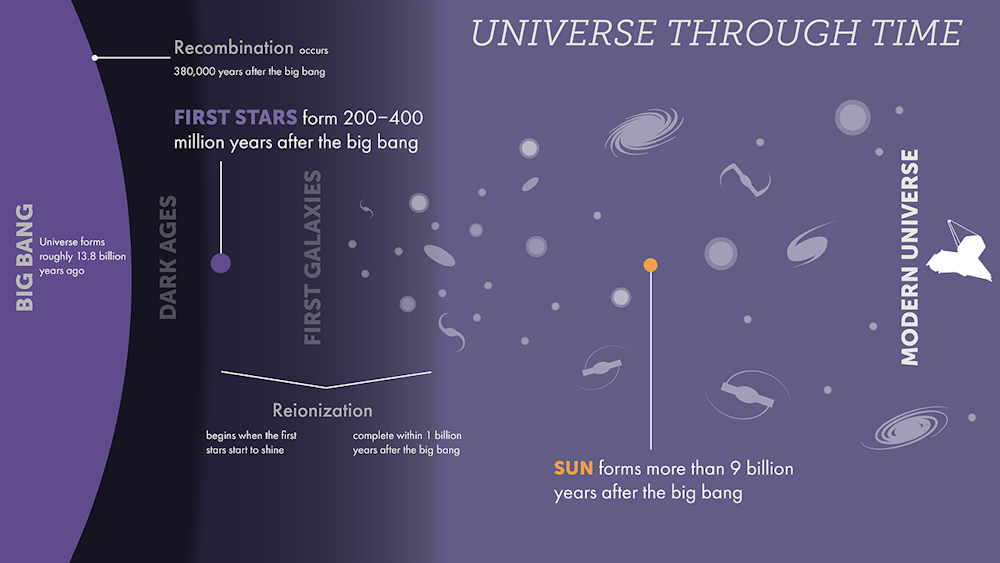
Excellent evidence shows that the universe started with an event called the Big Bang 13.8 billion years ago, which left it in an ultra-hot, ultra-dense state. The universe immediately began expanding after the Big Bang, cooling as it did so. One second after the Big Bang, the universe was a hundred trillion miles across with an average temperature of an incredible 18 billion F (10 billion C). Around 400,000 years after the Big Bang, the universe was 10 million light years across and the temperature had cooled to 5,500 F (3,000 C). If anyone had been there to see it at this point, the universe would have been glowing dull red like a giant heat lamp.
Throughout this time, space was filled with a smooth soup of high energy particles, radiation, hydrogen and helium. There was no structure. As the expanding universe became bigger and colder, the soup thinned out and everything faded to black. This was the start of what astronomers call the Dark Ages of the universe.
The soup of the Dark Ages was not perfectly uniform and due to gravity, tiny areas of gas began to clump together and become more dense. The smooth universe became lumpy and these small clumps of denser gas were seeds for the eventual formation of stars, galaxies and everything else in the universe.
Although there was nothing to see, the Dark Ages were an important phase in the evolution of the universe.

Looking for the first light
The Dark Ages ended when gravity formed the first stars and galaxies that eventually began to emit the first light. Although astronomers don’t know when first light happened, the best guess is that it was several hundred million years after the Big Bang. Astronomers also don’t know whether stars or galaxies formed first.
Current theories based on how gravity forms structure in a universe dominated by dark matter suggest that small objects – like stars and star clusters – likely formed first and then later grew into dwarf galaxies and then larger galaxies like the Milky Way. These first stars in the universe were extreme objects compared to stars of today. They were a million times brighter but they lived very short lives. They burned hot and bright and when they died, they left behind black holes up to a hundred times the Sun’s mass, which might have acted as the seeds for galaxy formation.
Astronomers would love to study this fascinating and important era of the universe, but detecting first light is incredibly challenging. Compared to massive, bright galaxies of today, the first objects were very small and due to the constant expansion of the universe, they’re now tens of billions of light years away from Earth. Also, the earliest stars were surrounded by gas left over from their formation and this gas acted like fog that absorbed most of the light. It took several hundred million years for radiation to blast away the fog. This early light is very faint by the time it gets to Earth.
But this is not the only challenge.
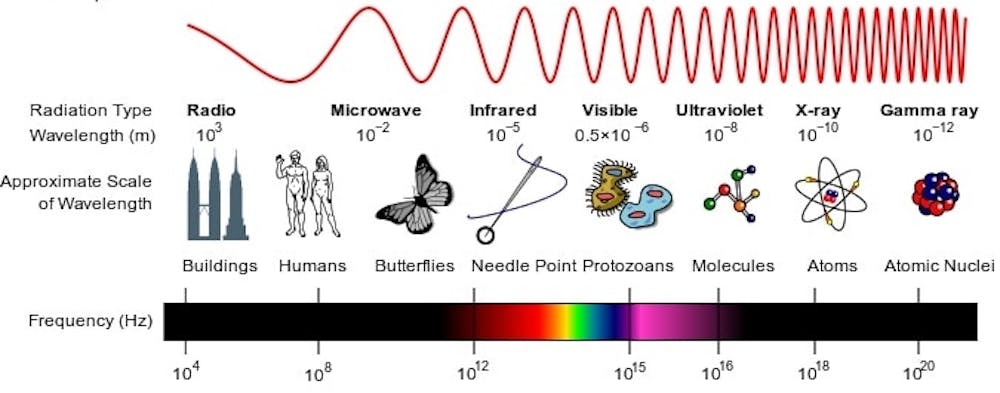
As the universe expands, it continuously stretches the wavelength of light traveling through it. This is called redshift because it shifts light of shorter wavelengths – like blue or white light – to longer wavelengths like red or infrared light. Though not a perfect analogy, it is similar to how when a car drives past you, the pitch of any sounds it is making drops noticeably.
By the time light emitted by an early star or galaxy 13 billion years ago reaches any telescope on Earth, it has been stretched by a factor of 10 by the expansion of the universe. It arrives as infrared light, meaning it has a wavelength longer than that of red light. To see first light, you have to be looking for infrared light.
[The Conversation’s science, health and technology editors pick their favorite stories. Weekly on Wednesdays.]
Telescope as a time machine
Enter the James Webb Space Telescope.
Telescopes are like time machines. If an object is 10,000 light-years away, that means the light takes 10,000 years to reach Earth. So the further out in space astronomers look, the further back in time we are looking.

Engineers optimized James Webb for specifically detecting the faint infrared light of the earliest stars or galaxies. Compared to the Hubble Space Telescope, James Webb has a 15 times wider field of view on its camera, collects six times more light and its sensors are tuned to be most sensitive to infrared light.
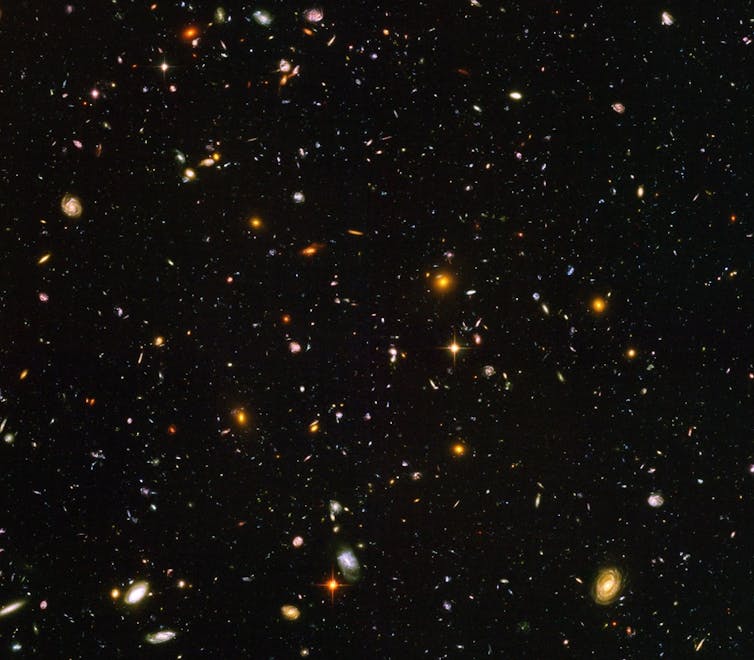
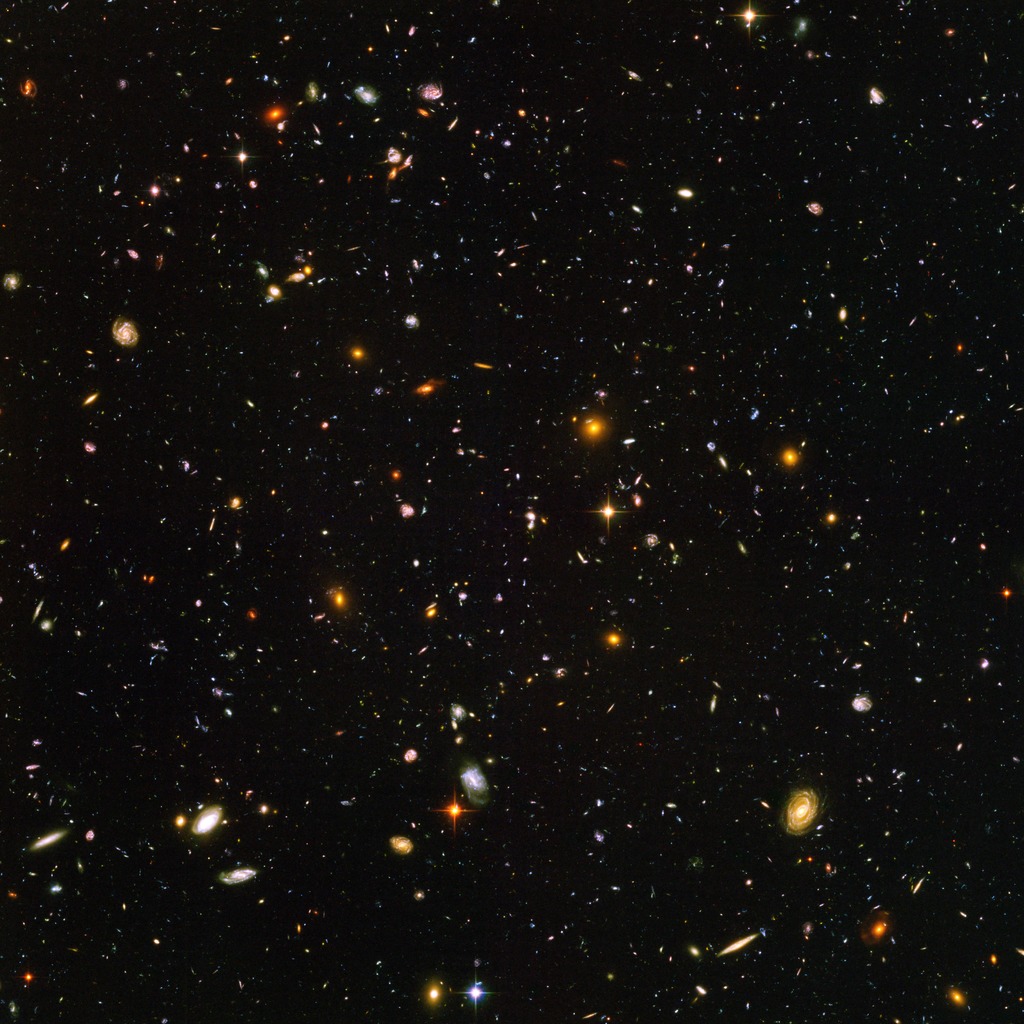
The strategy will be to stare deeply at one patch of sky for a long time, collecting as much light and information from the most distant and oldest galaxies as possible. With this data, it may be possible to answer when and how the Dark Ages ended, but there are many other important discoveries to be made. For example, unraveling this story may also help explain the nature of dark matter, the mysterious form of matter that makes up about 80% of the mass of the universe.
James Webb is the most technically difficult mission NASA has ever attempted. But I think the scientific questions it may help answer will be worth every ounce of effort. I and other astronomers are waiting excitedly for the data to start coming back sometime in 2022.
Chris Impey, University Distinguished Professor of Astronomy, University of Arizona
This article is republished from The Conversation under a Creative Commons license. Read the original article.
LAKE COUNTY, Calif. — Every 10 years, with the arrival of U.S. Census numbers, boundaries for federal, state and local jurisdictions undergo required adjustments based on population changes.
That work is going on right now with the California Citizens Redistricting Commission on the state level, which is responsible for the congressional, State Senate, State Assembly and State Board of Equalization district lines.
Community college districts also must draw new boundaries for their trustee districts.
At the county level, the Board of Supervisors is now engaged in redrawing the district boundaries for its five districts.
The board is due to have four meetings on the redistricting process, and has so far held two, one during its regular meeting on Aug. 31 and a special, stand-alone meeting on Saturday, Oct. 2. The video for the second meeting is posted on this page.
Two more meetings are planned for Nov. 2 and 30.
The county’s consultant, Margaret Long, facilitated the Oct. 2 meeting, which was focused on communities of interest.
The California Constitution defines a community of interest as “a contiguous population which shares common social and economic interests that should be included within a single district for purposes of its effective and fair representation. Examples of such shared interests are those common to an urban area, a rural area, an industrial area, or an agricultural area, and those common to areas in which the people share similar living standards, use the same transportation facilities, have similar work opportunities, or have access to the same media of communication relevant to the election process. Communities of interest shall not include relationships with political parties, incumbents, or political candidates.”
Long said at that time that the county was still waiting to get all of the final population information, primarily adjustments to the prison population, which the state is now requiring be attributed to the last county of residence.
She reviewed communities of interest in Lake County, and gave examples including tribal lands, the community of Buckingham, the Rivieras in Kelseyville, and certain apartment complexes with similar characteristics.
The census data was delivered by Sept. 30. From there, the timeline includes maps beginning to be published on Oct. 22, the projected adjustment due to prisoners in California on Oct. 30, Lake County’s final map to be ready for adoption on Nov. 30, ahead of the Dec. 15 map adoption deadline.
Long encouraged people to submit input, with community input a key activity for October.
It was reported that, as of that meeting, the county had received no emailed input on the redistricting.
Registrar of Voters Maria Valadez noted during the meeting that one of the toughest issues the county faced 10 years ago was keeping communities of interest together as much as possible.
She said districts 3 and 4 had to gain and lose the most residents during the last redistricting process.
That’s because Valadez said it has to be one person, one vote.
Carolyn Walker, who works with Long’s firm, reported the current supervisorial district population counts:
• District 1 — 13,294;
• District 2 — 14,311;
• District 3 — 13,905;
• District 4 — 13,821;
• District 5 — 12,708.
With Lake County’s current population divided five ways, each district should have 13,633 residents, officials said.
Long said the goal is to get those district population counts as even as possible. While the law requires getting the districts within 10% of that even number, she said a good goal is within 3 to 4%.
How to participate in redrawing the lines
Community members can draw maps to demonstration communities of interest with an online GIS tool here.
Instructions are provided when the map is launched, and Help is available using the “question mark” icon at the upper right.
To draw boundaries of a community of interest using the GIS map:
• Zoom into the area of Lake County where your community of interest is located (using a computer mouse, fingers on a touchscreen device and/or the “+” and “-” buttons in the upper left of the screen).
• Use the “Draw” function (paintbrush and artist’s palette icon at the upper right) to define boundaries.
• Once boundaries are drawn, select the printer icon at the upper right of the screen. This will launch a menu on the right side of the screen to create a PDF file that can then be saved and emailed to
Residents also can use the GIS tool to locate the area of their community of interest and print their map, and then draw the boundaries on with an ink pen, for example, and scan and email or mail their map to the above address.
The next meetings in the redistricting process will take place at 6 p.m. Nov. 2, at which time draft maps will be presented. The Zoom link is here; the pass code is 310792.
At the final meeting, to be held at 9 a.m. Nov. 30, the board will consider adopting the final map for the newly drawn districts. The Zoom link is here: pass code is 597249.
More information about Lake County’s redistricting process, in both English and Spanish, is available here.
General feedback or questions also can be sent to
Email Elizabeth Larson at
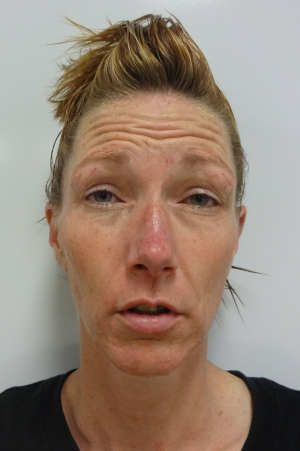
LAKE COUNTY, Calif. — On Wednesday the California Highway Patrol arrested a Nevada woman who is believed to have set a fire along Highway 29 near Kelseyville.
The CHP’s Clear Lake Area office said it took Nickelina Rose Williams, 38, of Fallon into custody on Wednesday afternoon.
Williams is the latest in a growing list of women over the past two years to be arrested in Lake County for arson.
At 3:06 p.m. Wednesday, the CHP said officers Brian Hanson and Jacob Hoberg were dispatched to a call of a possible wildland fire on Highway 29 near Bottle Rock Road.
Radio traffic indicated there were multiple callers reporting the roadside fire, which was spreading into a field.
When Hanson and Hoberg arrived in the area, the CHP said the officers located a group of motorists who had stopped and were attempting to extinguish a 10-foot by 10-foot fire just off Highway 29’s south shoulder.
The CHP said Officer Hoberg contacted Nickelina Williams, who was walking southbound on Highway 29 near the fire’s ignition point.
Williams denied any knowledge about the fire, however, the CHP said the investigation determined that Williams possessed a lighter and ignition materials matching materials found at the site of the fire ignition point.
Cal Fire Battalion Chief Arson Investigator Joe Baldwin also responded and assisted officers at the scene, the CHP said.
Officer Hanson placed Williams under arrest on suspicion of arson less than an hour after the incident was reported. She was later booked at the Lake County Jail, according to her booking sheet.
Williams remained in custody early Friday, with two felony charges of arson and two misdemeanor arrest warrants listed on her booking sheet. She is being held on no bail for the arson counts.
Booking records show that Williams, whose occupation is listed as “fast food,” is due to be arraigned in Lake County Superior Court on Friday.
The CHP said the case remains under investigation. Any witnesses to the incident are asked to call the Clear Lake CHP Office at 707-279-0103.
Email Elizabeth Larson at
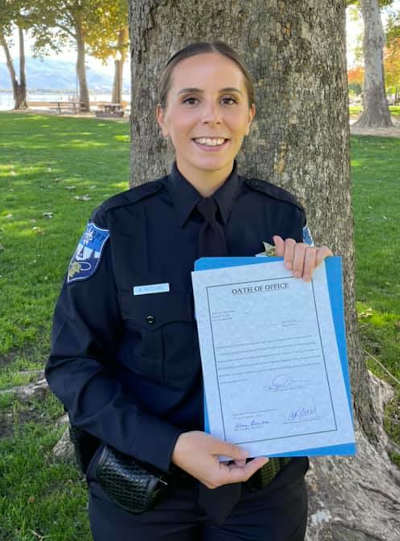
LAKEPORT, Calif. — The Lakeport Police Department is welcoming another new officer to its ranks.
The agency introduced Officer Katie Hutchins as its newest officer on Thursday.
Hutchins is a local Lake County resident and a graduate of Middletown High School, Lakeport Police reported.
She graduated from the Santa Rosa Junior College Public Safety Training Center Police Academy and went on to work as an officer for the Calistoga Police Department before being hired by the Lakeport Police Department.
Hutchins’ hire makes her the fourth female officer now working for the department. That’s the most in its history.
In addition to a growing number of female officers, the department is becoming more diverse in other ways, adding more Spanish-speaking officers and announcing last week the hire of officer trainee, Nicholas Steward, who is black.
“We are excited to have Katie on our team serving the Lakeport community,” the department said in a Thursday statement.
Email Elizabeth Larson at