 How to resolve AdBlock issue?
News

The average American’s everyday interactions with energy sources are limited. They range from turning appliances on or off, to commuting, to paying utility bills.
The connections between those acts and rising global temperatures may seem distant.
However, individuals hold many keys to unlocking solutions to climate change – the biggest challenge our species currently faces – which is perhaps why the fossil fuel industry spent decades misleading and misinforming the public about it.
I’m an assistant professor of geography and environmental studies at Texas State University. My research explores how geography affects the complex relationships between societies, energy and contemporary environmental challenges. I’ve found that the human element is critical for developing creative, effective and sustainable solutions to climate challenges.
There’s a large and growing body of evidence showing that individuals can have a major impact on climate change in a number of ways. Citizen action can compel utilities to increase renewable energy and governments to enact strong climate action laws. When enough individuals make changes that lower daily household energy consumption, huge emissions reductions can result. Consumer demand can compel businesses to pursue climate and environmental sustainability.
These actions combined could bridge the “emissions gap”: the significant difference between the greenhouse gas emissions expected globally and how much they need to drop in the next few decades to avoid catastrophic climate change.
Climate change is outracing government action
People have worked for decades to slow climate change by altering national energy policies. Several states, for example, have renewable portfolio standards for utilities that require them to increase their use of renewable energy.
But 30 years of evidence from international climate talks suggests that even when nations commit on paper to reducing emissions, they seldom achieve those cuts.
The United Nations climate summit in Glasgow is the latest example. Researchers have found that many countries’ pledges have been developed using flawed data.
People are also increasingly talking about geoengineering solutions for climate change. The idea is that over the coming decades, researchers will find ways to manipulate the environment to absorb more carbon pollution. However, some experts argue that geoengineering could be environmentally catastrophic. Also, there’s significant doubt that technological “draw down” interventions can be perfected and scaled up soon enough to make a difference.
So if government, technology or geoengineering aren’t good answers, what are?
Citizen action
Pledges, goals and targets for shifting from fossil fuels to cleaner energy sources are only as good as the efforts by utilities and governments to reach them. Citizen participation and action have proved effective at compelling decision-makers to act. For example, scholars studying the economic, political and social dynamics that led five U.S. municipalities to adopt 100% renewable energy found that grassroots citizen advocacy was one of the key factors that drove the change.
According to the Sierra Club, through citizen-driven action, over 180 cities, more than 10 counties and eight U.S. states have made commitments to transitioning to 100% renewable energy. Consequently, over 100 million U.S residents already live in a community with a 100% renewable energy target.
Citizens have also been taking collective action at the ballot box. For example, in 2019, after New York City voters elected a more climate conscious City Council, the city enacted an ambitious emissions reduction law, and has since begun to enforce it. Also in 2019, after voters similarly shook up the state legislature, New York state enacted the Climate Leadership and Community Protection Act. Among the nation’s strongest climate change laws, New York’s measure mandates that the state shift to 100% renewable energy by 2040 and that its emissions from all sources drop 40% by 2040 and 85% by 2050.
Consumer demand
How and where people spend their money can also influence corporate behavior. Companies and utilities are changing their products and production practices as consumers increasingly demand that they produce ecologically sustainable products and lower their carbon footprints. Scholars have documented that consumer boycotts negatively affect the wealth of a corporation’s shareholders – which in turn can create pressure for a firm to change in response.
The Natural Resources Defense Council has reported that thanks to surging consumer awareness and demand, more than 565 companies have publicly pledged to slash their carbon emissions. Some of the world’s biggest brands have responded to this pressure with claims of already being powered by 100% renewable energy, including Google and Apple.
Google put its global economic might behind climate solutions when it announced in 2019 that it would support the growth of renewable energy resources by making solar and wind energy deals worth US$2 billion.
[More than 140,000 readers get one of The Conversation’s informative newsletters. Join the list today.]
One drawback to consumer demand-driven action is that it’s often unclear how to hold these firms accountable for their promises. Recently, two impact investing experts suggested in Vox that since around 137 million Americans own stock in publicly traded companies, they could use their collective power as shareholders to make sure companies follow through.
Shifting household energy behavior
A substantial body of research shows that small changes to everyday behaviors can significantly reduce energy demand. This may be the biggest way individuals and families can contribute to lowering fossil fuel consumption and reducing carbon emissions.
These steps include weatherization and using energy-efficient appliances, as well as energy efficiency measures such as turning down thermostats, washing laundry with cold water and air-drying it rather than using a dryer.
So is shifting transportation behavior. Using public transportation, car pooling, riding a bicycle or walking can significantly reduce individual and cumulative emissions.

So since most governments aren’t acting quickly enough, and many technology and geoengineering solutions are still unproven or come with high risks, emission reduction goals won’t be achieved without incorporating additional strategies.
The evidence is clear that these strategies should include millions of average people factoring climate change into their everyday activities regarding their communities, purchases and personal energy use.
As the environmentalist Bill McKibben wrote in 2006 about dealing with climate change, “There are no silver bullets, only silver buckshot.” 
Tom Ptak, Assistant Professor of Geography and Environmental Studies, Texas State University
This article is republished from The Conversation under a Creative Commons license. Read the original article.
Watch as eight stars skirt a black hole one million times the mass of the sun in these supercomputer simulations.
As they approach, all are stretched and deformed by the black hole’s gravity. Some are completely pulled apart into a long stream of gas, a cataclysmic phenomenon called a tidal disruption event.
Others are only partially disrupted, retaining some of their mass and returning to their normal shapes after their horrific encounters.
These simulations, led by Taeho Ryu, a fellow at the Max Planck Institute for Astrophysics in Garching, Germany, are the first to combine the physical effects of Einstein’s general theory of relativity with realistic stellar density models.
The virtual stars range from about one-tenth to 10 times the sun’s mass.
The division between stars that fully disrupt and those that endure isn’t simply related to mass. Instead, survival depends more on the star’s density.
Ryu and his team also investigated how other characteristics, such as different black hole masses and stellar close approaches, affect tidal disruption events.
The results will help astronomers estimate how often full tidal disruptions occur in the universe and will aid them in building more accurate pictures of these calamitous cosmic occurrences.
Jeanette Kazmierczak is with NASA's Goddard Space Flight Center in Greenbelt, Maryland.
Board Chair Bruno Sabatier asked for the board to send the letter challenging the rate increase — which PG&E filed a request with the CPUC for on Sept. 16 — citing the negative impact on the community, as well as PG&E’s failure to follow rules imposed by the state and the company not providing a reliable power supply.
PG&E is asking for an increase totaling 4.9% for electricity and 0.2% for gas, and a nonbundled category for those not getting electricity with a rate increase of 2.3%. There is no nonbundled category for those not getting gas, which is the case for Lake County residents.
“It makes no sense to me that we only get partial service from PG&E,” said Sabatier, noting Lake County residents must use either electricity or propane, and propane isn’t cheap either.
Sabatier presented a letter for the board to consider that Deputy County Administrative Officer Matthew Rothstein helped him write. In addition, Sabatier included a letter he wrote personally and he asked board members to consider sending their own individual letters.
He said PG&E is requesting the increase to follow General Order 95 Section III for line maintenance and tree clearance and line construction.
Those are things that PG&E has not been following and the CPUC has not been enforcing those rules, said Sabatier, noting there is now more of an effort by PG&E to work on management and maintenance.
The utility’s other reasons for the rate increase — which is outside of its usual cycle for rate increase requests — is for public safety power shut-off and execution, which Sabatier said is due to PG&E’s inability to upgrade infrastructure.
Other reasons given for the increase request are wildfire mitigation, temporary generation to support customers and COVID-19.
In his letter and in his comments on Tuesday, Sabatier quoted an Associated Press article from Feb. 18, 2020, that said by 2024, PG&E may reach a profit of nearly $2.4 billion, up from the $454 million it realized in 2020.
“My question is, why are we doing a rate increase on a company that has failed to meet expectations and continues to go against what [the] CPUC mission statement is, which is to have a safe and reliable energy source,” said Sabatier.
He said PG&E’s energy source is not safe — pointing to the wildfires the company has caused — or reliable, noting the power outages.
He also pointed out that a judge insisted PG&E be fined $200 million for the 2018 Camp fire, that destroyed the Butte County town of Paradise. However, the CPUC waived the fine.
A judge has to agree with the rate increase, yet a judge wasn’t heard and listened to by the CPUC when it came to the fine, Sabatier said.
He referenced a report that has shown the CPUC was not the independent commission it was created to be. There has been a lot of intermingling between commission and governor’s office, with the governor controlling it, which led to the waiving of the Camp fire fine.
“I just think that the rate increase is a slap in the face to our constituents,” Sabatier said. “It doesn’t solve our problems that we’re also having with PG&E and their infrastructure.”
Sabatier said the board needed to be very direct about why the rate increase isn’t going to work for the county.
He asked the board to approve the general letter and to send their own letters. “We can go much further than just a board letter.”
Supervisor Tina Scott said she appreciated Sabatier bringing the matter to the board.
“I think we need to look at the fact that they’ve been making profit for years and have not been doing the job and that’s why we’ve had the fires that we’ve had,” she said of PG&E.
Scott agreed with Sabatier that the proposed rate increase is a slap in the face to constituents, and that the county can’t afford it.
“We’ve been told that this is going to be the status quo for the next 10 years,” not just with the power shut-offs but with the outages that occur when a branch hits lines, said Supervisor Jessica Pyska.
There have been a couple hundred outages that her district has been through “and now we have to pay more.” She said she appreciated the letter and also would send her own.
Pyska was referencing a passage in the proposed board letter that pointed out that customers reliant on PG&E’s Middletown Substation experienced 205 outages from Jan. 1 to Sept. 13, with the average duration lasting 8.2 hours. Customers served by the Konocti substation experienced 155 outages in the same period, with those outages spanning an average of 11.9 hours.
Sabatier clarified during the meeting that the PG&E employees in the blue trucks do good work and that it’s the administrative staff he’s talking about when criticizing the company.
Supervisors EJ Crandell and Moke Simon also voiced their support, with Crandell planning to send a letter of his own as well.
Sabatier noted that it will be awhile before this increase request is finalized. In speaking with CPUC, he and Rothstein decided the earlier it’s in the judge’s hands the better.
“Being ahead was definitely the better way to go but it’s going to be awhile before that judgment is made,” he said.
Scott asked for the time frame, and Sabatier said the decision is expected in the spring or later.
Scott suggested sending a letter now and then sending another later to remind state officials “that we’re still here and we’re angry.”
Sabatier added, “We shouldn’t reward a company with more money when there’s absolute failures in the system.”
Crandell said he planned to take the matter to the Rural County Representatives of California in an upcoming meeting.
Simon moved to approve the letter, with Scott seconding and the board voting 5-0.
How to voice opposition
Community members wanting to register their opposition to the rate increase should address their comments to the CPUC in one of several ways.
For reference, the proceeding number is A.21-09-008.
To provide comments to the CPUC:
• Submit comments online for the proceeding here: https://apps.cpuc.ca.gov/apex/f?p=401:65:0:ADDPC:NO .
• Write to them, with the proceeding number, the utility company name and any other relevant details, at California Public Utilities Commission, Public Advisor's Office, 505 Van Ness Ave., San Francisco, CA 94102.
• Attend a CPUC event; or
• Speak at a CPUC meeting.
For more information, call the CPUC Public Advisor’s Office at 866-849-8390, email
Email Elizabeth Larson at
2021-11-16 CPUC Letter of Opposition a.21!09!008 Effective 4 by LakeCoNews on Scribd
Sabatier - CPUC Letter of Opposition to A by LakeCoNews on Scribd
Officials at Mendocino College said a “safety first” mindset has been their approach when planning to return to a more normal offering of on-ground classes and student services after a long 18 months of mostly remote learning.
While the college never completely shut down, it’s announcing that many classes will be held in person in the spring.
The spring 2022 term begins Jan. 18, and will look similar to how it did pre-pandemic, with more on-ground classes.
The college will still offer a variety of online and hybrid classes for those who prefer this type of instruction or who are unable to attend on ground classes due to barriers such as full-time work or lack of transportation.
“I want to assure everyone that Mendocino College continues to have the safety and well-being of our campus community as our guiding principles,” said Superintendent/President Tim Karas. “The college will be increasing the slate of in-person classes in the spring, and restoring many activities, events, and opportunities that allow our students to enjoy learning, campus life, and community engagement. The past year and a half has been challenging, but we can get through these tough times with patience and kindness.”
In order to keep the community and campus safe, beginning January 2022, the college will require all students and staff to show proof of being fully vaccinated before coming to campus. Those who do not show proof of vaccination will have to provide negative COVID-19 test results on a weekly basis.
A new mobile app called Mendo Mobile allows students, staff and visitors to submit this information quickly, securely and efficiently.
In addition to vaccine and testing requirements, the college’s plan to return to on-ground teaching, learning and services has included implementing several measures to assure campus safety such as:
• All employees, students and guests are required to wear masks while indoors on campus.
• Districtwide air filters replaced with fresh MERV 13 filters for greater air filtration.
• Reprogramming of building automation systems to maximize fresh air flow as much as possible.
• Bipolar Ionization systems installed in all compatible HVAC systems.
• Strategic deployment of supplemental air purification systems.
• Updating restroom facilities with touchless fixtures.
• Addition of custodial staff to provide enhanced daytime cleaning.
• Providing hand sanitizing stations at all building entrances.
• Providing masks and disinfectant wipes in all offices and classrooms.
• Recruiting an official director of COVID-19 response to oversee district compliance with all health mandates put in place by local, state, and federal officials.
Mendocino College encourages eligible employees and students to sign up for vaccination opportunities and has offered $100 gift card incentives for those that do. Vaccines are now available to anyone 12 and over and can be scheduled through the MyTurn website at https://myturn.ca.gov.
Open registration for the spring 2022 semester has begun and students can view the full schedule online at www.mendocino.edu.
The City of Clearlake Animal Association also is seeking fosters for the animals waiting to be adopted.
Call the Clearlake Animal Control shelter at 707-273-9440, or email
Visit Clearlake Animal Control on Facebook or on the city’s website.
The newest dogs are listed at the top of the following list.

‘Andy’
“Andy” is a male American pit bull mix with a short gray and white coat.
He is dog No. 48995415.

‘Arnold’
“Arnold” is a male American Staffordshire terrier mix with a short brindle coat with white markings.
He is dog No. 49029348.

‘Bear’
“Bear” is a male Labrador retriever-American pit bull mix with a short charcoal and fawn coat.
He has been neutered.
He is dog No. 48443153.

‘Bella’
“Bella” is a female American pit bull mix with a short gray brindle coat.
She has been spayed.
She is dog No. 48448381.

‘Levi’
“Levi” is a male golden retriever-Labrador retriever mix.
He has a short golden coat.
He is dog No. 48975687.

‘Luscious’
“Luscious” is a male pit bull terrier mix with a short gray coat.
He has been neutered.
He is dog No. 48757611.

‘Maria’
“Maria” is a female Shar-Pei mix with a short tan coat.
She is dog No. 49047315.

‘Mitzi’
“Mitzi” is a female Australian cattle dog mix with a medium-length black and white coat.
She has been spayed.
She is dog No. 48443306.

‘Nala’
“Nala” is a 1-year-old female German shepherd mix.
She has a medium-length black and tan coat.
She is dog No. 48289638.

‘Sassy’
“Sassy” is a female American pit bull mix with a short black coat.
She has been spayed.
She is dog No. 48443128.

‘Tanisha’
“Tanisha” is a female Australian cattle dog mix with a short red and white coat.
She has been spayed.
She is dog No. 48443302.

‘Terry’
“Terry” is a male shepherd mix with a short brindle coat.
He is dog No. 48443693.

‘Turk’
“Turk” is a male chocolate Labrador retriever mix.
He is dog No. 48911836.
Email Elizabeth Larson at
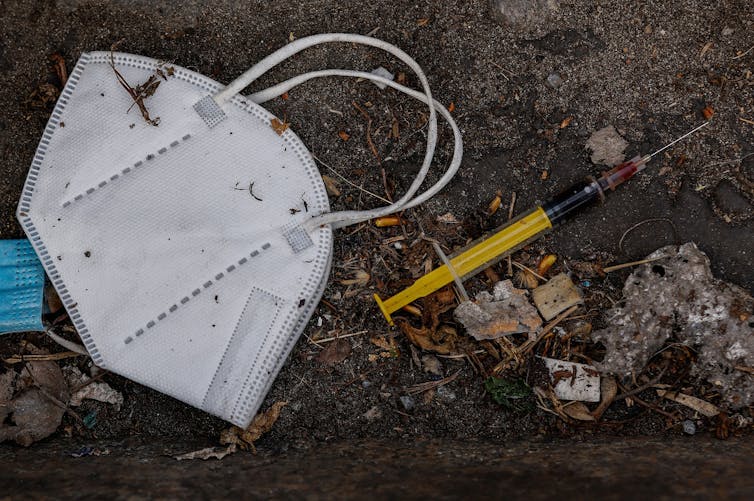
For the past 20 years, I have been engaged in efforts to end the opioid epidemic, as a public health official, researcher and clinician. And for every one of those years I have looked on as the number of deaths from drug overdoses has set a new record high.
Yet even knowing that trend I was surprised by the latest tally from the CDC showing that for the first time ever, the number of Americans who fatally overdosed over the course of a year surpassed 100,000. In a 12-month period ending at the end of April 2021, some 100,306 died in the U.S., up 28.5% over the same period a year earlier.
The soaring death toll has been fueled by a much more dangerous black market opioid supply. Illicitly synthesized fentanyl – a potent and inexpensive opioid that has driven the rise in overdoses since it emerged in 2014 – is increasingly replacing heroin. Fentanyl and fentanyl analogs were responsible for almost two-thirds of the overdose deaths recorded in the 12 months period ending in April 2021.
It is especially tragic that these deaths are mainly occurring in people with a disease – opioid addiction – that is both preventable and treatable. Most heroin users want to avoid fentanyl. But increasingly, the heroin they seek is mixed with fentanyl or what they purchase is just fentanyl without any heroin in the mix.
While the spread of fentanyl is the primary cause of the spike in overdose deaths, the coronavirus pandemic also made the crisis worse.
The geographical distribution of opioid deaths makes it clear that there has been a change during the pandemic months.
Before the COVID-19 health crisis, the skyrocketing increase in fentanyl-related overdose deaths in America was mainly affecting the eastern half of the U.S., and hit especially hard in urban areas like Washington, D.C., Baltimore, Philadelphia and New York City. A possible reason behind this was that in the eastern half of the U.S., heroin has mainly been available in powder form rather than the black tar heroin more common in the West. It is easier to mix fentanyl with powdered heroin.
COVID-19 resulted in less cross-national traffic, which made it harder to smuggle illegal drugs across borders. Border restrictions make it harder to move bulkier drugs, resulting in smugglers’ increased reliance on fentanyl – which is more potent and easier to transport in small quantities and as pills, making it easier to traffic by mail. This may have helped fentanyl spread to areas that escaped the earlier surge in fentanyl deaths.
Opioid-addicted individuals seeking prescription opioids instead of heroin have also been affected, because counterfeit pills made with fentanyl have become more common. This may explain why public health officials in Seattle and elsewhere are reporting many fatalities resulting from use of counterfeit pills.
Another factor that may have contributed to the soaring death toll is that the pandemic made it harder for those dependent on opioids to get in-person treatment.
More than anything else, what drives opioid-addicted individuals to continue using is that without opioids they will experience severe symptoms of withdrawal. Treatment, especially with buprenorphine and methadone, has to be easy to access or addicted individuals will continue using heroin, prescription opioids or illict fentanyl to stave off withdrawal. Some treatment centers innovated in the face of lockdowns, for example, by allowing more patients to take methadone unsupervised at home, but this may not have been enough to offset the disruption to treatment services.
And maintaining access to treatment is crucial to avoid relapse, especially during the pandemic. Research has shown that social isolation and stress – which became more common during the pandemic – increase the chances of a relapse in someone in recovery.
In the past, one slip might not be the end of the world for someone in recovery. But given the extraordinarily dangerous black market opioid supply, any slip can result in death.
[You’re smart and curious about the world. So are The Conversation’s authors and editors. You can read us daily by subscribing to our newsletter.]
Andrew Kolodny, Co-Director of Opioid Policy Research, Brandeis University
This article is republished from The Conversation under a Creative Commons license. Read the original article.