 How to resolve AdBlock issue?
News
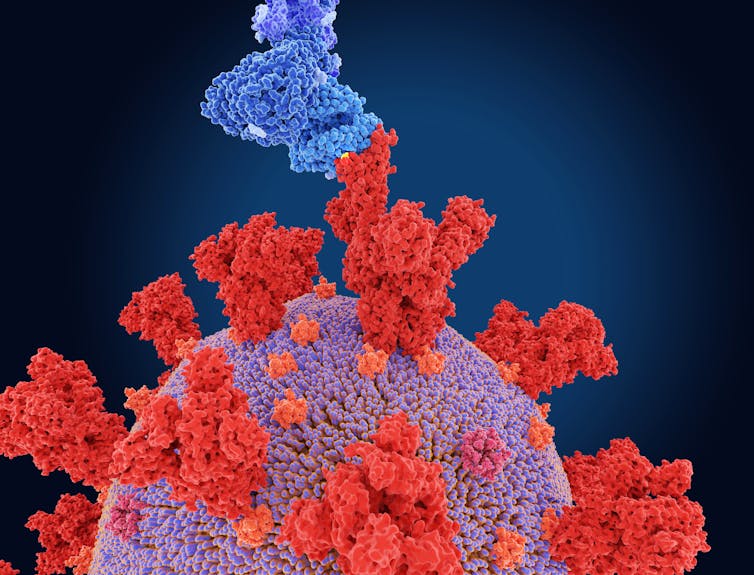
A new variant named omicron (B.1.1.529) was reported by researchers in South Africa on Nov. 24, 2021, and designated a “variant of concern” by the World Health Organization two days later. Omicron is very unusual in that it is by far the most heavily mutated variant yet of SARS-CoV-2, the virus that causes COVID-19.
The omicron variant has 50 mutations overall, with 32 mutations on the spike protein alone. The spike protein – which forms protruding knobs on the outside of the SARS-CoV-2 virus – helps the virus adhere to cells so that it can gain entry. It is also the protein that all three vaccines currently available in the U.S. use to induce protective antibodies. For comparison, the delta variant has nine mutations. The larger number of mutations in the omicron variant may mean that it could be more transmissible and/or better at evading immune protection – a prospect that is very concerning.
I am a virologist who studies emerging and zoonotic viruses to better understand how new epidemic or pandemic viruses emerge. My research group has been studying various aspects of the COVID-19 virus, including its spillover into animals.
Why do new SARS-CoV-2 variants continue to emerge?
While the unusually high number of mutations in the omicron variant is surprising, the emergence of yet another SARS-CoV-2 variant is not unexpected.
Through natural selection, random mutations accumulate in any virus. This process is sped up in RNA viruses, including SARS-CoV-2. If and when a set of mutations provides a survival advantage to a variant over its predecessors, the variant will out-compete all other existing virus variants.
Does the omicron variant’s greater number of mutations mean it is more dangerous and transmissible than delta? We simply don’t know yet. The conditions that led to the emergence of the variant are not yet clear, but what is clear is that the shear number and configuration of mutations in omicron is unusual.
One possible explanation for how viral variants with multiple mutations emerge is through prolonged infection in a patient whose immune system is suppressed – a situation that can lead to rapid viral evolution. Researchers have hypothesized that some of the earlier SARS-CoV-2 variants, such as the alpha variant, may have stemmed from a persistently infected patient. However, the unusual constellation and numerous mutations in the omicron variant make it very different from all other SARS-CoV-2 strains, which raises questions about how it came about.
Another possible source of variants could be through animal hosts. The virus that causes COVID-19 can infect several animal species, including mink, tigers, lions, cats and dogs. In a study that is not yet peer-reviewed, an international team that I lead recently reported widespread infection by SARS-CoV-2 in free-living and captive white-tailed deer in the U.S. Therefore, we also cannot rule out the possibility that the omicron variant emerged in an animal host through rapid evolution.

How the delta variant became dominant worldwide
Delta is between 40% and 60% more transmissible than the alpha variant and nearly twice as transmissible as the original SARS-CoV-2 virus first identified in China. The delta variant’s heightened transmissibility is the primary reason why researchers believe it was able to out-compete other variants to become the dominant strain.
A key factor in viral fitness is its replication rate – or how quickly a virus can make more copies of itself. The delta variant replicates faster than previous SARS-CoV-2 variants, and a not-yet-peer-reviewed study estimated that it produces 1,000 times more virus particles than its predecessors.
In addition, people infected with the delta variant are making and shedding more virus, which is another potential mechanism for its increased ability to spread. Research suggests that a possible explanation for the delta variant’s heightened ability to replicate is that mutations in the spike protein led to more efficient binding of the spike protein to its host, via the ACE-2 receptor.
The delta variant has also acquired mutations that would allow it to evade neutralizing antibodies that serve a critical role in the body’s defense against an invading virus. This could explain why, as multiple reports have shown, the COVID-19 vaccines have been somewhat less effective against the delta variant. This combination of high transmissibility and immune evasion could help explain how the delta variant became so successful.
Studies also show that people infected with the delta variant have a higher risk of being hospitalized compared to those infected with the original SARS-CoV-2 and early variants. One particular mutation on the spike protein of the delta variant – the P681R mutation – is thought to be a key contributor to its improved ability to enter cells and to cause more severe disease.
Will omicron replace delta?
It is too early to say if the omicron variant is fitter than delta or if it will become dominant. Omicron shares some mutations with the delta variant but also possesses others that are quite different. But one of the reasons why we in the research community are particularly concerned is that the omicron variant has 10 mutations in the receptor-binding domain – the part of the spike protein that interacts with the ACE-2 receptor and mediates entry into cells – compared with just two for the delta variant.
[Too busy to read another daily email? Get one of The Conversation’s curated weekly newsletters.]
Suppose the combination of all the mutations in omicron makes it either more transmissible or better at immune evasion than delta. In that case, we could see the spread of this variant globally. However, it is also possible that the unusually high number of mutations could be detrimental to the virus and make it unstable.
It is highly likely that the omicron variant is not the endgame and that more SARS-CoV-2 variants will emerge. As SARS-CoV-2 continues to spread among humans, natural selection and adaptation will result in more variants that could plausibly be more transmissible than delta.
We know from influenza viruses that the process of viral adaptation never ends. Lower vaccination rates among many countries means that there are still a lot of susceptible hosts out there for the virus, and that it will continue to circulate and mutate as long as it can spread. The emergence of the omicron variant is yet another reminder of the urgency to vaccinate to stop the further spread and evolution of SARS-CoV-2.
Suresh V. Kuchipudi, Professor of Emerging Infectious Diseases, Penn State
This article is republished from The Conversation under a Creative Commons license. Read the original article.
Initial radio reports of the crash came in shortly after 11:15 a.m. from near Konocti Vista Casino Resort.
Witnesses reported seeing the aircraft — initially described as a helicopter or glider — directly east of Soda Bay Road toward the lake. They reported it going down somewhere between the casino and South Main Street in Lakeport.
Sheriff Brian Martin confirmed to Lake County News that the aircraft appeared to be a gyrocopter, a small type of rotorcraft.
Firefighters, sheriff’s deputies and California Highway Patrol responded, with a CHP helicopter helping conduct the search. Incident command was established at Konocti Vista Casino’s dock.
Radio traffic indicated deputies and firefighters were challenged with reaching the crash site, and searching through tules described as 12 feet high.
The CHP helicopter cleared the scene just before 12:15 p.m. after being unable to locate the gyrocopter.
Minutes later, a sheriff’s deputy reported finding the downed craft in the tules, with one person dead inside, according to radio traffic.
Sheriff Martin said the crash scene was about a mile out from shore and they were working on logistics to reach it.
Incident command traffic said the site could only be reached by foot or by helicopter, although an airboat later was reported to be responding.
The sheriff’s office has notified the Federal Aviation Administration about the crash, Martin said.
More information will be published as it becomes available.
Email Elizabeth Larson at
LAKE COUNTY, Calif. — The Board of Supervisors on Tuesday held the fourth in a series of public hearings on the county supervisorial redistricting process, directing staff to bring back a resolution to adopt the final map.
The process takes place every 10 years following the release of the data from the U.S. Census Bureau.
The county process, which redraws the five supervisorial districts, is separate from the California Citizens Redistricting Commission’s ongoing efforts to delineate new state Assembly and Senate, and congressional districts.
Consultant Margaret Long told the board that the law requires at least four public hearings be held.
The first, held during the board’s regular Aug. 31 meeting, was to explain the process. A special stand-alone meeting on Saturday, Oct. 2, focused on communities of interest, while the third, held on the evening of Nov. 2, went over the maps and resulted in a recommendation for the final map.
Long said the final map proposed from the options offered to the board is No. 6, which she said incorporates all of the changes and recommendations from the supervisors and the public.
She said the option No. 6 map meets all legal requirements, including all districts being contiguous and within a 10% population deviation.
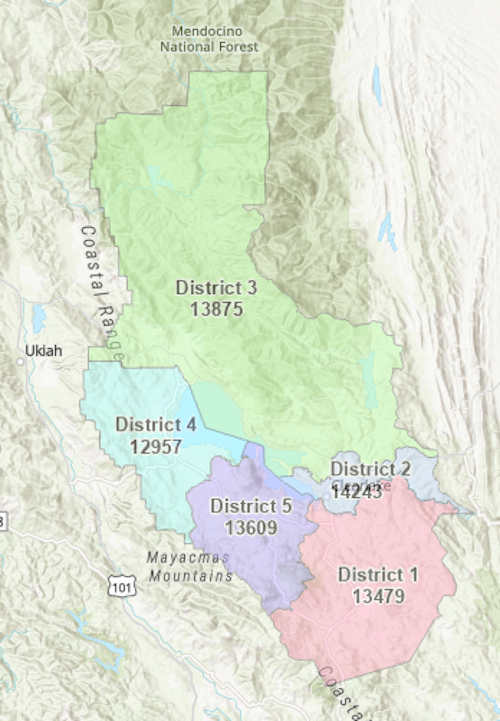
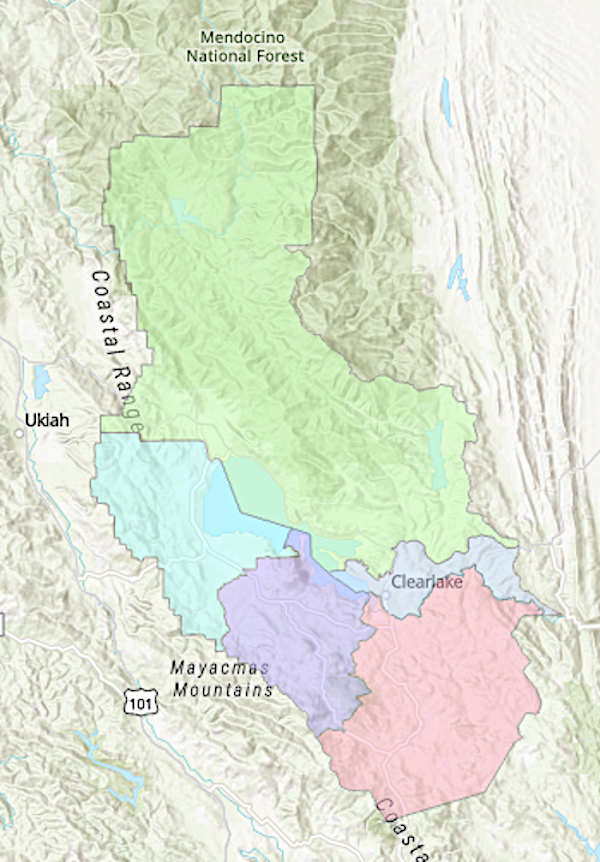
Each district should have 13,633 residents or be within 10% of that number. Option No. 6 places the population in the five districts as follows: District 1, 13,479; District 2, 14,243; District 3, 13,875; District 4, 12,957; and District 5, 13,609.
The new district boundaries would differ from the current boundaries as follows, based on the description placed on the option No. 6 map:
• In North Lakeport, the area bounded by Highway 29, the Nice-Lucerne Cutoff and Rodman Slough would be moved from District 3 to District 4 in order to move all of the contiguous tribal lands in that area into a single district.
• A small area east of Big Canyon Road at Ettawa Springs Rd has moved from District 1 to District 5 in order to keep as much of the Cobb Area Council within a single district.
• In the city of Clearlake, the census blocks south of Lakeshore Drive have been moved from District 1 to District 2 in order to keep the central business corridor along Lakeshore Drive within a single district, and the area south of Dam Road has been moved to District 1.
• Riviera Heights subdivision west to Lakeview Estates Drive has been moved from District 4 to District 5 to keep all of “The Rivieras” communities in a single district.
• North of Kelseyville, the area bounded by Kelsey Creek, Soda Bay Road and Clear Lake State Park has been moved from District 4 to District 5.
Based on the discussion and the options Long presented, the board chose to direct staff to bring back a resolution accepting the new map and emphasizing the use of census blocks, which will save time and allow the county to meet the Dec. 15 deadline.
The county’s GIS expert, Lon Sharp — who also was part of the redistricting effort in 2011 — told the board that using the county’s 2,900 census blocks is the easiest method, explaining that he could have a list of the census blocks for each proposed district by the end of the day if needed.
County Counsel Anita Grant also supported using census blocks and suggested that the resolution should include the maps if possible. It’s the legitimate way to go, she added, and can be done clearly and efficiently.
“The map was built on census blocks so it makes perfect sense to just use census blocks,” said Board Chair Bruno Sabatier.
Sabatier agreed that a resolution is the appropriate way to move forward, and that since the board has held four hearings, it didn’t need to go through a process that included a first and second reading of the final map approval document.
With the consensus of the board, Sabatier directed staff to come back with the resolution to accept the map and thanked the staff involved, which in addition to Sharp included Deputy Administrative Officer Matthew Rothstein.
All of the maps can be found on the county’s website.
Email Elizabeth Larson at
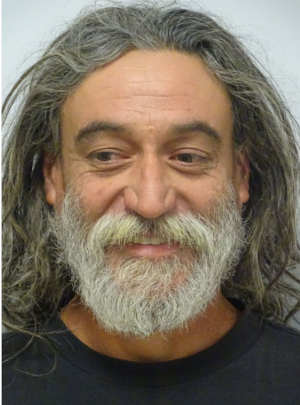
LAKE COUNTY, Calif. — A Kelseyville man arrested four years ago after a standoff with authorities has been arrested again, this time on new charges involving threats.
Joshua Caleb “Buck” Brown, 48, was taken into custody shortly after 7 a.m. Wednesday.
Lauren Berlinn, the Lake County Sheriff’s Office’s new public information and community outreach officer, said the agency served the search/arrest warrant Wednesday morning at the Brown property in Kelseyville.
“Mr. Brown was taken into custody without incident, was booked at the jail on the charges related to the warrant. The warrant was a result of an investigation of elder abuse and criminal threats,” Berlinn said.
Brown was booked shortly after 8 a.m. on charges including a felony charge of threatening a crime with intent to terrorize, and a misdemeanor arrest warrant. His bail was set at $115,000, according to booking records.
Berlinn said the sheriff’s office’s SWAT team was part of the warrant service “due to previous contacts with Mr. Brown.”
In August of 2017, an armed Brown confronted law enforcement officers, Caltrans workers and then-Supervisor Rob Brown as k-rail was being installed near an illegal road access that he had made near his property between Cruickshank Road and Cole Creek Road on Highway 29, as Lake County News has reported.
A manhunt of several hours involving SWAT teams from Lake, Mendocino and Sonoma counties followed, with Buck Brown surrendering on the evening of the same day the incident occurred.
He is due to be arraigned in Lake County Superior Court on Thursday.
Email Elizabeth Larson at
Greg Giusti, 66, was reappointed to the North Coastal Regional Water Quality Control Board, where he has served since 2013, the Governor’s Office reported.
Giusti is the former director adviser of forests and wildland ecology for the Lake County University of California, Cooperative Extension from 1985 to 2017. He now serves as adviser emeritus for the UCCE.
He also was agricultural biologist at the San Mateo County Department of Agriculture from 1981 to 1985 and chief biologist at the Marine Ecological Institute from 1978 to 1981.
Giusti has been a registered Professional Forester since 2013.
He earned a Master of Arts degree in Ecology and Systematic Biology from San Francisco State University.
This position requires Senate confirmation and the compensation is $250 per diem. Giusti is registered without party preference.
The Governor’s Office also reported that Santa Rosa resident Valerie Quinto, 37, also was reappointed to the North Coastal Regional Water Quality Control Board. She’s served on the board since 2014.
Quinto has been executive director at the Sonoma Resource Conservation District since 2017, where she was program director from 2012 to 2017. She held several positions at Sotoyome Resource Conservation District between 2009 and 2012 including project coordinator and conservation project manager.
The Governor’s Office said Quinto is a Democrat.
The California Department of Public Health said it and the San Francisco Department of Public Health have confirmed the case.
The University of California, San Francisco identified the case through its sequencing capabilities.
Now, the state of California is increasing COVID-19 testing at airports for arrivals from countries identified by the Centers for Disease Control and Prevention in order to detect and prevent the spread of the new variant.
On Monday, State Public Health Officer and Director of the California Department of Public Health Dr. Tomás J. Aragón reported on the efforts to monitor B.1.1.529, or Omicron, which the World Health Organization has labeled a “variant of concern.”
California has established a public-private partnership through the California SARS-CoV-2 Whole Genome Sequencing Initiative called COVIDNet to provide the state with genomic sequencing to help understand and control the spread of COVID-19.
Health officials are using that surveillance system to monitor the variant’s presence and progress through the state.
CDPH said the state is doubling down on “vaccination and booster efforts to ensure that all Californians have access to safe, effective, and free vaccines that can prevent serious illness and death.”
Members of the public are urged to get vaccinated and boosted, wear masks in indoor settings, get tested if they have symptoms and stay home if they are sick.
Travelers who have been in South Africa, Botswana, Eswatini, Lesotho, Malawi, Mozambique, Namibia or Zimbabwe within the last 14 days must follow CDC recommendations to get tested three to five days after arrival, quarantine for seven days even if testing negative and isolate for 10 days if COVID-19 symptoms develop.