 How to resolve AdBlock issue?
News
The council will meet at 2 p.m. Thursday, Dec. 16, in the council chambers at Clearlake City Hall, 14050 Olympic Drive.
The meeting will be broadcast live on the city's YouTube channel or the Lake County PEGTV YouTube Channel. Community members also can participate via Zoom or can attend in person.
The agenda can be found here.
Comments and questions can be submitted in writing for City Council consideration by sending them to City Clerk Melissa Swanson at
To give the council adequate time to review your questions and comments, please submit your written comments before 12 p.m. Thursday, Dec. 16.
Each public comment emailed to the city clerk will be read aloud by the mayor or a member of staff for up to three minutes or will be displayed on a screen. Public comment emails and town hall public comment submissions that are received after the beginning of the meeting will not be included in the record.
On the agenda is a public hearing to discuss a resolution approving an agreement to sell 29 acres at 2890 Old Highway 53.
City Manager Alan Flora’s written report to the council explains that the former successor agency to the former redevelopment agency owns the property.
“Several years ago, a subdivision was started, and tentative map adopted, but the project fell apart due to the Great Recession,” he wrote.
A year ago the city received interest from the previous developer in restarting the project, at which time another developer had come forward. Those proposals were taken up at a special meeting last December, Flora said.
The city selected the proposal from TJG/Summitt Development, but in May the company informed the city it would not pursue the project.
In May, the property was noticed as surplus property by the city to public agencies and through Housing and Community Development’s database for affordable housing development, as required by state law, Flora said.
Initially, the city received no interest, but over the summer four developers expressed interest and two submitted proposals. Since then, Flora said negotiations have resulted in a purchase and sale agreement with DANCO Communities.
DANCO also is working on an apartment project on Burns Valley Road near the location of the city’s proposed sports complex.
The sale price would be $100,000. Escrow would be opened with a $5,000 deposit. DANCO would have the tentative map reapproved, which Flora said would be substantially consistent with the previously adopted map resulting in 22 lots on approximately 1.25 acre lots. Escrow would close after the tentative map is recorded.
“DANCO believes that this project is feasible due to the efficiency of construction of the homes happening at the same time as the mixed income apartment project on Burns Valley Road, which is anticipated next year,” Flora wrote.
In other business, the council will consider purchasing property at 6461 Manzanita Ave. and 6452 Francisco Ave., which will be part of the city’s larger commercial development at the former Pearce Field airport.
Flora’s report said the proposal is to purchase the two properties for $550,000 from Edwin Jinks. Both of them are used for self-storage facilities.
“This purchase would allow the 18th Avenue road construction to be started next year. Mr. Jinks would deliver the property free of tenants and personal property before closing,” Flora wrote in his report.
On the meeting's consent agenda — items that are not considered controversial and are usually adopted on a single vote — are a resolution approving the applications for the Per Capita Grant Funds; award of contract for the purchase and installation of new traffic signal controllers at Old Highway 53 and Lakeshore Drive; authorization of the purchase of a submersible pump and related equipment to provide irrigation water to Redbud Park; adoption of a resolution opting to affirm an exemption from the requirements of mandatory organics collection services associated with SB 1383; approval of design services contract with California Engineering Co. for the 18th Avenue Road and Infrastructure Project; continuation of declaration of local emergency issued on March 14, 2020, and ratified by council action on March 19, 2020; continuation of declaration of local emergency issued on Aug. 18, 2021, and ratified by council action on Aug. 19, 2021; continuation of declaration of local emergency issued on Aug. 23, 2021, and ratified by council action on Sept. 16, 2021; continuation of declaration of local emergency issued on Oct. 9, 2017, and ratified by council action Oct. 12, 2017; and continuation of authorization to implement and utilize teleconference accessibility to conduct public meetings pursuant to Assembly Bill 361.
The council also will hold a closed session after the public portion of the meeting to discuss a liability claim from Glen Gillham.
Email Elizabeth Larson at
Looking for the perfect gift for your hard-to-please family member or friend who returns every gift you give them?
Out of ideas?
Your local bookstore may be just the place to find gifts for those who seem to have everything and like nothing. How about a coffee-table book with gorgeous photos of classic cars, national parks, or skyscrapers? Or a great novel that even the pickiest of people would enjoy curling up with on a sofa or beach lounge chair?
Despite all the advances in digital technology, bookstores still fill our need for knowledge and the written word and hearken back to simpler times when we were not so tethered to our electronic devices.
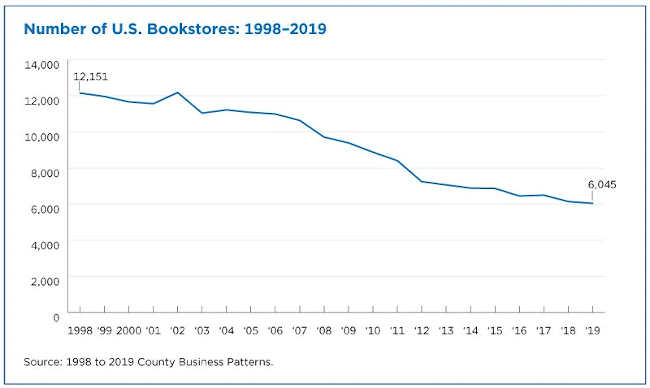
According to data from the Census Bureau’s County Business Patterns, while the number of U.S. Book stores (as listed in the North American Industry Classification System) dropped from 12,151 in 1998 to 6,045 in 2019, there were still more bookstores than some other types of retail businesses that are ubiquitous in our communities, including Home Centers (5,952 establishments) and Department Stores (3,856).
These employer (businesses with paid employees) bookstores had 61,068 workers and reported nearly $1.1 billion in annual payroll in 2019, averaging only $17,660 a year per employee. (FYI: This employment statistic was for the week of March 12 and therefore does not reflect any seasonal change in employment in this industry.)
Bookstores in Hawaii reported the highest average annual payroll per employee — $26,007.
Given it’s our most populated state, it’s no surprise there were more (605) bookstores in California and they employed the most (7,763) workers in this industry of any other state in 2019.
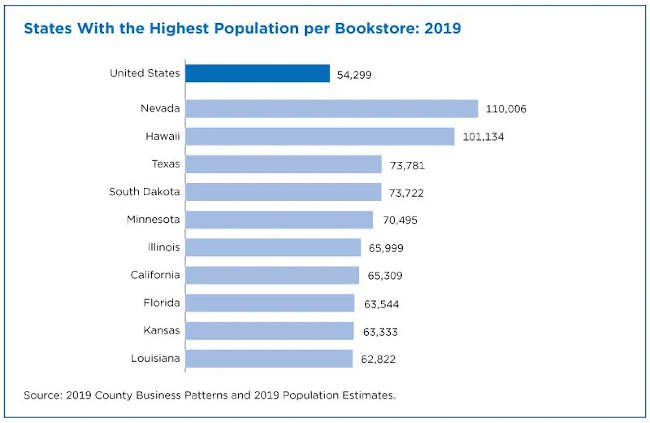
On average, there was one bookstore per 54,299 people in the United States in 2019. Nevada had the nation’s fewest number of bookstores per capita — one for every 110,006 state residents — perhaps making it an underserved market that could potentially support new bookstores.
Bookstore sales
Despite the steady decline in the number of bookstores, bookstore sales increased from $12.4 billion in 1997, to $15.1 billion in 2002, and to $16.8 billion in 2007, according to the Economic Census which is conducted every five years. Bookstore sales then started dropping — to $11.9 billion in 2012 and to $10.0 billion in 2017.
Retail sales of books made up 70.9% ($7.1 billion of the total $10.0 billion) of bookstores’ total sales in 2017. Among the other products bookstores sold:
• Office and school supplies and packaging materials ($412.3 million, 4.1%).
• Toys, games, and hobby supplies ($378.0 million, 3.8%).
• Meals and beverages ($305.7 million, 3.1%).
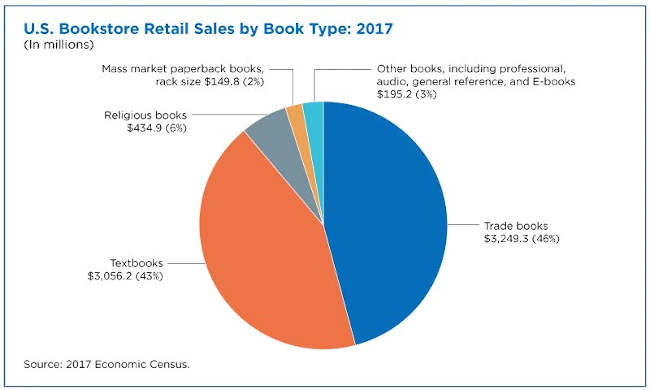
About 90% of bookstores’ total retail book sales in 2017 were for trade books and textbooks. The remaining 10% included religious books, mass market paperbacks, professional books, and others.
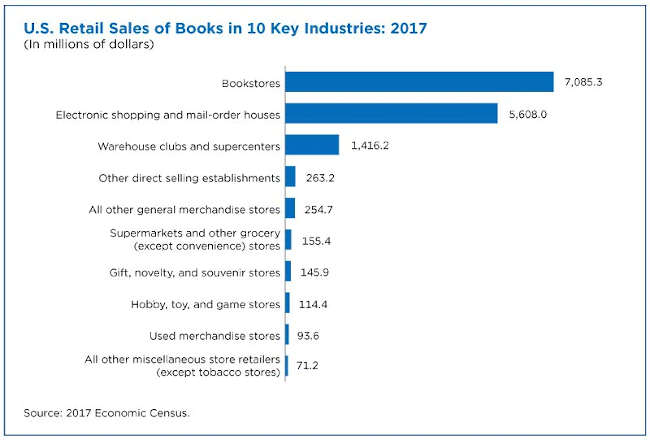
Clearly bookstores are the go-to for many book lovers. But they can also satisfy their thirst for reading at 50 or more other types of businesses, including Electronic Shopping and Mail Order Houses, Warehouse Clubs and Supercenters, and Other Direct Selling outlets. In fact, book sales ($8.3 billion) of businesses other than bookstores were similar to those made in bookstores in 2017.
Nonemployer bookstores
In addition to the 6,143 employer bookstores, there were also 8,109 nonemployer bookstores in the United States in 2018, according to the Census Bureau’s Nonemployer Statistics program. (These small businesses include self-employed people who often report their business income on the Internal Revenue Service form 1040 Schedule C or SE.)
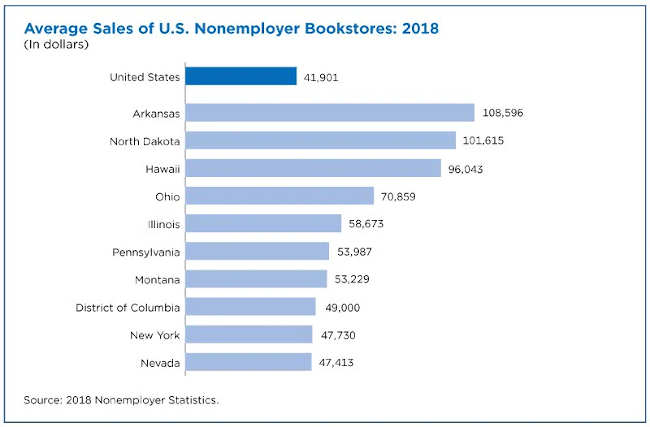
Nonemployer bookstores generated $339.8 million in sales in 2018, an average of $41,901 each. Nearly 30% (2,396) of these nonemployer bookstores earned less than $5,000 in total sales in 2018.
Arkansas reported the nation’s highest average annual sales —$108,596 — per nonemployer bookstore.
Bookstore business ownership characteristics
The Census Bureau’s 2018 Annual Business Survey (ABS) provides data that classifies firms by the sex, ethnicity, race and veteran status of the business owner in 2017.
Almost all bookstore firms (90.9%) could be classified by sex, ethnicity, race, and veteran status in 2017. These firms made up 58.5% of the total sales of all establishments in this industry and 57.3% of the industry employment.
The ABS shows that in 2017:
• 88.8% had non-Hispanic owners.
• 84.5% had white owners.
• 82.3% were not owned by minorities.
• 81.2% were not owned by veterans.
The remaining 9.1% (that could not be classified by sex, ethnicity, race, and veteran status) accounted for 41.5% of the total sales of all firms in this industry and 42.7% of the industry’s employment.
More recent findings
According to the Annual Retail Trade Survey, bookstore sales decreased from $10.3 billion in 2017 to $9.8 billion in 2018 and to $9.1 billion in 2019 (the latest yearly data available at the time of publication).
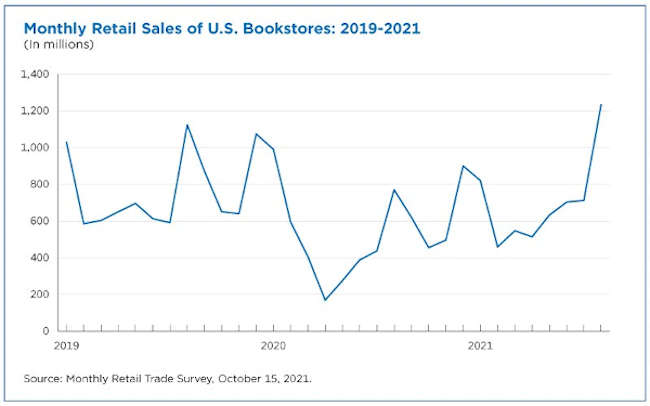
The monthly version of this survey, the Monthly Retail Trade Survey, provides additional insight into the industry’s seasonal nature. Bookstores typically experience increases in sales in August and December.
The next chapter for bookstores
As we enter the holiday shopping season, the variety of businesses consumers can turn to for their gift of reading will continue to impact the future of bookstores in our communities.
Bookstores will likely continue to offer a wide variety of products and services (like in-store coffee shops) to draw consumers and encourage them to buy their core products.
Census Bureau data can help business owners identify potentially underserved communities and additional products they could sell so they can continue to contribute to local economies.
Note on the data
The data in this story have undergone statistical testing and are significant at the 90% confidence level. Comparisons shown in the tables and graphics have not all been tested for statistical significance and, therefore, should be interpreted with caution.
Differences between estimates may be attributed to sampling or nonsampling error rather than to differences in underlying economic conditions. Caution should be used in drawing conclusions from the estimates and comparisons shown.
Monthly Retail Trade Survey (MRTS) estimates are not adjusted for seasonal variation, holidays, trading day differences or price changes. More information on MRTS confidentiality protection, sampling error, nonsampling error, sample design and definitions may be found on the MRTS methodology page.
Additional information on the Economic Census methodology, including sampling error and nonsampling error, may be found on the EC website.
Andrew W. Hait is a survey statistician/economist at the U.S. Census Bureau.
In addition to marijuana and chemicals, ammunition and weapons were also seized.
The trash and litter these operations leave behind also impacts public lands: almost 300 miles of waterline, 583 propane tanks were collected during these operations, as well as more than 67,000 pounds of grow site infrastructure.
“The BLM is proud of its law enforcement Rangers and Special Agents for conducting this important work,” said BLM California State Director Karen Mouritsen. “These illegal operations have a devastating impact on our environment and the health and safety of communities, which we cannot tolerate. The BLM looks forward to working with the Attorney General’s Office again next year on this very important effort.”
Like all the bureaus and agencies that make up the Department of the Interior, the BLM is playing a central role in protecting natural resources, pursuing environmental justice and honoring nation-to-nation relationships with Tribes in the stewardship of public lands.
The BLM supports the Biden Administration’s conservation vision for doing better for people, for fish and wildlife, and for the planet. Proper management of these resources keeps working public lands healthy and productive for current and future generations of Americans, the agency said.
“Growing marijuana on federal land is a crime, but that is not the only issue here,” said Special Agent In Charge Dylan Ragan. “It also has devastating impacts on public safety, wildlife and natural resources. I have a profound respect for the fantastic work our rangers and special agents involved in eradicating illegal grow sites and removing highly toxic chemicals that pollute public lands and waters.”
The BLM promotes safety, security, and environmental protection of public lands, public land users and employees.
The agency strongly advises anyone encountering what appears to be a growing site to leave the area immediately and call the county sheriff or the nearest BLM office.
For additional information or to notify law enforcement authorities of suspicious activities on public lands, please contact the BLM by visiting https://www.blm.gov/california.
The rule for universal indoor masking, which the agency announced this week, focuses on the holiday season, when people are more likely to travel and to be indoors in groups.
It is in effect as of Wednesday, Dec. 15, through Jan. 15. Surgical masks or higher-level respirators are recommended.
Masks are required regardless of vaccination status, CDPH said.
Exemptions remain in place for children under age 2; individuals with medical or mental health conditions or disabilities that prevent them from safely masking; those who are hearing impaired, or communicating with a person who is hearing impaired, where the ability to see the mouth is essential for communication; and others for whom wearing a mask would create a risk to the person related to their work.
State health officials announced the updated guidance in response to a 47% increase in California’s case rate since Thanksgiving, along with a 14% increase in hospitalizations statewide.
Hospitals are now at or near capacity, with the state noting that even a moderate case and hospitalization surge could impact the health care delivery system in certain regions of the state, CDPH reported.
CDPH said it’s also part of an effort to slow the spread of both Delta and the highly transmissible Omicron variant, the first U.S. case of which was detected in California earlier this month.
State Public Health Officer and CDPH Director, Dr. Tomás J. Aragón said the state is already seeing a higher level of transmission this winter “and it is important to act now to prevent overwhelming our busy hospitals so we can provide quality health care to all Californians.”
State officials reported that while overall vaccination rates are high, some areas of the state have lower vaccination rates.
As of Dec. 10, Lake County Public Health reported that 59% of county residents aged 5 years and older are fully vaccinated, with 7% partially vaccinated and 34% unvaccinated.
Aragón is continuing to urge Californians to be vaccinated or to get boosters to protect against COVID-19. “Testing and masking remain important tools in slowing the spread.”
Other updates CDPH announced this week include new requirements for mega events, with attendees required to provide proof of vaccination, a negative antigen COVID-19 test within one day of the event or a negative PCR test within two days of the event.
CDPH also has issued a travel advisory, recommending that all travelers arriving in California test for COVID-19 within three to five days after arrival, regardless of their vaccination status.
Actions and adjustments on the local level
During the course of the pandemic, masking guidance has been changed as health officials adjust to case rates and scientific data.
After California fully reopened on June 15, masking guidelines were loosened for a short period of time.
However, in July, when cases began to surge due to the Delta variant, local and state officials updated their guidelines.
At that time, the Board of Supervisors approved a resolution strongly urging community members to take extra precautions by continuing to wear masks while indoors at public places. At that time, Lake County’s case rate was the highest in the state.
About a week later, CDPH said it would require masking for those who are unvaccinated and recommended it for all in indoor public settings.
CDPH followed guidance from the Centers for Disease Control and Prevention that focused in particular on indoor masking for all individuals in areas of “substantial or high transmission,” which at that point included 90% of the state, including Lake County.
In early August, the Board of Supervisors approved an urgency ordinance to once again require masking in county facilities and also passed an updated workplace protocol as Lake County’s COVID-19 case rate continued its late summer climb.
Since the summer, Lake County has gone from leading the state in case rate to, as of Dec. 14, being among the lowest in the state.
On Dec. 14, Lake County’s case rate per 100,000 for a seven-day average was six cases, making it the third-lowest rate statewide. That’s compared to Mono County, which has the highest case rate, 52 per 100,000.
Lake’s total cases were at 6,958 with 115 deaths, CDPH reported.
Information on local hospitalizations was not immediately available on Tuesday.
Deputy County Administrative Officer Matthew Rothstein said both the resolution and urgency ordinances for masking passed by the supervisors have remained in place.
Rothstein said county staff have reported no challenges to the local resolution and ordinance thus far, and none are expected as a result of the state order effective on Wednesday.
The urgency ordinance was amended on Nov. 23 to clarify the activation and suspension of the masking mandate triggers in county facilities for the public and staff, Rothstein said.
The mandate is activated when Lake County’s COVID-19 case rate exceeds 10 per 100,000 and when the testing positivity rate exceeds 8%, and both indicators have remained at or above said rates for a minimum of seven days.
When the case rate falls below 3.9 cases per 100,000 and testing positivity rate falls below 4.9% and both indicators have remained at or below said rates for a minimum of 14 days, the ordinance will be reconsidered by the Board of Supervisors.
In deciding whether to lift the mandate, the board is required to consider various factors in addition to case and testing positivity rates that can include emergency room and ICU capacities and vaccination rates.
Rothstein said the state’s new mandate is more restrictive than the Board of Supervisors’ strong recommendation for masking.
He also noted that local governments can impose greater restrictions, but cannot reduce statewide requirements.
As such, the county’s urgency ordinance appears to not be overridden by the state’s changes announced this week.
“Where the urgency ordinance’s requirements are more strict, the local ordinance would prevail,” Rothstein said.
Email Elizabeth Larson at
Frank Stuart Kountz, 57, from Willows died in the crash, said Lauren Berlinn, the sheriff’s public information officer.
Kountz was driving a 2013 Kenworth tanker truck westbound on Highway 20 east of Clearlake Oaks shortly after 6 a.m. Saturday when the tanker overturned while he was negotiating a right-hand curve in the roadway, the California Highway Patrol’s Clear Lake Area office reported.
The truck, which was carrying a load of milk, crossed the eastbound lane before traveling down an embankment south of the highway, the CHP said.
Kountz died of his injuries at the scene, where reports from the scene indicated that it took until Saturday evening to remove the truck, respond to the milk spill and clear the incident.
Email Elizabeth Larson at

Despite a national nursing shortage in the United States, over 80,000 qualified applications were not accepted at U.S. nursing schools in 2020, according to the American Association of Colleges of Nursing.
This was due primarily to a shortage of nursing professors and a limited number of clinical placements where nursing students get practical job training. Additional constraints include a shortage of experienced practitioners to provide supervision during clinical training, insufficient classroom space and inadequate financial resources.
Although the 80,000 may not account for students who apply to multiple nursing schools, it clearly suggests that not all qualified students are able to enroll in nursing school.
I am a nurse researcher, professor of nursing and founding director of WIRES, an office at the University of South Florida that focuses on the well-being of the health care workforce. I’ve found that the nursing shortage is a complex issue that involves many factors – but chief among them is the shortage of faculty to train future nurses.
Growing demand for nurses
There are not enough new nurses entering the U.S. health care system each year to meet the country’s growing demand. This can have serious consequences for patient safety and quality of care.
Nationally, the number of jobs for registered nurses is projected to increase by 9% between 2020 and 2030.
Some states project an even higher demand for registered nurses because of their population and their needs. Florida, for example, will need to increase its number of registered nurses by 16% over the next decade.
The U.S. Bureau of Labor Statistics estimates there will be about 194,500 openings for registered nurses each year over the next decade to meet the demands of the growing population, and also to replace nurses who retire or quit the profession. This means the U.S. will need about 2 million new registered nurses by 2030.
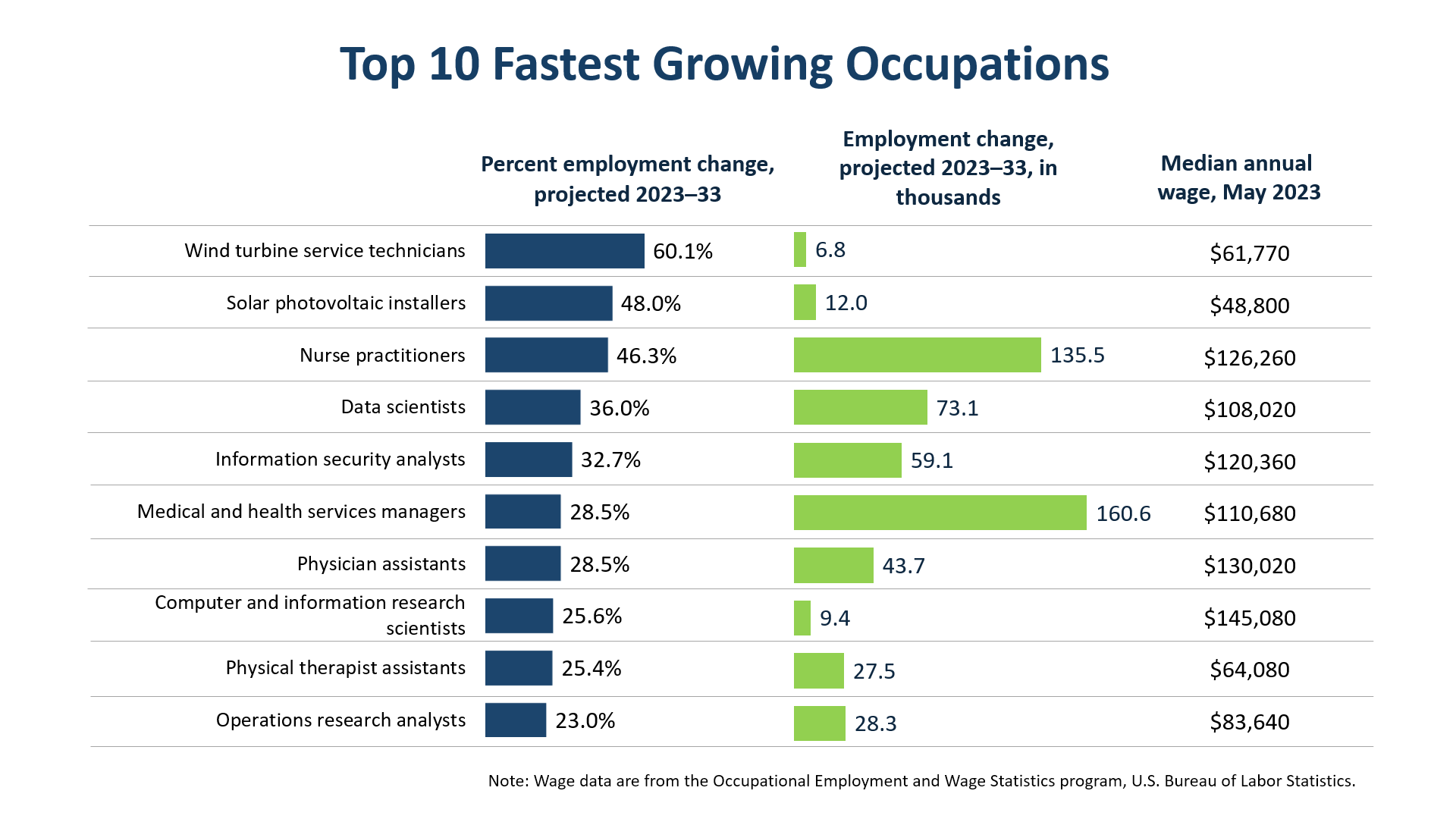
In addition to a shortage of registered nurses, there is also a shortage of nurse practitioners. Nurse practitioner is identified as the second fastest-growing occupation in the next decade, after wind turbine technicians, with a projected increase of 52.2%. Nurse practitioners have an advanced scope of practice compared with registered nurses. They must complete additional clinical hours, earn a master’s or doctoral degree in nursing, and complete additional certifications to work with specific patient populations.
The COVID-19 pandemic has exacerbated the health and wellness problems of the nursing workforce. Despite these problems, student enrollment in nursing schools increased in 2020. The pandemic has not turned people away from wanting to pursue a career in nursing. However, without enough nursing faculty and clinical sites, there will not be enough new nurses to meet the health care demands of the nation.
Need for more nursing faculty
Currently, the national nurse faculty vacancy rate is 6.5%. This is slightly improved from the 2019 rate of 7.2%. More than half of all nursing schools report vacant full-time faculty positions. The highest need is in nursing programs in Western and Southern states.
Nursing education in clinical settings requires smaller student-to-faculty ratios than many other professions in order to maintain the safety of patients, students and faculty members. Regulatory agencies recommend at least one faculty member to no more than 10 students engaged in clinical learning.
The faculty shortage is also affected by the fact that many current nursing faculty members are reaching retirement age. The percentage of full-time nursing faculty members aged 60 and older increased from roughly 18% in 2006 to nearly 31% in 2015.
The American Association of Colleges of Nursing reports the average ages of doctorally prepared nurse faculty members at the ranks of professor, associate professor and assistant professor were 62.6, 56.9 and 50.9 years, respectively.
[More than 140,000 readers get one of The Conversation’s informative newsletters. Join the list today.]
Another factor that contributes to the nursing faculty shortage, and the most critical issue related to faculty recruitment, is compensation. The salary of a nurse with an advanced degree is much higher in clinical and private sectors than it is in academia.
According to a survey by the American Association of Nurse Practitioners, the median salary of a nurse practitioner, across settings and specialties, is $110,000. By contrast, the AACN reported in March 2020 that the average salary for master’s-prepared assistant professors in nursing schools was just under $80,000.
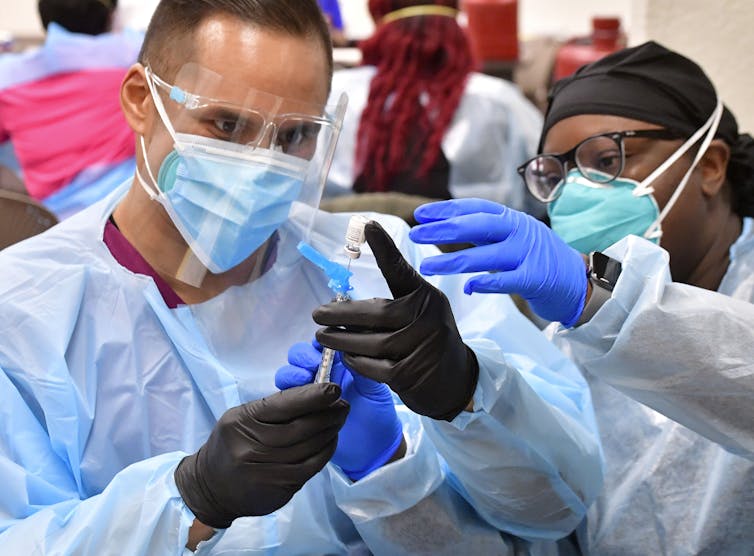
Fixing the faculty shortage
Innovative strategies are needed to address the nursing faculty shortage. The Title VIII Nursing Workforce Reauthorization Act of 2019 was a start. The act provides funding for nursing faculty development, scholarships and loan repayment for nurses, and grants for advanced nursing education, nursing diversity initiatives and other priorities.
The Build Back Better Act that passed the U.S. House of Representatives in November 2021 includes funding to help nursing schools across the country recruit and retain diverse nursing faculty and enroll and retain nursing students. The act is now before the U.S. Senate.
In addition to national strategies, individual states are addressing the shortage at the local level. Maryland, for example, awarded over $29 million in grants to 14 higher education institutions with nursing programs in Maryland to expand and increase the number of qualified nurses.
Finally, offering faculty salaries comparable to those in clinical settings may attract more nurses to use their expertise to train and expand the next generation of health care workers.
Rayna M. Letourneau, Assistant Professor of Nursing, University of South Florida
This article is republished from The Conversation under a Creative Commons license. Read the original article.