 How to resolve AdBlock issue?
News
For the first time in history, a spacecraft has touched the Sun. NASA’s Parker Solar Probe has now flown through the Sun’s upper atmosphere — the corona — and sampled particles and magnetic fields there. Credits: NASA's Goddard Space Flight Center/Joy Ng.
For the first time in history, a spacecraft has touched the Sun.
NASA’s Parker Solar Probe has now flown through the Sun’s upper atmosphere — the corona — and sampled particles and magnetic fields there.
The new milestone marks one major step for Parker Solar Probe and one giant leap for solar science. Just as landing on the Moon allowed scientists to understand how it was formed, touching the very stuff the Sun is made of will help scientists uncover critical information about our closest star and its influence on the solar system.
"Parker Solar Probe ‘touching the Sun’ is a monumental moment for solar science and a truly remarkable feat," said Thomas Zurbuchen, the associate administrator for the Science Mission Directorate at NASA Headquarters in Washington. "Not only does this milestone provide us with deeper insights into our Sun's evolution and its impacts on our solar system, but everything we learn about our own star also teaches us more about stars in the rest of the universe.”
As it circles closer to the solar surface, Parker is making new discoveries that other spacecraft were too far away to see, including from within the solar wind — the flow of particles from the Sun that can influence us at Earth. In 2019, Parker discovered that magnetic zigzag structures in the solar wind, called switchbacks, are plentiful close to the Sun. But how and where they form remained a mystery. Halving the distance to the Sun since then, Parker Solar Probe has now passed close enough to identify one place where they originate: the solar surface.
The first passage through the corona — and the promise of more flybys to come — will continue to provide data on phenomena that are impossible to study from afar.
“Flying so close to the Sun, Parker Solar Probe now senses conditions in the magnetically dominated layer of the solar atmosphere — the corona — that we never could before,” said Nour Raouafi, the Parker project scientist at the Johns Hopkins Applied Physics Laboratory in Laurel, Maryland. “We see evidence of being in the corona in magnetic field data, solar wind data, and visually in images. We can actually see the spacecraft flying through coronal structures that can be observed during a total solar eclipse.”
Closer than ever before
Parker Solar Probe launched in 2018 to explore the mysteries of the Sun by traveling closer to it than any spacecraft before. Three years after launch and decades after first conception, Parker has finally arrived.
Unlike Earth, the Sun doesn’t have a solid surface. But it does have a superheated atmosphere, made of solar material bound to the Sun by gravity and magnetic forces. As rising heat and pressure push that material away from the Sun, it reaches a point where gravity and magnetic fields are too weak to contain it.
That point, known as the Alfvén critical surface, marks the end of the solar atmosphere and beginning of the solar wind. Solar material with the energy to make it across that boundary becomes the solar wind, which drags the magnetic field of the Sun with it as it races across the solar system, to Earth and beyond.
Importantly, beyond the Alfvén critical surface, the solar wind moves so fast that waves within the wind cannot ever travel fast enough to make it back to the Sun — severing their connection.
Until now, researchers were unsure exactly where the Alfvén critical surface lay. Based on remote images of the corona, estimates had put it somewhere between 10 to 20 solar radii from the surface of the Sun — 4.3 to 8.6 million miles.
Parker’s spiral trajectory brings it slowly closer to the Sun and during the last few passes, the spacecraft was consistently below 20 solar radii (91 percent of Earth’s distance from the Sun), putting it in the position to cross the boundary — if the estimates were correct.
On April 28, 2021, during its eighth flyby of the Sun, Parker Solar Probe encountered the specific magnetic and particle conditions at 18.8 solar radii (around 8.1 million miles) above the solar surface that told scientists it had crossed the Alfvén critical surface for the first time and finally entered the solar atmosphere.
“We were fully expecting that, sooner or later, we would encounter the corona for at least a short duration of time,” said Justin Kasper, lead author on a new paper about the milestone published in Physical Review Letters, and deputy chief technology officer at BWX Technologies, Inc. and University of Michigan professor. “But it is very exciting that we’ve already reached it.”

Into the eye of the storm
During the flyby, Parker Solar Probe passed into and out of the corona several times. This is proved what some had predicted — that the Alfvén critical surface isn’t shaped like a smooth ball. Rather, it has spikes and valleys that wrinkle the surface.
Discovering where these protrusions line up with solar activity coming from the surface can help scientists learn how events on the Sun affect the atmosphere and solar wind.
Six panels of images taken from inside a coronal streamer. They appear grayish with white streaks showing particles in the solar wind.
At one point, as Parker Solar Probe dipped to just beneath 15 solar radii (around 6.5 million miles) from the Sun’s surface, it transited a feature in the corona called a pseudostreamer. Pseudostreamers are massive structures that rise above the Sun’s surface and can be seen from Earth during solar eclipses.
Passing through the pseudostreamer was like flying into the eye of a storm. Inside the pseudostreamer, the conditions quieted, particles slowed, and number of switchbacks dropped — a dramatic change from the busy barrage of particles the spacecraft usually encounters in the solar wind.
For the first time, the spacecraft found itself in a region where the magnetic fields were strong enough to dominate the movement of particles there. These conditions were the definitive proof the spacecraft had passed the Alfvén critical surface and entered the solar atmosphere where magnetic fields shape the movement of everything in the region.
The first passage through the corona, which lasted only a few hours, is one of many planned for the mission. Parker will continue to spiral closer to the Sun, eventually reaching as close as 8.86 solar radii (3.83 million miles) from the surface. Upcoming flybys, the next of which is happening in January 2022, will likely bring Parker Solar Probe through the corona again.
“I’m excited to see what Parker finds as it repeatedly passes through the corona in the years to come,” said Nicola Fox, division director for the Heliophysics Division at NASA Headquarters. “The opportunity for new discoveries is boundless.”
The size of the corona is also driven by solar activity. As the Sun’s 11-year activity cycle — the solar cycle — ramps up, the outer edge of the corona will expand, giving Parker Solar Probe a greater chance of being inside the corona for longer periods of time.
“It is a really important region to get into because we think all sorts of physics potentially turn on,” Kasper said. “And now we're getting into that region and hopefully going to start seeing some of these physics and behaviors.”
Narrowing down switchback origins
Even before the first trips through the corona, some surprising physics was already surfacing. On recent solar encounters, Parker Solar Probe collected data pinpointing the origin of zig-zag-shaped structures in the solar wind, called switchbacks. The data showed one spot that switchbacks originate is at the visible surface of the Sun — the photosphere.
By the time it reaches Earth, 93 million miles away, the solar wind is an unrelenting headwind of particles and magnetic fields.
But as it escapes the Sun, the solar wind is structured and patchy. In the mid-1990s, the NASA-European Space Agency mission Ulysses flew over the Sun’s poles and discovered a handful of bizarre S-shaped kinks in the solar wind’s magnetic field lines, which detoured charged particles on a zigzag path as they escaped the Sun.
For decades, scientists thought these occasional switchbacks were oddities confined to the Sun’s polar regions.
In 2019, at 34 solar radii from the Sun, Parker discovered that switchbacks were not rare, but common in the solar wind. This renewed interest in the features and raised new questions: Where were they coming from? Were they forged at the surface of the Sun, or shaped by some process kinking magnetic fields in the solar atmosphere?
The new findings, in press at the Astrophysical Journal, finally confirm one origin point is near the solar surface.
The clues came as Parker orbited closer to the Sun on its sixth flyby, less than 25 solar radii out. Data showed switchbacks occur in patches and have a higher percentage of helium — known to come from the photosphere — than other elements. The switchbacks’ origins were further narrowed when the scientists found the patches aligned with magnetic funnels that emerge from the photosphere between convection cell structures called supergranules.
In addition to being the birthplace of switchbacks, the scientists think the magnetic funnels might be where one component of the solar wind originates. The solar wind comes in two different varieties — fast and slow — and the funnels could be where some particles in the fast solar wind come from.
“The structure of the regions with switchbacks matches up with a small magnetic funnel structure at the base of the corona,” said Stuart Bale, professor at the University of California, Berkeley, and lead author on the new switchbacks paper. “This is what we expect from some theories, and this pinpoints a source for the solar wind itself.”
Understanding where and how the components of the fast solar wind emerge, and if they’re linked to switchbacks, could help scientists answer a long-standing solar mystery: how the corona is heated to millions of degrees, far hotter than the solar surface below.
While the new findings locate where switchbacks are made, the scientists can’t yet confirm how they’re formed. One theory suggests they might be created by waves of plasma that roll through the region like ocean surf. Another contends they’re made by an explosive process known as magnetic reconnection, which is thought to occur at the boundaries where the magnetic funnels come together.
“My instinct is, as we go deeper into the mission and lower and closer to the Sun, we're going to learn more about how magnetic funnels are connected to the switchbacks,” Bale said. “And hopefully resolve the question of what process makes them.”
Now that researchers know what to look for, Parker’s closer passes may reveal even more clues about switchbacks and other solar phenomena. The data to come will allow scientists a glimpse into a region that’s critical for superheating the corona and pushing the solar wind to supersonic speeds.
Such measurements from the corona will be critical for understanding and forecasting extreme space weather events that can disrupt telecommunications and damage satellites around Earth.
“It’s really exciting to see our advanced technologies succeed in taking Parker Solar Probe closer to the Sun than we’ve ever been, and to be able to return such amazing science,” said Joseph Smith, Parker program executive at NASA Headquarters. "We look forward to seeing what else the mission discovers as it ventures even closer in the coming years."
Parker Solar Probe is part of NASA’s Living with a Star program to explore aspects of the Sun-Earth system that directly affect life and society.
The Living with a Star program is managed by the agency’s Goddard Space Flight Center in Greenbelt, Maryland, for NASA’s Science Mission Directorate in Washington.
The Johns Hopkins University Applied Physics Laboratory in Laurel, Maryland, manages the Parker Solar Probe mission for NASA and designed, built, and operates the spacecraft.
Mara Johnson-Groh works for NASA’s Goddard Space Flight Center in Greenbelt, Maryland.

In a meeting that ran just under 30 minutes, the council unanimously supported the separate sale and purchase proposals, which address the city’s goals of increasing its housing stock and pursuing the construction of a major shopping center that will front Highway 53.
The property sale involves 29 acres at 2890 Old Highway 53, which is owned by the former successor agency to the city’s former redevelopment agency.
City Manager Alan Flora was not sure of exactly when the agency took over the property, explaining that a developer who had planned a subdivision on the land — for which a tentative map had been adopted — lost the property when the project fell apart as a result of the Great Recession. The redevelopment agency bought it shortly afterward.
Last year, the council accepted a proposal from TJG/Summitt Development for a subdivision there, but the company notified the city in May that it wasn’t moving forward with the project.
Flora said the city was required by state law to notice and list the property as surplus to public agencies and through the California Department of Housing and Community Development’s database for affordable housing development.
Over the summer, four developers came forward and two provided proposals, including Danco Communities, which has another project in the city.
Danco is planning to build an 84-unit mixed income multifamily housing project on a five-acre parcel at 14795 Burns Valley Road. That project is expected to be built in 2022, Flora said.
The land where that project is being built is a portion of a 31-acre property the city purchased last December. The other 26 acres will include a new city sports complex and corporation yard.
As proposed, the new project on Old Highway 53 would be consistent with the previous one, which Flora said calls for 22 lots, each 1.25 acres in size.
The proposed sale price is $100,000, with a $5,000 deposit, after which Flora said escrow would be opened. Escrow will close after the tentative map is recorded.
Danco Communities President Chris Dart, who attended the meeting via Zoom, said the company plans to build the subdivision as previously intended, on the 51,000 square foot lots.
He said the homes will be 2,000- to 3,000-square-foot ranch style homes.
The project is similar to one they are now building in Humboldt County on one-acre lots, Dart said.
The city received two emails from a family living nearby who didn’t want the subdivision built because it would impact the quiet neighborhood and country atmosphere. They said they would have loved to have the opportunity to purchase the property to build stables there.
In response to questions submitted during the meeting by Lake County News regarding the time to develop the site, Flora said they have some “generous” time frames in the sale agreement.
Flora said development of the subdivision project should begin at some point next year as the apartment complex is being built on Burns Valley Road.
“This is the most difficult type of housing to develop either in Clearlake or Lake County,” Flora said, adding he isn’t aware of a similar project under development anywhere else in Lake County.
Regarding the comments about the sale prices from the neighbors, Flora said the market value in normal situations for such a property is significantly above $100,000. The reason it’s been offered to the developer at that price is to encourage its development for housing of this type.
He said the taxpayers have invested in purchasing this property. “Letting it sit as green space is probably not really an option, at least from my perspective,” Flora said, noting housing development is badly needed.
Dart said they are going to work on the entitlements on the property right away, and that could take six to 12 months.
He said they are going to build the subdivision out while they are under construction with the affordable housing project. That’s a way to make it work, to already be under construction on another project, as there are efficiencies.
Flora said the county’s redevelopment oversight board will have to approve the sale. He hopes to schedule a meeting of that board in January, noting it’s been OK with similar deals previously.
Mayor Dirk Slooten said the city sorely lacks market rate housing and he’s excited about the project.
It’s a place where nurses and schoolteachers will be able to live. “We don’t have that in this town,” Slooten said.
Vice Mayor Russ Perdock and Councilman Russ Cremer agreed.
Cremer said the property has been subdivided for a number of years and waiting for the right moment.
He said he was thrilled Danco is stepping in to do the project.
Cremer then moved to approve the sale agreement with Danco Communities, which Perdock seconded. The council approved the agreement 4-0; Councilwoman Joyce Overton was absent.
Property purchase to facilitate intersection construction
The council then moved on to discuss Flora’s request to approve the agreement with Edwin Jinks to purchase from him properties at 6461 Manzanita Ave. and 6452 Francisco Ave. for $550,000.
The properties, each of which has a large self-storage building on it, together total just under half an acre, according to county property records.
They are located just to the west of the Highway 53 and 18th Avenue intersection, on the edge of the city-owned property that previously was the Pearce Field airport.
The parcels the city is purchasing from Jinks will be added to a 40-acre area along Highway 53 where the city is conducting strategic master planning for a commercial and retail development.
Flora explained that the city has been working on a lot of things related to the airport retail development. That includes intersection and road design in order to extend 18th Avenue from Highway 53 west to Old Highway 53.
“In order to have a safe and attractive intersection there, there’s a need to construct the road through one of these parcels,” he said.
The city had been in talks with Jinks for some time and reached agreement on the $550,000 sale price, Flora said.
Flora asked for the council’s approval to give him the authority to sign the agreement.
He said the sale should close between 45 and 60 days.
Once Jinks’ personal property is removed, Flora said they can start work on the road project.
There was no public comment before Cremer moved to approve the agreement, which was seconded by Councilman David Claffey. The council approved the agreement 4-0.
Email Elizabeth Larson at
Bonta said the work will help Californians who have such convictions to promptly obtain the relief they are entitled to under the law, namely, AB 1793, of which he was lead author.
Before July 2019, the California Department of Justice identified and provided county prosecuting agencies with a list of Californians that might have convictions eligible to be reduced or removed under AB 1793, Bonta’s office reported.
However, to date, Bonta’s office said there are still past convictions in the state's database that are potentially eligible for resentencing.
“Since this law went into effect, tens of thousands of Californians have been able to turn the page and make a fresh start — but unfortunately there are still some who are waiting for relief. I urge counties to prioritize processing their records so that these Californians can finally get the relief they deserve. My team is available as a resource, and we won't stop working until every Californian eligible for relief under AB 1793 is experiencing the law’s intended benefits,” Bonta said.
In 2016, California voters passed Proposition 64, legalizing the possession, cultivation and sale of cannabis by adults 21 years and older.
At the same time, Proposition 64 allowed individuals convicted of the possession, cultivation or sale of cannabis to petition, as appropriate, for resentencing.
Bonta, then a member of the Assembly, wrote AB 1793 to streamline the process, requiring the Department of Justice to review records in the state summary criminal history information database and to identify past convictions potentially eligible for recall or dismissal of sentence, dismissal and sealing, or re-designation.
If there is no challenge to the resentencing, Bonta’s office said courts are required to automatically reduce or dismiss the conviction and to notify the Department of Justice to update the state summary criminal history information database to reflect the resentencing.
Krones told Lake County News that the law required the Department of Justice to compile a list of marijuana convictions for each county.
She had until July 1, 2020, to review them all and decide if she was going to challenge the reduction or dismissal of any of the convictions.
“I did not oppose any of the cases to be reduced or dismissed,” she said.
Krones received assistance in organizing the information about the cases from Code for America, whose projects include criminal record clearance and expungement.
The nonprofit helps write computer programs to assist in analyzing data in a format that can be easier to understand. Krones said they used the information provided by the Department of Justice.
She sent 550 cases to the courts to be reduced or resentenced by the July 2020 deadline.
“The courts now have the list of cases that should be reduced or dismissed and will need to do the next steps to take action on them,” Krones said.
Bonta’s bulletin to county agencies can be read here.
Email Elizabeth Larson at
The City of Clearlake Animal Association also is seeking fosters for the animals waiting to be adopted.
Call the Clearlake Animal Control shelter at 707-273-9440, or email
Visit Clearlake Animal Control on Facebook or on the city’s website.
The newest dogs are listed at the top of the following list.

‘Gingy’
“Gingy’ is a female terrier mix with a tan and white coat.
She is dog No. 49228146.

‘Priscilla’
“Priscilla” is a female Brittany spaniel mix with a white and copper coat.
She is dog No. 49089138.

‘Bear No. 2’
“Bear No. 2” is a male American pit bull mix with a short tan coat.
He has been neutered.
He is dog No. 48731556.

‘Andy’
“Andy” is a male American pit bull mix with a short gray and white coat.
He is dog No. 48995415.

‘Arnold’
“Arnold” is a male American Staffordshire terrier mix with a short brindle coat with white markings.
He is dog No. 49029348.

‘Bear’
“Bear” is a male Labrador retriever-American pit bull mix with a short charcoal and fawn coat.
He has been neutered.
He is dog No. 48443153.

‘Bella’
“Bella” is a female American pit bull mix with a short gray brindle coat.
She has been spayed.
She is dog No. 48448381.

‘Levi’
“Levi” is a male golden retriever-Labrador retriever mix.
He has a short golden coat.
He is dog No. 48975687.

‘Maria’
“Maria” is a female Shar-Pei mix with a short tan coat.
She is dog No. 49047315.

‘Mitzi’
“Mitzi” is a female Australian cattle dog mix with a medium-length black and white coat.
She has been spayed.
She is dog No. 48443306.

‘Nala’
“Nala” is a 1-year-old female German shepherd mix.
She has a medium-length black and tan coat.
She is dog No. 48289638.

‘Sassy’
“Sassy” is a female American pit bull mix with a short black coat.
She has been spayed.
She is dog No. 48443128.

‘Snowball’
“Snowball” is a male American Staffordshire mix terrier with a white coat.
He is dog No. 49159168.

‘Tanisha’
“Tanisha” is a female Australian cattle dog mix with a short red and white coat.
She has been spayed.
She is dog No. 48443302.

‘Terry’
“Terry” is a male shepherd mix with a short brindle coat.
He is dog No. 48443693.

‘Turk’
“Turk” is a male chocolate Labrador retriever mix.
He is dog No. 48911836.

‘Willie’
“Willie” is a male Chihuahua mix with a short black coat and white markings.
He is dog No. 49141640.
Email Elizabeth Larson at
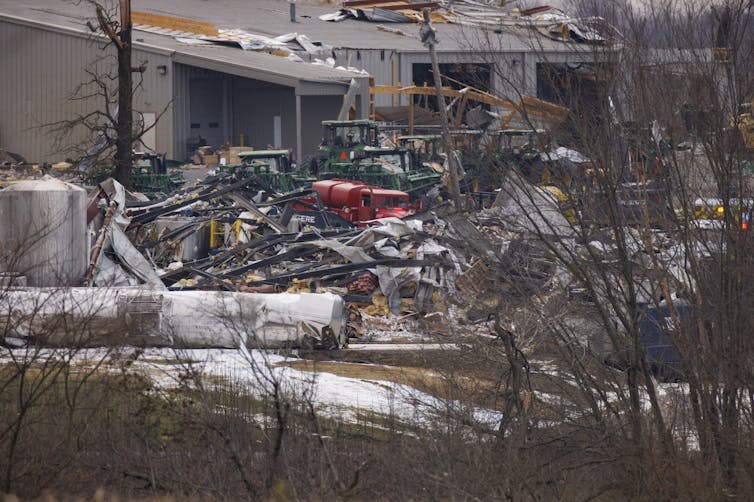
Communities across the U.S. Southeast and Midwest will be assessing damage from the deadly and widespread tornado outbreak on Dec. 10-11, 2021 for some time. But it’s clear that the cleanups will take months, and possibly years.
Dealing with enormous quantities of debris and waste materials is one of the most significant challenges for communities in the wake of natural disasters. Often this task overwhelms local waste managers, leaving waste untouched for weeks, months or even years.
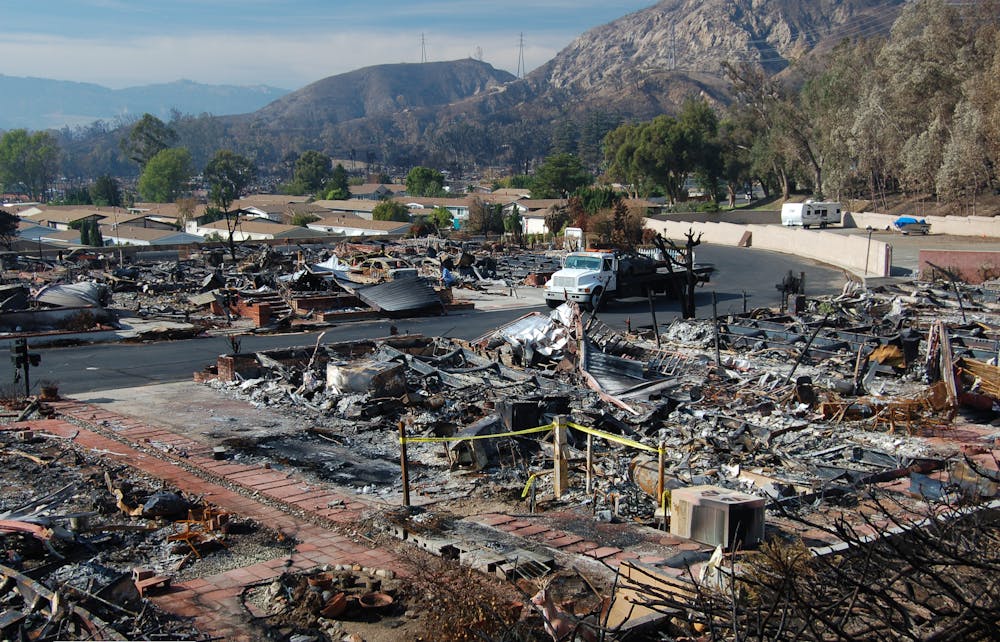
The most destructive and costliest wildfire in California’s history, the Camp Fire, killed 85 people and destroyed nearly 19,000 structures in November 2018. A year later, crews were still collecting and carrying away piles of wood, metals, appliances, contaminated soil, toxic household chemicals, and other debris and waste totaling more than 3.2 million metric tons – roughly the weight of 2 million cars.
Hurricane Michael, which hit Florida in October 2018, left about 13 million cubic meters of debris. To visualize what that looks like, picture a pile of 13 million boxes, each the size of a washer and dryer. More than a year later, crews were still removing the waste.
As researchers who study urban engineering, disaster management and planning, and waste management, we see this as a critical and under-studied problem. Disasters will continue to happen and the losses they cause will continue to grow as a result of climate change, population growth, urbanization, deforestation and aging infrastructures. Societies urgently need better strategies for dealing with the wastes these events leave behind.
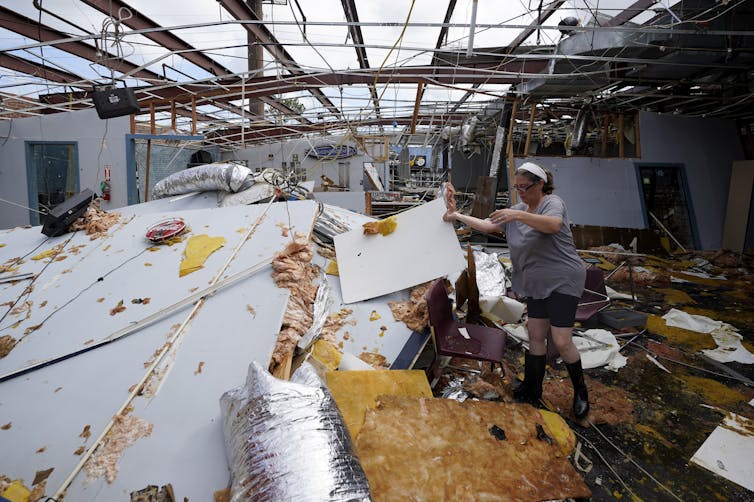
Trails of wreckage
Climate-related disasters like floods, landslides, storms, wildfires, and extreme hot and cold waves afflict millions of people around the world. These events have been increasing over time, particularly over the past several decades, and so have the losses they cause.
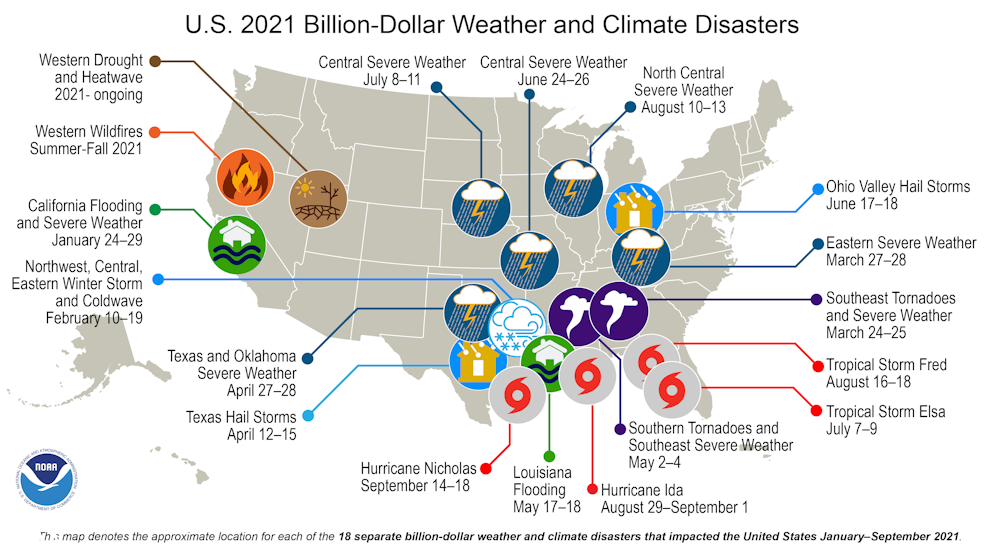
In 2020, the U.S. experienced a record-setting 22 natural disasters that each caused at least a billion dollars in damages. For 2021, the count stood at 18 such events through early October. The mid-December tornado outbreak doubtlessly will add to it.
Disasters commonly produce thousands to millions of tons of debris in a single event. For example, waste from hurricanes includes vegetation, such as trees and shrubs; municipal solid waste, such as household garbage; construction and demolition materials; vehicles; and household hazardous materials, including paints, cleaning agents, pesticides and pool chemicals.
Debris from wildfires largely consists of ash, contaminated soils, metal and concrete, along with other structural debris and household hazardous items such as paints, cleaners, solvents, oils, batteries, herbicides and pesticides.
Dangerous and in the way
Debris collection and cleanup following a disaster is a slow, expensive and dangerous process. First, crews clear out debris from roads used for rescue efforts. They then move the material to temporary storage areas. No one has yet invented a way to easily sort or contain hazardous materials, so they remain mixed into the debris mass. This poses major challenges for reusing and recycling post-disaster waste.
Beyond direct health and safety risks, debris also threatens the environment. It can emit air pollutants and contaminate groundwater, surface waters and soil. Uncollected debris and waste can hamper rescue and recovery efforts and slow down rebuilding efforts.
As an example, when Hurricane Katrina flooded New Orleans in 2005, it left behind an estimated 75 million cubic meters of waste that interfered with and slowed down recovery efforts. The debris included close to 900,000 white goods, such as refrigerators, 350,000 cars and more than 16,000 metric tons of rotten meat. Cleanup costs were estimated at roughly US$4 billion.
Toward reusing disaster waste
At an expert workshop that we organized in 2019, we identified steps for sustainably managing disaster debris and waste. As we see it, the key tasks are to (1) identify what is contained in these wastes; (2) find better approaches to recycling and reuse; (3) design new technologies to identify hazardous components and sort the different types of waste; and (4) develop markets to promote reuse and recycling.
Today public officials and planners know little about the amount and types of materials generated during disasters – what they contain, in what proportions, whether they are large and sortable versus fine and mixed, and how much can be reused or recycled. Developing new technologies and management approaches that can assist debris characterization, reuse and recycling should be a top priority.

For example, drones and autonomous sensing technologies can be combined with artificial intelligence to estimate amounts and quality of debris, the types of materials it contains and how it can be repurposed rapidly. Technologies that allow for fast sorting and separation of mixed materials can also speed up debris management operations.
[ Deep knowledge, daily. Sign up for The Conversation’s newsletter. ]
Turning the problem around, creating new sustainable construction materials – especially in disaster-prone areas – will make it easier to repurpose debris after disasters.
Finally, new business models can help generate demand for and access to waste and recycled products. With proper sorting, some disaster materials can be used to make new products or materials. For example, downed whole trees can become timber resources for furniture makers. Today, opportunities to match materials with markets are wasted – pun intended.
This is an updated version of an article originally published on Dec. 10, 2019.
Sybil Derrible, Associate Professor of Sustainable Infrastructure Systems, University of Illinois at Chicago; Juyeong Choi, Assistant Professor, Florida A&M University-Florida State University College of Engineering, Florida State University, and Nazli Yesiller, Director, Global Waste Research Institute, California Polytechnic State University
This article is republished from The Conversation under a Creative Commons license. Read the original article.
The board considered a proposed resolution with language that was identical to resolutions approved last week by the boards of Lucerne Elementary, Konocti Unified and Lakeport Unified school districts.
The resolutions local districts have been considering and approving are in response to Gov. Gavin Newsom’s October announcement that he would mandate that the COVID-19 vaccine be added to the list of required vaccinations for students to have for in-person instruction and that school employees also would be required to be vaccinated.
The language of the documents all ask the state to recommend, and not require, the COVID-19
vaccine for students and staff.
As of last week, as the first resolutions were being approved in Lake County, the California Department of Public Health told Lake County News that only six districts among 1,037 statewide had requested changes or modifications to the COVID-19 vaccination requirements.
Middletown Superintendent Tim Gill said the resolution promotes local control.
“I totally understand the desire to pass a resolution like this,” said Annette Lee, an educator and new board member appointed earlier this month to fill one of two board vacancies.
However, Lee said she couldn’t accept it as written because she didn’t believe it represented the district’s entire constituency. She also suggested it was a time for everyone to work together, and not take a position to divide the community further.
She offered alternative language that addressed the need for choice. Her revision called for the district to uphold California citizens’ rights to provide informed consent, and for Middletown Unified to petition the state to ensure and maintain the personal belief exemption in any and all upcoming COVID-19 legislation.
Board President Misha Grothe said she didn’t think the original resolution was divisive, adding people who want to vaccinate their children have ample opportunity to do so.
“I don’t understand why we need to support a mandate,” Grothe said, adding she felt people needed to have a choice.
Lee said she was trying to be mindful of getting to the same result while respecting the beliefs of more than one set of the people that the district serves. “We’re not making policy today, we’re making a statement.”
Board member Zoi Bracisco said she felt it was important that parents have a choice to vaccinate their children and she also didn’t support adding Lee’s changes because she didn’t see a difference in the language.
Lee said there are people in the school district who are very much in favor of a mandate — who want teachers and students alike to be vaccinated — and her wording was meant to validate their concerns. It also offered the ability to opt out of vaccinations.
Board member Larry Allen said they had heard a lot about the issue from one side — referring to those who oppose the mandate — and not as much from the other side. If you take one side, you’re ignoring the other half, he added.
Under Newsom’s mandate, the personal belief exemption remains in place. Gill pointed out that if the state Legislature gets involved and adds the COVID-19 vaccine to the list of vaccines required to go to school, there will be no personal belief exemption.
Grothe said several state senators are proposing to mandate it through the Legislature.
During public comment, Charise Reynolds asked Gill if the district had done surveys to ask teachers about the mandate, and to find out if teachers would quit or if parents would pull their children from school if the mandate went through.
Gill said no, although he’s working on a survey on another topic and could look at doing that.
“This feels a little premature to be making this decision at this time,” said Reynolds.
She said it’s hard for some people to come to the meetings, recalling how he was shouted down at a previous meeting when she asked people in the room to mask up. Reynolds added that she wanted them to make sure they are acting in the interests of constituents.
Sharon Huggins, president of the Middletown Teachers Association, said they have surveyed teachers. Some feel strongly about freedom and a small group thinks COVID-19 is ridiculous and they want the board to be brave.
“There is a segment of our teacher population that is just surviving,” she said.
Another segment wants the board to protect them with mandated vaccines and masks, and they would feel abandoned, unsafe and insecure, and it would be one more stressor. Huggins said another group believes that, whatever the board decides, it needs to stick with that decision and enforce it.
“You really do need to make sure you’re representing the entirety of your population,” she said, adding that the teacher population leans more toward the protection of masking and vaccines.
Community member Jennifer Hughes said the resolution was not preventing people from being vaccinated, and she said the government was taking charge of people’s bodies.
Eileen Anderson questioned there being an ongoing public emergency due to Lake County’s low case rates.
She also challenged the vaccine’s efficacy and said the state mandate is unconstitutional.
Allen moved to add Lee’s language to the resolution but the motion failed.
Bracisco then said she wanted more information and moved to table or postpone the discussion. That motion was approved 5-0.
Grothe asked Gill to bring the matter back to the board for further discussion in January.
Kelseyville Unified Superintendent Dave McQueen said his board also will consider its version of the resolution next month.
Upper Lake Unified had its last regular meeting of the year this week and the resolution wasn’t on it. That district so far has not reported if it will consider the matter in January.
Email Elizabeth Larson at