 How to resolve AdBlock issue?
News
Under the proposed regulations, which could be in effect by this summer, insurance companies would be required to factor consumers’ and businesses’ wildfire safety actions into their pricing of residential and commercial coverage.
The new regulations also will provide consumers with transparency about their “wildfire risk score” that insurance companies assign to properties.
These regulations address complaints Commissioner Lara heard from many consumers and businesses across the state that insurance companies are unwilling to account for steps taken to harden their properties and communities against wildfire, lowering their risk of loss and damage.
“With more Californians rolling up their sleeves and reaching into their own pockets to protect their homes and businesses, insurance pricing must reflect their efforts,” said Lara. “Holding insurance companies accountable for accurately rating wildfire risk in the premiums they charge Californians will help save lives and reduce losses. My new regulations will help encourage a competitive insurance market for all by putting safety first and driving down costs for consumers.”
The announced regulations incorporate the new “Safer from Wildfires” framework, a list of achievable, expert-endorsed actions that will help save lives and reduce risk for property owners.
Commissioner Lara unveiled the Safer from Wildfires framework with state emergency leaders on Feb. 14, marking the first time that state agencies have been brought together to identify a common insurance framework of mitigation actions for existing homes and businesses.
By requiring insurance companies to utilize the Safer from Wildfires framework in their pricing for insurance, Commissioner Lara said he is sending a strong signal to consumers about the need to better prepare for extreme wildfires — which will lead to a more competitive market for all California residents and businesses.
Specifically, the regulations will require insurance companies to comply with Proposition 103, passed by voters in 1988 to give the insurance commissioner authority to approve rates set by insurance companies, by incorporating the new framework in “wildfire risk scores” that insurance companies commonly use to rate individual and commercial properties.
In community meetings and town halls that Commissioner Lara held across California before the pandemic and in his virtual investigatory wildfire hearing in October 2020, consumers described taking action to protect their homes — often at the cost of thousands of dollars out of pocket — while many insurance companies simply declined to recognize the value of these actions.
Still other insurance companies assigned opaque wildfire risk scores to increase the price of insurance for a given property.
Consumers rarely know their property’s wildfire risk scores let alone how to improve them, even though these scores are a critical factor in many insurance companies’ decisions about how much to charge for insurance.
These regulations will help Commissioner Lara increase consumer discounts that insurance companies offer for safer homes and businesses, which has been a major focus of his comprehensive strategy to reduce the growing threat of wildfires.
Currently, 17 insurance companies representing 40% of the insurance marketplace have answered Commissioner Lara’s call to offer discounts, up from just 7% of the market when Commissioner Lara took office three years ago, demonstrating expanding options for consumers. View the list of insurance companies currently offering discounts at the Department of Insurance website.
These regulations also increase transparency by providing an opportunity for consumers and businesses to review their property’s risk score or other factors used in pricing for accuracy based on mitigation work they have undertaken. Consumers and businesses will be able to appeal scores or other factors insurance companies use to assess wildfire risk.
Fire chiefs and consumer advocates joined Commissioner Lara in calling for increased wildfire safety efforts.
"By rewarding homeowners and businesses for the wildfire safety actions they take, these regulations will be a huge assist to our efforts to prevent the severe loss of life and property from wildfires like we saw in the devastating Thomas Fire and debris flow that followed," said Montecito Fire Chief Kevin Taylor, who testified at the investigatory hearing the Department of Insurance held in October 2020. "I am glad to see the state supporting local communities like ours with wildfire safety programs like this."
“This is the most significant, concrete step forward on wildfire safety that brings all of the pieces together to help Californians maintain and obtain high quality insurance at a reasonable cost,” said Novato Fire District Chief Bill Tyler, who also testified at the investigatory hearing. “This helps people take back control over their risk by having insurance companies recognize their efforts.”
“Now that experts concur and the Safer from Wildfires framework has been established, we need regulations to ensure that consistent and clear rewards will be in place to incentivize and accomplish wildfire risk reduction at the parcel and community level,” said Amy Bach, United Policyholders’ executive director and architect of the Wildfire Risk Reduction and Asset Protection working group that contributed to the Safer from Wildfires framework. “United Policyholders commends Commissioner Lara for this important progress.”
"California's farmers, ranchers and agriculture communities are very appreciative of Commissioner Lara's work to create an insurance framework we can all use to make our businesses safer from wildfires," said Jamie Johansson, president of the California Farm Bureau Federation. "By pricing insurance to recognize farmers' wildfire safety efforts, these regulations will help drive insurance companies to better support our agriculture sector, which is not only critical to our state but to our entire country."
The Department of Insurance invites the public to testify on the new regulations at a hearing on April 13 or in writing.
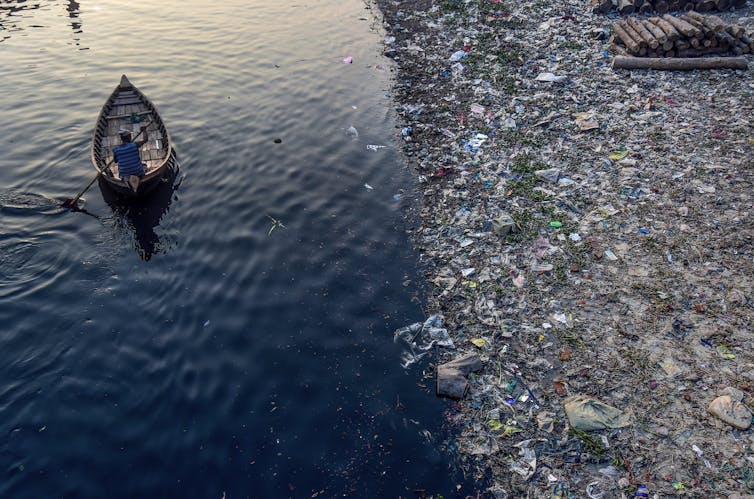
Plastic pollution is accumulating worldwide, on land and in the oceans. According to one widely cited estimate, by 2025, 100 million to 250 million metric tons of plastic waste could enter the ocean each year. Another study commissioned by the World Economic Forum projects that without changes to current practices, there may be more plastic by weight than fish in the ocean by 2050.
On Feb. 28, 2022, a meeting of the United Nations Environment Assembly will open in Nairobi, Kenya. At that meeting, representatives from 193 countries are expected to consider a resolution that would launch negotiations on a legally binding global treaty to reduce plastic pollution. “[N]o country can adequately address the various aspects of this challenge alone,” the draft resolution states.
I am a legal scholar and have studied questions related to food, animal welfare and environmental law. My forthcoming book, “Our Plastic Problem and How to Solve It,” explores legislation and policies to address this global “wicked problem.”
I believe plastic pollution requires a local, national and global response. While acting together on a world scale will be challenging, lessons from some other environmental treaties suggest features that can improve an agreement’s chances of success.
A pervasive problem
Scientists have discovered plastic in some of the most remote parts of the globe, from polar ice to Texas-sized gyres in the middle of the ocean. Plastic can enter the environment from a myriad of sources, ranging from laundry wastewater to illegal dumping, waste incineration and accidental spills.
Plastic never completely degrades. Instead, it breaks down into tiny particles and fibers that are easily ingested by fish, birds and land animals. Larger plastic pieces can transport invasive species and accumulate in freshwater and coastal environments, altering ecosystem functions.
A 2021 report by the National Academies of Sciences, Engineering and Medicine on ocean plastic pollution concluded that “[w]ithout modifications to current practices … plastics will continue to accumulate in the environment, particularly the ocean, with adverse consequences for ecosystems and society.”
National policies are not enough
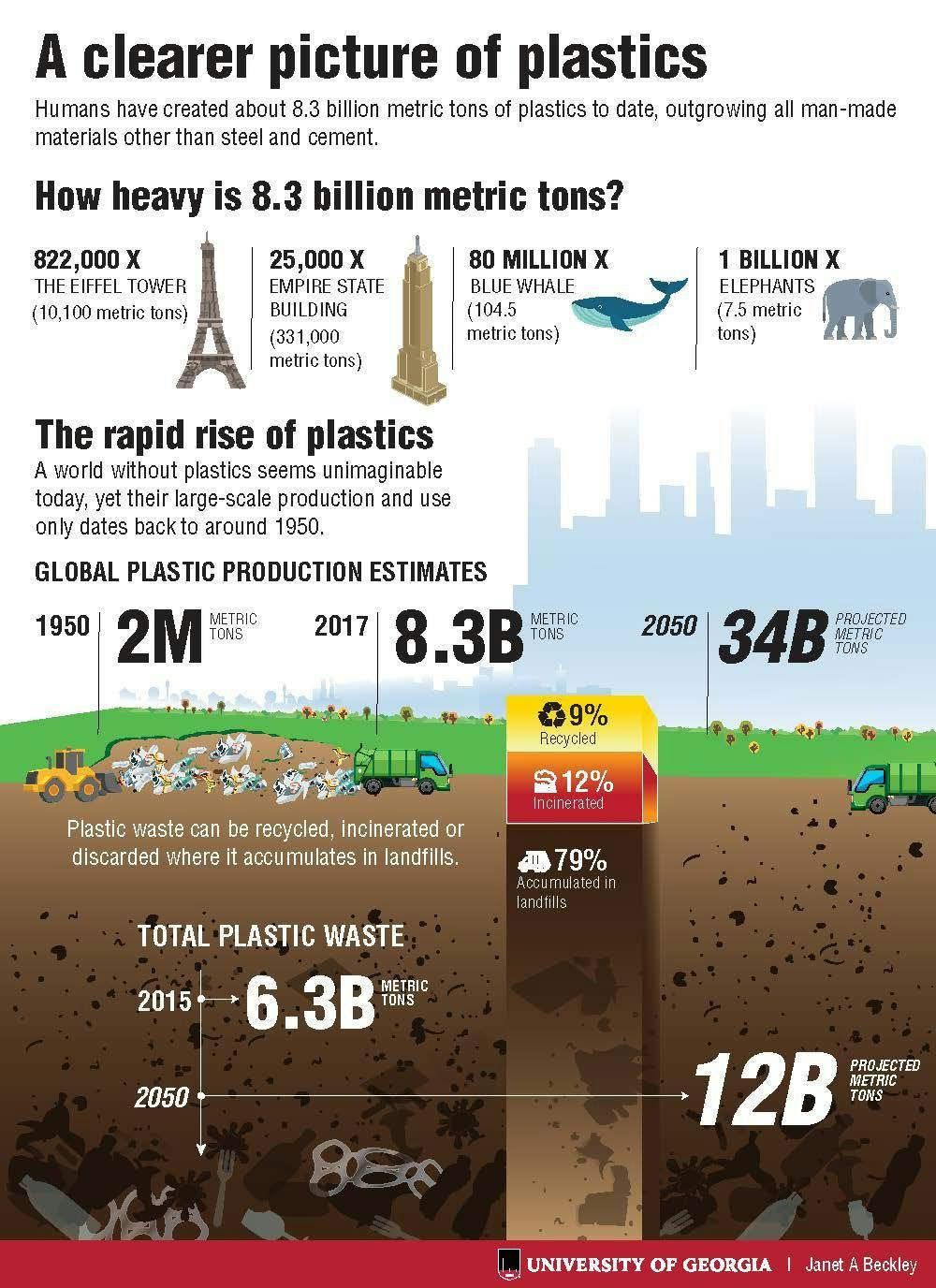
To address this problem, the U.S. has focused on waste management and recycling rather than regulating plastic producers and businesses that use plastic in their products. Failing to address the sources means that policies have limited impact. That’s especially true since the U.S. generates 37.5 million tons of plastic yearly, but only recycles about 9% of it.
Some countries, such as France and Kenya, have banned single-use plastics. Others, like Germany, have mandated plastic bottle deposit schemes. Canada has classified manufactured plastic items as toxic, which gives its national government broad power to regulate them.
In my view, however, these efforts too will fall short if countries producing and using the most plastic do not adopt policies across its life cycle.
Growing consensus
Plastic pollution crosses boundaries, so countries need to work together to curb it. But existing treaties such as the 1989 Basel Convention, which governs international shipment of hazardous wastes, and the 1982 U.N. Convention on the Law of the Sea offer little leverage, for several reasons.
First, these treaties were not designed specifically to address plastic. Second, the largest plastic polluters – notably, the U.S. – have not joined these agreements. Alternative international approaches such as the Ocean Plastics Charter, which encourages governments and global and regional businesses to design plastic products for reuse and recycling, are voluntary and nonbinding.
Fortunately, many world and business leaders now support a uniform, standardized and coordinated global approach to managing and eliminating plastic waste in the form of a treaty.
The American Chemistry Council, an industry trade group, supports an agreement that will accelerate a transition to a more circular economy that promotes waste reduction and reuse by focusing on waste collection, product design and recycling technology. America’s Plastic Makers and the International Council of Chemical Associations have also made public statements supporting a global agreement to establish “a targeted goal to ensure access to proper waste management and eliminate leakage of plastic into the ocean.”
However, these organizations maintain that plastic products can help reduce energy use and greenhouse gas emissions – for example, by enabling automakers to build lighter cars – and are likely to oppose an agreement that limits plastic production. As I see it, this makes leadership and action by governments critical.
The Biden administration also has stated its support for a treaty and is sending Secretary of State Antony Blinken to the Nairobi meeting. On Feb. 11, 2022, the White House released a joint statement with France that expressed support for negotiating “a global agreement to address the full life cycle of plastics and promote a circular economy.”
Early treaty drafts outline two competing approaches. One seeks to reduce plastic throughout its life cycle, from production to disposal, a strategy that would probably include methods such as banning or phasing out single-use plastic products.
A contrasting approach focuses on eliminating plastic waste through innovation and design – for example, by spending more on waste collection, recycling and development of environmentally benign plastics.
Elements of an effective treaty
Countries have come together to solve environmental problems before. The global community has successfully addressed acid rain, stratospheric ozone depletion and mercury contamination through international treaties. These agreements, which include the U.S., offer strategies for a plastics treaty.
The Montreal Protocol, for example, required countries to report their production and consumption of ozone-depleting substances so that countries could hold each other accountable. As part of the Convention on Long-range Air Pollution, countries agreed to reduce sulfur dioxide emissions, but were allowed to select the method that worked best for them. For the U.S., that involved a system of buying and selling emission allowances that became part of the Clean Air Act Amendments of 1990.
Based on these precedents, I see plastic as a good candidate for an international treaty. Like ozone, sulfur and mercury, plastic comes from specific, identifiable human activities that occur across the globe. Many countries contribute, so the problem is transboundary in nature.
In addition to providing a framework for keeping plastic out of the ocean, I believe a plastic pollution treaty should include reduction targets for both producing less plastic and generating less waste that are specific, measurable and achievable. The treaty should be binding but flexible, allowing countries to meet these targets as they choose.
In my view, negotiations should consider the interests of those who experience the disproportionate impacts of plastic, as well as those who make a living off recycling waste as part of the informal economy. Finally, an international treaty should promote collaboration and sharing of data, resources and best practices.
Since plastic pollution doesn’t stay in one place, all nations will benefit from finding ways to curb it.
[Over 140,000 readers rely on The Conversation’s newsletters to understand the world. Sign up today.]
Sarah J. Morath, Associate Professor of Legal Writing, Wake Forest University
This article is republished from The Conversation under a Creative Commons license. Read the original article.
A spectacular head-on collision between two galaxies fueled the unusual triangular-shaped star-birthing frenzy, as captured in a new image from NASA’s Hubble Space Telescope.
The interacting galaxy duo is collectively called Arp 143. The pair contains the glittery, distorted, star-forming spiral galaxy NGC 2445 at right, along with its less flashy companion, NGC 2444 at left.
Astronomers suggest that the galaxies passed through each other, igniting the uniquely shaped star-formation firestorm in NGC 2445, where thousands of stars are bursting to life on the right-hand side of the image.
This galaxy is awash in starbirth because it is rich in gas, the fuel that makes stars. However, it hasn’t yet escaped the gravitational clutches of its partner NGC 2444, shown on the left side of the image. The pair is waging a cosmic tug-of-war, which NGC 2444 appears to be winning. The galaxy has pulled gas from NGC 2445, forming the oddball triangle of newly minted stars.
“Simulations show that head-on collisions between two galaxies is one way of making rings of new stars,” said astronomer Julianne Dalcanton of the Flatiron Institute’s Center for Computational Astrophysics in New York and the University of Washington in Seattle.
“Therefore, rings of star formation are not uncommon. However, what’s weird about this system is that it’s a triangle of star formation. Part of the reason for that shape is that these galaxies are still so close to each other and NGC 2444 is still holding on to the other galaxy gravitationally. NGC 2444 may also have an invisible hot halo of gas that could help to pull NGC 2445’s gas away from its nucleus. So they’re not completely free of each other yet, and their unusual interaction is distorting the ring into this triangle,” said Dalcanton.
NGC 2444 is also responsible for yanking taffy-like strands of gas from its partner, stoking the streamers of young, blue stars that appear to form a bridge between the two galaxies.
These streamers are among the first in what appears to be a wave of star formation that started on NGC 2445’s outskirts and continued inward. Researchers estimate the streamer stars were born between about 50 million and 100 million years ago. But these infant stars are being left behind as NGC 2445 continues to pull slowly away from NGC 2444.
Stars no older than 1 million to 2 million years are forming closer to the center of NGC 2445. Hubble’s keen sharpness reveals some individual stars. They are the brightest and most massive in the galaxy. Most of the brilliant blue clumps are groupings of stars. The pink blobs are giant, young, star clusters still enshrouded in dust and gas.
Although most of the action is happening in NGC 2445, it doesn’t mean the other half of the interacting pair has escaped unscathed. The gravitational tussle has stretched NGC 2444 into an odd shape. The galaxy contains old stars and no new starbirth because it lost its gas long ago, well before this galactic encounter.
“This is a nearby example of the kinds of interactions that happened long ago. It’s a fantastic sandbox to understand star formation and interacting galaxies,” said Elena Sabbi of the Space Telescope Science Institute in Baltimore, Maryland.
The Hubble Space Telescope is a project of international cooperation between NASA and ESA (European Space Agency). NASA’s Goddard Space Flight Center in Greenbelt, Maryland, manages the telescope. The Space Telescope Science Institute (STScI) in Baltimore, Maryland, conducts Hubble science operations. STScI is operated for NASA by the Association of Universities for Research in Astronomy in Washington, D.C.
Donna Weaver works for the Space Telescope Science Institute.
Zarina Otchkova’s We Grow LLC’s project proposed a nine-acre grow, processing and distribution operation on a 309-acre property located at 16750 Herrington Road, 17610 Sandy Road and 19678 Stinson Road in Middletown.
The proposal included 34 greenhouses, four drying buildings, a shed, 20 water tanks and privacy fencing.
The previous version of the project was approved by the commission in April of last year but concerned neighbors appealed that decision within the prescribed seven-day appeal period.
In June 2021, the Board of Supervisors heard the appeal and upheld it, citing a faulty environmental document.
However, the board’s vote for the appeal was done without prejudice, allowing the project to be resubmitted, which it was later last year.
On Thursday, Community Development Department staff told the commission that they were recommending denying the project, which the applicant’s attorney and consultant indicated was an abrupt change that caught them off guard when they found out about it earlier this month.
Associate Planner Eric Porter said planning staff put the project through another evaluation under the California Environmental Quality Act, or CEQA.
Porter said CEQA is fairly specific in terms of when a project rises to the level of “significant”and requires an environmental impact report, or EIR. A “significant” finding is whenever there are impacts that cannot be adequately mitigated, he said.
In this case, one of the key issues was the proposed removal of 130 mature blue oak trees, which would have to be replaced at a three-to-one ratio, with the tree restoration to take place over a period of up to 40 years.
Porter questioned if those trees’ removal could be mitigated, concluding that it’s unknown but “highly unlikely,” and that the project’s tree removal and replacement plan was not sufficient.
Porter said the tree removal goes beyond the trees itself, and affects the earth, results in erosion and has water impacts which haven’t been evaluated for the difference in demand between mature trees and saplings. He added that the water issue is an unknown.
Commissioner John Hess said it would be years before replacement trees are mature and able to provide what the original trees do. Porter said that’s what concerned groups like the Redbud Audubon Society.
“You’re right. The impacts are pretty obvious and pretty significant,” Porter said to Hess.
He also referred to extensive public comment against the project, with the county receiving close to 150 such comments. Recurring themes in those comments included traffic, security, safety, conflicting land use, water, habitat and odor, among others.
Porter added that an appeal, no matter what decision the commission made, was likely.
Due to the unmitigated impacts, Porter said staff recommended denying the use permit application.
Deputy County Counsel Nicole Johnson read over the mitigated negative declaration and EIR requirements, noting that a mitigated negative declaration can’t go forward if impacts aren’t mitigated.
Otchkova’s attorney, Andrew Azarmi of the Dentons law firm in San Francisco, urged the commission to approve the permit, noting that Otchkova had jumped through each and every hoop asked for by Community Development.
He said the project hadn’t changed one bit in terms of scope and content and yet had taken nearly a year to get back on the agenda.
A few weeks ago, without any consultation or advanced warning, Community Development did “a stunning about face” by informing them that they were recommending the denial. Azarmi said a year ago the commission had unanimously approved the project.
“Respectfully, this is unfair treatment,” he said.
Azarmi said he was not aware of any similar project having to undergo an EIR. “That further indicates that the project is being treated arbitrarily, and that’s what the law prohibits.”
If the commission wanted further study, Azarmi asked for it to be added to the initial study rather than ordering an EIR, which would take a year or more and require hundreds of thousands of dollars in additional cost.
Sufyan Hamouda, We Grow’s consultant, said they were notified 17 days beforehand that an EIR would be required. He said they don’t know how the decision changed.
Hamouda said they had done a tree study but can do more study still if required. He added that he didn’t believe an EIR was necessary or fair after the review the project has undergone.
Addressing the fair argument standard for requiring an EIR, Johnson said it must be prepared when it can be fairly argued that a project may have a significant effect on the environment. “This is a low standard.”
She said impacts include direct, indirect and cumulative, and the evidence doesn’t need to be absolute or unequivocal. It’s not necessary to have information to contradict what the applicant has provided to find contrary to the applicant’s preferred outcome.
“Even if staff had presented you with the same recommendations that had come with any other project that included approval, you are not required to make those findings,” she said.
Johnson said the commission is required to consider all of the evidence and make a determination.
Community speaks against the project
During public comment, project neighbor Dan Levine asked the commission to deny it, noting there have been a lot of changes. He said in an earlier iteration, there had been no plan to cut down oak trees. Even with mitigations, it would have a huge impact on the community.
“I think we need to rethink this,” said Glenn Goodman, explaining that the citizens of the county didn’t sign on for how many cannabis projects the county has approved.
Goodman also said it was “optimistic” that the oak trees would grow back in his grandchildren’s lifetimes.
Bart Levenson said the project would impact roads used as evacuation routes and is likely to further degrade those roads with the traffic the project would generate. She said the project is completely inappropriate. “The community is not being considered.”
Newest Planning Commissioner Maile Field said the commission’s membership has changed since it approved Otchkova’s project last year.
Field went on to say she doesn’t think the oak removal is mitigatable.
Hess said he didn’t agree with Azarmi that nothing has changed in the project.
Commissioner Everardo Chavez said he also had concerns about the project, and said the concerns from community members are real.
Field moved to deny adopting the initial study, which the commission voted unanimously to approve.
Hess then moved to deny the resubmitted major use permit due to insufficient review of the project according to the California Environmental Quality Act as it relates to oak tree removal of 130 oak trees and as it relates to treatment of soil erosion and drainage.
The commission also voted unanimously to deny the use permit, with that final vote followed by applause.
There is a seven calendar day appeal for the decision.
In other business on Thursday, the commission approved cannabis projects proposed by North Coast Select Inc. at 1496 Bell Hill Road in Kelseyville; Cristhian Hernandez at 2000 Clover Valley Road in Upper Lake; and Linodhi Inc. at 6690 Wilkinson Road in Kelseyville.
Editor’s note: The wording of the motion Field made to deny the adoption of the initial study has been updated to make the action more clear.
Email Elizabeth Larson at
The City of Clearlake Animal Association also is seeking fosters for the animals waiting to be adopted.
Call the Clearlake Animal Control shelter at 707-273-9440, or email
Visit Clearlake Animal Control on Facebook or on the city’s website.
Adoption and rescue update: On Wednesday, West Columbia Gorge Humane Society made a trip to Clearlake to take a number of the animals at the shelter to find new homes in Washington state.
Those taking a trip up north to find their new families are Edgar, Sonny, Bella, Nala, Jaxx, Rama, Annie and Tippie, two other dogs that hadn’t been taken to the shelter but were surrendered to rescue, a mama cat and five kittens, four other cats, and 10 abandoned puppies.
The following dogs continue to wait for new homes at the shelter.

‘Terry’
“Terry” is a male shepherd mix with a short brindle coat.
He is dog No. 48443693.

‘Snowball’
“Snowball” is a male American Staffordshire mix terrier with a white coat.
He has been neutered.
He is dog No. 49159168.

‘Sassy’
“Sassy” is a female American pit bull mix with a short black coat.
She has been spayed.
She is dog No. 48443128.

‘Priscilla’
“Priscilla” is a female Brittany spaniel mix with a white and copper coat.
She is dog No. 49089138.

‘Isabella’
“Isabella” is a female Chihuahua mix with a short tan coat.
She is dog No. 49292130.

‘Fritz’
“Fritz” is a male Australian shepherd mix with a black and white coat.
He is dog No. 49278179.

‘Ebenezer’
“Ebenezer” is a male American pit bull terrier mix with a short tan and white coat.
He is dog No. 49191651.

‘Claire’
“Claire” is a female border collie mix with a short black and white coat.
She has been spayed.
Claire is dog No. 49397880.

‘Chai’
“Chai” is a female Alaskan husky mix with a gray and white coat.
She has been spayed.
She is dog No. 49279552.

‘Bear No. 2’
“Bear No. 2” is a male American pit bull mix with a short tan coat.
He has been neutered.
He is dog No. 48731556.

‘Bear’
“Bear” is a male Labrador retriever-American pit bull mix with a short charcoal and fawn coat.
He has been neutered.
He is dog No. 48443153.

‘Andy’
“Andy” is a male American pit bull mix with a short gray and white coat.
He is dog No. 48995415.
Email Elizabeth Larson at
“Caltrans is fully committing to a fundamental shift in road safety and is laying the framework for significant reductions in roadway deaths and injuries,” said Caltrans Director Toks Omishakin. “We play an important role in the building and maintaining of the state’s highways. With the numbers of serious injuries and deaths trending the wrong way, now is the time to focus even more on what we can do to save lives and work collaboratively with other stakeholders who play a role in roadway safety.”
California and the rest of the nation are seeing an increase in fatalities and serious injuries on the roadways.
In California, more than 3,600 people die each year in traffic crashes and more than 13,000 people are severely injured.
More than 3,200 people died on the state’s roadways in the first nine months of 2021 — a 17% increase from the previous year.
To address this trend, Caltrans is aligning departmental activities, as appropriate, with the Safe System approach, which identifies several interconnected elements to achieving a vision of zero fatalities and serious injuries — safe road users, safe roads, safe speeds, safe vehicles, and post-crash care.
As part of this policy, Caltrans commits to:
• Prioritizing “safety first” in highway planning, operation, construction and maintenance.
• Focusing on eliminating the most serious crashes, rather than all crashes.
• Eliminating race-, age-, ability- and transportation mode-based disparities in road safety outcomes by addressing historic and current barriers to transportation access and safety.
This policy takes steps to further institutionalize a shift that began in 2020, as state transportation leaders recognized a bolder and more focused approach was necessary to combat the troubling rise in fatalities and serious injuries on California roads.
The state’s 2020-24 Strategic Highway Safety Plan – managed by Caltrans and involving more than 400 stakeholders – was updated to include the Safe System approach.
This policy also aligns with the U.S. Department of Transportation’s National Roadway Safety Strategy released in January, which set the first national goal of zero roadway fatalities and recognizes the Safe System approach as encompassing a range of roadway safety programs and stakeholders.
“The U.S. Department of Transportation has adopted the Safe System Approach that guides our safety actions within the recently announced National Roadway Safety Strategy to address the national crisis in roadway fatalities and serious injuries,” said Deputy Federal Highway Administrator Stephanie Pollack. “We commend Caltrans for adopting this approach and working to bend the curve on roadway fatalities to zero.”
The Safe System approach is based on the following principles:
• Eliminate death and serious injury: While no crashes are desirable, the Safe System approach prioritizes addressing crashes that result in death and serious injuries.
• Humans make mistakes: People on the road will inevitably make mistakes that can lead to crashes. The transportation system is designed and operated to accommodate human mistakes and injury tolerances, and avoid deaths and serious injuries.
• Humans are vulnerable: Crash forces contribute to deaths and serious injuries. Minimizing speeds and impact angles reduces the risk of death and serious injuries.
• Responsibility is shared: All stakeholders, including road users, vehicle manufacturers, policy makers, law enforcement, licensing and education entities, those in road design and maintenance, and others must commit to working together to reduce fatal and serious injury crashes to zero. No one entity can achieve this goal alone, and it will take the coordinated effort of stakeholders working across a variety of disciplines to improve safety outcomes.
• Redundancy is crucial: Reducing risk requires that all parts of the transportation system are strengthened, so that if one element fails, there are still multiple layers of protection.
• Safety is proactive and reactive: Through both proactive and reactive safety efforts such as road safety audits, traffic investigations, road monitoring, flexible design, and others help identify potential areas for safety enhancement to reduce fatal and serious injury crashes.
Caltrans’ adoption of the Safe System approach builds on its ongoing work to improve safety on the state’s transportation system.
In December, Caltrans adopted a new policy for all new transportation projects it funds or oversees to include “complete street” features that provide safe and accessible options for people walking, biking and taking transit.
For more information about Caltrans’ new safety guidelines, visit its Safety Program webpage.