How to resolve AdBlock issue?
News
The city of Lakeport was notified last week that the U.S. Department of Agriculture approved the exemption for the 48-unit Martin Street Apartments, phase two, at 1255 Martin St.
Lakeport Community Development Director Jenni Byers said the apartment complex received its certificates of occupancy at the end of July.
The developer, Lakeport Family Associates LLC, had received agriculture housing credits which required that the housing be made available to farm laborers. However, Byers said those limitations resulted in only two of the units being rented.
In August, the month after the apartment complex was approved for occupancy, the Cache fire destroyed dozens of homes in Clearlake.
Byers said Lakeport city staff reached out to the developers to see if the housing could be made available to those victims. However, because they received tax credits, they were limited to only renting the units to agriculture industry workers.
She said the developer began the process of reaching out to USDA to see if they could get a waiver that allowed them to not limit the individuals they could rent to, however, by January, there had been very little progress in receiving the waiver from USDA.
Byers said Mayor Stacey Mattina then reached out to Congressman Mike Thompson’s office to see if he could assist in the discussions.
The USDA subsequently reviewed the market study by the developer and granted the appeal, Byers said.
“Martin Street II apartments will now be available to any qualifying low-income family but USDA required that there be priority occupancy to farm labor applicants,” she said.
She added, “The Cache fire victims were why we reached out to see if the housing could be provided, but at this point the housing is not limited to only those individuals.”
Byers said she and City Manager Kevin Ingram received word of this USDA decision only 30 minutes before the Lakeport Planning Commission began on Wednesday, Feb. 16.
Clearlake City Manager Alan Flora reported that, of the families they are tracking who were impacted by the Cache fire, three still needed housing.
He said he planned to follow up with Ingram, as they welcome any options to get all of the fire victims rehoused.
Email Elizabeth Larson at
We reviewed business patterns among Black business owners, drawing on Census Bureau data since 2017.
Among our findings:
• In 2019, there were 134,567 Black-owned employer businesses (businesses with more than one employee) in all sectors of the U.S. economy, an 8% hike from the 124,551 Black-owned employer businesses in 2018, according to the ABS.
• In 2018, there were about 3,115,000 nonemployer businesses with Black owners, up 5.6% from 2,951,000 in 2017, according to the Census Bureau’s 2018 Nonemployer Statistics by Demographics, or NES-D.
• Census Bureau data shows that American entrepreneurship as a whole has been increasing. The Census Bureau’s most recent Business Formation Statistics showed that Americans applied for a record 5.4 million business ID numbers in 2021.
Resources for minority-owned businesses
The U.S. Department of Commerce or DOC — the Census Bureau’s parent agency — has long been a leader in promoting and providing resources to minority-owned businesses.
DOC’s Office of Minority Business Enterprise created the Minority Business Development Agency, or MBDA, on March 5, 1969.
The MBDA has several key initiatives designed to promote and support minority-owned businesses.
Among them: the Enterprising Women of Color Initiative, which recognizes the impact of minority women-owned businesses in communities. In fact, minority women are the fastest growing population of entrepreneurs, according to MBDA.
The MBDA also set up business centers throughout the country designed to help minority populations expand their businesses and/or markets by, for example, helping them identify strategic partners or become export-ready.
The Census Bureau also offers multiple resources for small- and minority-owned business owners, including:
• Exploring Census Data Webinar Series: Small and Minority-Owned Businesses.
• Free training and workshops on how to access key economic data tools and tables.
• Facts for Features: Black History Month.
• Community Resilience Estimates for Equity.
• Census Business Builder: Small Business Edition (4.0).
Adam Grundy and Lynda Lee are supervisory statisticians in the Census Bureau’s Economic Management Division.

On Feb. 22, 2022, AT&T is scheduled to turn off its 3G cellular network. T-Mobile is scheduled to turn its off on July 1, 2022, and Verizon is slated to follow suit on Dec. 31, 2022.
The vast majority of cellphones in service operate on 4G/LTE networks, and the world has begun the transition to 5G, but as many as 10 million phones in the U.S. still rely on 3G service. In addition, the cellular network functions of some older devices like Kindles, iPads and Chromebooks are tied to 3G networks. Similarly, some older internet-connected systems like home security, car navigation and entertainment systems, and solar panel modems are 3G-specific. Consumers will need to upgrade or replace these systems.
So why are the telecommunications carriers turning off their 3G networks? As an electrical engineer who studies wireless communications, I can explain. The answer begins with the difference between 3G and later technologies such as 4G/LTE and 5G.
Picture a family trip. Your spouse is on the phone arranging activities to do at the destination, your teenage daughter is streaming music and chatting with her friends on her phone, and her younger sibling is playing an online game with his friends. All those separate conversations and data streams are communicated over the cellular network, seemingly simultaneously. You probably take this for granted, but have you ever wondered how the cellular system can handle all those activities at the same time, from the same car?

Communicating all those messages
The answer is a technological trick called multiple access. Imagine using a sheet of paper to write messages to 100 different friends, one private message for each person. The multiple access technology used in 3G networks is like writing every message to each of your friends using the whole sheet of paper, so all the messages are written on top of each other. But you have a special set of pens with different colors that allows you to write each message in a unique color, and each of your friends has a special pair of glasses that reveals only the color intended for that person.
However, the number of colored pens is fixed, so if you want to send messages to more people than the number of colored pens you have, you will need to start mixing colors. Now when a friend applies their special lenses, they will see a little bit of the messages to other friends. They won’t see enough to read the other messages, but the overlap might be enough to blur the message intended for them, making it harder to read.
The multiple access technology used by 3G networks is called Code Division Multiple Access, or CDMA. It was invented by Qualcomm founder Irwin M. Jacobs with several other prominent electrical engineers. The technique is based on the concept of spread spectrum, an idea that can be traced back to the early 20th century. Jacobs’ 1991 paper showed that CDMA can increase the cellular capacity manyfold over systems at the time.
CDMA lets all cellular users send and receive their signals at all times and over all frequencies. So if 100 users wish to initiate a call or use a cell service at around the same time, their 100 signals will overlap with each other over the entire cellular spectrum for the whole time they communicate.
The overlapping signals create interference. CDMA solves the interference problem by letting each user have a unique signature: a code sequence that can be used to recover each user’s signal. The code corresponds to the color in our paper analogy. If there are too many users on the system at the same time, the codes can overlap. This leads to interference, which gets worse as the number of users increases.
Slices of time and spectrum
Instead of allowing users to share the entire cellular spectrum at all times, other multiple access techniques divide access by time or frequency. Division over time creates time slots. Each connection can last over multiple time slots spread out in time, but each time slot is so short – a matter of milliseconds – that the cellphone user doesn’t perceive the interruptions from alternating time slots. The connection appears to be continuous. This time slicing technique is time-division multiple access (TDMA).
The division can also be done in frequency. Each connection is given its own frequency band within the cellular spectrum, and the connection is continuous for its duration. This frequency slicing technique is frequency division multiple access (FDMA).
In our paper analogy, FDMA and TDMA are like dividing the paper into 100 strips in either dimension and writing each private message on one strip. FDMA would be, for example, horizontal strips, and TDMA would be vertical strips. With individual strips, all messages are separated.
4G/LTE and 5G networks use Orthogonal Frequency Division Multiple Access (OFDMA), a highly efficient combination of FDMA and TDMA. In the paper analogy, OFDMA is like drawing strips along both dimensions, dividing the whole paper into many squares, and assigning each user a different set of squares according to their data need.

End of the line for 3G
Now you have a basic understanding of the difference between 3G and the later 4G/LTE and 5G. You might still reasonably ask why 3G needs to be shut down. It turns out that because of those differences in the access technology, the two networks are built using completely different equipment and algorithms.
[Over 140,000 readers rely on The Conversation’s newsletters to understand the world. Sign up today.]
3G handsets and base stations operate on a wideband system, meaning they use the whole cellular spectrum. 4G/LTE and 5G operate on narrowband or multi-carrier systems, which use slices of the spectrum. These two systems need completely different sets of hardware, from the antenna on the cell tower down to the components in your phone.
So if your phone is a 3G phone, it cannot connect to a 4G/LTE or 5G tower. For a long while, the cellular service providers have been keeping their 3G networks going while building a completely separate network with new tower equipment and servicing new handsets using 4G/LTE and 5G. Imagine bearing the cost of operating two separate networks at the same time for the same purpose. Eventually, one has to go. And now, as the carriers are starting to deploy 5G systems in earnest, that time has come for 3G.
Mai Vu, Associate Professor of Electrical and Computer Engineering, Tufts University
This article is republished from The Conversation under a Creative Commons license. Read the original article.
The meeting will begin at 9 a.m. Thursday, Feb. 24, in the board chambers on the first floor of the Lake County Courthouse, 255 N. Forbes St., Lakeport.
The agenda is here.
To participate in real-time, join the Zoom meeting by clicking this link.
The webinar ID is 987 3297 2508, the pass code is 425122.
Access the meeting via one tap mobile at +16699006833,,98732972508#,,,,*425122# or dial in at 669-900-6833.
The meeting also can be viewed on the county’s website or Facebook page.
In an item scheduled for 9:20 a.m., the commission will hold a public hearing to consider a major use permit and mitigated negative declaration sought by Zarina Otchkova, owner of We Grow LLC., for a project to be located at 16750 Herrington Road, 17610 Sandy Road and 19678 Stinson Road in Middletown.
The property size is 300 acres but the cannabis-related operations will cover about nine acres and include 34 greenhouses, four drying buildings, a shed, 20 water tanks and privacy fencing. An estimated 130 blue oak trees will need to be removed.
The commission approved a slightly different version of the project — with one more greenhouse and fewer water tanks — in April of last year.
However, two months later, the Board of Supervisors — citing a faulty environmental document — upheld the appeal by a group of concerned neighbors, but did so without prejudice, leaving the door open for Otchkova to resubmit the project.
The project continues to face opposition from neighbors and area residents, who in letters to the commission are raising a host of issues — from water supply, to noise, smell, traffic and appropriate land use.
The full agenda follows.
AGENDA
Consideration of the adoption of Assembly Bill 361 findings authorizing teleconference meetings during a state of emergency.
Consideration of the approval of the minutes from the Dec. 16, 2021, and Jan. 13, 2022, Planning Commission hearings.
9 a.m.: Public hearing on consideration of a major use permit (UP 20-75) and a mitigated negative declaration (IS 20-88). The project applicant, North Coast Select Inc., is proposing a co-location/clustering of permits for cannabis cultivation operation to allow 70,560 square feet mixed-light canopy area within greenhouses equipped with air filtration systems in a total of 168,680 square feet cultivation area. The project includes additional greenhouses for immature plants, a processing facility,a drying building, thirty-two 2,500 gallon water tanks, security and a perimeter fence. The project is located at 1496 Bell Hill Road, Kelseyville, and further described as APNs 017-002-02, 007-010-24 and 017-002-01.
9:10 a.m.: Public hearing on consideration of a major use permit (UP 20-68) and a mitigated negative declaration (IS 20-83). The project applicant, Cristhian Hernandez, is applying for a two-acre outdoor canopy area within 170,730 square feet cultivation area to include 12 shipping containers with a total of 4,000 square feet solar panels and eight outdoor drying tents on existing agricultural land located at 2000 Clover Valley Road in Upper Lake, also known as APN 004-007-25.
9:15 a.m.: Public hearing on consideration of a major use permit (UP 21-42) and a mitigated negative declaration (IS 21-44). The applicant Linodhi Inc. is proposing three A-Type 3 medium outdoor commercial cannabis cultivation licenses and one A-Type 13 Self Distribution license to allow legal transport of cannabis to and from the site. The project location is 6680 Wilkinson Road (cultivation site) and 6690 Wilkinson Road, Kelseyville, and further described as APNs 007-018-14 and 007-018-15.
9:20 a.m.: Public hearing on consideration of a major use permit (UP 20-22) and a mitigated negative declaration (IS 20-25). The applicant Zarina Otchkova/We Grow LLC., proposes 15 A-Type 3B mixed light commercial cannabis cultivation licenses and one A-Type 13 ‘Self Distribution’ license. Proposed are 32 90-foot by 125-foot greenhouses; two 90-foot by 125-foot greenhouses for immature plant starts; four 50-foot by 100-foot drying buildings; one 200 square foot shed; 20 5,000 gallon water tanks; one 6-foot tall galvanized woven wire fence covered with privacy mesh to screen the greenhouses from public view. Total proposed cultivation area is 387,600 square feet, or roughly nine acres; total proposed canopy area is 330,000 square feet. The applicant is also proposing the removal of 130 blue oak trees. The project is located at 16750 Herrington Road (cultivation site), 17610 Sandy Road and 19678 Stinson Road in Middletown; and further described as APN 013-060-40 (cultivation site) and A.P.N.s 013-014-03 and 013-014-11 (clustering sites).
Email Elizabeth Larson at
LAKE COUNTY, Calif. — The Board of Supervisors and the Clearlake City Council last week presented proclamations recognizing February as Black History Month.
Gov. Gavin Newsom earlier this month also issued a proclamation declaring February 2022 as Black History Month.
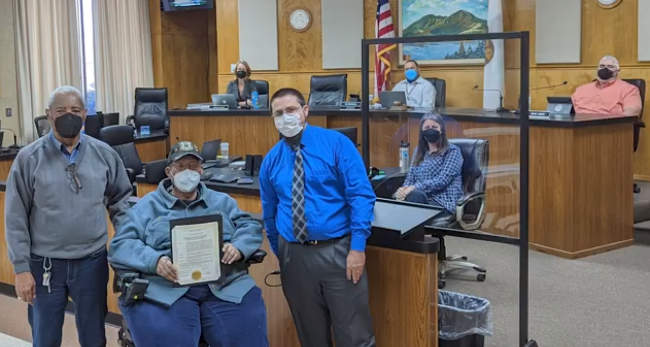
Last Tuesday, the Board of Supervisors presented its proclamation — which also celebrates the birthday of Dr. Martin Luther King Jr. — to Rick Mayo, president of the Lake County Branch of the NAACP, which he founded in 1982.
The proclamation, given to Mayo by Supervisor Bruno Sabatier, recognized the NAACP for its diligent efforts on social programs that aim to eliminate racial hatred, bigotry and poverty.
Mayo noted how far the organization has come in the 25 years the county has offered the proclamations.
“Our nation is at a crossroads,” he said, questioning whether the country is going to continue as a democracy or fall into some kind of autocracy.
“It’s up to us to maintain this democracy that we have,” said Mayo, who called for the protection of voting and other rights.
He added that the Lake County government reflects the diversity of the community.
His cousin, St. Elmo Mosby, was with him to receive the presentation.
Mosby, who has lived in Lake County since 2004, said they both grew up in the South. He said he looks forward to the annual proclamations.
On Thursday, the Clearlake City Council followed up by offering its own proclamation to Mayo and the NAACP.
Mayo and his board members were on hand to receive the proclamation.
Mayo said the Clearlake community stands out in the state for recognizing diversity.
“Black history is American history,” said board member Kenneth Bagsby, adding they can look forward to a better day.
Board member Bessie Bell said she was proud of the police department under Chief Andrew White, noting the changes he’s brought. “I like what I see.”
She added, “Keep the good work up,” and said she is here to help.
Email Elizabeth Larson at

LAKE COUNTY, Calif. — A nonprofit group is undertaking a fundraising effort to rebuild trails in the Boggs Mountain Demonstration State Forest, which was devastated in the 2015 Valley fire.
Redwood Trails Alliance is launching its “Bring Back Boggs” fundraising campaign.
In partnership with Trail House of Santa Rosa and various stakeholders, Redwood Trails Alliance is raising funds to rebuild Boggs Mountain Demonstration State Forest trails and give away an awesome trail bike to one lucky winner.
Redwood Trails Alliance, a 501(c)(3) trail stewardship organization, is launching the “Bring Back Boggs'' bike giveaway. Trail House of Santa Rosa donated a Specialized Stumpjumper Expert mountain bike worth $5,900 to raise funds to rebuild the trails at Boggs Mountain Demonstration State Forest.
The forest has been a popular mountain bike destination for years, and home of the Bike Monkey Boggs 8 hour race and the NorCal Interscholastic Cycling League’s state championship race.
After nearly 90% of the 3,100 acres of forest was burned, rebuilding is underway, but the Redwood Trails Alliance said it needs community support to get the job done.
This forest is so important to the local community, Lake County District 5 Supervisor Jessica Pyska announced actions to make healthier living more accessible in District 5.
Pyska is dedicating $25,000 in cannabis tax funds to the Friends of Boggs and Redwood Trails Alliance, kicking off a $100,000 “Bring Back Boggs” fundraising campaign to rebuild trails in Boggs forest.
You too can donate towards Boggs recovery. Each $5 donation goes toward one chance to win the giveaway prizes. The campaign closes on Sunday, Feb. 27, at 6 p.m. Pacific Time.
Interested parties can enter to win here at www.trailsalliance.org or https://trailsalliance.givingfuel.com/bringbackboggs.
Further support of the Bring Back Boggs campaign comes from Calpine Corp. Calpine donated $15,000 towards the $100,000 goal to rebuild trails in the forest.
“Calpine Corp. and Supervisor Pyska’s donations give us a $40,000 boost to our Bring Back Boggs campaign. We are optimistic for a successful campaign and grateful to work in partnership with Friends of Boggs Mountain,” said Debbie St. Cyr, executive director of Redwood Trails Alliance.
“None of the work we do would be possible without support from our members, loyal sponsors, partners and the many visitors from around the Bay Area who cherish our trails,” said St. Cyr. “Trail House of Santa Rosa has supported Redwood Trails Alliance from the very beginning, and together, we’ve brought world-class trails to the community. With the Specialized Bicycles Stumpjumper Expert, they've bottled up that ‘new bike day’ feeling and put it into a radical new trail bike so agile, so lively, so in-tune with the trail, that it feels like an extension of your body. Levitate up the climbs. Decimate the descents. It’s the perfect NorCal trail bike!”
St. Cyr said they also have runner-up prizes for more chances to win, including a set of Reserve 30 29 inch carbon mountain bike wheels donated by Reserve Wheels and a Wahoo Roam bike computer donated by RIDE Napa Valley. Click here to enter to win one today.
For more information, click here or email Tom Boss at