 How to resolve AdBlock issue?
News
During a special Thursday evening meeting, the board voted unanimously to hire Thad Owens as the new superintendent, as Lake County News has reported.
Two nights earlier, the board voted to accept the resignation of Tim Gill, who had been superintendent for four months before his sudden resignation on Monday.
After accepting Gill’s resignation, the board had announced that it intended to fill the superintendent vacancy through the appointment of an interim superintendent as soon as possible.
However, the district confirmed on Friday that Owens was hired on a permanent — not interim — basis.
Owens’ hiring is pending final contract approval, which the district said will be on the agenda of the next regular board meeting on March 9.
Owens served a portion of one term on the school board until he resigned in November.
The district said Owens was born and raised in Choteau, Montana.
He is a U.S. Army combat veteran, having served in the 3rd US Cavalry, the 6th US Cavalry and the 18th Airborne Corp.
He received his Bachelor of Science in agriculture education from New Mexico State University and his Master of Science in education administration from California Coast University.
Owens completed the Association of California School Administrators Superintendents Academy in 2020.
The district said Owens has taught for 10 years in grades sixth through 12. He has been an elementary, middle, high school and alternative education principal for a combined 14 years and is currently serving as the director of alternative education for Konocti Unified School District.
He has been employed by Middletown Unified in the past as the Middletown High School assistant principal, Middletown High School athletic director, Middletown Middle School principal and Minnie Cannon Elementary principal.
Owens is the district’s fourth superintendent in the space of 28 months.
Email Elizabeth Larson at

Behind some of the most fascinating scientific discoveries and innovations are women whose names might not be familiar but whose stories are worth knowing.
Of course, there are far too many to all fit on one list.
But here are five profiles from The Conversation’s archive that highlight the brilliance, grit and unique perspectives of five women who worked in geosciences, math, ornithology, pharmacology and physics during the 20th century.
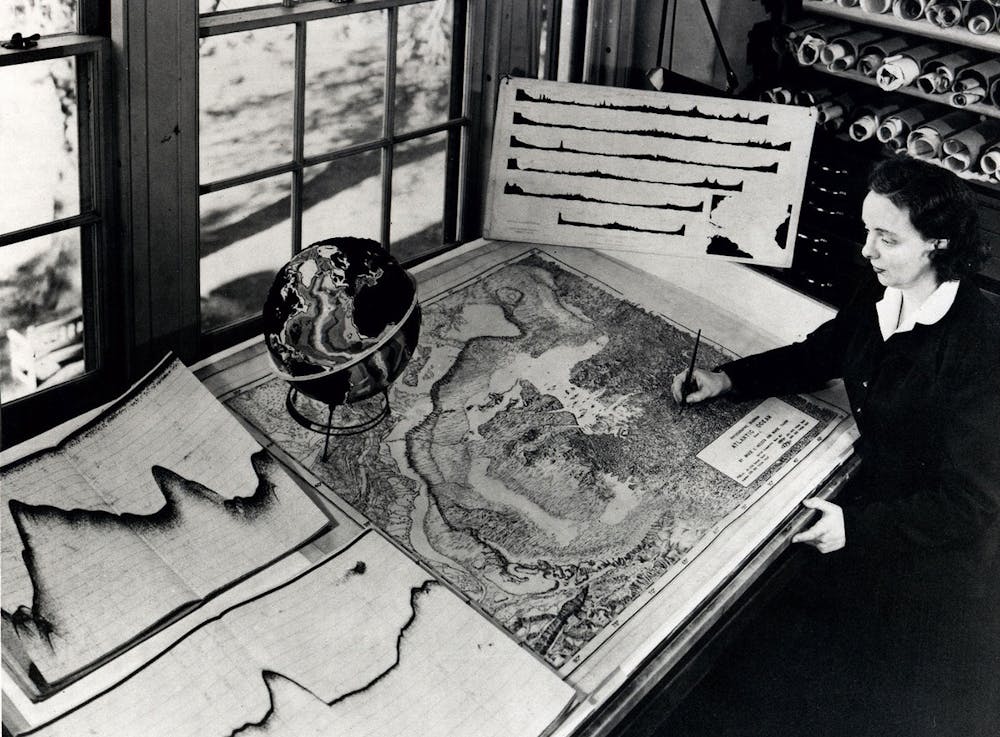
1. Revealing and mapping the ocean floor
As late as the 1950s, wrote Wesleyan University geoscientist Suzanne OConnell, “many scientists assumed the seabed was featureless.”
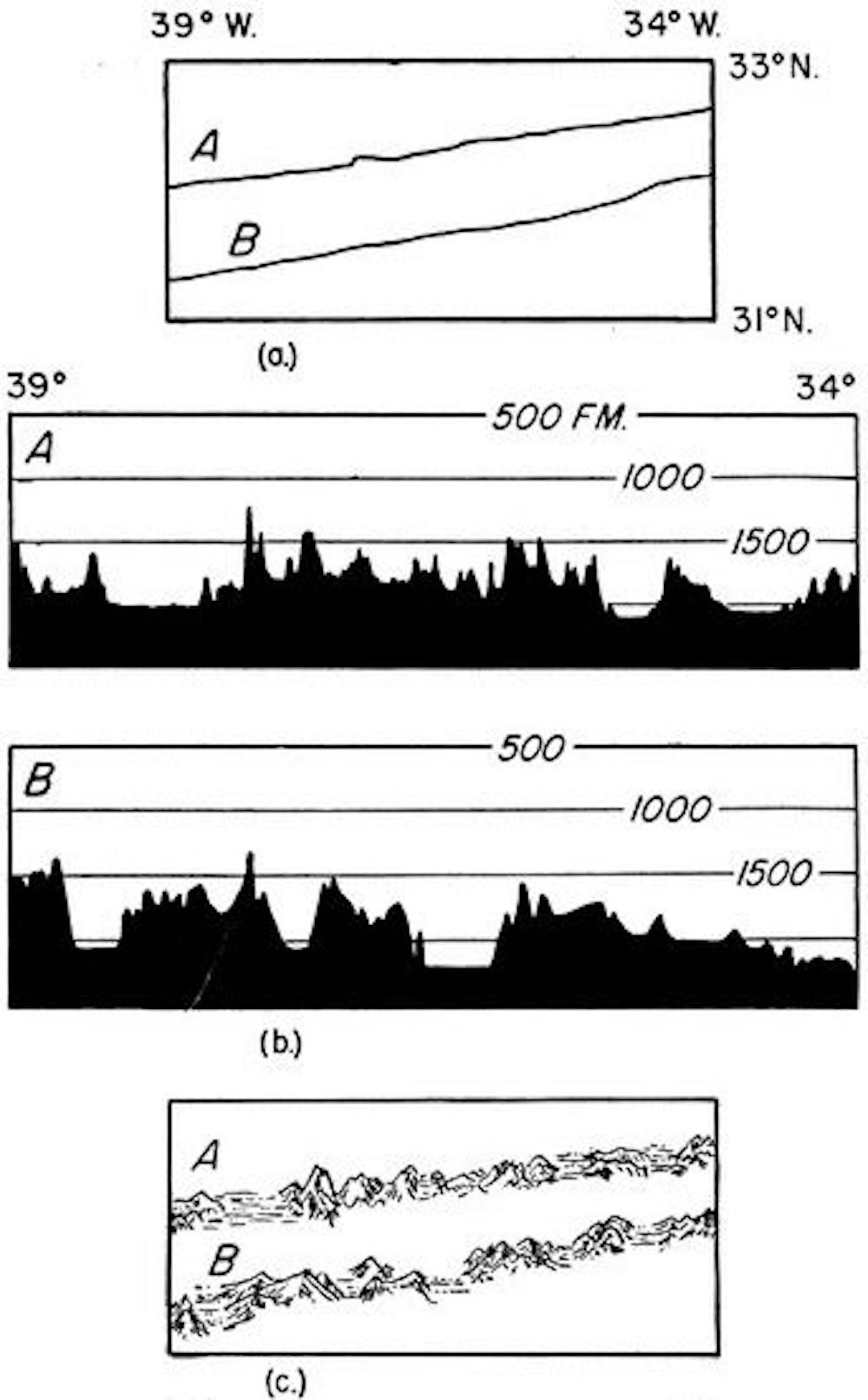
Enter Marie Tharp. In 1957, she and her research partner started publishing detailed hand-drawn maps of the ocean floor, complete with rugged mountains, valleys and deep trenches.
Tharp was a geologist and oceanographer. Aboard research ships, she would carefully record the depth of the ocean, point by point, using sonar. One of her innovations was to translate this data into topographical sketches of what the seafloor looked like.
Her discovery of a rift valley in the North Atlantic shook the world of geology – her supervisor on the ship dismissed her idea as “girl talk,” and Jacques Cousteau was determined to prove her wrong. But she was right, and her insight was a key contribution to plate tectonic theory. That’s part of why, OConnell writes, “I believe Tharp should be as famous as Jane Goodall or Neil Armstrong.”
2. Sympathetic observation of bird behavior
Margaret Morse Nice was a field biologist who got into the minds of her study subjects to garner new insights into animal behavior. Most famously she observed song sparrows in the 1920s and ‘30s.
Rochester Institute of Technology professor of science, technology and society Kristoffer Whitney recounted what Nice called her “phenomenological method,” acknowledging the obvious “affection and anthropomorphism” you can see in her descriptions.
“When I first studied the Song Sparrows,” Nice wrote, “I had looked upon Song Sparrow 4M as a truculent, meddlesome neighbor; but … I discovered him to be a delightful bird, spirited, an accomplished songster and a devoted father.”
Despite earning no advanced degrees and being considered an amateur, Nice promoted innovations like the “use of colored leg bands to distinguish individual birds,” gained the respect of her better-known peers and enjoyed a long, successful career.
3. A medical researcher in Maoist China

At the height of China’s Cultural Revolution, a young scientist named Tu Youyou headed a covert operation called Project 523 under military supervision. One of her team’s goals was to identify and systematically test substances used in traditional Chinese medicine in an effort to vanquish chloroquine-resistant malaria.
Historian Jia-Chen Fu described how “contrary to popular assumptions that Maoist China was summarily against science and scientists, the Communist party-state needed the scientific elite for certain political and practical purposes.”
Tu followed a hunch about how to extract an antimalarial compound from the qinghao or artemisia plant. By 1971, her team had successfully “obtained a nontoxic and neutral extract that was called qinghaosu or artemisinin.” In 2015, she was honored with a Nobel Prize.
4. A mathematician who wouldn’t be diverted
Not everyone gets called a “creative mathematical genius” by Albert Einstein. But Emmy Noether did.
Mathematician Tamar Lichter Blanks wrote about the roadblocks Noether faced as a Jewish woman who wanted to pursue a math career in early 1900s Germany. For a while, Noether supervised doctoral students without pay and taught university courses listed under the name of a male colleague.
All the while, she conducted her own research in theoretical physics, contributing to Einstein’s theory of relativity. Her most revolutionary work was in ring theory and is still pondered by mathematicians today.
Noether died less than two years after emigrating to the U.S. to escape the Nazis.
5. Testing nuclear theories one by one

While sometimes called the “Chinese Marie Curie” in her home country, nuclear physicist Chien-Shiung Wu is less well-known in the U.S., where she did the bulk of her work. Rutgers University-Newark physicist Xuejian Wu considered Chien-Shiung Wu (no relation) “an icon” who inspired his own career path.
As a grad student, Wu traveled by steamship to California in 1936, where she fell in love with atomic nuclei research at UC Berkeley, home of a brand new cyclotron. She worked on the Manhattan Project during World War II.
Among her many accomplishments, Wu’s careful experimental work discovered what’s called parity nonconservation – that is, that a physical process and its mirror reflection are not necessarily identical. Her colleagues who focused on the theoretical side of this breakthrough won the 1957 Nobel Prize in physics, but Wu was overlooked.
Editor’s note: This story is a roundup of articles from The Conversation’s archives.
Maggie Villiger, Senior Science + Technology Editor, The Conversation
This article is republished from The Conversation under a Creative Commons license. Read the original article.
Since announcing plans on Monday to introduce legislation to divest state public funds from Russia and Russian-state entities following the unprovoked war against Ukraine, Senate Majority Leader Mike McGuire’s office reported that an overwhelming show of support has poured in resulting in nearly half of all legislators in California signing on to co-author the bill.
SB 1328 requires public pensions systems — including the two largest in America, STRS and PERS — to divest from Russian and Belarusian assets and companies.
“The State of California has incredible economic power and strength and we must use this clout for good. The people of California will not stand idly by while an autocratic thug attacks the innocent people of Ukraine and attempts to destroy their country,” McGuire said. “Democrats and Republicans alike are working together on SB 1328. The Golden State stands strong for Ukraine and we’ll do everything in our power to usher in debilitating economic consequences on Russia for this horrific and bloody war.”
As of Friday, the bill had 57 co-authors, and the number was reported to be growing.
California is the world’s fifth largest economy and enhanced action taken by the State can help the people of Ukraine by putting additional financial pressure on the already beaten-up Russian economy.
It’s believed California has Russian investments approaching $2 billion, primarily in its pension funds. At this point there can be no excuse to invest in and support Putin, his oligarchs, and the Russian economy.
Russia’s economy, not even in the top 10 of world economies, is one of their big pressure points, and California should use its power to exert influence where it can, the bill’s authors said.
“The free world has a moral obligation to help the people of Ukraine. This creates a legal one as well. By requiring California’s capital to divest from Russian assets, we can play a real role in helping defend democracy internationally,” said SB 1328 Co-author Assemblymember Chad Mayes.
SB 1328 also asks private companies based in California to divest their investments in the Russian economy. In addition, the legislation would block the awarding of state contracts to any company that is conducting business with Russia.
The legislation can be found here.
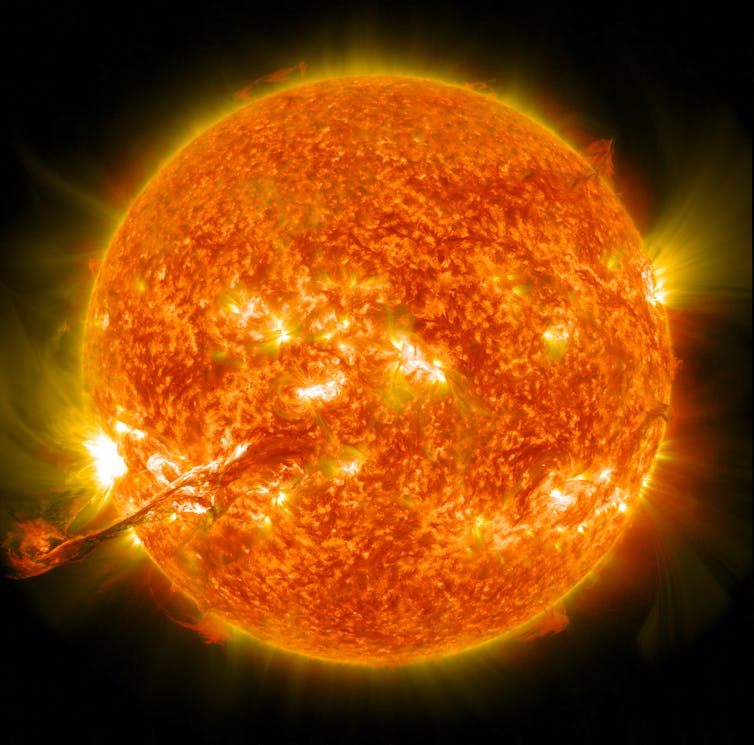

On Feb. 4, 2022, SpaceX launched 49 satellites as part of Elon Musk’s Starlink internet project, most of which burned up in the atmosphere days later. The cause of this more than US$50 million failure was a geomagnetic storm caused by the Sun.
Geomagnetic storms occur when space weather hits and interacts with the Earth. Space weather is caused by fluctuations within the Sun that blast electrons, protons and other particles into space. I study the hazards space weather poses to space-based assets and how scientists can improve the models and prediction of space weather to protect against these hazards.
When space weather reaches Earth, it triggers many complicated processes that can cause a lot of trouble for anything in orbit. And engineers like me are working to better understand these risks and defend satellites against them.
What causes space weather?
The Sun is always releasing a steady amount of charged particles into space. This is called the solar wind. Solar wind also carries with it the solar magnetic field. Sometimes, localized fluctuations on the Sun will hurl unusually strong bursts of particles in a particular direction. If Earth happens to be in the path of the enhanced solar wind generated by one of these events and gets hit, you get a geomagnetic storm.
The two most common causes of geomagnetic storms are coronal mass ejections – explosions of plasma from the surface of the Sun – and solar wind that escapes through coronal holes – spots of low density in the Sun’s outer atmosphere.
The speed at which the ejected plasma or solar wind arrives at Earth is an important factor – the faster the speed, the stronger the geomagnetic storm. Normally, solar wind travels at roughly 900,000 mph (1.4 million kph). But strong solar events can release winds up to five times as fast.
The strongest geomagnetic storm on record was caused by a coronal mass ejection in September 1859. When the mass of particles hit Earth, they caused electrical surges in telegraph lines that shocked operators and, in some extreme cases, actually set telegraph instruments on fire. Research suggests that if a geomagnetic storm of this magnitude hit Earth today, it would cause roughly $2 trillion in damage.
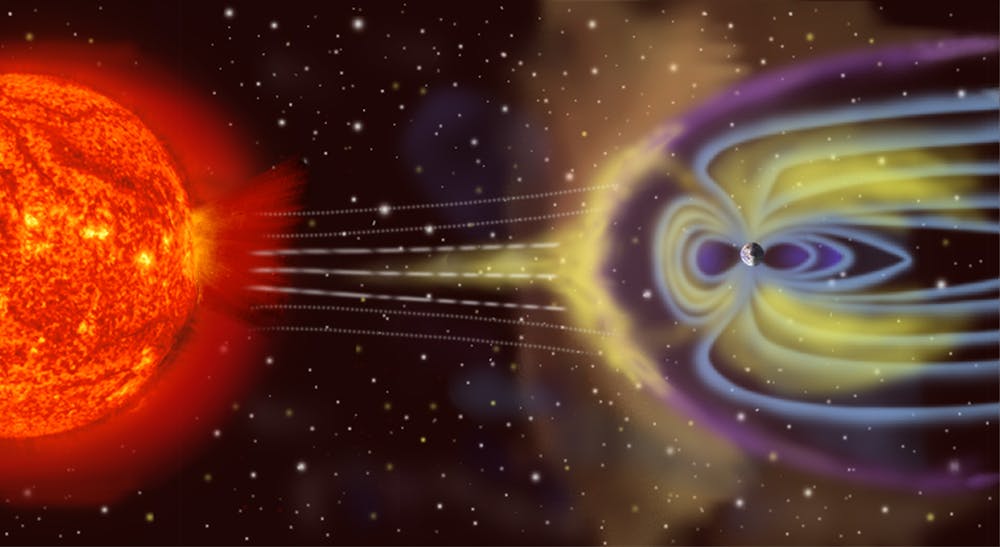

A magnetic shield
Emissions from the Sun, including the solar wind, would be incredibly dangerous to any life form unlucky enough to be directly exposed to them. Thankfully, Earth’s magnetic field does a lot to protect humanity.
The first thing solar wind hits as it approaches Earth is the magnetosphere. This region surrounding the Earth’s atmosphere is filled with plasma made of electrons and ions. It’s dominated by the planet’s strong magnetic field. When solar wind hits the magnetosphere, it transfers mass, energy and momentum into this layer.
The magnetosphere can absorb most of the energy from the everyday level of solar wind. But during strong storms, it can get overloaded and transfer excess energy to the upper layers of Earth’s atmosphere near the poles. This redirection of energy to the poles is what results in fantastic aurora events, but it also causes changes in the upper atmosphere that can harm space assets.

Dangers to what’s in orbit
There a few different ways geomagnetic storms threaten orbiting satellites that serve people on the ground daily.
When the atmosphere absorbs energy from magnetic storms, it heats up and expands upward. This expansion significantly increases the density of the thermosphere, the layer of the atmosphere that extends from about 50 miles (80 kilometers) to roughly 600 miles (1,000 km) above the surface of the Earth. Higher density means more drag, which can be a problem for satellites.

.jpg#/media/File:Starlink_Mission_(47926144123).jpg)
This situation is exactly what led to the demise of the the SpaceX Starlink satellites in February. Starlink satellites are dropped off by Falcon 9 rockets into a low-altitude orbit, typically somewhere between 60 and 120 miles (100 and 200 km) above the Earth’s surface. The satellites then use onboard engines to slowly overcome the force of drag and raise themselves to their final altitude of approximately 350 miles (550 km).
The latest batch of Starlink satellites encountered a geomagnetic storm while still in very low-Earth orbit. Their engines could not overcome the significantly increased drag, and the satellites began slowly falling toward Earth and eventually burned up in the atmosphere.
Drag is just one hazard that space weather poses to space-based assets. The significant increase in high-energy electrons within the magnetosphere during strong geomagnetic storms means more electrons will penetrate the shielding on a spacecraft and accumulate within its electronics. This buildup of electrons can discharge in what is basically a small lightning strike and damage electronics.
Penetrating radiation or charged particles in the magnetosphere – even during mild geomagnetic storms – can also alter the output signal from electronic devices. This phenomenon can cause errors in any part of a spacecraft’s electronics system, and if the error occurs in something critical, the entire satellite can fail. Small errors are common and usually fixable, but total failures, though rare, do happen.
Finally, geomagnetic storms can disrupt the ability of satellites to communicate with Earth using radio waves. Many communications technologies, like GPS, for example, rely on radio waves. The atmosphere always distorts radio waves by some amount , so engineers correct for this distortion when building communication systems. But during geomagnetic storms, changes in the ionosphere – the charged equivalent of the thermosphere that spans roughly the same altitude range – will change how radio waves travel through it. The calibrations in place for a quiet atmosphere become wrong during geomagnetic storms.
This, for example, makes it difficult to lock onto GPS signals and can throw off the positioning by a few meters. For many industries – aviation, maritime, robotics, transportation, farming, military and others – GPS positioning errors of a few meters are simply not tenable. Autonomous driving systems will require accurate positioning as well.
How to protect against space weather
Satellites are critically important for much of the modern world to function, and protecting space assets from space weather is an important area of research.
Some of the risks can be minimized by shielding electronics from radiation or developing materials that are more resistant to radiation. But there is only so much shielding that can be done in the face of a powerful geomagnetic storm.
[Over 140,000 readers rely on The Conversation’s newsletters to understand the world. Sign up today.]
The ability to accurately forecast storms would make it possible to preemptively safeguard satellites and other assets to a certain extent by shutting down sensitive electronics or reorienting the satellites to be better protected. But while the modeling and forecasting of geomagnetic storms has significantly improved over the past few years, the projections are often wrong. The National Oceanic and Atmospheric Administration had warned that, following a coronal mass ejection, a geomagnetic storm was “likely” to occur the day before or the day of the February Starlink launch. The mission went ahead anyway.
The Sun is like a child that often throws tantrums. It’s essential for life to go on, but its ever-changing disposition make things challenging.
Piyush Mehta, Assistant Professor of Mechanical and Aerospace Engineering, West Virginia University
This article is republished from The Conversation under a Creative Commons license. Read the original article.
Following an hour-and-a-half-long closed session at a special meeting that began late Thursday afternoon, the board emerged and President Misha Grothe announced that it had selected Thad Owens to take on the superintendent’s role, pending contract approval.
The Thursday meeting was the second special meeting the board has held this week. During the first, on Tuesday night, the board accepted the resignation of Superintendent Tim Gill.
The board had said in a statement issued after the Tuesday meeting that it intended to look for an interim superintendent immediately.
However, based on the announcement at the Thursday meeting, Owens’ hiring does not appear to be on an interim basis.
Owens served a portion of a term on the school board before resigning, without giving a reason, in November. Allison Berlogar later was appointed to fill his seat.
He will succeed Gill, who resigned on Monday and left the following day after only four months on the job.
Gill has not given a public reason for his departure. However, on Wednesday the Lake County Sheriff’s Office reported that it had served a search warrant on a parent who is alleged to have recorded a conversation with Gill without his knowledge.
Owens is listed as a principal for the Konocti Unified School District’s Blue Heron Opportunity High School on that district’s website.
He’s also previously served as principal at Middletown Middle School and Minnie Cannon Elementary School, according to his LinkedIn page.
Email Elizabeth Larson at
The proposal, which must be approved by the Legislature, would require counties to provide comprehensive treatment to the most severely impaired and untreated Californians and hold patients accountable to their treatment plan.
“CARE Court is about meeting people where they are and acting with compassion to support the thousands of Californians living on our streets with severe mental health and substance use disorders,” said Gov. Newsom. “We are taking action to break the pattern that leaves people without hope and cycling repeatedly through homelessness and incarceration. This is a new approach to stabilize people with the hardest-to-treat behavioral health conditions.”
CARE Court does not wait until someone is hospitalized or arrested before providing treatment.
CARE Court will provide an opportunity for a range of people, including family members, first responders, intervention teams, and mental health service providers, among others, to refer individuals suffering from a list of specific ailments, many of them unhoused, and get them into community-based services.
Based on the initial information from the governor, the CARE Courts will be housed within each superior court.
However, Krista LeVier, court executive officer of the Lake County Superior Court, said they have no details yet about how the proposal will work and its impact on the local court.
“It’s time we face the painful, but obvious truth: our behavioral health system in California is broken. All of us see it every day on our streets — and it’s long past time we fix it,” said San Diego Mayor Todd Gloria, who called the proposal “a major step forward.”
CARE Court offers court-ordered individualized interventions and services, stabilization medication, advanced mental health directives, and housing assistance — all while remaining community-based. Plans can be up to 12 to 24 months.
In addition to their full clinical team, the client-centered approach also includes a public defender and a supporter to help individuals make self-directed care decisions.
“We need to stop trying to fix a failed system,” said Santa Clara County Superior Court Judge Stephen V. Manley. “We are rapidly moving back to where we were 100 years ago in using incarceration as the only alternative for those persons who are severely mentally ill. We need new ideas and a fresh approach and Gov. Newsom is offering us one.”
The CARE Court framework was created using the evidence that many people can stabilize, begin healing, and exit homelessness in less restrictive, community-based care settings.
The plan focuses on people with schizophrenia spectrum and other psychotic disorders, who may also have substance use challenges, and who lack medical decision-making capacity, and advances an upstream diversion from more restrictive conservatorships or incarceration.
The framework provides individuals with a clinically appropriate, community-based and court-ordered Care Plan consisting of culturally and linguistically competent county mental health and substance use disorder treatment services. These include short-term stabilization medications, wellness and recovery supports, and connection to social services, including a housing plan.
Services are provided to the individual through an outpatient model while they live in the community.
“After 30 years in the field serving vulnerable individuals and experiencing difficulty in getting these individuals the appropriate level of care, I welcome the discussion around a definitive evaluation process and look forward to participating in discussions to find solutions that better serve this population,” said California Professional Firefighters President Brian K Rice.
In the event that a participant cannot successfully complete a care plan, the individual may be referred for a conservatorship, consistent with current law, with a presumption that no suitable alternatives to conservatorship are available.
All counties across the state will participate in CARE Court under the proposal. If local governments do not meet their specified duties under court-ordered care plans, the court will have the ability to order sanctions and, in extreme cases, appoint an agent to ensure services are provided.
The California State Association of Public Administrators, Public Guardians, and Public Conservators called for increased resources to serve California’s most vulnerable populations.
“Gov. Newsom has proposed sweeping changes to the continuum of care to serve a growing number of Californians with severe mental illness and cognitive deficits, people who are seriously and persistently mentally ill and homeless, and adults who have been victimized and exploited,” said Scarlet Hughes, executive director of the California State Association of Public Administrators, Public Guardians, and Public Conservators.
“As experts on the front lines serving the most vulnerable Californians, we look forward to working with the governor and the Legislature to strengthen the CARE Courts proposal and address the significant impacts it will undoubtedly have on demand for local county public conservators and public guardian safety net programs,” said Hughes. “We share the governor’s goal to provide care and compassion for vulnerable individuals and ensure our guardians and conservators have the resources to meet both current demand and increasing needs.”