 How to resolve AdBlock issue?
News
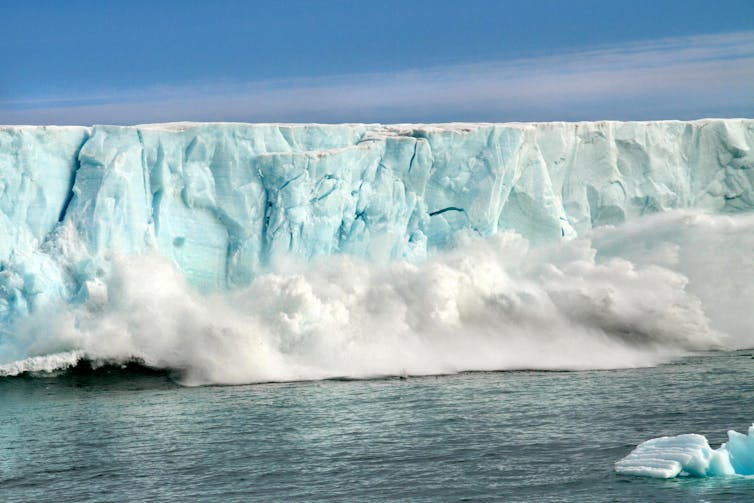
The Earth is approximately 1.1℃ warmer than it was at the start of the industrial revolution. That warming has not been uniform, with some regions warming at a far greater pace. One such region is the Arctic.
A new study shows that the Arctic has warmed nearly four times faster than the rest of the world over the past 43 years. This means the Arctic is on average around 3℃ warmer than it was in 1980.
This is alarming, because the Arctic contains sensitive and delicately balanced climate components that, if pushed too hard, will respond with global consequences.
Why is the Arctic warming so much faster?
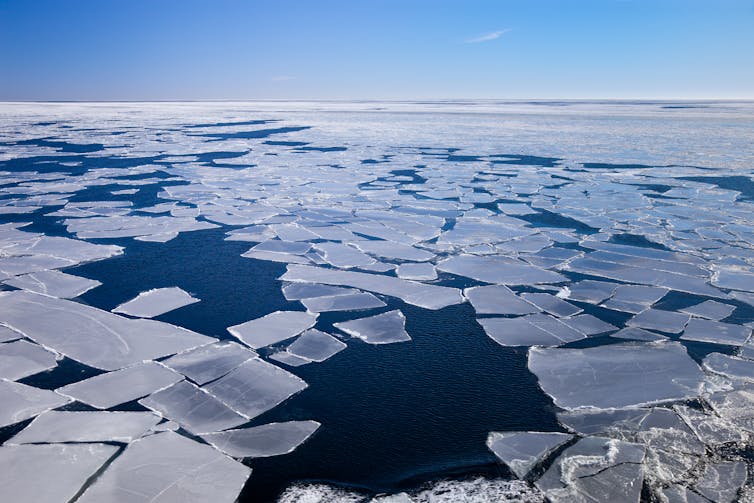
A large part of the explanation relates to sea ice. This is a thin layer (typically one metre to five metres thick) of sea water that freezes in winter and partially melts in the summer.
The sea ice is covered in a bright layer of snow which reflects around 85% of incoming solar radiation back out to space. The opposite occurs in the open ocean. As the darkest natural surface on the planet, the ocean absorbs 90% of solar radiation.
When covered with sea ice, the Arctic Ocean acts like a large reflective blanket, reducing the absorption of solar radiation. As the sea ice melts, absorption rates increase, resulting in a positive feedback loop where the rapid pace of ocean warming further amplifies sea ice melt, contributing to even faster ocean warming.
This feedback loop is largely responsible for what is known as Arctic amplification, and is the explanation for why the Arctic is warming so much more than the rest of the planet.
Is Arctic amplification underestimated?
Numerical climate models have been used to quantify the magnitude of Arctic amplification. They typically estimate the amplification ratio to be about 2.5, meaning the Arctic is warming 2.5 times faster than the global average. Based on the observational record of surface temperatures over the last 43 years, the new study estimates the Arctic amplification rate to be about four.
Rarely do the climate models obtain values as high that. This suggests the models may not fully capture the complete feedback loops responsible for Arctic amplification and may, as a consequence, underestimate future Arctic warming and the potential consequences that accompany that.
How concerned should we be?
Besides sea ice, the Arctic contains other climate components that are extremely sensitive to warming. If pushed too hard, they will also have global consequences.
One of those elements is permafrost, a (now not so) permanently frozen layer of the Earth’s surface. As temperatures rise across the Arctic, the active layer, the topmost layer of soil that thaws each summer, deepens. This, in turn, increases biological activity in the active layer resulting in the release of carbon into the atmosphere.
Arctic permafrost contains enough carbon to raise global mean temperatures by more than 3℃. Should permafrost thawing accelerate, there is the potential for a runaway positive feedback process, often referred to as the permafrost carbon time bomb. The release of previously stored carbon dioxide and methane will contribute to further Arctic warming, subsequently accelerating future permafrost thaw.
A second Arctic component vulnerable to temperature rise is the Greenland ice sheet. As the largest ice mass in the northern hemisphere, it contains enough frozen ice to raise global sea levels by 7.4 metres if melted completely.

When the amount of melting at the surface of an ice cap exceeds the rate of winter snow accumulation, it will lose mass faster than it gains any. When this threshold is exceeded, its surface lowers. This will quicken the pace of melting, because temperatures are higher at lower elevations.
This feedback loop is often called the small ice cap instability. Prior research puts the required temperature rise around Greenland for this threshold to be be passed at around 4.5℃ above pre-industrial levels. Given the exceptional pace of Arctic warming, passing this critical threshold is rapidly becoming likely.
Although there are some regional differences in the magnitude of Arctic amplification, the observed pace of Arctic warming is far higher than the models implied. This brings us perilously close to key climate thresholds that if passed will have global consequences. As anyone who works on these problems knows, what happens in the Arctic doesn’t stay in the Arctic.
Jonathan Bamber, Professor of Physical Geography, University of Bristol
This article is republished from The Conversation under a Creative Commons license. Read the original article.

BERKELEY, Calif. — Over the last 25 years, astronomers have found thousands of exoplanets around stars in our galaxy, but more than 99% of them orbit smaller stars — from red dwarfs to stars slightly more massive than our sun, which is considered an average-sized star.
Few have been discovered around even more massive stars, such as A-type stars — bright blue stars twice as large as the sun — and most of the exoplanets that have been observed are the size of Jupiter or larger. Some of the brightest stars in the night sky, such as Sirius and Vega, are A-type stars.
University of California, Berkeley, astronomers now report a new, Neptune-sized planet — called HD 56414 b — around one of these hot-burning, but short-lived, A-type stars and provide a hint about why so few gas giants smaller than Jupiter have been seen around the brightest 1% of stars in our galaxy.
Current exoplanet detection methods most easily find planets with short, rapid orbital periods around their stars, but this newly found planet has a longer orbital period than most discovered to date. The researchers suggest that an easier-to-find Neptune-sized planet sitting closer to a bright A-type star would be rapidly stripped of its gas by the harsh stellar radiation and reduced to an undetectable core.
While this theory has been proposed to explain so-called hot Neptune deserts around redder stars, whether this extended to hotter stars — A-type stars are about 1.5 to 2 times hotter than the sun — was unknown because of the dearth of planets known around some of the galaxy’s brightest stars.
“It's one of the smallest planets that we know of around these really massive stars,” said UC Berkeley graduate student Steven Giacalone. “In fact, this is the hottest star we know of with a planet smaller than Jupiter. This planet's interesting first and foremost because these types of planets are really hard to find, and we're probably not going to find many like them in the foreseeable future.”
Hot Neptune desert
The discovery of what the researchers term a “warm Neptune” just outside the zone where the planet would have been stripped of its gas suggests that bright, A-type stars may have numerous unseen cores within the hot Neptune zone that are waiting to be discovered through more sensitive techniques.
“We might expect to see a pileup of remnant Neptunian cores at short orbital periods” around such stars, the researchers concluded in their paper.
The discovery also adds to our understanding of how planetary atmospheres evolve, said Courtney Dressing, UC Berkeley assistant professor of astronomy.
“There's a big question about just how do planets retain their atmospheres over time,” Dressing said. “When we're looking at smaller planets, are we looking at the atmosphere that it was formed with when it originally formed from an accretion disk? Are we looking at an atmosphere that was outgassed from the planet over time? If we're able to look at planets receiving different amounts of light from their star, especially different wavelengths of light, which is what the A stars allow us to do — it allows us to change the ratio of X-ray to ultraviolet light — then we can try to see how exactly a planet keeps its atmosphere over time.”
Giacalone and Dressing reported their discovery in a paper accepted by The Astrophysical Journal Letters and posted online on Aug. 12.
According to Dressing, it’s well-established that highly-irradiated, Neptune-sized planets orbiting less massive, sun-like stars are rarer than expected. But whether this holds for planets orbiting A-type stars is not known because those planets are challenging to detect.
And an A-type star is a different animal from smaller F, G, K and M dwarfs. Close-in planets orbiting sun-like stars receive high amounts of both X-ray and ultraviolet radiation, but close-in planets orbiting A-type stars experience much more near-ultraviolet radiation than X-ray radiation or extreme ultraviolet radiation.
“Determining whether the hot Neptune desert also extends to A-type stars provides insight into the importance of near-ultraviolet radiation in governing atmospheric escape,” she said. “This result is important for understanding the physics of atmospheric mass loss and investigating the formation and evolution of small planets.”
The planet HD 56414 b was detected by NASA’s TESS mission as it transited its star, HD 56414. Dressing, Giacalone and their colleagues confirmed that HD 56414 was an A-type star by obtaining spectra with the 1.5-meter telescope operated by the Small and Moderate Aperture Research Telescope System (SMARTS) Consortium at Cerro Tololo in Chile.
The planet has a radius 3.7 times that of Earth and orbits the star every 29 days at a distance equal to about one-quarter the distance between Earth and the sun. The system is roughly 420 million years old, much younger than our sun’s 4.5-billion-year age.
The researchers modeled the effect that radiation from the star would have on the planet and concluded that, while the star may be slowly whittling away at its atmosphere, it would likely survive for a billion years — beyond the point at which the star is expected to burn out and collapse, producing a supernova.
Giacalone said that Jupiter-sized planets are less susceptible to photoevaporation because their cores are massive enough to hold onto their hydrogen gas.
“There's this balance between the central mass of the planet and how puffy the atmosphere is,” he said. “For planets the size of Jupiter or larger, the planet is massive enough to gravitationally hold on to its puffy atmosphere. As you move down to planets the size of Neptune, the atmosphere is still puffy, but the planet is not as massive, so they can lose their atmospheres more easily.”
Giacalone and Dressing continue to search for more Neptune-sized exoplanets around A-type stars, in hopes of finding others in or near the hot Neptune desert, to understand where these planets form in the accretion disk during star formation, whether they move inward or outward over time, and how their atmospheres evolve.
The work was supported by a FINESST award from NASA (80NSSC20K1549) and the David and Lucile Packard Foundation (2019-69648).
Robert Sanders writes for the UC Berkeley News Center.
Over the summer, Adventist Health had notified patients with Anthem Blue Cross that if negotiations failed their insurance would no longer be accepted at Adventist Health facilities.
Negotiations had been set to expire in the middle of July and were extended to earlier this month, as Lake County News has reported.
On Friday, the health care system and insurance company announced they had reached a new contract agreement.
The agreement, which goes into effect immediately, provides Anthem health plan members with continued in-network access to hospital-based services at Adventist Health facilities.
“We are pleased to have reached a mutual agreement with Adventist Health that provides our members with continued access to care at Adventist Health facilities,” said John Pickett, regional vice president, Anthem Blue Cross. “The successful resolution of our discussions builds on our long-term partnership and shared commitment to providing access to high-quality care for those in the communities we serve.”
“We are pleased to continue our long working relationship with Anthem Blue Cross,” said Todd Hofheins, chief operating officer, Adventist Health. “Our mission calls us to provide high quality care to patients in our communities and we’re excited to continue caring for Anthem Blue Cross members.”
Email Elizabeth Larson at
The original deadline, which was 5 p.m. Friday, has been extended to 5 p.m. Wednesday, Aug. 17, for seats on the boards of 10 school and special districts.
The offices for which the deadlines have been extended are as follows.
Mendocino-Lake Community College District: Trustee Area No. 6, one vacancy, four-year term.
Lake County Board Of Education: Trustee Area No. 4, one vacancy, four-year term.
Lucerne Elementary School District: Two vacancies, four-year term.
Middletown Unified School District: Three vacancies, four-year terms; one vacancy, one two-year unexpired term.
Lake County Fire Protection District: Four vacancies, four-year terms.
South Lake County Fire Protection District: Two vacancies, four-year terms.
Callayomi County Water District: Three vacancies, four-year terms.
Konocti County Water District: Three vacancies, four-year terms.
Upper Lake County Water District: Two vacancies, four-year terms.
Villa Blue Estates Water District: three vacancies, four-year terms; three vacancies, two-year terms.
Interested persons desiring information regarding filing for any of the elective offices that have been extended until Aug. 17 are advised to contact the Lake County Registrar of Voters office at 707-263-2372, 325 N. Forbes St., Lakeport, during regular office hours of 8 a.m. to 5 p.m. prior to the deadline.
The City of Clearlake Animal Association also is seeking fosters for the animals waiting to be adopted.
Call the Clearlake Animal Control shelter at 707-273-9440, or email
Visit Clearlake Animal Control on Facebook or on the city’s website.
The following dogs are available for adoption. The newest additions are at the top.

‘Groucho’
“Groucho” is a male Chihuahua-miniature pinscher mix with a short tricolor coat.
He has been neutered.
He is dog No. 49651597.

‘Sparkles’
“Sparkles” is a female terrier mix with a short brindle coat.
Shehas been spayed.
She is dog No. 50592729.

‘Willie’
“Willie” is a male German shepherd mix with a black and tan coat.
He has been neutered.
He is dog No. 50596003.

‘Andy’
“Andy” is a male American pit bull mix with a short gray and white coat.
He is dog No. 48995415.

‘Bear’
“Bear” is a male Labrador retriever-American pit bull mix with a short charcoal and fawn coat.
He has been neutered.
He is dog No. 48443153.

‘Betsy’
“Betsy” is a female American pit bull mix with a short white coat.
She has been spayed.
She is dog No. 50236145.

‘Bluey’
“Bluey” is a male retriever mix with a short black coat.
He has been neutered.
He is dog No. 50552999.

‘Big Phil’
“Big Phil” is a 13-year-old male American pit bull terrier mix with a blue coat.
He has been neutered.
He is dog No. 49951647.

‘Colt’
“Colt” is a male Rhodesian Ridgeback mix with a short rust and black coat.
He has been neutered.
He is dog No. 49812106.

‘Hakuna’
“Hakuna” is a male shepherd mix with a tan coat.
He has been neutered.
He is dog No. 50176912.

‘Kubota’
“Kubota” is a male German shepherd mix with a short tan and black coat.
He has been neutered.
Kubota is dog No. 50184421.

‘Luna’
“Luna” is an 8-month-old Labrador retriever-terrier mix with a black and white coat.
She is dog No. 50339254.

‘Mamba’
“Mamba” is a male Siberian husky mix with a gray and cream-colored coat.
He has been neutered.
He is dog No. 49520569.

‘Matata’
“Matata” is male shepherd mix with a tan coat.
He has been neutered.
He is dog No. 50176912.

‘Newman’
“Newman” is a 1-year-old male American pit bull terrier mix with a black and white coat.
He has been neutered.
Newman is dog No. 49057809.

‘Sadie’
“Sadie” is a female German shepherd mix with a black and tan coat.
She has been spayed.
She is dog No. 49802563.

‘Terry’
“Terry” is a handsome male shepherd mix with a short brindle coat.
He gets along with other dogs, including small ones, and enjoys toys. He also likes water, playing fetch and keep away.
Staff said he is now getting some training to help him build confidence.
He is dog No. 48443693.

‘Tiramisu’
“Tiramisu” is a female Alaskan husky mix with a short brown and cream coat.
She is dog No. 49652833.

‘Ziggy’
“Ziggy” is a male American pit bull terrier mix with a short gray and white coat.
He has been neutered.
Ziggy is dog No. 50146247
Email Elizabeth Larson at

If you’re like many Americans, you probably start your day with a cup of coffee – a morning latte, a shot of espresso or maybe a good ol’ drip brew.
A common explanation among avid coffee drinkers is that we drink coffee to wake ourselves up and alleviate fatigue.
But that story doesn’t completely hold up. After all, the amount of caffeine in a cup of coffee can vary wildly. Even when ordering the same type of coffee from the same coffee shop, caffeine levels can double from one drink to the next. And yet, we coffee drinkers don’t seem to notice.
So what else might be driving us in our quest for that morning brew?
That’s one question we set out to answer in our recent research. The answer has far-reaching implications for the way we approach major societal challenges such as diet and climate change.
As behavioral scientists, we’ve learned that people often repeat everyday behaviors out of habit. If you regularly drink coffee, you likely do so automatically as part of your habitual routine – not just out of tiredness.
But habit just doesn’t feel like a good explanation – it’s unsatisfying to say that we do something just because it’s what we’re used to doing. Instead, we concoct more compelling explanations, like saying we drink coffee to ease our morning fog.
This reluctance means that we fail to recognize many habits, even as they permeate our daily lives.
Unpacking what lies behind habits
To test whether people underestimate the role that habit plays in their life, we asked more than 100 coffee drinkers what they think drives their coffee consumption. They estimated that tiredness was about twice as important as habit in driving them to drink coffee. To benchmark these assumptions against reality, we then tracked these people’s coffee drinking and fatigue over the course of one week.
The actual results starkly diverged from our research participants’ explanations. Yes, they were somewhat more likely to drink coffee when tired – as would be expected – but we found that habit was an equally strong influence. In other words, people wildly overestimated the role of tiredness and underestimated the role of habit. Habits, it seems, aren’t considered much of an explanation.
We then replicated this finding in a second study with a behavior that people might consider a “bad” habit – failing to help in response to a stranger’s request. People still overlooked habit and assumed that their reluctance to proffer help was due to their mood at the time.
The gap between the actual and perceived role of habit in our lives matters. And this gap is key to understanding why people often struggle to change repeated behaviors. If you believe that you drink coffee because you are tired, then you might try to reduce coffee drinking by going to bed early. But ultimately you’d be barking up the wrong tree – your habit would still be there in the morning.
Why habits are surprisingly difficult to change
The reason that habits can be so difficult to overcome is that they are not fully under our control. Of course, most of us can control a single instance of a habit, such as by refusing a cup of coffee this time or taking the time to offer directions to a lost tourist. We exert willpower and just push through. But consistently reining in a habit is fiendishly difficult.
To illustrate, imagine you had to avoid saying words that contain the letter “I” for the next five seconds. Pretty simple, right? But now imagine if you had to maintain this rule for a whole week. We habitually use many words that contain “I.” Suddenly, the required 24/7 monitoring turns this simple task into a far more onerous one.
We make a similar error when we try to control unwanted habits and form new, desirable ones. Most of us can achieve this in the short run – think about your enthusiasm when starting a new diet or workout regimen. But we inevitably get distracted, tired or just plain busy. When that happens, your old habit is still there to guide your behavior, and you end up back where you started. And if you fail to recognize the role of habit, then you’ll keep overlooking better strategies that effectively target habits.
The flip side is also true: We don’t recognize the benefits of our good habits. One study found that on days when people strongly intended to exercise, those with weak and strong exercise habits got similar amounts of physical activity. On days when intentions were weaker, however, those with strong habits were more active. Thus, strong habits keep behavior on track even as intentions ebb and flow.
It’s not just willpower
American culture is partly responsible for the tendency to overlook habits. Compared with residents of other developed nations, Americans are more likely to say that they control their success in life.
Accordingly, when asked what stops them from making healthy lifestyle changes, Americans commonly cite a lack of willpower. Granted, willpower is useful in the short term, as we muster the motivation to, for example, sign up for a gym membership or start a diet.
But research shows that, surprisingly, people who are more successful at achieving long-term goals exert – if anything – less willpower in their day-to-day lives. This makes sense: As explained above, over time, willpower fades and habits prevail.
If the answer isn’t willpower, then what is the key to controlling habits?
Changing habits begins with the environments that support them. Research shows that leveraging the cues that trigger habits in the first place can be incredibly effective. For example, reducing the visibility of cigarette packs in stores has curbed cigarette purchases.
Another path to habit change involves friction: in other words, making it difficult to act on undesirable habits and easy to act on desirable ones. For example, one study found that recycling increased after recycle bins were placed right next to trash cans – which people were already using – versus just 12 feet away.
Effectively changing behavior starts with recognizing that a great deal of behavior is habitual. Habits keep us repeating unwanted behaviors but also desirable ones, even if just enjoying a good-tasting morning brew.
Asaf Mazar, Postdoctoral fellow in Behavioral Science, University of Pennsylvania and Wendy Wood, Provost Professor Emeritus of Psychology and Business, USC Dornsife College of Letters, Arts and Sciences
This article is republished from The Conversation under a Creative Commons license. Read the original article.