As wildfire season continued to unfold today with a string of blazes across California, the state Assembly approved legislation from Sen. Bill Dodd, D-Napa, that would enhance wildfire prevention through implementation of a $20 million prescribed fire claims fund.
“Clearing our forests of tinder-dry brush and weeds has proven to be a cost-effective way to minimize the intensity and scope of wildfires,” Sen. Dodd said. “It’s why I wrote the law last year to encourage more prescribed fires. Now we can enhance our use of this time-tested technique by establishing guidelines for a fund to cover some costs borne by prescribed fire professionals. The Assembly’s approval today takes us a step closer to achieving our goal.”
Prescribed fire, also known as controlled burning, has been used for centuries to clear dead trees and brush that are known to fuel runaway wildfires.
Rarely do prescribed fires escape their bounds and cause damage to neighboring properties. Yet affordable insurance is difficult to secure, preventing property owners from treating their land.
Sen. Dodd’s bill, Senate Bill 926, would create standards for a fund to help cover costs.
It is a followup to Senate Bill 332, also written by Sen. Dodd and signed into law last year, which protects landowners and prescribed fire managers from having to pay fire suppression expenses unless they have acted with gross negligence.
SB 926 is sponsored by The Nature Conservancy.
It passed the Assembly on Thursday and heads next to Gov. Gavin Newsom for his signature following a concurrence vote in the Senate.
“If we are going to restore our forests at a pace and scale, we need to reduce barriers to prescribed burning — our most effective long-term landscape fire management tool,” said Jay Ziegler, director of policy and external affairs at The Nature Conservancy. “Science shows prescribed fire is critical to curbing catastrophic megafires in California. SB 926 will help us do more of it. We appreciate Sen. Dodd’s leadership on establishing a prescribed fire claims fund.”
Dodd represents the Third Senate District, which includes all or portions of Napa, Solano, Yolo, Sonoma, Contra Costa and Sacramento counties.
CLEARLAKE, Calif. — Clearlake Animal Control has many great dogs waiting to be adopted by new families.
The City of Clearlake Animal Association also is seeking fosters for the animals waiting to be adopted.
Call the Clearlake Animal Control shelter at 707-273-9440, or email This email address is being protected from spambots. You need JavaScript enabled to view it. to inquire about adoptions and schedule a visit to the shelter.
Visit Clearlake Animal Control on Facebook or on the city’s website.
The following dogs are available for adoption. The newest additions are at the top.
“Andy.” Photo courtesy of Clearlake Animal Control. ‘Andy’
“Andy” is a male American pit bull mix with a short gray and white coat.
He is dog No. 48995415.
“Bear.” Photo courtesy of Clearlake Animal Control. ‘Bear’
“Bear” is a male Labrador retriever-American pit bull mix with a short charcoal and fawn coat.
He has been neutered.
He is dog No. 48443153.
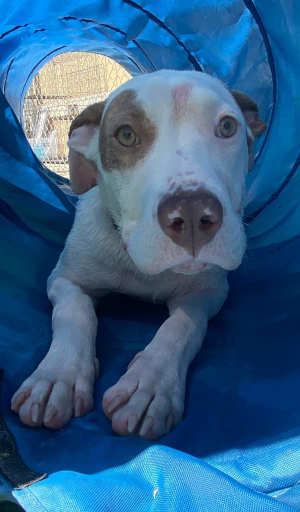
“Betsy.” Photo courtesy of Clearlake Animal Control. ‘Betsy’
“Betsy” is a female American pit bull mix with a short white coat.
She has been spayed.
She is dog No. 50236145.
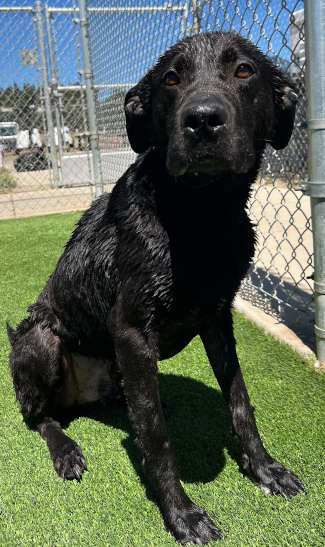
“Bluey.” Photo courtesy of Clearlake Animal Control. ‘Bluey’
“Bluey” is a male retriever mix with a short black coat.
He has been neutered.
He is dog No. 50552999.
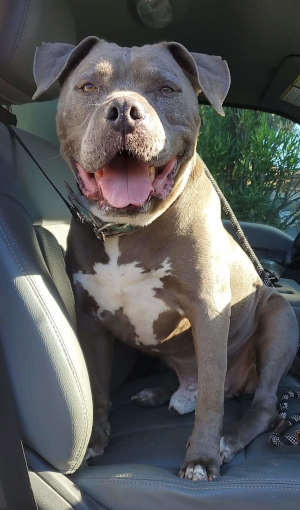
“Big Phil.” Photo courtesy of Clearlake Animal Control. ‘Big Phil’
“Big Phil” is a 13-year-old male American pit bull terrier mix with a blue coat.
He has been neutered.
He is dog No. 49951647.
“Colt.” Photo courtesy of Clearlake Animal Control. ‘Colt’
“Colt” is a male Rhodesian Ridgeback mix with a short rust and black coat.
He has been neutered.
He is dog No. 49812106.
“Groucho.” Photo courtesy of Clearlake Animal Control. ‘Groucho’
“Groucho” is a male Chihuahua-miniature pinscher mix with a short tricolor coat.
He has been neutered.
He is dog No. 49651597.
“Hakuna.” Photo courtesy of Clearlake Animal Control. ‘Hakuna’
“Hakuna” is a male shepherd mix with a tan coat.
He has been neutered.
He is dog No. 50176912.
“Kubota.” Photo courtesy of Clearlake Animal Control. ‘Kubota’
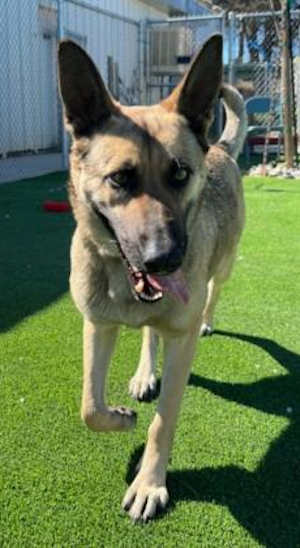
“Kubota” is a male German shepherd mix with a short tan and black coat.
He has been neutered.
Kubota is dog No. 50184421.
“Luna.” Photo courtesy of Clearlake Animal Control. ‘Luna’
“Luna” is an 8-month-old Labrador retriever-terrier mix with a black and white coat.
She is dog No. 50339254.
“Mamba.” Photo courtesy of Clearlake Animal Control. ‘Mamba’
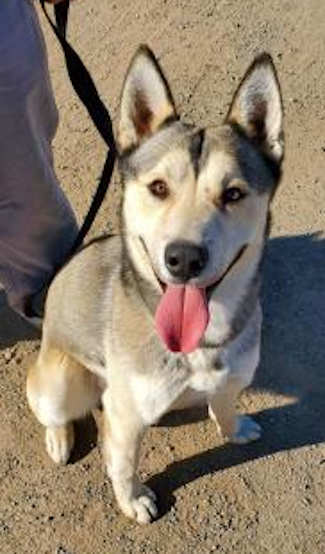
“Mamba” is a male Siberian husky mix with a gray and cream-colored coat.
He has been neutered.
He is dog No. 49520569.
“Matata.” Photo courtesy of Clearlake Animal Control. ‘Matata’
“Matata” is male shepherd mix with a tan coat.
He has been neutered.
He is dog No. 50176912.
“Newman.” Photo courtesy of Clearlake Animal Control. ‘Newman’
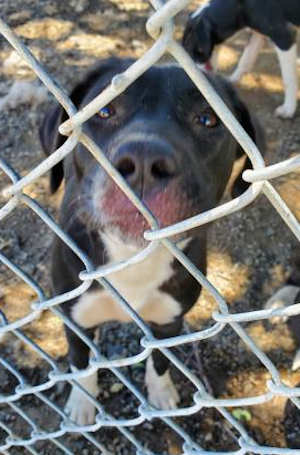
“Newman” is a 1-year-old male American pit bull terrier mix with a black and white coat.
He has been neutered.
Newman is dog No. 49057809.
“Sadie.” Photo courtesy of Clearlake Animal Control. ‘Sadie’
“Sadie” is a female German shepherd mix with a black and tan coat.
She has been spayed.
She is dog No. 49802563.
“Sparkles.” Photo courtesy of Clearlake Animal Control. ‘Sparkles’
“Sparkles” is a female terrier mix with a short brindle coat.
Shehas been spayed.
She is dog No. 50592729.
“Terry.” Photo courtesy of Clearlake Animal Control. ‘Terry’
“Terry” is a handsome male shepherd mix with a short brindle coat.
He gets along with other dogs, including small ones, and enjoys toys. He also likes water, playing fetch and keep away.
Staff said he is now getting some training to help him build confidence.
He is dog No. 48443693.
“Tiramisu.” Photo courtesy of Clearlake Animal Control. ‘Tiramisu’
“Tiramisu” is a female Alaskan husky mix with a short brown and cream coat.
She is dog No. 49652833.
“Willie.” Photo courtesy of Clearlake Animal Control. ‘Willie’
“Willie” is a male German shepherd mix with a black and tan coat.
He has been neutered.
He is dog No. 50596003.
“Ziggy.” Photo courtesy of Clearlake Animal Control. ‘Ziggy’
“Ziggy” is a male American pit bull terrier mix with a short gray and white coat.
He has been neutered.
Ziggy is dog No. 50146247
Email Elizabeth Larson at This email address is being protected from spambots. You need JavaScript enabled to view it.. Follow her on Twitter, @ERLarson, or Lake County News, @LakeCoNews.
Artist’s concept of Kepler-186f, an Earth-size exoplanet orbiting a red dwarf star in the constellation Cygnus. Credits: NASA/Tim Pyle. Imagine you go to a theme park with your family and you ask a park employee to take a group photo.
A celebrity walks by in the background and waves at the camera, stealing the focus of the photo. Surprisingly, this concept of “photobombing” is relevant to astronomers looking for habitable planets, too.
When scientists point a telescope at an exoplanet, the light the telescope receives could effectively be “contaminated” by light from other planets in the same star system, according to a new NASA study. The research, published in the Astrophysical Journal Letters on Aug. 11, modeled how this “photobombing” effect would impact an advanced space telescope designed to observe potentially habitable exoplanets and suggested potential ways to overcome this challenge.
“If you looked at Earth sitting next to Mars or Venus from a distant vantage point, then depending on when you observed them, you might think they’re both the same object,” explained Dr. Prabal Saxena, a scientist at NASA’s Goddard Space Flight Center in Greenbelt, Maryland, who led the research.
Saxena uses our own solar system as an analog to explain this photobombing effect.
“For example, depending on the observation, an exo-Earth could be hiding in [light from] what we mistakenly believe is a large exo-Venus,” said Dr. Saxena. Earth’s neighbor Venus is generally thought to be hostile to habitability, with surface temperatures hot enough to melt lead – so this mixing could lead scientists to miss out on a potentially habitable planet.
Astronomers use telescopes to analyze light from distant worlds to gather information that may reveal whether they could support life. One light-year, the distance light travels in a year, is almost six trillion miles (over nine trillion kilometers), and there are about 30 stars similar to our Sun within roughly 30 light-years of our solar system.
This photobombing phenomenon, in which observations of one planet are contaminated by light from other planets in a system, stems from the “point-spread function” (PSF) of the target planet. The PSF is an image created due to diffraction of light (the bending or spreading of light waves around an opening) coming from a source and is larger than the source for something very far away (such as an exoplanet).
The size of the PSF of an object depends on the size of the telescope aperture (the light-collecting area) and wavelength at which the observation is taken. For worlds around a distant star, a PSF may resolve in such a way that two nearby planets or a planet and a moon could seem to morph into one.
If that is the case, the data that scientists can gather about such an Earth analog would be skewed or affected by whatever world or worlds were photobombing the planet in question, which could complicate or outright prevent the detection and confirmation of an exo-Earth, a potential planet like Earth beyond our solar system.
Saxena examined an analogous scenario in which otherworldly astronomers might be looking at Earth from more than 30 light-years away, using a telescope similar to that recommended in the 2020 Astrophysics Decadal Survey.
“We found that such a telescope would sometimes see potential exo-Earths beyond 30 light-years distance blended with additional planets in their systems, including those that are outside of the habitable zone, for a range of different wavelengths of interest,” Saxena said.
The habitable zone is that region of space around a star where the amount of starlight would allow liquid water on a planet’s surface, which may enable the existence of life.
There are multiple strategies to deal with the photobombing problem. These include developing new methods of processing data gathered by telescopes to mitigate the potential that photobombing will skew the results of a study.
Another method would be to study systems over time, to avoid the possibility that planets with close orbits would appear in each other’s PSFs. Saxena’s study also discusses how using observations from multiple telescopes or increasing the size of the telescope could reduce the photobombing effect at similar distances.
Discovering exoplanets and determining if any can support life is part of NASA’s mission to explore and understand the unknown, to inspire and benefit humanity.
The research was funded by NASA under award number 80GSFC21M0002 and was also funded in part by the Goddard Sellers Exoplanet Environments Collaboration.
Nick Oakes writes for NASA.
This is a cartoon illustrating the planetary photobombing concept. Photobombers like Mars and the Moon could sneak into a picture of Earth, if you tried to observe it in a way similar to how scientists will try to find and understand potentially habitable worlds outside our solar system. Credits: NASA/Jay Friedlander/Prabal Saxena.
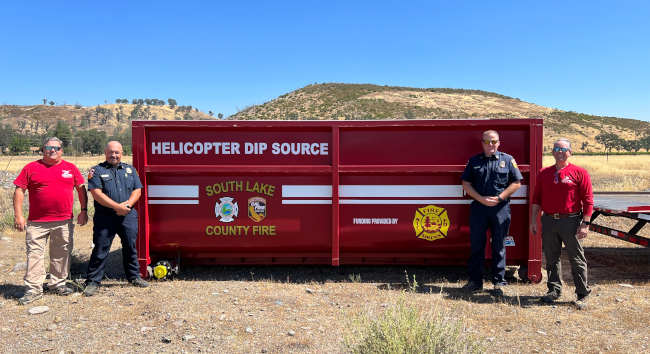
From left, Bill Ward, Assistant Fire Chief Paul Duncan, Battalion Chief Brian York and Walt Dorn following the delivery of the new HeloPods at the Middletown Fire Station in Middletown, California, on Thursday, August 18, 2022. Photo courtesy of Cal Fire. MIDDLETOWN, Calif. — A generous donation from the South Lake Fire Sirens Auxiliary Group has allowed South Lake County Fire Protection District to order two new generation portable dip tanks known as HeloPods.
The HeloPod is a groundbreaking product manufactured in Simi Valley, California, designed and built as a mobile Helicopter Dip Tank and Cistern for large helicopters.
This game changing tool helps get a water dip site set up quickly during an incident. With the quick set-up, firefighters will only need to connect the hoses to the hydrant, then helicopters are ready to start pulling water from it, while still hovering, greatly reducing turnaround times.
South Lake County Fire joins San Diego County Fire and Riverside County Fire deploying these HeloPods in their areas.
Other departments include but are not limited to Los Angeles County Fire, Santa Barbara County Fire and Orange County Fire.
Soon to follow is another leader in Northern California, the Northern Sonoma County Fire District.
With the new CAL FIREHAWK, while much more fire capable, water sources can be more challenging to find.
The HeloPod builds on the broader goal for the South Lake Fire Protection District to improve our community's fire readiness and capabilities.
This first started with "Operation Force Multiplier,” a region-first program that has put firefighting tools and extinguishers in the hands of our residents.
The second was the purchase of Engine 6061, South Lake County Fire's new Type 6 wildland firefighting engine. Engine 6061 is smaller, lighter, faster, and more capable for off-road use.
Regarding the HeloPod, Assistant Fire Chief Paul Duncan said, "Our Team here at South Lake County Fire has been researching this new type of resource for a few years. When the opportunity presented itself, our research was already done. And with a special thanks to the South Lake Fire Sirens, we were able to do the right thing, increasing the safety of our communities."
Two HeloPods were delivered on Thursday morning. One will be placed within the Middletown area, and the other in the Cobb area.
South Lake County Fire is collaborating with the Cobb Water District and the Callayomi County Water District to supply water to the tanks and local property owners for the locations to place them.
These locations have been chosen for the first locations to help spread water availability throughout the fire district. The Hidden Valley Lake area already has the community lake as a water source.
“It is our group's passion and drive to support our firefighters. We are just thrilled to be able to fund this critical purchase to support the communities in our fire district,” said Carol Olsen, who runs the thrift shop for the Fire Sirens.
South Lake Fire Protection District as well as the Cal Fire Sonoma-Lake-Napa Unit is excited to have these game changing tools located within our responsibility areas.
For more information about the HeloPods, see the video below or contact South Lake County Fire Protection District.
COBB, Calif. — Cobb resident Larry Allen has thrown his hat into the ring to run for Middletown Unified School District Board of Trustees in the upcoming Nov. 8 election.
Currently serving on the MUSD School Board as president, Allen hopes to be reelected for an additional two-year term.
Allen is a longtime Cobb resident, a retired MUSD teacher of 35 years, and an involved community member.
He coached football and wrestling at the high school for several years. Additionally, he served on the California Teachers Association’s Board of Directors — which served nine counties in Northern California, including Lake County — for 11 years.
“My experiences in the classrooms, in the athletic arenas, and as a teacher advocate give me a unique perspective of the workings and priorities of schools,” Allen said. “It’s a given that the highest priority is to best serve our students, but let’s remember those in the trenches day in and day out. If we forget our educators, or put them on the ‘back burner’ we might lose them to other districts. To recruit and retain the best and brightest we have to place them above ‘stuff’.”
Allen raised his family on Cobb, and his children attended Middletown schools from kindergarten through their graduation from Middletown High School.
“I believe my kids got a wonderful, well-rounded education here, and I believe that we are on track to deliver the best education Lake County has to offer,” Allen said.
Listening to all parents is paramount to being able to make the wisest decisions as a board member, Allen said.
“MUSD has had its share of turmoil, and now we’ve found our groove,” Allen said. “Our current board is experienced, thoughtful and wise. I am honored to serve on the current board, and I support the reelection bids of my fellow incumbents, Chris Ochs and Allison Berlogar. Additionally, I think that candidate Annette Lee — currently serving as the dean of Woodland Community College — will be an excellent addition to the board. I look forward to continuing our ongoing work of supporting our schools and striving to be as inclusive, as enriching, and as academically excellent as possible.”
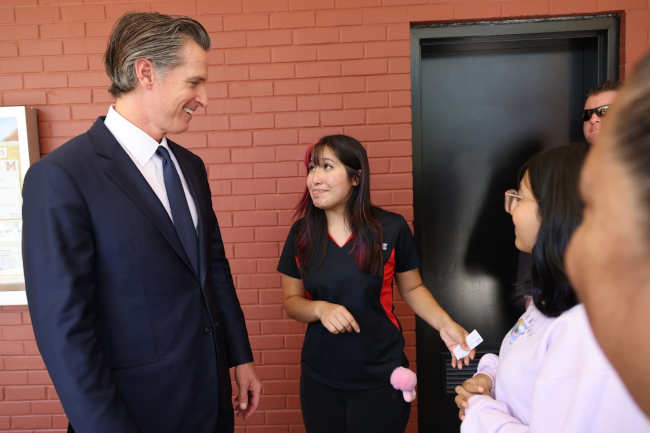
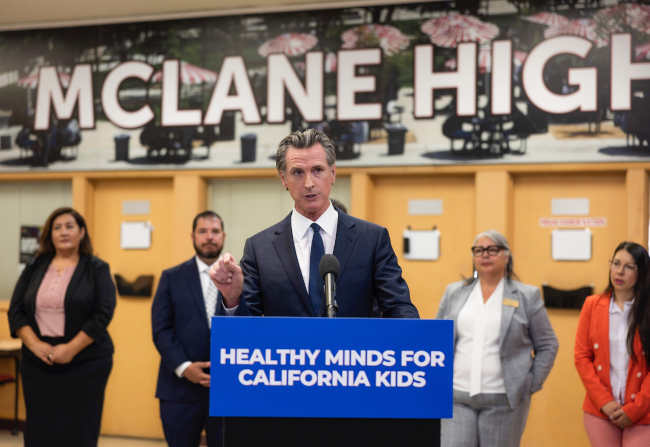
Gov. Gavin Newsom unveils the new plan to transform children’s mental health at McLane High School in Fresno, California, on Thursday, August 18, 2022. Photo courtesy of the Governor’s Office.
With children across California headed back to school, Gov. Gavin Newsom on Thursday unveiled California’s Master Plan for Kids’ Mental Health to ensure all California kids, parents and communities have increased access to mental health and substance use services.
Nationally, children are reporting symptoms of depression and anxiety at record rates and are considering or attempting suicide at historic levels.
Here in California, about one-third of seventh and ninth graders and half of 11th graders experienced chronic sadness in the 2020-2021 school year and it’s estimated that 1 in 10 kids between the ages of 12 and 17 suffered from at least one major depressive episode in the last year. Suicide rates for California youth ages 10 to 18 increased by 20% from 2019 to 2020.
California is taking urgent action to address this crisis. For kids and families needing help now, some elements of the governor’s plan are already available to all California kids, including the Children’s Mental Health Resources Hub, which offers kids and parents a central hub for a variety of resources, including several support hotlines, CalHOPE and informational guides on suicide and depression warning signs.
The governor unveiled the plan at McLane High School in Fresno, which provides social emotional support services for students with a dedicated social emotional support staff made up of psychologists, social workers, and welfare specialists.
Over the past decade, the Fresno Unified School District has increased mental health staffing from around 50 to more than 200 professionals.
The Master Plan for Kids’ Mental Health provides funding to schools across the state to offer the same kind of resources McLane and Fresno Unified does.
“Mental and behavioral health is one of the greatest challenges of our time. As other states take away resources to support kids’ mental health, California is doubling down with the most significant overhaul of our mental health system in state history,” Governor Newsom said. “We’re investing billions of dollars to ensure every California child has better access to comprehensive mental health and substance use services. The Master Plan for Kids’ Mental Health is premised on a very simple belief: every single kid deserves to have their mental health supported. That’s the California Way – putting our kids first.”
The governor also signed AB 2508 by Assemblymember Sharon Quirk-Silva (D-Fullerton) to better define the role of school counselors that recognizes the importance of access to mental health.
Over the last three years, California has launched an historic overhaul of the state’s mental health system – investing $4.7 billion to boost coverage options and public awareness so all children and youth are routinely screened, supported, and served. The funding creates new virtual platforms and establishes a new pipeline for the mental health workforce, adding 40,000 new mental health workers in the state.
Other investments include:
• $4.1 billion on a community schools strategy to connect kids and families to essential services including health screenings, meals and more.
• $5 billion on a Medi-Cal initiative, CalAIM, to better integrate health and behavioral health services for low-income kids.
• $1.4 billion to build a more diverse healthcare workforce that expands our capacity to meet the health needs of Californians, including children and families.
“As a parent, there’s nothing worse than seeing your child in pain and feeling powerless to help. And that’s the case for far too many families around the country with children struggling with serious issues such as depression and anxiety without access to the care they need,” said First Partner Jennifer Siebel Newsom. “In California, we take the mental health and wellbeing of our children seriously, and we’re tackling this problem head-on with significant investments in the infrastructure of the state’s mental health system. And for those looking for support today, California’s mental health resource hub for youth is connecting parents, caregivers, educators, and children with the resources and support kids need to improve their mental health and build healthy wellness habits and practices that will help them thrive.”
“I truly believe every student would benefit from a connection with a mental health counselor and I am hopeful we will continue to see a positive change from investments in social emotional support for our students and I know Governor Gavin Newsom can provide students with the much needed resources to successfully navigate life,” said Aliyah Barajas, a senior at McLane High School.
Gov. Gavin Newsom announces California’s Master Plan for Kids’ Mental Health at McLane High School in Fresno, California, on Thursday, August 18, 2022. Photo courtesy of the Governor’s Office.
The Master Plan for Kids’ Mental Health outlines action across three key pillars:
Healthy Minds for California Kids
• Provide Medi-Cal coverage for parent-child services
• Make it easier for schools to provide prevention and treatment
• De-stigmatize mental health support for kids
• Offer additional resources for parents
Rebuilding California’s Mental Health Systems
• Create new virtual platforms
• Expand early interventions
• More school counselors
• Expand clinic and treatment slots
• Develop a suicide prevention program
Developing a Mental Health Workforce
• Hire, train, and engage 40,000 new mental health workers
• Expand remote access to services
• Training for teachers
The plan announced today will make it easier than ever before for kids to access critical mental health and substance use services – in their schools, in their homes and in their communities. Read the full Master Plan for Kids’ Mental Health here.
If you or a friend or loved one is having suicidal thoughts, call the National Suicide Prevention Lifeline: call or text 988 or chat at www.988lifeline.org/.
 How to resolve AdBlock issue?