 How to resolve AdBlock issue?
News
On Thursday, Rep. Mike Thompson (CA-05) announced $9 million in new grant opportunities from the Bipartisan Infrastructure Law to advance research into wildfire prevention and post-fire restoration on federal lands.
The Joint Fire Science Program is accepting applications for grants to research innovative fuels treatments and post-fire rehabilitation efforts through Dec. 20, 2022, for fiscal year 2023.
The Bipartisan Infrastructure Law is bringing much-needed support to communities across the country to increase the resilience of lands facing the threat of wildland fires and to better support federal wildland firefighters.
“The Bipartisan Infrastructure Law is delivering much needed funding to assist our communities in combating the impact of climate change,” said Thompson. “As California remains on the front lines of the climate crisis, wildfires pose a significant risk and it remains a top priority to provide the funding we need to mitigate the risk of wildfires and protect our communities.”
“With increasing wildfire activity due to climate change, it is imperative we fund research to better understand how to manage fire prone landscapes now and into the future,” said Grant Beebe, Bureau of Land Management assistant director of fire and aviation, based at the National Interagency Fire Center. “The Joint Fire Science Program brings the science and management community together in a unique, collaborative manner so that research can be used to make sound decisions on the ground.”
This funding is in addition to $3.4 billion in wildfire suppression and mitigation included in the Bipartisan Infrastructure Law.
This includes investments such as:
• $600 million to increase federal firefighter salaries by up to $20,000/year and convert at least 1,000 seasonal firefighters to year-round positions.
• $500 million for hazardous fuels mitigation.
• $500 million for prescribed fires.
• $500 million for communities to implement their community wildfire defense plan, a collaborative plan to address local hazards and risks from wildfire.
• $500 million for developing control locations and installing fuel breaks.
• $100 million for preplanning fire response workshops and workforce training.
• $40 million for radio frequency interoperability and to create Reverse-911 systems.
• $20 million for NOAA to create a satellite that rapidly detects fires in areas the federal government has financial responsibility.
• $10 million to procure real-time wildfire detection and monitoring equipment in high-risk or post-burn areas.
Funding opportunities for wildland fire research priorities are posted on the Joint Fire Science Program’s website.
Thompson represents California’s Fifth Congressional District, which includes all or part of Contra Costa, Lake, Napa, Solano and Sonoma counties.
The Joint Fire Science Program is accepting applications for grants to research innovative fuels treatments and post-fire rehabilitation efforts through Dec. 20, 2022, for fiscal year 2023.
The Bipartisan Infrastructure Law is bringing much-needed support to communities across the country to increase the resilience of lands facing the threat of wildland fires and to better support federal wildland firefighters.
“The Bipartisan Infrastructure Law is delivering much needed funding to assist our communities in combating the impact of climate change,” said Thompson. “As California remains on the front lines of the climate crisis, wildfires pose a significant risk and it remains a top priority to provide the funding we need to mitigate the risk of wildfires and protect our communities.”
“With increasing wildfire activity due to climate change, it is imperative we fund research to better understand how to manage fire prone landscapes now and into the future,” said Grant Beebe, Bureau of Land Management assistant director of fire and aviation, based at the National Interagency Fire Center. “The Joint Fire Science Program brings the science and management community together in a unique, collaborative manner so that research can be used to make sound decisions on the ground.”
This funding is in addition to $3.4 billion in wildfire suppression and mitigation included in the Bipartisan Infrastructure Law.
This includes investments such as:
• $600 million to increase federal firefighter salaries by up to $20,000/year and convert at least 1,000 seasonal firefighters to year-round positions.
• $500 million for hazardous fuels mitigation.
• $500 million for prescribed fires.
• $500 million for communities to implement their community wildfire defense plan, a collaborative plan to address local hazards and risks from wildfire.
• $500 million for developing control locations and installing fuel breaks.
• $100 million for preplanning fire response workshops and workforce training.
• $40 million for radio frequency interoperability and to create Reverse-911 systems.
• $20 million for NOAA to create a satellite that rapidly detects fires in areas the federal government has financial responsibility.
• $10 million to procure real-time wildfire detection and monitoring equipment in high-risk or post-burn areas.
Funding opportunities for wildland fire research priorities are posted on the Joint Fire Science Program’s website.
Thompson represents California’s Fifth Congressional District, which includes all or part of Contra Costa, Lake, Napa, Solano and Sonoma counties.
LAKE COUNTY, Calif. — Community members and landowners are invited to a two-day workshop that will focus on the work to protect communities from wildfire and to restore lands damaged by fires.
FireScape Mendocino will host the in-person “Collaborative Planning Workshop for Wildfire Resilience and Post-fire Restoration” workshop on Wednesday, Nov. 16, and Thursday, Nov. 17.
The workshop is free. Participants should plan to attend both days and should register in advance online at https://bit.ly/Firescape-14.
FireScape Mendocino is a collaborative of private citizens and public organizations focused on creating more fire-resilient landscapes in and around the Mendocino National Forest. This is the 14th workshop hosted by the organization.
The group said private landowners and land managers interested in learning potential operational delineations, or PODs, for wildfire resilience and the Mendocino National Forest’s post-fire restoration strategy should attend.
The group said speakers from tribes, local and federal agencies will be presenting information and looking for public feedback.
Topics planned for the workshop include forest restoration and resiliency on the Upper Lake Ranger District, potential operational delineations, or PODs, planning process and values at risk and ecologically-based post-fire restoration for Mendocino National Forest.
The workshop schedule includes a field trip to the Upper Lake Ranger District on Nov. 16. Participants should meet at the Robinson Rancheria Resort and Casino, 1545 E. State Hwy 20, Nice, Calif., at 8:30 am before carpooling to the forest.
On Nov. 17, the workshop will be conducted at the Robinson Rancheria Resort and Casino from 8:30 am to 4 pm.
Bob Schneider is working with FireScape Mendocino on the workshop and is co-lead on the core management team. He generally works to represent the conservation community and general public.
Schneider said California is being subdivided into PODS, a management tool for fire and fuel that also can help with fire restoration and planning. POD boundaries are never finalized, but constantly updated and refined.
He said the concept came out of the Rocky Mountain Research Station.
The U.S. Forest Services explains that PODs are “fire management and planning units whose boundaries are defined by potential control features (e.g., roads, natural barriers), and within which fire risk to values can be quantified and summarized.”
From a firefighter perspective, Schneider said PODs include ridges, roads and areas where firefighters can manage, control or direct fires.
The PODs concept extends beyond physical boundaries, but also what an area includes — such as cultural and important biological resources, Schneider said. “It’s kind of a preplanning management tool.”
As an example, with the 2018 Ranch fire, when it was burning north, Schneider said firefighters felt they would be able to use Brushy Ridge as a control line. “That actually worked at that location.”
Schneider said PODs are being used throughout Lake County, including by Cal Fire.
“I don’t think Lake County per se has had any workshops or involvement with PODs to date, so this is one of the first opportunities,” he said.
While this workshop is about the Mendocino National Forest, it also will inform people about what might happen in Lake County to manage wildfire if it occurs, Schneider said.
Schneider said he attended a workshop at Pepperwood Preserve in Santa Rosa almost a year ago in which they were discussing the west side of the Mendocino National Forest. However, he felt they needed to be doing something for the whole forest, and that became the genesis of this month’s workshop.
He pointed out that in Lake County, all along the Northshore, the top of the ridge is bordered by the Mendocino National Forest.
The question is, how should these areas be best managed for the values of the communities and the forest, and prevent fires from moving back and forth between them, Schneider said, explaining the Nov. 16 field trip will look at that aspect.
The workshop will then move to forest resilience and management and what kind of forest to work toward. “We kinda have this blank slate right now,” Schneider said.
At the workshop, Schneider said they will have two means of engagement for the public — paper maps as well as the link to the online map, available on this page, for people to access, consider and to use for submitting comments in sharing their interests and values.
He said FireScape Mendocino can’t make decisions but can provide information to the forest, which can then take the suggestions and use them for planning and restoration projects.
Schneider said this process is an opportunity to come together to address fire in the region. “It can lead to an ability to have more prescribed fire.”
Email Elizabeth Larson at
LAKE COUNTY, Calif. — Each Veterans Day, we acknowledge and celebrate the sacrifices of people in our communities, and across the nation, who have chosen to serve in the United States Armed Forces.
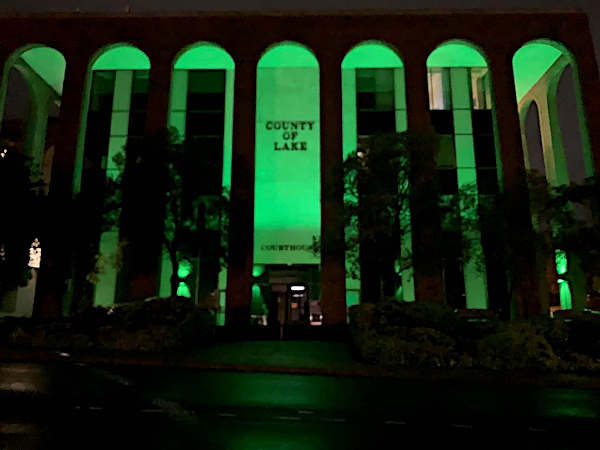
On Tuesday, Nov. 8, the Lake County Board of Supervisors voted to join Operation Greenlight, a nationwide effort to highlight veterans and the challenges they face.
Through Nov. 13, the Lake County Courthouse will shine green each night, a visible statement that the county stands in solidarity with our veterans and other participating jurisdictions nationwide.
Lake County has one of the highest veteran populations, per capita, in California. Services are available to support veterans and their families with management of housing, medical, and mental and behavioral health-related concerns.
The Veterans Affairs, or VA, clinic, located at 15145 Lakeshore Drive in Clearlake, offers primary care and specialty health services, including audiology, podiatry, outpatient mental health services. Rideshares are accessible to those referred to Bay Area facilities for a higher level of care. For further information, call 707-995-7200.
The Lake County Veteran Services office assists veterans, their dependents, and survivors in obtaining federal, state, and local supports.
Lake County veterans can get information regarding entitlement to benefits, as well as advocacy and professional assistance.
This can include support accessing compensation due to injury or diseases, dependent allowances, admissions to State Veterans Homes, medical and dental benefits, and other services.
Lake County Veterans Services Officer, Saul Sanabria, can be reached at 707-263-2384, or by email, at
The Employment Development Department of California also has a consolidated veterans representative, Chris Taliaferro. He encourages business owners to hire veterans, and helps veterans gain employment.
Taliaferro has also been instrumental in recent and ongoing efforts to house Lake County’s unsheltered veterans.
He appreciates the mental health and other hardships many veterans face, and how being out in the elements can complicate many aspects of daily life.
Taliaferro has played an important role in Stand Down and Vet Connect events around the county. These events, held throughout the year, offer connection to services, including non-veteran services, access to food and clothing, and camaraderie.
Taliaferro can be reached at 707-262-3111 or
This Friday, Nov. 11, please join in celebrating all veterans. Their sacrifice, bravery, and service is vital to our great country’s continued work to become a more perfect union.
LAKE COUNTY, Calif. — The county of Lake has hired its new chief climate resiliency officer, a position funded by a state grant program.
Officials said Terre Logsdon has been appointed to the position, effective Dec. 5.
On June 30, the California Governor’s Office of Emergency Services and county officials announced Lake County’s selection among six communities for the first-ever round of Prepare California “Jumpstart” grants, intended to provide resiliency funding to disaster-vulnerable communities,
Lake County was awarded $636,545 to support hiring of a chief climate resiliency officer. This marks the first time a full-time county position has been dedicated to this purpose.
The performance period for this grant runs through June 30, 2027.
Since 2018, Logsdon has served as environmental director and chief operations officer for Scotts Valley Band of Pomo Indians.
She has represented the tribe on the Lake County Community Risk Reduction Authority, Blue Ribbon Commission for the Rehabilitation of Clear Lake, the Scotts Valley Community Advisory Council and its groundwater protection subcommittee.
Logsdon also assisted in development of the first-ever Federal Emergency Management Agency-approved Multi-Jurisdictional/Multi-Tribal Hazard Mitigation Plan.
As chief operations officer of Scotts Valley’s The Clean Carbon Corp., Logsdon explored bioenergy and biochar production, a means of turning waste woody biomass into renewable energy and a highly sought-after soil amendment that retains nutrients and water.
Logsdon earned a master’s degree in management/managerial leadership in 2001, and has extensive experience in leadership roles in the public, private and nonprofit sectors.
As chief climate resiliency officer, Logsdon will function as part of the County Administrative Office team, with a full-time focus on preparing Lake County to mitigate the effects of global climate change.
Logsdon will be responsible for bringing together a wide array of community stakeholders to identify resiliency challenges, local capabilities, and resource gaps that must be filled.
Feedback gathered through this proactive process and previous planning efforts, including the Community Mitigation Assessment Team report of 2021 and Community Wildfire Protection Plan will inform development of a comprehensive local resilience strategy.
The role is expected to include significant grant writing responsibilities, to fund identified needs.
“The role of chief climate resiliency officer will exercise a complement of strengths Ms. Logsdon has gathered in her previous leadership roles,” said County Administrative Officer Susan Parker. “Our communities have faced repeated and compounding disasters, particularly since 2015. We are now facing severe and pervasive tree mortality.”
Parker added, “Creation of this position was an urgent and necessary investment in our county’s future, and we couldn’t be more grateful that CalOES recognized this need. Ms. Logsdon will have the full support of the County Administrative Office, and I look forward to working with her and supporting her success.”
Officials said Terre Logsdon has been appointed to the position, effective Dec. 5.
On June 30, the California Governor’s Office of Emergency Services and county officials announced Lake County’s selection among six communities for the first-ever round of Prepare California “Jumpstart” grants, intended to provide resiliency funding to disaster-vulnerable communities,
Lake County was awarded $636,545 to support hiring of a chief climate resiliency officer. This marks the first time a full-time county position has been dedicated to this purpose.
The performance period for this grant runs through June 30, 2027.
Since 2018, Logsdon has served as environmental director and chief operations officer for Scotts Valley Band of Pomo Indians.
She has represented the tribe on the Lake County Community Risk Reduction Authority, Blue Ribbon Commission for the Rehabilitation of Clear Lake, the Scotts Valley Community Advisory Council and its groundwater protection subcommittee.
Logsdon also assisted in development of the first-ever Federal Emergency Management Agency-approved Multi-Jurisdictional/Multi-Tribal Hazard Mitigation Plan.
As chief operations officer of Scotts Valley’s The Clean Carbon Corp., Logsdon explored bioenergy and biochar production, a means of turning waste woody biomass into renewable energy and a highly sought-after soil amendment that retains nutrients and water.
Logsdon earned a master’s degree in management/managerial leadership in 2001, and has extensive experience in leadership roles in the public, private and nonprofit sectors.
As chief climate resiliency officer, Logsdon will function as part of the County Administrative Office team, with a full-time focus on preparing Lake County to mitigate the effects of global climate change.
Logsdon will be responsible for bringing together a wide array of community stakeholders to identify resiliency challenges, local capabilities, and resource gaps that must be filled.
Feedback gathered through this proactive process and previous planning efforts, including the Community Mitigation Assessment Team report of 2021 and Community Wildfire Protection Plan will inform development of a comprehensive local resilience strategy.
The role is expected to include significant grant writing responsibilities, to fund identified needs.
“The role of chief climate resiliency officer will exercise a complement of strengths Ms. Logsdon has gathered in her previous leadership roles,” said County Administrative Officer Susan Parker. “Our communities have faced repeated and compounding disasters, particularly since 2015. We are now facing severe and pervasive tree mortality.”
Parker added, “Creation of this position was an urgent and necessary investment in our county’s future, and we couldn’t be more grateful that CalOES recognized this need. Ms. Logsdon will have the full support of the County Administrative Office, and I look forward to working with her and supporting her success.”
As we enter winter and the holiday season, the California Department of Public Health urges Californians to protect themselves and their families against many circulating viruses this holiday season, including the flu, COVID-19, and respiratory syncytial virus, or RSV.
“Our winter virus season is here early, especially for our kids. We are seeing stress on our clinics and hospitals that care for kids, especially infants and kids under 12,” said State Public Health Officer and CDPH Director Dr. Tomás Aragón. “It’s important to remember that kids get infected from other kids and adults, so everyone needs to do their part. As we head into the holiday season with more indoor gatherings and travel, there are five easy steps that can help keep you and your family healthy.”
Dr. Aragón’s five tips to protect yourself and others from severe illness and hospitalization include:
Get vaccinated, boosted (and treated). Flu and COVID-19 vaccines continue to be your best defense to limit severe illness and death — and you can get both at the same time. If you test positive for COVID-19, contact your doctor or a test-to-treat site immediately to seek treatment. Treatments work best when started right after symptoms begin.
Stay home if you’re sick! It’s crucial to stay home if you are feeling ill. Avoid close contact with others to protect them, and take the time you need to heal. This is especially important for respiratory viruses like the flu, RSV and COVID-19, which can lead to more severe illness.
Wear a mask. There is no vaccine for RSV, so wearing a mask can significantly slow the spread and protect babies and young children who do not yet have immunity and are too young to wear a mask themselves. Wearing a mask in indoor public places is a good way to limit the spread of germs.
Wash your hands. Your mom was right: frequent hand-washing, with soap and warm water — for at least 20 seconds, is an easy way to prevent getting sick and spreading germs.
Cover your cough or sneeze. Remember to cough or sneeze into your elbow, your arm, or a disposable tissue to help prevent the spread of winter viruses. Just make sure to wash your hands or sanitize and dispose of your tissue after.
CDPH continues to monitor hospitalizations related to winter respiratory viruses, including flu, COVID-19, and RSV, as well as trends across the country and state.
With many viruses already circulating at high levels in California, it is important to take these measures to ensure our hospitals have capacity to care for all vulnerable Californians, including babies and children, who need lifesaving treatment.
LAKE COUNTY, Calif. — The general election in Lake County saw voters casting ballots for numerous local races, from city councils to school and fire boards, with the final count set to start this week.
"It was busy today,” said Registrar of Voters Maria Valadez on Tuesday evening.
Valadez said there was “steady turnout” throughout the day.
She and her staff worked into the early morning hours on Wednesday to complete the preliminary tally of votes.
Challenges with the county’s website led to results not being posted online until late Tuesday night.
By 1 a.m. Wednesday, Valadez’s office had issued the last preliminary ballot count of the night, which included the election night initial count for all 80 Lake County precincts.
The Registrar of Voters Office now moves into the canvass period to finalize the results and certify the election.
The preliminary count included 7,842 ballots, or 21.2% of Lake County’s 37,165 registered voters.
However, as is usual in elections, those numbers will change throughout the canvass period as more vote-by-mail ballots arrive at the elections office to be counted, and as other ballots — including provisionals — are tallied.
The Secretary of State’s Office said election results will be certified across the state by Dec. 16.
School board seats among leading races
With assessor-record, district attorney, sheriff and supervisorial races decided in the primary, the key contested races this fall were with local school boards.
For the Kelseyville Unified School District Board, two seats were up for election, with three candidates: Incumbents Allison Panella and Rick Winer, and challenger Janet Rykert.
The preliminary results have Panella and Winer heading for victory, with Panella receiving 40.28%, or 1,034 votes, followed by Winer with 33.39%, or 857 votes. Rykert received 26.33% of the vote, or 676 ballots cast in her favor.
In the Konocti Unified School District race, the three incumbents whose seats are on the ballot led in early results: Bill Diener, 25.28%, 1,089 ballots; Pamela Bening-Hale, 20.59%, 887 ballots cast; and Joan Shelley Mingori, 19.17% or 826 ballots cast.
Trailing in early returns are challengers Marty Aarreberg, 18.38%, 792 ballots, and Jennifer Hughes, 16.57%, or 714 ballots cast.
The Middletown Unified School District had two separate races on the ballot, one for a two-year unexpired term and another race for three full terms.
For the two-year unexpired term, incumbent Larry Allen had a substantial lead in the preliminary returns, with 64.67%, or 736 ballots cast in his favor, to the 402 ballots, making up 35.33% of the vote, cast for challenger Hank Lescher.
For the three full terms, appointed incumbent Chris Ochs led with 661 ballots, or 29.9% of the vote, followed closely by Annette Lee, who he campaigned with and who received 651 votes, or 29.44%.
Ochs and Lee were followed by appointed incumbent Allison Berlogar, with 515 votes, or 23.29%.
In fourth position was Eileen Anderson, whose name was on the ballot but who dropped out early in the race. She received 17.37% or 384 ballots cast.
Annexation, city council seats on the ballot
The city of Lakeport’s long-running effort to conclude an annexation project was up for election.
A small number of voters appeared to have made a decision against Measure P, which would have approved annexing an area along South Main Street into the city of Lakeport.
The early results showed that just three ballots were cast by residents of the annexation area, all of them against the annexation.
Voters in the cities of Clearlake and Lakeport also had council seats to decide.
For Clearlake City Council, incumbents Russ Cremer and Dirk Slooten ran unopposed for reelection. Cremer received 51.41%, or 748 ballots, and Slooten received 48.59%, or 707 ballots.
The city of Clearlake’s treasurer position, which hasn’t had an elected individual in the seat for more than a decade, received no votes, including no write-ins.
For the Lakeport City Council, Mayor Stacey Mattina won a fourth term uncontested, receiving 56.10%, or 437 votes.
Mireya Turner, who served nearly two terms on the council and was on the ballot for a third, received 43.9% of the vote, or 342 votes. However, Turner, who resigned from the Lakeport City Council in August after being appointed Lake County’s Community Development director, is expected to resign the newly won seat, which will then go to an appointment.
In the race for a seat on the Lake County Board of Education, the preliminary count showed Nancy Hudson leading with 74.13% of the vote, or 1,103 ballots cast, followed by Jeffrey Lyon, with 25.87%, or 385 votes.
For Yuba Community College District Trustee Area No. 7, appointed incumbent Douglas M. Harris received 58.21% of the vote, or 1,617 ballots, with challenger Jeffrey Dryden receiving 41.79%, or 1,161 ballots cast in his favor.
Races for special district and fire board seats
There also were several other seats on the ballot for special districts and fire boards.
For the Northshore Fire Protection District’s at-large director seat, incumbent James Burton led with 685 ballots cast in his favor, or 52.81%, to 47.19% or 612 ballots cast for challenger Leah Robbins.
Northshore also had two other seats on the ballot, for the Lucerne and Nice zones.
For Lucerne, challenger Becky Schwenger led with 68.34%, or 177 ballots, to 31.66%, or 82 ballots, for incumbent Gerald Shepherd.
For Nice, John Barnette led with 62.34%, or 149 votes, to 37.66%, or 90 votes, for challenger Lori Carter-Runyon.
The Lake Pillsbury Fire Protection Board had one seat on the ballot, an unexpired two-year term. Heather Hasler received 11 votes, or 78.57%, while Warner Henderson received three votes, or 21.43%.
Three seats were up for the Anderson Springs Community Services District Board of Directors. Karen Coker, Carol Ohsiek and Donna Taylor tied with eight ballots each, or 29.63% of the vote, followed by Cynthia Weber, who received three votes, or 11.11%.
For the three open seats on the Cobb Area County Water District Board of Directors, Joshua Dixon received 32.62%, or 167 ballots; Steve Barnes, 30.47%, or 156 ballots; Joel Pyska received 25.20%, or 129 ballots; and David Peters received 11.72%, or 60 ballots.
Email Elizabeth Larson atThis email address is being protected from spambots. You need JavaScript enabled to view it. . Follow her on Twitter, @ERLarson, or Lake County News, @LakeCoNews.
"It was busy today,” said Registrar of Voters Maria Valadez on Tuesday evening.
Valadez said there was “steady turnout” throughout the day.
She and her staff worked into the early morning hours on Wednesday to complete the preliminary tally of votes.
Challenges with the county’s website led to results not being posted online until late Tuesday night.
By 1 a.m. Wednesday, Valadez’s office had issued the last preliminary ballot count of the night, which included the election night initial count for all 80 Lake County precincts.
The Registrar of Voters Office now moves into the canvass period to finalize the results and certify the election.
The preliminary count included 7,842 ballots, or 21.2% of Lake County’s 37,165 registered voters.
However, as is usual in elections, those numbers will change throughout the canvass period as more vote-by-mail ballots arrive at the elections office to be counted, and as other ballots — including provisionals — are tallied.
The Secretary of State’s Office said election results will be certified across the state by Dec. 16.
School board seats among leading races
With assessor-record, district attorney, sheriff and supervisorial races decided in the primary, the key contested races this fall were with local school boards.
For the Kelseyville Unified School District Board, two seats were up for election, with three candidates: Incumbents Allison Panella and Rick Winer, and challenger Janet Rykert.
The preliminary results have Panella and Winer heading for victory, with Panella receiving 40.28%, or 1,034 votes, followed by Winer with 33.39%, or 857 votes. Rykert received 26.33% of the vote, or 676 ballots cast in her favor.
In the Konocti Unified School District race, the three incumbents whose seats are on the ballot led in early results: Bill Diener, 25.28%, 1,089 ballots; Pamela Bening-Hale, 20.59%, 887 ballots cast; and Joan Shelley Mingori, 19.17% or 826 ballots cast.
Trailing in early returns are challengers Marty Aarreberg, 18.38%, 792 ballots, and Jennifer Hughes, 16.57%, or 714 ballots cast.
The Middletown Unified School District had two separate races on the ballot, one for a two-year unexpired term and another race for three full terms.
For the two-year unexpired term, incumbent Larry Allen had a substantial lead in the preliminary returns, with 64.67%, or 736 ballots cast in his favor, to the 402 ballots, making up 35.33% of the vote, cast for challenger Hank Lescher.
For the three full terms, appointed incumbent Chris Ochs led with 661 ballots, or 29.9% of the vote, followed closely by Annette Lee, who he campaigned with and who received 651 votes, or 29.44%.
Ochs and Lee were followed by appointed incumbent Allison Berlogar, with 515 votes, or 23.29%.
In fourth position was Eileen Anderson, whose name was on the ballot but who dropped out early in the race. She received 17.37% or 384 ballots cast.
Annexation, city council seats on the ballot
The city of Lakeport’s long-running effort to conclude an annexation project was up for election.
A small number of voters appeared to have made a decision against Measure P, which would have approved annexing an area along South Main Street into the city of Lakeport.
The early results showed that just three ballots were cast by residents of the annexation area, all of them against the annexation.
Voters in the cities of Clearlake and Lakeport also had council seats to decide.
For Clearlake City Council, incumbents Russ Cremer and Dirk Slooten ran unopposed for reelection. Cremer received 51.41%, or 748 ballots, and Slooten received 48.59%, or 707 ballots.
The city of Clearlake’s treasurer position, which hasn’t had an elected individual in the seat for more than a decade, received no votes, including no write-ins.
For the Lakeport City Council, Mayor Stacey Mattina won a fourth term uncontested, receiving 56.10%, or 437 votes.
Mireya Turner, who served nearly two terms on the council and was on the ballot for a third, received 43.9% of the vote, or 342 votes. However, Turner, who resigned from the Lakeport City Council in August after being appointed Lake County’s Community Development director, is expected to resign the newly won seat, which will then go to an appointment.
In the race for a seat on the Lake County Board of Education, the preliminary count showed Nancy Hudson leading with 74.13% of the vote, or 1,103 ballots cast, followed by Jeffrey Lyon, with 25.87%, or 385 votes.
For Yuba Community College District Trustee Area No. 7, appointed incumbent Douglas M. Harris received 58.21% of the vote, or 1,617 ballots, with challenger Jeffrey Dryden receiving 41.79%, or 1,161 ballots cast in his favor.
Races for special district and fire board seats
There also were several other seats on the ballot for special districts and fire boards.
For the Northshore Fire Protection District’s at-large director seat, incumbent James Burton led with 685 ballots cast in his favor, or 52.81%, to 47.19% or 612 ballots cast for challenger Leah Robbins.
Northshore also had two other seats on the ballot, for the Lucerne and Nice zones.
For Lucerne, challenger Becky Schwenger led with 68.34%, or 177 ballots, to 31.66%, or 82 ballots, for incumbent Gerald Shepherd.
For Nice, John Barnette led with 62.34%, or 149 votes, to 37.66%, or 90 votes, for challenger Lori Carter-Runyon.
The Lake Pillsbury Fire Protection Board had one seat on the ballot, an unexpired two-year term. Heather Hasler received 11 votes, or 78.57%, while Warner Henderson received three votes, or 21.43%.
Three seats were up for the Anderson Springs Community Services District Board of Directors. Karen Coker, Carol Ohsiek and Donna Taylor tied with eight ballots each, or 29.63% of the vote, followed by Cynthia Weber, who received three votes, or 11.11%.
For the three open seats on the Cobb Area County Water District Board of Directors, Joshua Dixon received 32.62%, or 167 ballots; Steve Barnes, 30.47%, or 156 ballots; Joel Pyska received 25.20%, or 129 ballots; and David Peters received 11.72%, or 60 ballots.
Email Elizabeth Larson at