How to resolve AdBlock issue?
News
The council will meet at 6 p.m. Tuesday, Nov. 15, in the council chambers at Lakeport City Hall, 225 Park St.
The agenda can be found here.
The council chambers will be open to the public for the meeting. Masks are highly encouraged where 6-foot distancing cannot be maintained.
If you cannot attend in person, and would like to speak on an agenda item, you can access the Zoom meeting remotely at this link or join by phone by calling toll-free 669-900-9128 or 346-248-7799.
The webinar ID is 973 6820 1787, access code is 477973; the audio pin will be shown after joining the webinar. Those phoning in without using the web link will be in “listen mode” only and will not be able to participate or comment.
Comments can be submitted by email to
On Tuesday the council will meet new Public Works employees Cody Morland and Lucy Avilez.
The meeting’s main item will be the public hearing on Waterstone Residential’s plan to build 128 apartments and 48 cluster homes at 1310 Craig Ave., next to the original Parkside subdivision near Westside Community Park.
The council had discussed the matter in September and held off on a decision to give the developer additional time to speak with neighbors about their concerns.
Staff is presenting the council with the option of adopting a mitigated negative declaration and mitigation monitoring and reporting program for the Parkside Residential Project’s general plan amendment, zone change and other necessary entitlements for the project based on the information and findings contained in the initial study/environmental review.
The council will consider the project’s general plan amendment revising the existing land use classification of residential for a 3.42-acre portion of the property to high density residential.,
Council members also will consider introducing a proposed zone change that will revise the property’s base zoning from low density residential to high density resident and schedule a public hearing for the second reading of the zone change on Dec. 6.
In other action on Tuesday, the council will hold a public hearing to introduce the draft ordinance modifying city guidelines for outdoor dining design and set a second reading for Dec. 6 and adopt the draft resolution establishing the outdoor dining design guidelines.
Under council business, the council will consider adopting a resolution authorizing the city to submit an application to the California Department of Housing and Community Development for funding under the CPLHA Competitive Permanent Local Housing Allocation Program, and, if selected, authorize the city manager to execute the agreement and other necessary documents and approve the corresponding budget revenue and expense amendments.
On the consent agenda — items usually accepted as a slate on one vote — are ordinances; minutes of the regular council meeting on Nov. 1; adoption of a resolution authorizing continued remote teleconference meetings of the Lakeport City Council and its legislative bodies pursuant to Government Code section 54953(e); confirm the continuing existence of a local emergency for the COVID-19 Public Health Emergency; conduct a second reading and adopt the ordinance amending Chapter 15.04 of the Lakeport Municipal Code regarding the text of the 2022 Building Code Adoption; adoption of a resolution approving a memorandum of understanding with the Lakeport Police Officers’ Association for the period of Nov. 15, 2022, to June 30, 2025; and authorize the recruitment of an administrative specialist or permit technician in the Community Development Department.
Email Elizabeth Larson at

CLEARLAKE, Calif. — The Clearlake Police Department said it is asking for the community’s assistance in locating a missing woman.
Angelina Trisha Fagundo, 34, was last heard from while on her way back to Clearlake from the Vacaville area.
She is described as a black female adult, 5 feet 10 inches tall and approximately 205 pounds, with black hair and brown eyes.
If you have any information regarding her please contact the Clearlake Police Department at 707-994-8251, Extension 1 for dispatch.
The board will meet beginning at 9 a.m. Tuesday, Nov. 15, in the board chambers on the first floor of the Lake County Courthouse, 255 N. Forbes St., Lakeport.
The meeting can be watched live on Channel 8, online at https://countyoflake.legistar.com/Calendar.aspx and on the county’s Facebook page. Accompanying board documents, the agenda and archived board meeting videos also are available at that link.
To participate in real-time, join the Zoom meeting by clicking this link.
The meeting ID is 978 1805 4172, pass code 124753. The meeting also can be accessed via one tap mobile at +16694449171,,97818054172#,,,,*124753#.
All interested members of the public that do not have internet access or a Mediacom cable subscription are encouraged to call 669-900-6833, and enter the Zoom meeting ID and pass code information above.
To submit a written comment on any agenda item visit https://countyoflake.legistar.com/Calendar.aspx and click on the eComment feature linked to the meeting date. If a comment is submitted after the meeting begins, it may not be read during the meeting but will become a part of the record.
At 9:15 a.m. Tuesday, staff will present to the board the redesigned county website.
Staff reported that the redesigned CivicPlus-supported website is expected to launch publicly that morning at https://www.lakecountyca.gov/.
In an untimed item, the board will consider awarding a bid for $449,900.00 to R&B Electronics-Electrical Contracting for the Hill Road Correctional Facility Tower Electronics Security Systems Upgrade Project.
The full agenda follows.
CONSENT AGENDA
5.1: Approve continuation of proclamation of the existence of a local emergency due to pervasive tree mortality.
5.2: Adopt resolution amending Resolution No. 2022-119 establishing position allocations for Fiscal Year 2022-2023, Budget Unit No. 1012, Administrative Office.
5.3: Approve Board of Supervisors minutes for Oct. 25 and Nov. 1, 2022.
5.4: Approve continuation of resolution authorizing teleconferenced meetings during a state of emergency continue to exist.
5.5: Approve continuation of a local health emergency related to the 2019 Coronavirus (COVID-19) as proclaimed by the Lake County Public Health officer.
5.6: Approve continuation of a local emergency due to COVID-19.
5.7: Approve Continuation of an emergency declaration for drought conditions.
5.8: Approve a multi-year agreement with Peterson Tractor Co. for the servicing and repairs of county-owned heavy equipment used at the Eastlake Landfill for an annual amount not-to-exceed $300,000, and authorize the chair to sign.
5.9: Adopt resolution expressing support for the Lower Lake Light Parade and Street Fair, and temporarily authorizing a road closure, prohibiting parking and authorizing removal of vehicles and ordering the posting of signs.
5.10: Approve amendment four to the agreement between the county of Lake and Quincy Engineering Inc. for engineering services for replacement of Bartlett Creek Bridge at Bartlett Springs Road (14C-0099) and rehabilitation of Cache Creek Bridge at Bartlett Springs Road (14C-0107) in Lake County and authorize the chairman to execute said amendment.
5.11: Approve and sign the agreement between county of Lake and Creative Resources Strategies LLC. for the development of an invasive mussel introduction rapid response containment transition plan for Clear Lake in Lake County.
TIMED ITEMS
6.2, 9:15 a.m.: Presentation of redesigned county of Lake website.
6.3, 9:30 a.m.: Public hearing, request for hearing (appeal) by Thomas D. Humphrey (property owner) 13231 Second St., Clearlake Oaks, CA / APN#035-412-16.
6.4, 9:40 a.m.: Public hearing, request for hearing (appeal) by Thomas D. Humphrey for:13221 Second St., Clearlake Oaks, CA / APN#035-412-15.
UNTIMED ITEMS
7.2: Consideration of the following Advisory Board Appointment: Lower Lake Cemetery District.
7.3: Consideration of the award of Bid No. 22-30 for the Hill Road Correctional Facility Tower Electronics Security Systems Upgrade Project in the amount of $449,900.00 to R&B Electronics-Electrical Contracting, and authorize the chair to sign the agreement and notice of award.
CLOSED SESSION
8.1: Conference with legal counsel: Existing litigation pursuant to Gov. Code Sec. 5456.9(d)(1) – City of Clearlake v. County of Lake, et al.
Email Elizabeth Larson at

First it was the “Great Resignation.” Then it was “nobody wants to work anymore.” Now it’s “quiet quitting.”
Yet it seems like no one wants to talk about what I see as the root cause of America’s economic malaise – work under contemporary capitalism is fundamentally flawed.
As a political philosopher studying the effects of contemporary capitalism on the future of work, I believe that the inability to dictate and meaningfully control one’s own working life is the problem.
Democratizing work is the solution.
The problem of work
What can be said about the malaise surrounding work under capitalism today?
There are at least four major problems:
First, work can be alienating. Workers are often not in control of how they work, when they work, what is done with the goods and services they produce, and what is done with the profits made from their work.
This is particularly evident in the rise of precarious forms of work, like those that are found in the gig economy.
According to the Pew Research Center, there’s been a decline in people finding meaning in their work. Nearly half of front-line managers and employees do not think that they can “live their purpose” through their jobs.
Second, workers are not paid the full value of their labor. Real wages have not kept pace with productivity, driving economic inequality and a decline in labor’s share of income.
Third, people are time poor. In the U.S., full-time employed workers work an average of 8.72 hours per day despite productivity increases. Long working hours, along with a number of other factors, contribute to the feeling of “time poverty,” which has a negative impact on psychological well-being.

Fourth, automation puts jobs and wages at risk. While technological innovation could in theory liberate people from the 40-hour workweek, as long as changes aren’t made to the structure of work, automation will simply continue to exert downward pressure on wages and contribute to increases in precarious employment.
Ultimately, the potential of automation to reduce working hours is inconsistent with the profit motives of capitalist companies.
Humanize work or reduce it?
On the one hand, many people lack work that is personally meaningful. On the other hand, many are also desperate for a more complete life – one that allows for creative self-expression and community-building outside of work.
So, what is to be done with the problem of work?
There are two competing visions of the best way to arrive at a solution.
The first is what Kathi Weeks, author of “The Problem with Work,” calls the “socialist humanist” position. According to socialist humanists, work “is understood as an individual creative capacity, a human essence, from which we are now estranged and to which we should be restored.”
In other words, jobs often make workers feel less human. The way to remedy this problem is by re-imagining work so that it is self-determined and people are better compensated for the work they do.
The second is what’s known as the “post-work” position. The post-work theorists believe that while doing some work might be necessary, the work ethic, as a prerequisite for social value, can be corrosive to humanity; they argue that meaning, purpose and social value are not necessarily found in work but instead reside in the communities and relationships built and sustained outside of the workplace.
So people should be liberated from the requirement of work in order to have the free time to do as they please, and embrace what French-Austrian philosopher André Gorz called “life as an end in itself.”
While both positions might stem from theoretical disagreements, is it possible to have the best of both worlds? Can work be humanized and play a less central role in our lives?
Democratic worker control
My own research has focused on what I see as a critical answer to the above question: democratic worker control.
Democratic worker control – where companies are owned and controlled by the workers themselves – is not a new concept. Worker cooperatives are already found in many sectors throughout the U.S. and elsewhere around the globe.
In contrast to how work is currently organized under capitalism, democratic worker control humanizes work by allowing workers to determine their own working conditions, to own the full value of their labor, to dictate the structure and nature of their jobs and, crucially, to determine their own working hours.
This perspective recognizes that the problems people face in their working lives are not merely the result of an unjust distribution of resources. Rather, they result from power differentials in the workplace. Being told what to do, when to do it and how much you will earn is an alienating experience that leads to depression, precarity and economic inequality.

On the other hand, having a democratic say over your working life means the ability to make work less alienating. If people have democratic control over the work they do, they are unlikely to choose work that feels meaningless. They can also find their niche and figure out what’s fulfilling to them within a community of equals.
Democratizing work also leads to an increase in labor’s share of income and a reduction in economic inequality. It has been shown that unionized workers earn an average of 11.2% more in wages than nonunionized workers in similar industries. Income inequality is also much lower in worker cooperatives compared with capitalist companies.
But work should not be confused with the whole of life. Nor should it be assumed that a sense of purpose, a sense of belonging and the acquisition of new skills can’t occur outside of work. Playing, volunteering and worshipping can all do the same.
However, in capitalist companies, labor-saving technologies do not afford workers with more leisure time. Instead, labor-saving technologies mean workers are more likely to face unemployment and downward pressure on wages.
Under democratic worker control, workers can choose to prioritize values that are consistent with themselves rather than the dictates of profit-seeking shareholders. Labor-saving technologies make it more likely that leisure time can become a choice. Workers are free to assert their own values, including that of less work and more play.
A mosaic approach
Of course, democratic worker control is not a silver bullet to economic discontent, and these changes to the workplace can’t occur in a vacuum.
For instance, trials of a four-day workweek without a reduction in pay are increasingly popular, and they have had resounding success in both the United Kingdom and Iceland. Workers report feeling less stressed and less burned out. They have a better work-life balance and report being just as productive, if not more so. Federal legislation to reduce working hours without a reduction in pay, such as through the implementation of a four-day workweek, could accompany a movement for democratic worker control.
The expansion of social services, the development of a public banking system and the provision of a universal basic income may also be important components of meaningful change. A broader movement to democratize the U.S. economy is needed if society is going to take the challenges of work in the 21st century seriously. In short, I believe a mosaic of approaches is necessary.
But one thing is clear: As long as work remains the dictates of shareholders rather than the workers themselves, much work will remain a source of alienation and will persist as an organizing feature of American life.
Alec Stubbs, Postdoctoral Fellow of Philosophy, UMass Boston
This article is republished from The Conversation under a Creative Commons license. Read the original article.
Call Lake County Animal Care and Control at 707-263-0278 or visit the shelter online at http://www.co.lake.ca.us/Government/Directory/Animal_Care_And_Control.htm for information on visiting or adopting.
The following cats at the shelter have been cleared for adoption.

‘Mom’
“Mom” is a 2-year-old female domestic shorthair cat with an orange and white coat.
She is in cat room kennel No. 3, ID No. LCAC-A-4080.

Female domestic shorthair
This 2-year-old female domestic shorthair cat has a gray tabby coat.
“She is an adult cat with some playful kitten tendencies when toys are brought out. She has a sweet little meow and likes to have playful chats with you,” shelter staff said.
She is in cat room kennel No. 10, ID No. LCAC-A-3661.

Male domestic shorthair
This 3-year-old male domestic shorthair cat has an orange tabby coat.
“This guy can be shy at first, but once he knows that you are all about the pets, he will roll right over and start his purr machine. He has a unique curly tail which he flicks around when curious,” shelter staff said.
He is in cat room kennel No. 13, ID No. LCAC-A-4021.

Female domestic shorthair kitten
This 3-month-old female domestic shorthair kitten has a gray and white coat.
Staff said the kitten is outgoing and all about fun and games. “She loves to play with toys and enjoys cuddle time. She also enjoys playing with the other kittens and cats.”
She is in cat room kennel No. 36, ID No. LCAC-A-4085.

Female domestic shorthair
This 2-year-old female domestic shorthair cat has a Siamese coat with reddish points and blue eyes.
Shelter staff said she came in as an injured stray. “When we met her, even in obvious distress, she was purring and happy to see us.”
After successful surgery to repair a rectal prolapse due to a large bladder stone, “she has continued to have a wonderful attitude and would make a lovely cuddle partner,” staff said, noting she is very sweet and talkative.
In her adoptive home, staff recommends she continue on a specific bladder health diet in order to prevent the possibility of future bladder stones.
She is in cat room kennel No. 73, ID No. LCAC-A-4090.

Male domestic longhair cat
This 1-year-old male domestic longhair cat has a black and white coat.
“This guy had a hard start, but has a lot of love to give once he warms up to you,” shelter staff said.
Staff said he also loves brushing and shows his appreciation with purring and head bumps.
He is in kennel No. 107, ID No. LCAC-A-4023.
Email Elizabeth Larson at

Below-normal rainfall and above-average temperatures intensified drought conditions, broadening the geographic areas of drought across the U.S. in October 2022.
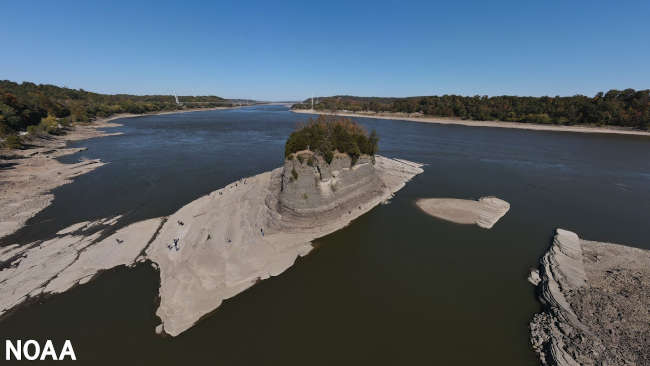
Those dry conditions were also felt along the Mississippi River, where some locations reported their lowest water levels in 10 years.
Here are more highlights from NOAA’s latest monthly U.S. climate report:
Climate by the numbers
October 2022
The average October temperature across the contiguous U.S. was 55.3 degrees F, 1.2 degrees above the 20th-century average, ranking in the warmest third in the climate record.
Several states had a top-10 warm October. Looking at the western U.S., Washington saw its warmest October on record, Oregon its second warmest, and California its seventh warmest. Along the eastern U.S., Maine had its sixth-warmest October.
The average precipitation was 1.66 inches — 0.50 of an inch below average — placing the month in the driest third of Octobers on record.
Florida had its eighth-driest October on record while California and Minnesota each saw their 11th driest. Conversely, an abundance of precipitation during the month gave New Jersey its 10th-wettest October on record.
Year to date (YTD, January through October 2022)
The average U.S. temperature for the YTD was 56.7 degrees F, 1.7 degrees above the 20th-century average, ranking as the 13th-warmest such YTD in the climate record. California saw its third warmest while Oregon saw its sixth warmest.
The U.S. precipitation total for the YTD was 23.19 inches — 2.17 inches below average — ranking as the 15th-driest such YTD on record. California had its driest, Nebraska ranked fourth and Nevada saw its eighth driest on record for this 10-month period.
Other notable climate events
The Mississippi River ran historically low: The Mississippi River dropped to its lowest water levels in a decade near Memphis, Tennessee, and Vicksburg, Mississippi, closing off a vital channel to barge traffic at a crucial time of year for crop transportation. In October 2022, the U.S. Coast Guard reported a total of eight barges that ran aground, along with a long backup of 144 vessels and 2,253 barges trying to access narrow river passages.
More of the nation impacted by drought: According to the Nov. 1, 2022, U.S. Drought Monitor report, about 62.8% of the contiguous U.S. was in drought, up approximately 11.9% from the end of September. Drought conditions expanded or intensified across much of the Southeast and Mississippi, Ohio and Tennessee valleys, and parts of the Plains, central Rockies and Northwest. Drought conditions shrank or were eliminated across portions of the Southwest, southern Plains, Northeast and Hawaii.