 How to resolve AdBlock issue?
News
The repeat concussions suffered by Miami Dolphins quarterback Tua Tagovailoa less than a week apart in September 2022 have brought the seriousness of traumatic brain injury back into the public eye and triggered scrutiny of the NFL’s concussion protocols. And the upcoming World Cup soccer competition, which begins Nov. 20, 2022, will likely include highly visible head injuries.
The Conversation asked David Howell, director of the Colorado Concussion Research Laboratory at the University of Colorado School of Medicine, to explain the latest science behind concussions and why a recently injured brain is more vulnerable to repeat injury. Howell’s work focuses on the many different areas of concussion-related dysfunction and recovery, including movement deficits, sleep problems and rehabilitation.
How widespread are concussions?
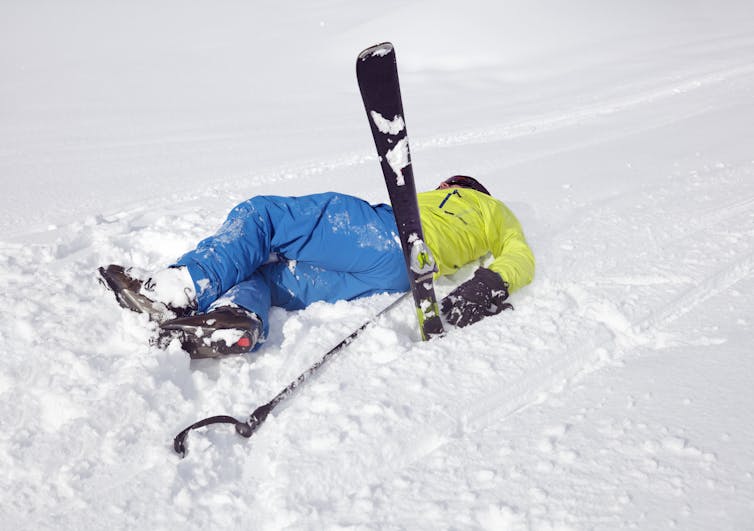
The word concussion can evoke a variety of different images for different people. While concussions are most visible during high-profile sporting events, they can also occur on the playground, during the junior varsity football team practice or on the ski slope. The effects can be just as severe for children and teens as for high-profile athletes.
Concussion effects range from mild to severe, from short term to long term, and can affect many different facets of life. A concussion is defined as a traumatic brain injury caused by an impact to the head, resulting in an alteration of brain function.
A concussion often leads to disruptions to everyday life – whether it be a job, academics, sports, physical activity or sleep. Given how unique people’s brains are and how differently they may respond to the injury, concussion recognition, diagnosis and treatment remain challenging for patients and clinicians alike.
What happens to the brain during a concussion?
There is a complex set of events that occur within the brain during and after a concussion occurs.
As a result of the trauma to the brain, brain cells – or neurons – stop functioning as they typically do when healthy. Generally there is not one specific area of the brain that is affected by a concussion. Instead, the injury can affect a widespread set of brain regions, not necessarily at the impact point. Thus, each person may experience a unique set of symptoms or functional problems following the injury.
One main problem that arises following a concussion is an energy crisis of sorts. This occurs when the brain requires a large volume of energy, in the form of glucose delivered by blood flow to the brain, to restore the injured processes. The body also may have trouble delivering blood to the brain because of a brain blood flow disruption caused by the injury, at the very time the brain needs extra energy to restore the injured areas. This mismatch can produce a variety of different symptoms people experience following a concussion.
What signs should you look for if you suspect a concussion?
Concussions produce a wide range of signs and symptoms, such as problems with walking and balance, dizziness, mood changes, disruptions to sleep and more.
Some of the main signs that health care providers look for following an impact to the head or body include unsteadiness of gait, loss of consciousness, seizures or other concussion symptoms like headache, cognitive impairment or problems with vision or balance.
It is critical that if a concussion is suspected, individuals cease playing their sport or activity. A simple mantra of “If in doubt, sit them out” should always be applied, regardless of the setting.
Why is the injured brain more vulnerable to repeat injury?
Miami Dolphins quarterback Tua Tagovailoa, who was carted off the field in late September 2022 after his second head injury in less than a week, serves as an example of how vulnerable the brain can be to additional trauma following an initial concussion.
Research shows that the rate of second concussions is highest in the immediate days following an initial concussion. In addition, recent studies have found that athletes who continue to play following a concussion experience longer recovery times and more severe symptoms.
While athletes of all ages may want to continue competing after a concussion, relying on a person with an injured brain to determine whether their brain is healthy enough to continue playing is flawed logic. Qualified health care professionals should always make these sorts of decisions for an athlete, rather than someone with a vested interest such as the athletes themselves or their coaches.

Given the energy crisis described above that occurs following a head injury, the brain simply cannot handle the added and cumulative stress of two injuries occurring in short succession. A second insult to the brain is often simply too much for the brain to handle, and the brain will preserve its most basic functions, such as breathing, above all else.
This is why it is imperative that athletes who experience a concussion be removed from the field of play and allowed to recover fully before returning to unrestricted sport participation. This often involves a stepwise reintegration approach, which allows for a gradual and safe reintroduction into physical activity at first, and an appropriately safe return to play under medical care.
You’ve had a concussion – now what?
The first step following a concussion is to stop playing sports and to rest for a day or two. Sleep is critically important in the days following a concussion.
A myth that continues to persist is that a person should be woken up every hour following a concussion. This is simply not supported by science. In fact, poor sleep after a concussion has been widely documented as being a predictor of poor outcomes, including longer recovery times and more severe anxiety, depression or cognitive symptoms. Waking someone up every hour applies to more severe brain injuries that would be ruled out by a health care provider during diagnosis.
In addition, recent guidelines and past research suggest that complete physical and cognitive rest, which is sometimes called cocoon therapy, can actually be harmful to recovery.
Therefore, it is important to keep a balanced approach in mind. Following a day or two of physical rest, people with a concussion should begin resuming light physical and cognitive activity that does not provoke or exacerbate ongoing symptoms.
When a person begins to feel better following a concussion, they should gradually add in higher intensity and greater amounts and duration of exercise, dictated by whether their symptoms are not significantly provoked. Recent studies have focused on the value of an individualized aerobic exercise program in the week following a concussion. Past work suggests that performing aerobic exercise at a heart rate just below the level at which symptoms are exacerbated is safe and effective for recovery.
It is important to note that the effects of a concussion may also result in secondary conditions, such as anxiety or depression due to the biological, social or psychological effects of the injury. A recent study showed that adolescents who sustained a concussion have a higher risk of mental health issues compared to those with an orthopedic injury.
David Howell, Assistant Professor of Orthopedics,, University of Colorado Anschutz Medical Campus
This article is republished from The Conversation under a Creative Commons license. Read the original article.
Dogs available for adoption this week include mixes of basset hound, German shepherd, hound, husky, Labrador retriever and pit bull.
Dogs that are adopted from Lake County Animal Care and Control are either neutered or spayed, microchipped and, if old enough, given a rabies shot and county license before being released to their new owner. License fees do not apply to residents of the cities of Lakeport or Clearlake.
The following dogs at the Lake County Animal Care and Control shelter have been cleared for adoption.
Call Lake County Animal Care and Control at 707-263-0278 or visit the shelter online for information on visiting or adopting.

Female husky
This 2-year-old female husky has a short brown coat with white markings.
She is in kennel No. 11, ID No. LCAC-A-4269.

Male pit bull puppy
This 3-month-old male pit bull terrier has a short brown and white coat.
He is in kennel No. 24a, ID No. LCAC-A-4118.

‘Chief’
“Chief” is a 4-year-old male pit bull terrier with a brown and white coat.
He is in kennel No. 28, ID No. LCAC-A-4169.

‘Ruby’
“Ruby” is a 6-month-old female hound mix with a brindle coat.
She is in kennel No. 5, ID No. LCAC-A-3753.

Female pit bull
This 3-year-old female pit bull terrier has a fawn-colored coat.
She is in kennel No. 8, ID No. LCAC-A-4210.

‘Arlo’
“Arlo” is a 3-year-old male basset hound-Labrador retriever mix with a short brown coat.
He is in kennel No. 9, ID No. LCAC-A-4164.

Female Labrador retriever
This 3-month-old female Labrador retriever has a short black coat.
She is in kennel No. 13, ID No. LCAC-A-4162.

Male Labrador retriever
This 2-year-old male Labrador retriever has a short black coat.
He is in kennel No. 14, ID No. LCAC-A-4112.

Male Labrador retriever
This 3-month-old male Labrador retriever has a short black coat.
He is in kennel No. 15, ID No. LCAC-A-4163.

Male hound mix
This 2-year-old male hound mix has a short tan coat.
He is in kennel No. 20, ID No. LCAC-A-4176.

Female pit bull puppy
This 2-month-old female pit bull puppy has a short white and red coat.
She is in kennel No. 24b, ID No. LCAC-A-4121.

Male German shepherd
This 1-year-old male German shepherd has a short black and tan coat.
He is in kennel No. 33, ID No. LCAC-A-4204.
Email Elizabeth Larson at

Herman Daly had a flair for stating the obvious. When an economy creates more costs than benefits, he called it “uneconomic growth.” But you won’t find that conclusion in economics textbooks. Even suggesting that economic growth could cost more than it’s worth can be seen as economic heresy.
The renegade economist, known as the father of ecological economics and a leading architect of sustainable development, died on Oct. 28, 2022, at the age of 84. He spent his career questioning an economics disconnected from an environmental footing and moral compass.
In an age of climate chaos and economic crisis, his ideas that inspired a movement to live within our means are increasingly essential.
The seeds of an ecological economist
Herman Daly grew up in Beaumont, Texas, ground zero of the early 20th century oil boom. He witnessed the unprecedented growth and prosperity of the “gusher age” set against the poverty and deprivation that lingered after the Great Depression.
To Daly, as many young men then and since believed, economic growth was the solution to the world’s problems, especially in developing countries. To study economics in college and export the northern model to the global south was seen as a righteous path.
But Daly was a voracious reader, a side effect of having polio as a boy and missing out on the Texas football craze. Outside the confines of assigned textbooks, he found a history of economic thought steeped in rich philosophical debates on the function and purpose of the economy.
Unlike the precision of a market equilibrium sketched on the classroom blackboard, the real-world economy was messy and political, designed by those in power to choose winners and losers. He believed that economists should at least ask: Growth for whom, for what purpose and for how long?
Daly’s biggest realization came through reading marine biologist Rachel Carson’s 1962 book “Silent Spring,” and seeing her call to “come to terms with nature … to prove our maturity and our mastery, not of nature but of ourselves.” By then, he was working on a Ph.D. in Latin American development at Vanderbilt University and was already quite skeptical of the hyperindividualism baked into economic models. In Carson’s writing, the conflict between a growing economy and a fragile environment was blindingly clear.
After a fateful class with Nicholas Georgescu-Roegen, Daly’s conversion was complete. Georgescu-Roegen, a Romanian-born economist, dismissed the free market fairy tale of a pendulum swinging back and forth, effortlessly seeking a natural state of equilibrium. He argued that the economy was more like an hourglass, a one-way process converting valuable resources into useless waste.
Daly became convinced that economics should no longer prioritize the efficiency of this one-way process but instead focus on the “optimal” scale of an economy that the Earth can sustain. Just shy of his 30th birthday in 1968, while working as a visiting professor in the poverty-stricken Ceará region of northeastern Brazil, Daly published “On Economics as a Life Science.”
His sketches and tables of the economy as a metabolic process, entirely dependent on the biosphere as source for sustenance and sink for waste, were the road map for a revolution in economics.
Economics of a full world
Daly spent the rest of his career drawing boxes in circles. In what he called the “pre-analytical vision,” the economy – the box – was viewed as the “wholly owned subsidiary” of the environment, the circle.
When the economy is small relative to the containing environment, a focus on the efficiency of a growing system has merit. But Daly argued that in a “full world,” with an economy that outgrows its sustaining environment, the system is in danger of collapse.
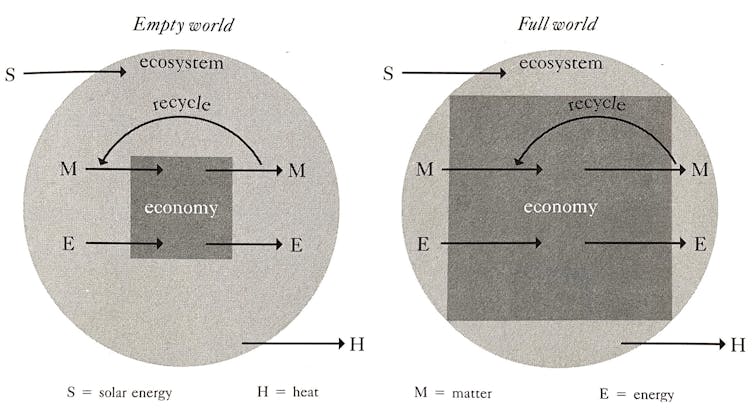
While a professor at Louisiana State University in the 1970s, at the height of the U.S. environmental movement, Daly brought the box-in-circle framing to its logical conclusion in “Steady-State Economics.” Daly reasoned that growth and exploitation are prioritized in the competitive, pioneer stage of a young ecosystem. But with age comes a new focus on durability and cooperation. His steady-state model shifted the goal away from blind expansion of the economy and toward purposeful improvement of the human condition.
The international development community took notice. Following the United Nations’ 1987 publication of “Our Common Future,” which framed the goals of a “sustainable” development, Daly saw a window for development policy reform. He left the safety of tenure at LSU to join a rogue group of environmental scientists at the World Bank.
For the better part of six years, they worked to upend the reigning economic logic that treated “the Earth as if it were a business in liquidation.” He often butted heads with senior leadership, most famously with Larry Summers, the bank’s chief economist at the time, who publicly waved off Daly’s question of whether the size of a growing economy relative to a fixed ecosystem was of any importance. The future U.S. treasury secretary’s reply was short and dismissive: “That’s not the right way to look at it.”
But by the end of his tenure there, Daly and colleagues had successfully incorporated new environmental impact standards into all development loans and projects. And the international sustainability agenda they helped shape is now baked into the U.N. Sustainable Development Goals of 193 countries, “a plan of action for people, planet and prosperity.”
In 1994, Daly returned to academia at the University of Maryland, and his life’s work was recognized the world over in the years to follow, including by Sweden’s Right Livelihood Award, the Netherlands’ Heineken Prize for Environmental Science, Norway’s Sophie Prize, Italy’s Medal of the Presidency, Japan’s Blue Planet Prize and even Adbuster’s person of the year.
Today, the imprint of his career can be found far and wide, including measures of the Genuine Progress Indicator of an economy, new Doughnut Economics framing of social floors within environmental ceilings, worldwide degree programs in ecological economics and a vibrant degrowth movement focused on a just transition to a right-sized economy.
I knew Herman Daly for two decades as a co-author, mentor and teacher. He always made time for me and my students, most recently writing the foreword to my upcoming book, “The Progress Illusion: Reclaiming Our Future from the Fairytale of Economics.” I will be forever grateful for his inspiration and courage to, as he put it, “ask the naive, honest questions” and then not be “satisfied until I get the answers.”
Jon D. Erickson, Professor of Sustainability Science and Policy, University of Vermont
This article is republished from The Conversation under a Creative Commons license. Read the original article.
BERKELEY, Calif. — Weather and climate modelers understand pretty well how seasonal winds and ocean currents affect El Niño patterns in the eastern equatorial Pacific Ocean, impacting weather across the United States and sometimes worldwide.
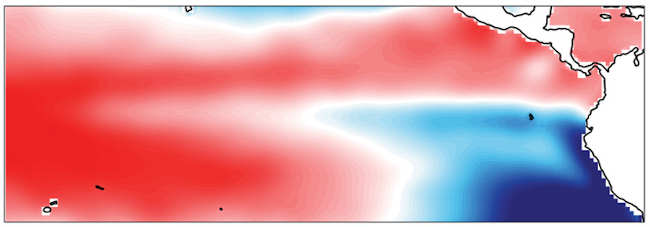
But new computer simulations show that one driver of annual weather cycles in that region — in particular, a cold tongue of surface waters stretching westward along the equator from the coast of South America — has gone unrecognized: the changing distance between Earth and the sun.
The cold tongue, in turn, influences the El Niño-Southern Oscillation (ENSO), which impacts weather in California, much of North America, and often globally.
The Earth-sun distance slowly varies over the course of the year because Earth’s orbit is slightly elliptical. Currently, at its closest approach — perihelion — Earth is about 3 million miles closer to the sun than at its farthest point, or aphelion. As a result, sunlight is about 7% more intense at perihelion than at aphelion.
Research led by the University of California, Berkeley, demonstrates that the slight yearly change in our distance from the sun can have a large effect on the annual cycle of the cold tongue. This is distinct from the effect of Earth’s axial tilt on the seasons, which is currently understood to cause the annual cycle of the cold tongue.
Because the period of the annual cycle arising from the tilt and distance effects are slightly different, their combined effects vary over time, said lead researcher John Chiang, UC Berkeley professor of geography.
“The curious thing is that the annual cycle from the distance effect is slightly longer than that for tilt — around 25 minutes, currently — so over a span of about 11,000 years, the two annual cycles go from being in phase to out of phase, and the net seasonality undergoes a remarkable change, as a result,” Chiang said.
Chiang noted that the distance effect is already incorporated into climate models — though its effect on the equatorial Pacific was not recognized until now — and his findings will not alter weather predictions or climate projections. But the 22,000-year phase cycle may have had long-term, historical effects. Earth’s orbital precession is known to have affected the timing of the ice ages, for example.
The distance effect — and its 22,000-year variation — also may affect other weather systems on Earth. The ENSO, which also originates in the equatorial Pacific, is likely affected because its workings are closely tied to the seasonal cycle of the cold tongue.
“Theory tells us that the seasonal cycle of the cold tongue plays a key role in the development and termination of ENSO events,” said Alyssa Atwood, a former UC Berkeley postdoctoral fellow who is now an assistant professor at Florida State University in Tallahassee. “Because of this, many of ENSO’s key characteristics are synced to the seasonal cycle.”
For example, ENSO events tend to peak during Northern Hemisphere winters, she said, and they don’t typically persist beyond northern or boreal spring months, which scientists refer to as the “spring predictability barrier.” Because of these linkages, it is reasonable to expect that the distance effect could also have a major impact on ENSO — something that should be examined in future studies.
“Very little attention has been paid to the cold tongue seasonal cycle because most people think it's solved. There's nothing interesting there,” Chiang said. “What this research shows is that it's not solved. There's still a mystery there. Our result also begs the question whether other regions on Earth may also have a significant distance effect contribution to their seasonal cycle.”
“We learn in science classes as early as grade school that the seasons are caused by the tilt of Earth’s axis,” added Anthony Broccoli of Rutgers University. “This is certainly true and has been well understood for centuries. Although the effect of the Earth-sun distance has also been recognized, our study indicates that this ‘distance effect’ may be a more important effect on climate than had been recognized previously.”
Chiang, Atwood, Broccoli and their colleagues reported their findings last week in the journal Nature.
Two distinct yearly cycles affect Pacific cold tongue
The main driver of global weather changes is seasonal change. Earth’s equator is tilted relative to its orbit around the sun, so the Northern and Southern hemispheres are illuminated differently. When the sun shines directly overhead in the north, it’s warmer in the north and colder in the south, and vice versa.
These yearly changes have major effects on the Pacific equatorial trade winds, which blow from southeast to northwest across the south and equatorial Pacific and push surface waters westward, causing upwelling of cold water along the equator that creates a tongue of cold surface water that stretches from Ecuador across the Pacific — almost one-quarter the circumference of the planet.
The yearly hemispheric changes in seasonal temperature alters the strength of the trades, and thus cause a yearly cycle in the temperature of the cold tongue. This, in turn, has a major influence on ENSO, which typically peaks during Northern Hemisphere winter.
The occurrence of El Niño — or its opposite, La Niña — helps determines whether California and the West Coast will have a wet or dry winter, but also whether the Midwest and parts of Asia will have rain or drought.
“In studying past climates, much effort has been dedicated to trying to understand if variability in the tropical Pacific Ocean — that is, the El Niño/La Niña cycle — has changed in the past,” Broccoli said. “We chose to focus instead on the yearly cycle of ocean temperatures in the eastern Pacific cold tongue. Our study found that the timing of perihelion — that is, the point at which the earth is closest to the sun — has an important influence on climate in the tropical Pacific."
In 2015, Broccoli, co-director of the Rutgers Climate Institute, along with his then-graduate student Michael Erb, employed a computer climate model to show that the distance changes caused by Earth’s elliptical orbit dramatically altered the cold tongue yearly cycle. But climate modelers mostly ignored the result, Chiang said.
“Our field is focused on El Niño, and we thought that the seasonal cycle was solved. But then we realized that the result by Erb and Broccoli challenged this assumption,” he said.
Chiang and his colleagues, including Broccoli and Atwood, examined similar simulations using four different climate models and confirmed the result. But the team went further to show how the distance effect works.
Earth’s ‘marine’ and ‘continental’ hemispheres
The key distinction is that changes in the sun’s distance from Earth don’t affect the Northern and Southern hemispheres differently, which is what gives rise to the seasonal effect due to Earth’s axial tilt. Instead, they warm the eastern “continental hemisphere” dominated by the North and South American and African and Eurasian landmasses, more than it warms the Western Hemisphere — what he calls the marine hemisphere, because it is dominated by the Pacific Ocean.
“The traditional way of thinking about monsoons is that the Northern Hemisphere warms up relative to the Southern Hemisphere, generating winds onto land that bring monsoon rains,” Chiang said. “But here, we’re actually talking about east-west, not north-south, temperature differences that cause the winds. The distance effect is operating through the same mechanism as the seasonal monsoon rains, but the wind changes are coming from this east-west monsoon.”
The winds generated by this differential heating of the marine and continental hemispheres alter the yearly variation of the easterly trades in the western equatorial Pacific, and thereby the cold tongue.
“When Earth is closest to the sun, these winds are strong. In the offseason, when the sun is at its furthest, these winds become weak,” Chiang said. “Those wind changes are then propagated to the Eastern Pacific through the thermocline, and basically it drives an annual cycle of the cold tongue, as a result.”
Today, Chiang said, the distance effect on the cold tongue is about one-third the strength of the tilt effect, and they enhance one another, leading to a strong annual cycle of the cold tongue. About 6,000 years ago, they canceled one another, yielding a muted annual cycle of the cold tongue. In the past, when Earth’s orbit was more elliptical, the distance effect on the cold tongue would have been larger and could have led to a more complete cancellation when out of phase.
Though Chiang and his colleagues did not examine the effect of such a cancellation, this would potentially have had a worldwide effect on weather patterns.
Chiang emphasized that the distance effect on climate, while clear in climate model simulations, would not be evident from observations because it cannot be readily distinguished from the tilt effect.
“This study is purely model based. So, it is a prediction,” he said. “But this behavior is reproduced by a number of different models, at least four. And what we did in this study is to explain why this happens. And in the process, we've discovered another annual cycle of the cold tongue that's driven by Earth's eccentricity.”
Atwood noted that, unlike the robust changes to the cold tongue seasonal cycle, changes to ENSO tend to be model-dependent.
“While ENSO remains a challenge for climate models, we can look beyond climate model simulations to the paleoclimate record to investigate the connection between changes in the annual cycle of the cold tongue and ENSO in the past,” she said. “To date, paleoclimate records from the tropical Pacific have largely been interpreted in terms of past changes in ENSO, but our study underscores the need to separate changes in the cold tongue annual cycle from changes in ENSO.”
Chiang’s colleagues, in addition to Broccoli and Atwood, are Daniel Vimont of the University of Wisconsin in Madison; former UC Berkeley undergraduate Paul Nicknish, now a graduate student at the Massachusetts Institute of Technology; William Roberts of Northumbria University in Newcastle-upon-Tyne in the United Kingdom; and Clay Tabor of the University of Connecticut in Storrs. Chiang conducted part of the research while on sabbatical at the Research Institute for Environmental Changes of the Academia Sinica in Taipei, Taiwan.
Robert Sanders writes for the UC Berkeley News Center.
Warm for the Winter will distribute warm winter clothing once again at the Clearlake Rotary Club's annual Christmas community dinner from 10 a.m. to 2 p.m. on Saturday, Dec. 10, in the courtyard next to the dining hall at Burns Valley School, 3620 Pine St. in Clearlake.
Warm for the Winter is celebrating its 16th year of giving warm clothing to those in need.
The effort is driven solely by community members helping others in need.
Warm for the Winter started in 2006. Joyce Overton began the effort to collect sleeping bags and tents to help the homeless survive the winter weather.
As the years went on, Overton saw the need extended beyond the homeless, and it has since turned into a community giving program.
Overton takes no monetary donations but relies on donations of blankets, gloves, shoes, hats and any winter clothing, either new or used but in good repair and clean.
With the hardship of the pandemic, warm attire is in great demand this year, Overton said.
Donations are being collected until Dec. 7.
If you would like to make a monetary donation you may do that through the Clearlake Rotary Club and specify the Warm for the Winter program.
Donations can be dropped off from 9 a.m. to 2 p.m. Monday through Friday at the Highlands Senior Center, 3245 Bowers Road, Clearlake.
Overton thanked the community for its donations and support over the past 16 years.
For more information contact Overton at the Clearlake Senior Center, 707-994-3051, or text her at 707-350-2898.
The City of Clearlake Animal Association also is seeking fosters for the animals waiting to be adopted.
Call the Clearlake Animal Control shelter at 707-273-9440, or email
Visit Clearlake Animal Control on Facebook or on the city’s website.
The following dogs are available for adoption. New additions are at the top.

‘Athena’
“Athena” is a female American pit bull mix terrier with a short brindle coat.
She has been spayed.
She is dog No. 49934476.

‘Jack’
“Jack” is a 9-month-old male terrier mix with a short black and brindle coat.
He has been neutered.
He is dog No. 50992658.
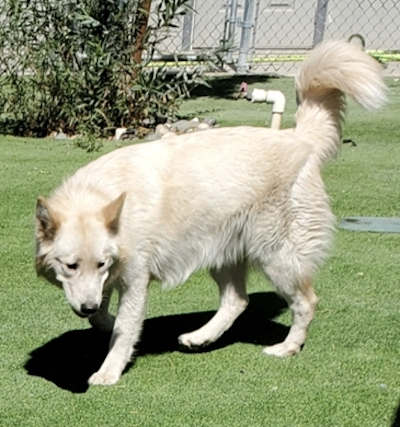
‘Molly’
“Molly” is a female Samoyed mix with a long white coat.
She has been spayed.
She is dog No. 50933031.

‘Paige’
“Paige” is a female American pit bull mix with a short brown coat.
She has been spayed.
She is dog No. 51194668.

‘Trike’
“Trike” is a male border collie-Australian shepherd mix with a black and white coat and blue eyes.
He has been neutered.
He is dog No. 51029972.
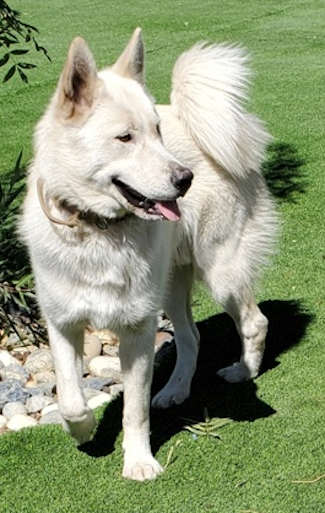
‘Zeus’
“Zeus” is a male Samoyed mix with a long white coat.
He has been neutered.
He is dog No. 50933068.

‘Aoki’
“Aoki” is a male Siberian husky mix with a white coat.
He has been neutered.
He is dog No. 50905477.

‘Babs’
“Babs” is a female Labrador retriever mix with a short black coat.
She has been spayed.
She is dog No. 49505856.

‘Baby’
“Baby” is a female American pit bull mix with a white coat.
She has been spayed.
She is dog No. 50933640.

‘Bruce’
“Bruce” is a 2-year-old American pit bull mix with a short gray coat with white markings.
He has been neutered.
He is dog No. 50684304.

‘Buster’
“Buster” is a male pit bull mix with a short tan coat.
He has been neutered.
He is dog No. 50762164.

‘Domino’
“Domino” is a male terrier mix with a short white coat.
He has been neutered.
He is dog No. 50815541.

‘Eros’
“Eros” is a male Rottweiler mix with a short black and tan coat.
He has been neutered.
He is dog No. 50754504.

‘Foxie’
“Foxie” is a female German shepherd with a red, black and white coat.
She has been spayed.
She is dog No. 49702845.

‘Goliath’
“Goliah” is a male Rottweiler mix with a short black and tan coat.
He is dog No. 50754509.

‘Hakuna’
“Hakuna” is a male shepherd mix with a tan coat.
He has been neutered.
He is dog No. 50176912.

‘Herman’
“Herman” is a 7-year-old male American pit bull terrier mix with a brown coat.
He has been neutered.
He is dog No. 51236411.

‘Hondo’
“Hondo” is a male Alaskan husky mix with a buff coat.
He has been neutered.
He’s dog No. 50227693.

‘Little Boy’
“Little Boy” is a male American pit bull terrier mix with a short tan coat.
He has been neutered.
He is dog No. 50075256.

‘Luciano’
“Luciano” is a male Siberian husky mix with a short black and white coat.
He has been neutered.
He is dog No. 50596272.

‘Mamba’
“Mamba” is a male Siberian husky mix with a gray and cream-colored coat.
He has been neutered.
He is dog No. 49520569.

‘Matata’
“Matata” is male shepherd mix with a tan coat.
He has been neutered.
He is dog No. 50176912.
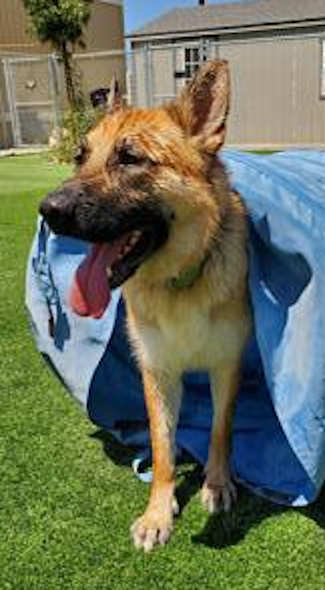
‘Maya’
“Maya” is a female German shepherd with a black and tan coat.
She has been spayed.
She is dog No. 50428151.

‘Mikey’
“Mikey” is a male German shepherd mix with a short brown and tan coat.
He has been neutered.
He is dog No. 51012855.

‘Poppa’
“Poppa” is a 3-year-old male American pit bull terrier mix with a short red and white coat.
He has been neutered.
He is dog No. 50773597.

‘Rascal’
“Rascal” is a male shepherd mix with a black and brown coat.
He has been neutered.
He is dog No. 50806384.

‘Reese’
“Reese” is a female German Shepherd with a black and an coat.
She has been spayed.
She is dog No. 50884542.

‘Sadie’
“Sadie” is a female German shepherd mix with a black and tan coat.
She has been spayed.
She is dog No. 49802563.

‘Snowball’
“Snowball is a 1 and a half year old male American Staffordshire terrier mix with a short white coat.
He has been neutered.
He is dog No. 49159168.
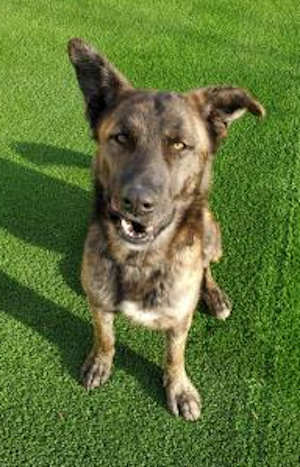
‘Terry’
“Terry” is a handsome male shepherd mix with a short brindle coat.
He gets along with other dogs, including small ones, and enjoys toys. He also likes water, playing fetch and keep away.
Staff said he is now getting some training to help him build confidence.
He is dog No. 48443693.

‘Willie’
“Willie” is a male German shepherd mix with a black and tan coat.
He has been neutered.
He is dog No. 50596003.

‘Zeda’
“Zeda” is a female Labrador retriever mix.
She has been spayed.
She is dog No. 51108916.
Email Elizabeth Larson at