 How to resolve AdBlock issue?
News
Glen Eddie Igo of Lower Lake, age 62, was identified as the man who died in a solo-vehicle crash on Dec. 27, according to sheriff’s spokeswoman Lauren Berlinn.
The California Highway Patrol’s Clear Lake Area office, which originally had given Igo’s age as 58, said the crash occurred at around 3:15 a.m. Dec. 27.
The CHP said Igo was driving a 2015 Chevrolet Trax SUV traveling westbound on Highway 281 east of Konocti Bay Road at an unknown rate of speed in rainy conditions when he “unsafely turned” and went off the highway’s south edge.
His SUV crashed into an uphill dirt/grass embankment and overturned, and Igo — who was not wearing a seat belt — was partially ejected.
The CHP said Igo died at the scene.
Additional information has not been released by the CHP on what may have caused the wreck.
Email Elizabeth Larson at
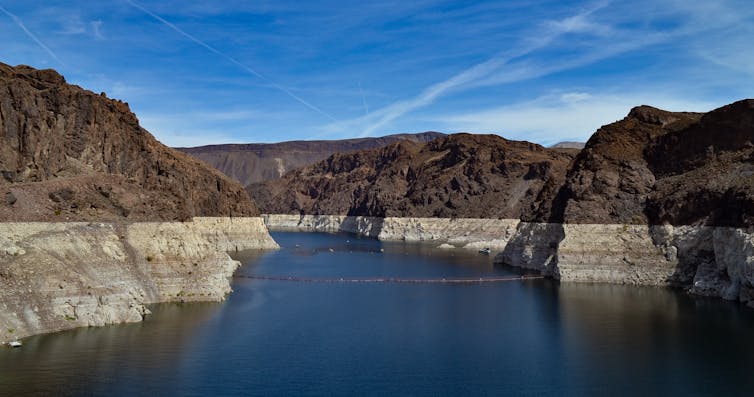
Where does your water supply come from?
If you live near mountains, for instance in British Columbia, a lot of your water probably comes from mountain snowpack. Over 1.9 billion people globally rely on the snow melting and running off from these mountain snowpacks for their water supply.
Accurate predictions of this annual trend is critical for water supply planning. And forecasting models often rely on the historical relationship between mountain snowpack and the subsequent water supply.
However, in times of unprecedented drought and a changing climate, these forecasting models seem to no longer be reliable. Following an intense drought in California in 2021, snowmelt from mountain snowpack delivered significantly less water than historical models predicted, meaning that reservoirs remained drier than anticipated. For the first time in 100 years, water supply models were wrong.
In an attempt to address the gaps in the traditional model, we recently developed an updated water supply forecasting model that considers additional factors, like water storage deficits in the soil and bedrock. This new model significantly improves the accuracy of water supply forecasts following drought.
What are existing water supply models missing?
Models used for forecasting snowmelt typically consider winter rain and snowpack. But it turns out that water absorbed by the ground matters too. The amount of water absorbed into the soil and bedrock varies from year to year and is especially impacted by drought.
When snow melts or rain falls, almost all of it goes underground first before heading downstream to water supply systems . The water storage processes below the surface of the ground are key to understanding the ultimate fate of rain and snow in the mountains.
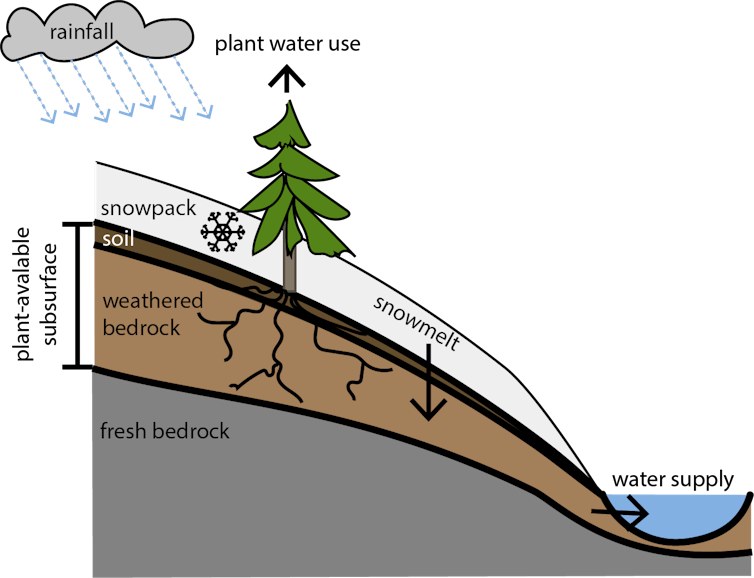
The below ground environment is made up of complex layers of soil, fractures and weathered bedrock that can store, detain and transport water. The details of these processes are complicated, but the overall effect can be likened to a giant sponge.
Over the summer, the ground dries out and it gets wet again with the arrival of rain and snowmelt in winter and spring. Once the ground is wet enough, it starts to drip. This dripping water enters the groundwater and streams and eventually goes into the water supply systems.
How much water drips depends on how much snowmelt and rain is received, which is included in forecasting models. It also depends on how dry the subsurface was to begin with, which is not traditionally included in forecasting models.
Plants use a lot of water
How dry the subsurface is this year can depend on how much water the plants used last year (or even over the last few years). In hotter, drier years, plants can use more water from underground, causing the subsurface to dry out more.
Recent studies show us that trees routinely dry up not just soils but also weathered bedrock metres below the surface.
Scientists are still struggling to identify how dry these mountain environments can get and how far below the surface they dry. With a drier subsurface at the start of the year, more snowmelt is needed before water starts to flow downstream to water supply systems.
As droughts become more frequent and intense with climate change, this process could become more important even in regions that historically haven’t faced much drought.
Measuring the moisture underground
Directly observing the moisture levels of the ground’s subsurface is difficult, especially when it’s stored in weathered bedrock, which can extend many metres below the ground surface and be challenging to observe.
In our research, we found the most accurate measurements by lowering geophysical instruments down boreholes and taking water content readings at different depths. By comparing these readings over time, we observe how the subsurface dries out and gets wet again.
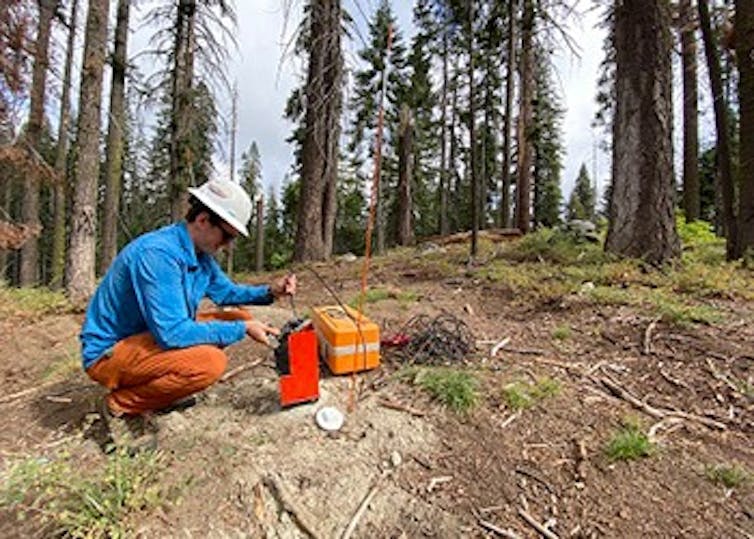
However, this intensive monitoring is nearly impossible to do over large areas.
While we can’t look directly underground everywhere, we can track how much water enters (rain and snowmelt) and leaves (plant water use) the ground using satellite-derived data.
By taking a running account of water going in and out of the ground, we can estimate how dry the subsurface is — a metric we call the water storage deficit.
Water supply models must dig deeper
Our newly-developed water supply forecasting model accounts for water storage deficits in both soil and bedrock. This has improved post-drought forecast accuracy substantially, taking the probability of error in the calculation of predictions from 60 per cent to about 20 per cent.
Since we can calculate deficits before spring snowmelts, they serve as an early warning sign and can aid water management strategies.
As the climate changes, the water supply challenges in California foreshadow issues that will become increasingly prevalent in British Columbia and other regions reliant on mountain snowpack. Using updated forecasting models in the future can help these regions better prepare for continued water shortages even when snowpack seems normal.
Dana Ariel Lapides, Postdoctoral Research Fellow, Geography, Simon Fraser University; Daniella Rempe, Assistant professor, Jackson School of Geosciences, The University of Texas at Austin; David Dralle, Research officer, Hydrology, University of California, Berkeley, and Jesse Hahm, Department of Geography, Assistant Professor, Simon Fraser University
This article is republished from The Conversation under a Creative Commons license. Read the original article.
The forecast is calling for rain through Sunday, with particularly heavy rainfall expected on Wednesday and Thursday.
National Weather Service forecasters are reporting that the strong storm expected to make landfall on Wednesday shows the potential for a moderate to strong atmospheric river over northwest California.
The Lake County forecast expects showers to begin on Monday morning and continue through Sunday morning.
From Monday through Thursday, the anticipated rainfall could be as high as 3 inches, the forecast said.
Daytime temperatures will mostly hover in the mid to high 40s, hitting the low 50s on Wednesday, with nighttime lows in the low 30s.
In Lake County’s higher elevations, including the Lake Pillsbury area, a winter weather advisory will be in effect from 8 a.m. to 10 p.m. Monday.
The National Weather Service is forecasting rain and snow showers in those areas on Monday and Tuesday, and then showers for the rest of the week and fog on the weekend.
Only a small amount of snow accumulation — less than an inch — is predicted.
Daytime temperatures in the higher elevations are expected to be in the low to mid 40s throughout the weekend, with nighttime conditions dropping into the high 20s.
Email Elizabeth Larson at
The council will meet at 6 p.m. Tuesday, Jan. 3, in the council chambers at Lakeport City Hall, 225 Park St.
The agenda can be found here.
The council chambers will be open to the public for the meeting. Masks are highly encouraged where 6-foot distancing cannot be maintained.
If you cannot attend in person, and would like to speak on an agenda item, you can access the Zoom meeting remotely at this link or join by phone by calling toll-free 669-900-9128 or 346-248-7799.
The webinar ID is 973 6820 1787, access code is 477973; the audio pin will be shown after joining the webinar. Those phoning in without using the web link will be in “listen mode” only and will not be able to participate or comment.
Comments can be submitted by email to
On Tuesday, City Attorney David Ruderman will present an lead a council and civic engagement training, including presenting an update on recent Brown Act legislation.
Administrative Services Director/City Clerk Kelly Buendia will present a resolution appointing representatives to represent and vote on behalf of the city at the League of California Cities, Redwood Empire Division Business meetings and represent the city and vote at Division Legislative Committee meetings.
The council also will consider approving a telecommute program policy for city employees.
Also on Tuesday, City Manager Kevin Ingram will give a traffic safety update, and lead a discussion and review of observed trends in received traffic safety-related complaints to the city.
On the consent agenda — items usually accepted as a slate on one vote — are ordinances; minutes of the regular council meeting on Dec. 20; adoption of a resolution authorizing continued remote teleconference meetings of the Lakeport City Council and its legislative bodies pursuant to Government Code section 54953(e); confirm the continuing existence of a local emergency for the COVID-19 Public Health Emergency; accept notification of the Lakeport Police Department intent to request federal property should desirable property become available utilizing the LESO Program while adhering to its Military Equipment Policy; approve the 2023 Military Equipment Policy and City Ordinance, as drafted; and, set this matter for public hearing and adoption at the Feb. 7 Lakeport City Council meeting; approve a resolution rescinding Resolution 2896 (2022) and revising the Master Pay Schedule in conformance with California Code of Regulations, Title 2, Section 570.5; and adopt the resolution accepting construction of the 2022 Microsurface Project, by Pavement Coatings Co. and authorize the filing of the Notice of Completion.
Email Elizabeth Larson at
The meeting will begin at 4 p.m. at the Moose Lodge, located at 15900 Moose Lodge Lane in Clearlake Oaks.
The group on Wednesday will discuss a proposed revision to its bylaws.
Discussion topics also will include the Clearlake Oaks consolidated lighting district, the Lake County Geothermal Project Watchlist, a commercial cannabis cultivation update, a request for review by the Community Development Department and Sulphur Bank Mine Superfund Site public outreach.
There also will be updates on Spring Valley, the Northshore Fire Protection District, the Oaks Arm and Keys Restoration projects, and a report from Supervisor EJ Crandell.
The group’s next meeting will take place on Feb. 1.
ERTH’s members are Denise Loustalot, Jim Burton, Tony Morris and Pamela Kicenski.
For more information visit the group’s Facebook page.
On New Year’s Eve, the two federal agency partners officially retired the use of one of two measuring feet, to reduce surveying errors that can cost money.
Discontinuing the use of the U.S. survey foot and embracing of its replacement — the international foot — are also part of NOAA’s modernization of the National Spatial Reference System.
“Officially retiring one of these measurements will reduce accidental confusion in engineering, surveying, mapping, agriculture and other industries that depend on accurate positioning,” said Juliana Blackwell, director of NOAA’s National Geodetic Survey.
The difference between the U.S. survey foot and the international foot is tiny and barely noticeable in everyday use and function.
But when it comes to measuring the distance between coordinates that span hundreds or thousands of miles, the difference can add up to several feet — and lead to costly errors and delays for various types of projects.
The U.S. began reconciling two slightly different versions of the foot in 1959, when it adopted a definition that differed just 1/100 of a foot per mile from the U.S. survey foot, established in 1893.
The 1959 definition became known as the international foot because several other nations also adopted it at about the same time.
From this point forward, surveyors will refer to the international foot as simply the foot.