 How to resolve AdBlock issue?
News

Precipitation map showing the atmospheric rivers hitting California since Jan. 6.
As California enters the third week of severe winter storms, Gov. Gavin Newsom is urging people to keep their guard up as strong winds and heavy rains continue to threaten communities across the state.
On Sunday night, President Joe Biden approved Gov. Newsom’s request for a federal emergency declaration, activating the full weight of the federal government to support California’s storm response and recovery efforts.
The Federal Emergency Management Agency, or FEMA, is making federal disaster assistance available to supplement local and state resources, including funding, equipment and personnel.
On Monday, Gov. Newsom was briefed by state emergency officials on the latest conditions and response efforts, and the governor continues to actively monitor storm impacts.
Also on Monday, the California Governor’s Office of Emergency Services brought together more than 400 community-based organizations throughout the state in a first-of-its-kind effort to mobilize resources with a special emphasis on delivering help to vulnerable communities — unsheltered individuals, those with disabilities and older Californians.
As of Monday afternoon, winter storms have claimed the lives of 14 Californians — more lives than wildfires in the past two years combined.
“Our message to Californians is simple: be hyper-vigilant,” said Gov. Newsom on Monday. “There are still several days of severe winter weather ahead and we need all Californians to be alert and heed the advice of emergency officials. Thanks to the president signing off on our request for emergency declaration, we are mobilizing all available resources at every level of government to protect lives and limit storm damage. Today marks five years since the deadly Montecito mudslides that claimed 23 lives — as Montecito faces evacuations today, it’s a solemn reminder of how quickly conditions can change.”
On Sunday, the governor announced $202 million in new investments for long-term flood prevention proposed in the upcoming state budget.
Also on Sunday, Gov. Newsom visited two sites along Deer Creek in Sacramento County to highlight the state’s work to repair damage from earlier storms and prepare for incoming severe weather.
The state is working to support the most vulnerable Californians with 11 shelters statewide along with an additional 20 shelters that are prestaged and on standby. Temporary shelter, food and additional resources are available at these sites and all are welcome. No ID is required.
Weather forecast
Heavy rainfall is forecasted throughout the state Tuesday and northern California on Wednesday, increasing the potential for flooding given saturated soils from the previous two weeks of precipitation.
According to the National Weather Service, rainfall levels are 400 to 600% above average across California.
Emergency alerts
Californians are reminded to dial 2-1-1 or 3-1-1 to get help or ask questions. If you have a critical emergency, call 911.
Staying informed by signing up for emergency alerts including warnings and evacuation notices. Go to CalAlerts.org to sign up to receive alerts from your county officials.
Download the Caltrans QuickMap app to receive real-time notifications for road closures, emergencies, and other traffic updates. You can download the app here.
You can also view real-time information on anticipated river floodings here.
The committee, or LEDAC, will meet via Zoom from 7:30 to 9 a.m. Wednesday, Jan. 11, in the council chambers at Lakeport City Hall, 225 Park St. It is open to the public.
The meeting also will be available via Zoom: Meeting ID, 880 3641 4661; pass code, 202031. Dial by your location, 1-346-248-7799.
The meeting will start with the elections of the chair, vice chair and secretary for 2023.
Current Chair Wilda Shock said City Manager Kevin Ingram and Chief Building Official Bethany Moss Childers will provide information about city projects and discuss the role of LEDAC and the City Council priorities.
Laura McAndrews Sammel, chief executive officer of the Lake County Chamber of Commerce, will present the chamber’s strategic plan and the process for creating and implementing it, Shock said.
Shock said LEDAC members and the public will have the opportunity for announcements about activities and programs in their respective organizations.
LEDAC’s next meeting will be March 8.
LEDAC advocates for a strong and positive Lakeport business community and acts as a conduit between the city and the community for communicating the goals, activities and progress of Lakeport’s economic and business programs.
Members are Chair Wilda Shock, Vice Chair Denise Combs and Secretary JoAnn Saccato, along with Bonnie Darling, Jeff Davis, Candy De Los Santos, Bill Eaton, Monica Flores, Barbara Flynn, Pam Harpster, Laura McAndrews Sammel and Tim Stephens. City staff who are members include City Manager Kevin Ingram and Community Development Department representatives.
Email Elizabeth Larson at
County officials to take oaths, supervisors to consider raises and Clear Lake hitch emergency action
The board will meet beginning at 9 a.m. Tuesday, Jan. 10, in the board chambers on the first floor of the Lake County Courthouse, 255 N. Forbes St., Lakeport.
The meeting can be watched live on Channel 8, online at https://countyoflake.legistar.com/Calendar.aspx and on the county’s Facebook page. Accompanying board documents, the agenda and archived board meeting videos also are available at that link.
To participate in real-time, join the Zoom meeting by clicking this link.
The meeting ID is 934 5333 8139, pass code 387270. The meeting also can be accessed via one tap mobile at +16699006833,,93453338139#,,,,*387270#.
All interested members of the public that do not have internet access or a Mediacom cable subscription are encouraged to call 669-900-6833, and enter the Zoom meeting ID and pass code information above.
To submit a written comment on any agenda item visit https://countyoflake.legistar.com/Calendar.aspx and click on the eComment feature linked to
the meeting date. If a comment is submitted after the meeting begins, it may not be read during the meeting but will become a part of the record.
On Tuesday, the meeting will begin with the election of the chair and vice chair of the Board of Supervisors, the Lake County Board of Equalization and the Lake County In-Home Supportive Services Public Authority Board of Directors for 2023.
At 9:04 a.m., the registrar of voters will then administer the oath of office to District 2 Supervisor Bruno Sabatier, District 3 Supervisor Eddie Crandell, Treasurer-Tax Collector Patrick Sullivan, County Clerk-Auditor Jenavive Herrington, Sheriff-Coroner Eutice “Rob” Howe, Assessor-Recorder Richard Ford, District Attorney Susan Krones and Superintendent of Schools Brock Falkenberg.
In an untimed item, 7.10, the board will hold the second reading of an ordinance amending Section 2-3A.1 of Article I, Chapter 2 of the Lake County Code, relating to the compensation of the Board of Supervisors.
At the Dec. 20 meeting, the board approved the first reading of the ordinance, which will give members a 40% annual raise.
If approved on Tuesday, the raises would go into effect 60 days after passage, on or around March 10, unless challenged by a referendum.
In another untimed item, 7.4, the board will consider a number of final agreements and promissory notes to allow construction to move forward on the Collier Avenue Housing Project, which will be an apartment complex for Behavioral Health Services clients in Nice.
At 9:30 a.m., the board will consider a proclamation declaring the existence of a local emergency due to persistent drought, habitat loss and potential extinction of Clear Lake hitch.
In a memo to the board, supervisors Michael Green and EJ Crandell are proposing a resolution which they said “proposes a multi-jurisdictional call to acknowledge the chi emergency and take appropriate measures; to rank and prioritize projects and funding sources to support chi repopulation; to assess enforcement and compliance of existing laws and regulations; and to encourage robust discussion and public participation as the county and its partners consider next steps.”
The full agenda follows.
CONSENT AGENDA
5.1: Approve continuation of proclamation of the existence of a local emergency due to pervasive tree mortality.
5.2: Approve Amendment No. 3 (no cost period of performance extension) to agreement Sulphur, Pawnee and Mendocino Complex wildfires structural burn debris removal insurance cost recovery and invoicing in Lake County.
5.3: Approve Board of Supervisors minutes for Dec. 6, 2022.
5.4: Adopt proclamation designating the month of January 2023 as Human Trafficking Awareness Month in Lake County.
5.5: Approve continuation of resolution authorizing teleconferenced meetings during a state of emergency continue to exist.
5.6: Approve continuation of a local health emergency related to the 2019 Coronavirus (COVID-19) as proclaimed by the Lake County Public Health officer.
5.7: Approve continuation of an emergency declaration for drought conditions.
5.8: Approve continuation of a local emergency due to COVID-19.
5.9: Approve agreement between the Lake County Probation Department and the state of California Franchise Tax Board for the purpose of the collection of unpaid court-ordered fines, monetary sanctions, forfeitures and penalties through Nov. 30, 2025, and authorize the chief probation officer to sign.
5.10: Approve travel for interim Chief Probation Officer Wendy Mondfrans and staff services analyst Kelly Morin to the Tyler Technologies Conference May 2023 in San Antonio, Texas.
5.11: Approve the capitalized fixed asset listing required upon departure from elected office.
5.12: Approve contract between the county of Lake and Lake Transit Authority for local public transportation services in the amount of $65,600, from July 1, 2022, to June 30, 2025, and authorize the chair to sign.
5.13: Approve contract between the county of Lake and Redwood Community Services Inc. for the provision of SB163 wraparound services in the amount of $402,393 per fiscal year, from Sept. 1, 2022, to June 30, 2025, and authorize the chair to sign.
5.14: Approve contract between the county of Lake and Lake Family Resource Center for domestic violence services, in the amount of $25,000 per fiscal year from July 1, 2022, to June 30, 2025, and authorize the chair to sign.
5.15: Approve contract between county of Lake and Adams Ashby Group for HOME and Community Development Block Grant loan portfolio management services in the amount of $50,000, from Jan. 1, 2023, to Dec. 31, 2024, and authorize the chair to sign.
5.16: Approve amendment one to the agreement between the county of Lake on behalf of CSA-02, Spring Valley and Anchor QEA LLC for engineering and design services for the Spring Valley Lake Recovery Project for an increase of $134,351.00 to the contract amount.
5.17: Approve agreement between county of Lake and Harmony Research for professional research services related to tax default land sales in an amount not to exceed $307,500 and authorize the chair to sign.
TIMED ITEMS
6.1, 9:01 a.m.: Election of chair of the Board of Supervisors and vice-chair of the Board of Supervisors for 2023 (outgoing chair conducts election).
6.2, 9:02 a.m.: Sitting as the Lake County Board of Equalization, election of chair and vice-chair of the Lake County Local Board of Equalization for 2023.
6.3, 9:03 a.m.: Sitting as the Lake County In-Home Supportive Services, election of chair and vice-chair of the Lake County In-Home Supportive Services Public Authority Board of Directors for 2023.
6.4, 9:04 a.m.: Erratum, a) Administer oath of office to District 2 Supervisor Bruno Sabatier; and b) administer oath of office to District 3 Supervisor Eddie Crandell; and c) administer oath of office to Treasurer-Tax Collector Patrick Sullivan; and d) administer oath of office to County Clerk-Auditor Jenavive Herrington; and e) administer oath of office to Sheriff-Coroner Eutice “Rob” Howe; and f) administer oath of office to Assessor-Recorder Richard Ford; and g) administer oath of office to District Attorney Susan Krones; and h) administer oath of office to Lake County Superintendent of Schools Brock Falkenberg.
6.5, 9:06 a.m.: Public input.
6.6, 9:07 a.m.: Presentation of proclamation designating the month of January 2023 as Human Trafficking Awareness Month in Lake County.
6.7, 9:11 a.m.: Reappoint members of the Lake County Planning Commission for a two-year term (a) reappoint District 1 Commissioner John Hess; (b) reappoint District 2 Commissioner Everardo Chavez Perez; (c) reappoint District 3 Commissioner Batulwin A. Brown; (d) reappoint District 4 Commissioner Christina Price; and (e) reappoint District 5 Commissioner Maile Field.
6.8, 9:30 a.m.: Consideration of proclamation declaring the existence of a local emergency due to persistent drought, habitat loss and potential extinction of Clear Lake Hitch.
6.9, 1:15 p.m.: Consideration of an agreement to provide funding in support of the BUILD Program, facilitated by North Coast Opportunities Inc., in the not-to-exceed amount of $800,000.
UNTIMED ITEMS
7.2: Consideration of direction to the Cannabis Task Force to prioritize regulations surrounding cannabis retail operations in the first quarter of 2023.
7.3: Consideration of Behavioral Health Service Department's update regarding Tribal 638 Clinic payment process and New Life Clinic LLC.
7.4: Consideration of the PLHA Loan Agreement, PLHA Deed of Trust, PLHA Promissory Note, PLHA Regulatory Agreement, MHSA/HHAP Loan Agreement, MHSA/HHAP Deed of Trust, MHSA/HHAP Promissory Note, Chase/County Subordination Agreement, County/Sponsor Subordination Agreement, County/DDS Subordination Agreement for the Collier Avenue Housing Project.
7.5: Consideration of Amendment No. 1 to the agreement between county of Lake and Native American Mental Health Services dba North American Mental Health Services for telepsychiatry services for fiscal years 2022-23, 2023-24, and 2024-25 for a new contract maximum of $3,875,877.36 and authorize the board chair to sign.
7.6: Consideration of 2023 committee assignments for members of the Board of Supervisors.
7.7: Consideration of advisory board appointments.
7.8: Consideration of delegation of investment authority to treasurer–tax collector.
7.9: Consideration of resolution authorizing investment of monies in the Local Agency Investment Fund.
7.10: ADDENDUM — Second reading of an ordinance amending Section 2-3A.1 of Article I, Chapter 2 of the Lake County Code, Compensation of the Board of Supervisors.
7.11: ADDENDUM — Consideration of resolution authorizing investment of monies with U.S. Bank NA and authorizing the county treasurer to act as the duly authorized and qualified representative.
CLOSED SESSION
8.1: Public employee evaluation: Health Services Director Jonathan Portney.
8.2, 3:30 p.m.: Public employee appointment pursuant to Gov. Code Section 54957(b)(1): interviews for Public Health officer appointment of Public Health officer.
Email Elizabeth Larson at
LAKE COUNTY, Calif. — The Lakeport Planning Commission will start off the new year considering a new affordable housing complex for the city and a request for a permit to allow residential use at a commercial property.
The commission will meet at 5:30 p.m. Wednesday, Jan. 11, in the council chambers at Lakeport City Hall, 225 Park St.
The council chambers will be open to the public for the meeting. Masks are highly encouraged where 6-foot distancing cannot be maintained.
The agenda is available here.
To speak on an agenda item, access the meeting remotely here; the meeting ID is 814 1135 4347, pass code is 847985.
To join by phone, dial 1-669-444-9171; for one tap mobile, +16694449171,,81411354347#,,,,*847985#.
Comments can be submitted by email to
Please indicate in the email subject line "for public comment" and list the item number of the agenda item that is the topic of the comment. Comments that are read to the council will be subject to the three minute time limitation (approximately 350 words). Written comments that are only to be provided to the council and not read at the meeting will be distributed to the council before the meeting.
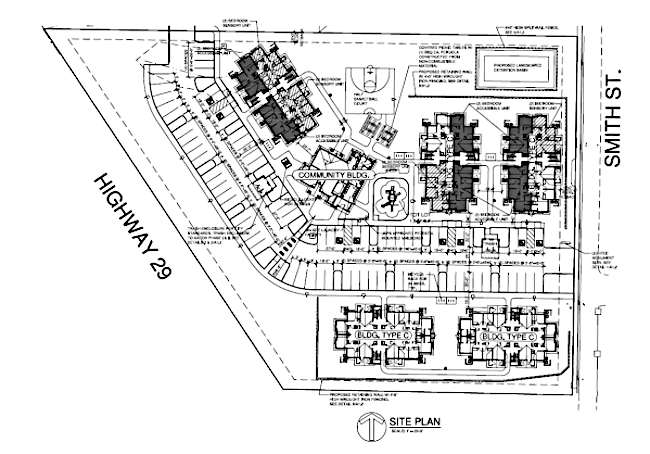
On Wednesday, the commission will consider the application from AMG & Associates LLC for a general plan amendment, zone change and mitigated negative declaration for a 40-unit apartment complex to be located at 519 S. Smith St.
The city staff report on the project explains that the 3.7-acre project site is undeveloped, and Phase I and II of the Martin Street Apartments are to the north of the project site.
The complex, which the staff report calls an “affordable housing community,” would include 40 total dwelling units within five multi-family residential buildings with a total of eight units per building. Of those, 10 units will be adaptable units, six units will be compliant with the Americans with Disabilities Act and four units will be sensory impaired units.
There also will be a 2,469-square-foot community center, a playground and half basketball court.
Staff is supporting the commission’s recommendation of approval to the Lakeport City Council.
If approved, this would be AMG’s fifth project in the city.
AMG is the builder of the Bella Vista senior housing complex and the Martin Street affordable housing apartment complex, and early last year received the commission’s approval to build a 40-unit senior apartment complex on Bevins Street.
Also on the agenda is an application from Lisa Tomassini for a use permit to allow a residential use in conjunction with a commercial business at 341 N Main St. Staff is recommending approval.
The commission is next scheduled to meet on Wednesday, Feb. 8.
Email Elizabeth Larson at
Call Lake County Animal Care and Control at 707-263-0278 or visit the shelter online for information on visiting or adopting.
The following cats at the shelter have been cleared for adoption.

“Leo” is a 3-year-old female domestic shorthair cat with a yellow tabby and white coat.
She is in cat room kennel No. 7, ID No. LCAC-A-4464.

‘Star’
“Star” is a 3-year-old female domestic shorthair cat with a calico coat.
She is in kennel No. 36, ID No. LCAC-A-4465.

‘Cris’
“Cris” is a 6-month-old orange tabby with a short coat.
He is in cat room kennel No. 57, ID No. LCAC-A-4375.

‘Sonny’
“Sonny” is a 2-year-old male orange tabby with a short coat.
He is in cat room kennel No. 84, ID No. LCAC-A-4372.
Email Elizabeth Larson at
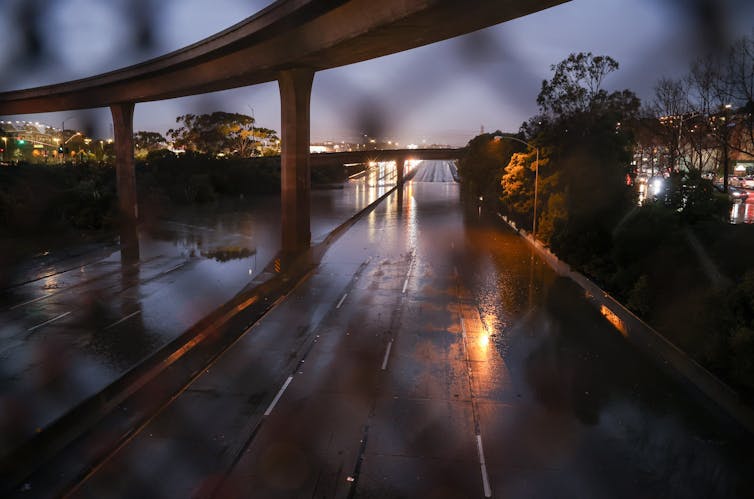
California has seen so much rain over the past few weeks that farm fields are inundated and normally dry creeks and drainage ditches have become torrents of water racing toward the ocean. Yet, most of the state remains in severe drought.

All that runoff in the middle of a drought begs the question — why can’t more rainwater be collected and stored for the long, dry spring and summer when it’s needed?
As a hydrogeologist at the University of California at Santa Cruz, I’m interested in what can be done to collect runoff from storms like this on a large scale. There are two primary sources of large-scale water storage that could help make a dent in the drought: holding that water behind dams and putting it in the ground.
Why isn’t California capturing more runoff now?
When California gets storms like the atmospheric rivers that hit in December 2022 and January 2023, water managers around the state probably shake their heads and ask why they can’t hold on to more of that water. The reality is, it’s a complicated issue.
California has big dams and reservoirs that can store large volumes of water, but they tend to be in the mountains. And once they’re near capacity, water has to be released to be ready for the next storm. Unless there’s another reservoir downstream, a lot of that water is going out to the ocean.
In more populated areas, one of the reasons storm water runoff isn’t automatically collected for use on a large scale is because the first runoff from roads is often contaminated. Flooding can also cause septic system overflows. So, that water would have to be treated.
You might say, well, the captured water doesn’t have to be drinking water, we could just use it on golf courses. But then you would need a place to store the water, and you would need a way to distribute it, with separate pipes and pumps, because you can’t put it in the same pipes as drinking water.
Putting water in the ground
There’s another option, and that’s to put it in the ground, where it could help to replenish groundwater supplies.
Managed recharge has been used for decades in many areas to actively replenish groundwater supplies. But the techniques have been gaining more attention lately as wells run dry amid the long-running drought. Local agencies have proposed more than 340 recharge projects in California, and the state estimates those could recharge an additional 500,000 acre-feet of water a year on average if all were built.
One method being discussed by the state Department of Water Resources and others is Flood-MAR, or flood-managed aquifer recharge. During big flows in rivers, water managers could potentially divert some of that flow onto large parts of the landscape and inundate thousands of acres to recharge the aquifers below. The concept is to flood the land in winter and then farm in summer.
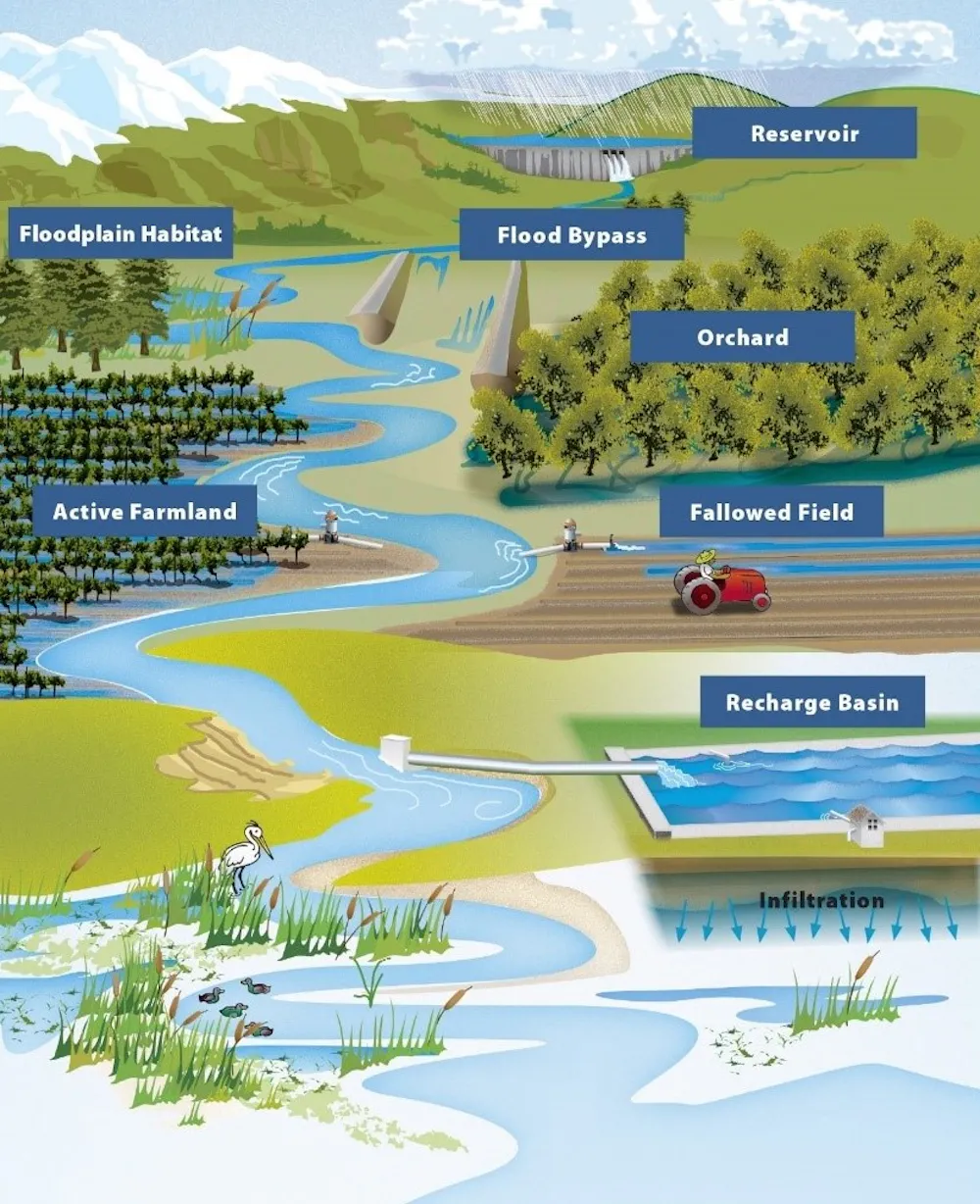
Flood-MAR is promising, provided we can find people who are willing to inundate their land and can secure water rights. In addition, not every part of the landscape is prepared to take that water.
You could inundate 1,000 acres on a ranch, and a lot of it might stay flooded for days or weeks. Depending on how quickly that water soaks in, some crops will be OK, but other crops could be harmed. There are also concerns about creating habitat that encourages pests or risks food safety.
Another challenge is that most of the big river flows are in the northern part of the state, and many of the areas experiencing the worst groundwater deficits are in central and southern California. To get that excess water to the places that need it requires transport and distribution, which can be complex and expensive.
Encouraging landowners to get involved
In the Pajaro Valley, an important agricultural region at the edge of Monterey Bay, regional colleagues and I are trying a different type of groundwater recharge project where there is a lot of runoff from hill slopes during big storms.
The idea is to siphon off some of that runoff and divert it to infiltration basins, occupying a few acres, where the water can pool and percolate into the ground. That might be on agricultural land or open space with the right soil conditions. We look for coarse soils that make it easier for water to percolate through gaps between grains. But much of the landscape is covered or underlain by finer soils that don’t allow rapid infiltration, so careful site selection is important.
One program in the Pajaro Valley encourages landowners to participate in recharge projects by giving them a rebate on the fee they pay for water use through a “recharge net metering” mechanism.
We did a cost-benefit analysis of this approach and found that even when you add in all the capital costs for construction and hauling away some soil, the costs are competitive with finding alternative supplies of water, and it is cheaper than desalination or water recycling.
Is the rain enough to end the drought?
It’s going to take many methods and several wet years to make up for the region’s long period of low rainfall. One storm certainly doesn’t do it, and even one wet year doesn’t do it.
For basins that are dependent on groundwater, the recharge process takes years. If this is the last rainstorm of this season, a month from now we could be in trouble again.
Andrew Fisher, Professor of Earth and Planetary Sciences, University of California, Santa Cruz
This article is republished from The Conversation under a Creative Commons license. Read the original article.