 How to resolve AdBlock issue?
News
Tis the season to be giving. Many older adults enjoy giving money during their lifetime to family members or donations to a religious or charitable organizations.
For example, a grandparent may make a generous holiday gift of money to a needy grandchild in college or to an adult child who is struggling in-between jobs. The magnitude of such giving is usually governed by a person’s financial resources, life circumstances, and generosity.
This natural tendency to bestow gifts, at holidays and birthdays, can grind to an abrupt halt when someone becomes incapacitated, such as when a person becomes demented.
That said, anyone who wishes to continue a pattern of gifting, or otherwise provide for possible gifts, in the event of their own future incapacity, should plan ahead by including appropriate gifting provisions in their estate planning documents.
An express gifting authority can be included in a person’s trust to allow the person’s trustee to make gifts using assets inside the trust and also included in a person’s power of attorney to allow the person’s agent to gift using assets outside of the trust. Such gifting authority must be expressly stated written authorization and cannot be implied based on a person’s past behavior.
For example, a commonly used express gifting provision in a power of attorney is, “the Agent is authorized to make gifts on the Principal's behalf to the Principal's children, any of their issue, or both, to the full extent of the federal annual gift tax exclusion … and, for such purposes, to remove the Principal's assets from any revocable trust of which the Principal is a grantor.”
The foregoing authority allows the Agent the discretion to make gifts to the principal’s descendants (e.g., children and grandchildren) up to the current annual federal gift tax exclusion amount, presently $16,000, each year, per donee. The Agent may request assets from the Principal’s trust to fulfill the gifts.
Thus, in 2022, if the principal had one child and two grandchildren, the agent may gift up to $16,000 to each and $48,000 altogether. In 2023, the annual gift tax exclusion amount is $17,000.
Gifting is not to be confused with a person’s legal duties of support to a spouse or to dependent minor child(ren). A power of attorney and a trust may, and should, also provide for meeting a person’s legal duty of support during their incapacity.
However, some people provide financial support to family members which is not legally required.
For example, a parent may pay a disabled child’s living expenses. In such cases, whether such support continues if the provider becomes incapacitated depends on whether the provider’s estate planning documents provide for continued support that is not legally required.
An agent under a power of attorney and a trustee under a trust instrument are each a fiduciary (i.e., a legal representative with duties and obligations).
Any actions, including discretionary gifts, taken by an agent or trustee must agree with their legal duty and obligations as a fiduciary.
Thus, any exercise of fiduciary discretion must be reasonable, in good faith, and consistent with any instructions provided in the instrument. Thus, an Agent, or a Trustee, ordinarily should not make imprudent or unjustified gifts that might jeopardize the financial welfare of the principal or settlor.
An important exception is when the agent or trustee is expressly authorized to gift assets away in order to qualify the principal or settlor as eligible for needs-based government welfare benefits (e.g., SSI and Medi-Cal).
There are many good reasons to give during one’s lifetime. Sometimes it may be appropriate and desirable that such gifting continues even during one’s incapacity. If so, then plan ahead. Happy Holidays.
The foregoing discussion is not legal advice. Consult an attorney.
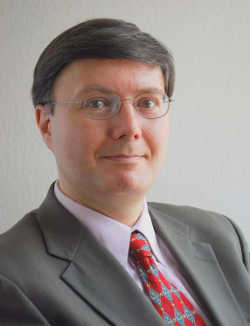
Dennis A. Fordham, attorney, is a State Bar-Certified Specialist in estate planning, probate and trust law. His office is at 870 S. Main St., Lakeport, Calif. He can be reached at

Cameras on the Surface Water and Ocean Topography spacecraft captured the antennas for its main science instrument unfurling in orbit.
But before it can do that, the satellite would need to unfold its large mast and antenna panels (see above) after successfully deploying the solar panel arrays that power the spacecraft. The mission monitors and controls the satellite using telemetry data, but it also equipped spacecraft with four customized commercial cameras to record the action.
The solar arrays fully deployed shortly after launch, taking about 10 minutes.
The antennas successfully deployed over four days, a process that was completed on Dec. 22. The two cameras focused on the KaRIn antennas captured the mast extending out from the spacecraft and locking in place but stopped short of capturing the antennas being fully deployed (a milestone the team confirmed with telemetry data.)
Thirty-three feet apart, at either end of the mast, the two antennas belong to the groundbreaking Ka-band Radar Interferometer, or KaRIn, instrument.
Designed to capture precise measurements of the height of water in Earth’s freshwater bodies and the ocean, KaRIn will see eddies, currents, and other ocean features less than 13 miles across.
It will also collect data on lakes and reservoirs larger than 15 acres and rivers wider than 330 feet across.
KaRIn will do this by bouncing radar pulses off the surface of water on Earth and receiving the signals with both of those antennas, collecting data along a swath that’s 30 miles wide on either side of the satellite.
The data SWOT provides will help researchers and decision-makers address some of the most pressing climate questions of our time and help communities prepare for a warming world.
More about the mission
SWOT was jointly developed by NASA and the French space agency Centre National d’Études Spatiales, or CNES, with contributions from the Canadian Space Agency, or CSA, and the UK Space Agency.
JPL, which is managed for NASA by Caltech in Pasadena, California, leads the U.S. component of the project.
For the flight system payload, NASA is providing the KaRIn instrument, a GPS science receiver, a laser retroreflector, a two-beam microwave radiometer, and NASA instrument operations.
CNES is providing the Doppler Orbitography and Radioposition Integrated by Satellite system, the dual frequency Poseidon altimeter (developed by Thales Alenia Space), the KaRIn radio-frequency subsystem (together with Thales Alenia Space and with support from the UK Space Agency), the satellite platform, and ground operations.
CSA is providing the KaRIn high-power transmitter assembly. NASA is providing the launch vehicle and the agency’s Launch Services Program, based at Kennedy Space Center, is managing the associated launch services.
To learn more about SWOT, visit https://swot.jpl.nasa.gov/.
LAKEPORT, Calif. — Three years after Lakeport’s Kmart closed, the building that once housed the retail giant is poised to get new life and new tenants.
At its last meeting of 2022 on Dec. 14, the Lakeport Planning Commission approved Upward Architects’ application for a use permit and an architectural and design review for a new commercial project at the building, located at 2019 S. Main St.
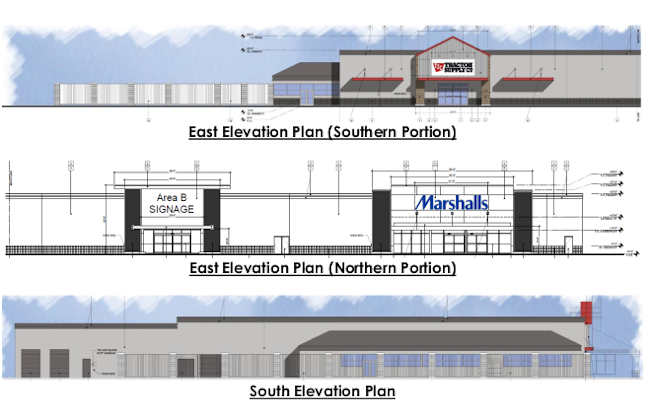
The commission’s approval will allow Upward Architects to renovate and subdivide the 90,852-square-foot building into three lease spaces, two of which will be occupied by Marshalls and Tractor Supply Co.
Upward Architects, a Tempe, Arizona-based commercial architecture firm, submitted the project’s land use application in September.
The owner of the 8.59-acre property is Ken Simons of Simons Real Estate Group Inc. in Moorpark, California, the land use application showed.
During the Dec. 14 meeting, City Manager Kevin Ingram noted that for the city, the project is “the biggest thing we’ve got going.”
Kmart closed the store at the end of 2019 after operating it there since the early 1990s and despite the fact that it was reported to be one of the struggling company’s top 25 performing stores in the country.
The store had been a major sales tax generator for the city of Lakeport. Since its closure the city has worked to fill the void.
The city has been helped by The Retail Coach, a company it had hired in July 2019 to help recruit retailers, before word of the Kmart closure became public.
At the Nov. 1 Lakeport City Council meeting, during which the council extended the contract with The Retail Coach, it received an update on the company’s efforts, which included a report on plans for the former Kmart building.
Austin Farmer of The Retail Coach told the council at that meeting that they had received two letters of intent from retailers for the redevelopment of the Kmart property.
Farmer didn’t identify the two retailers at that point, but at the Planning Commission meeting and in the application from Upward Architects, it was confirmed that Marshalls and Tractor Supply Co. are the retailers.
Marshalls is a department store which has offerings including clothing, shoes, cosmetics, accessories, gifts and home décor.
Tractor Supply Co. offers equipment, tools, food for pets and livestock, and housewares. This will be Lake County’s second Tractor Supply.
The other is located in Clearlake in the Walmart shopping center on Dam Road, in a building that formerly was the location for Ray’s Food Place, which closed in late 2016. That building was renovated and now, in addition to Tractor Supply, it houses Big 5 and a new Department of Motor Vehicles office.
Commission gets report on project, votes to support it
During the Planning Commission’s half-hour meeting on Dec. 14, Chairman Mark Mitchell recused himself from the discussion and the vote because he is involved in the project.
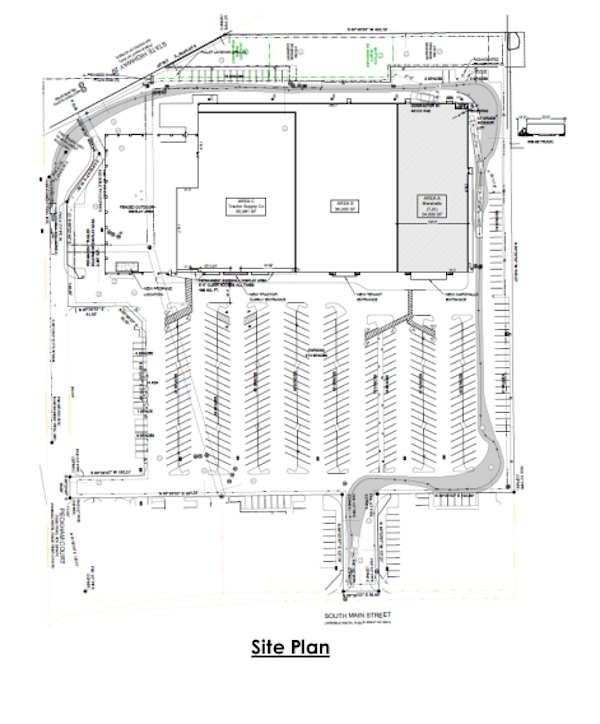
City Associate Planner Victor Fernandez explained that the project application calls for Tractor Supply Co. to occupy the southern portion of the building, which consists of 30,981 square feet.
In addition to the indoor section of the building, Tractor Supply also will have outdoor sales of large equipment and outdoor sidewalk sales.
The project includes expansion of the 21,977-square-foot outdoor fenced area — which had been Kmart’s outdoor garden section — for Tractor Supply’s use.
The plans also call for increasing the building’s height from 29 feet to 32 feet. Fernandez said the maximum height within the city’s C-2 commercial zoning is 35 feet.
Fernandez said it’s anticipated that Marshalls will occupy the northern portion of the building, which is about 24,000 square feet.
The 36,005 square foot middle section of the building will be for a future tenant which is unknown at this time, Fernandez said.
Lakeport planning staff analyzed the project and determined that it’s compliant with the city’s general plan and that it’s exempt from the California Environmental Quality Act, or CEQA, under a section which allows improvements to existing facilities, Fernandez said.
The staff report noted that the existing site layout would remain “mostly unchanged” except for the expansion of Tractor Supply’s fenced outdoor area and some minor parking space modifications to allow for semi truck access.
Fernandez said the project’s site plan will eliminate a small amount of parking due to those modifications.
However, he reviewed the parking requirements under the city’s most restrictive guidelines that require one space for 250 square feet of building space.
That would equal 364 parking spaces for the entire project and the three leased spaces. Even with the loss of some parking spaces, Fernandez said the project would have more than enough parking, with 471 total parking stalls.
During public comment, Rick Sander, an architect with Upward Architects and senior project manager, said the only “asterisk” on the project as proposed is that there are unknowns about the middle section of the store that doesn’t yet have a tenant.
Sander said it’s possible that center space could be divided, but it’s only a discussion at this point and it’s unknown as to what stores might go in there. Once they know, they will return to talk to the city.
Fernandez said such a modification to divide the building’s center section would consist of interior remodeling and wouldn’t increase square footage so the city would be able to do that modification to the plan with a building permit application.
If the exterior facade changed, Fernandez said the plan might need to go through a modification, adding it would be a “fairly standard” process.
The commission unanimously passed three separate motions for a categorical exemption to CEQA, approval of architectural and design review and the use permit.
Sander asked about next steps, and Fernandez said he would contact him the following morning regarding the approval letter and the project conditions agreement.
Email Elizabeth Larson at

The California Highway Patrol urges everyone to ring in 2023 responsibly by designating a sober driver.
The CHP will conduct a maximum enforcement period, or MEP, starting at 6:01 p.m. on Friday, Dec. 30, 2022, continuing through 11:59 p.m. on Monday, Jan. 2, 2023.
During that time, all available CHP officers will be out on patrol with a focus on removing impaired drivers.
“Every year, people’s lives are impacted forever by making the decision to get behind the wheel while under the influence,” CHP Commissioner Amanda Ray said. “Driving impaired is never worth it and certainly not the way to ring in the new year — always designate a sober driver.”
During the previous New Year’s MEP, 29 people were killed and CHP officers arrested 495 impaired drivers.
Additionally, the CHP issued over 2,300 citations for speeding and 26 citations for seat belt violations during the same time period.
To help bolster this year’s holiday traffic safety effort across state lines, the CHP will again coordinate with the National Highway Transportation Safety Administration and law enforcement partners from all over the Western United States.
With this year’s “Eyes on the Interstates” initiative, officers from Washington, Oregon, Nevada, Arizona, Idaho and Montana will be teaming up with the CHP to increase awareness about driving under the influence and removing impaired drivers from the roadways.
State Fire Marshal Michael J. Richwine has announced his retirement from the California Department of Forestry and Fire Protection, or Cal Fire, Office of the State Fire Marshal, after a 42-year career, including 36 years with the department.
Chief Richwine was appointed State Fire Marshal by Governor Gavin Newsom on May 15, 2020, after serving as the assistant state fire marshal from 2012 to 2018.
As state fire marshal, Chief Richwine oversaw a staff of more than 220 employees.
“Among many things, one of my proudest career achievements was leading the Office of the State Fire Marshal and overhauling the California Fire Service Training and Education System — a state fire training certification and education program — including aligning it with national training standards and national and international accreditation of the firefighter program,” said Chief Richwine. “Through this important work, we continue to find ways to innovate, set the bar high and prepare the next generation of fire professionals in California.”
Chief Richwine's total 42-year fire service career began with the Hanford Fire Department. He has since risen through the ranks and held a variety of fire prevention and training positions within the Office of the State Fire Marshal, including, fire service training specialist, deputy state fire marshal within fire and life safety, Hazardous Materials and Pipeline Safety Divisions, chief of state fire training, and chief of the Fire Engineering Division.
Chief Richwine also served as a member on Cal Fire’s Incident Management Teams for six years and holds numerous professional certifications.
“My hope for the future is that the Office of the State Fire Marshal continues its tradition of working collaboratively with its many partners and continues to communicate effectively. That is what I have preached on a regular basis — up and down and across our entire organization,” said Chief Richwine.
The mission of the State Fire Marshal is to protect life and property through the development and application of fire prevention engineering, education, and enforcement.
The Office of the State Fire Marshal supports the mission of Cal Fire by focusing on fire prevention and providing support through a wide variety of fire safety responsibilities through code development and analysis, community wildfire preparedness and mitigation, fire and life safety, fire engineering and investigations, pipeline safety and certified unified program agency, and state fire training.
During his retirement, Chief Richwine is looking forward to spending time with his wife, a retired elementary school teacher, and their children and grandchildren.
His last day with the Department will be Dec. 30.
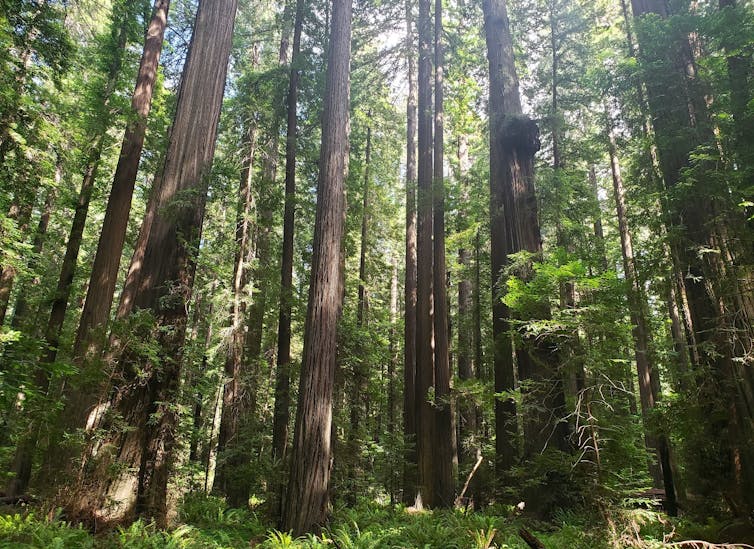
Many of the companies promising “net-zero” emissions to protect the climate are relying on vast swaths of forests and what are known as carbon offsets to meet that goal.
On paper, carbon offsets appear to balance out a company’s carbon emissions: The company pays to protect trees, which absorb carbon dioxide from the air. The company can then claim the absorbed carbon dioxide as an offset that reduces its net impact on the climate.
However, our new satellite analysis reveals what researchers have suspected for years: Forest offsets might not actually be doing much for the climate.
You can listen to more articles from The Conversation, narrated by Noa, here.
When we looked at satellite tracking of carbon levels and logging activity in California forests, we found that carbon isn’t increasing in the state’s 37 offset project sites any more than in other areas, and timber companies aren’t logging less than they did before.
The findings send a pretty grim message about efforts to control climate change, and they add to a growing list of concerns about forest offsets. Studies have already shown that projects are often overcredited at the beginning and might not last as long as expected. In this case we’re finding a bigger issue: a lack of real climate benefit over the 10 years of the program so far.
But we also see ways to fix the problem.
How forest carbon offsets work
Forest carbon offsets work like this: Trees capture carbon dioxide from the air and use it to build mass, effectively locking the carbon away in their wood for the life of the tree.
In California, landowners can receive carbon credits for keeping carbon stocks above a minimum required “baseline” level. Third-party verifiers help the landowners take inventory by manually measuring a sample of trees. So far, this process has only involved measuring carbon levels relative to baseline and has not leveraged the emerging satellite technologies that we explored.
Forest owners can then sell the carbon credits to private companies, with the idea that they have protected trees that would otherwise be cut down. These include large oil and gas companies that use offsets to meet up to 8% of their state-mandated reductions in emissions.

Forest offsets and other “natural climate solutions” have received a great deal of attention from companies, governments and nonprofits, including during the U.N. climate conference in November 2022. California has one of the world’s largest carbon offset programs, with tens of millions of dollars flowing through offset projects, and is often a model for other countries that are planning new offset programs.
It’s clear that offsets are playing a large and growing role in climate policy, from the individual to the international level. In our view, they need to be backed by the best available science.
3 potential problems
Our study used satellite data to track carbon levels, tree harvesting rates and tree species in forest offset projects compared with other similar forests in California.
Satellites offer a more complete record than on-the-ground reports collected at offset projects. That allowed us to assess all of California since 1986.

From this broad view, we identified three problems indicating a lack of climate benefit:
-
Carbon isn’t being added to these projects faster than before the projects began or faster than in non-offset areas.
-
Many of the projects are owned and operated by large timber companies, which manage to meet requirements for offset credits by keeping carbon above the minimum baseline level. However, these lands have been heavily harvested and continue to be harvested.
-
In some regions, projects are being put on lands with lower-value tree species that aren’t at risk from logging. For example, at one large timber company in the redwood forests of northwestern California, the offset project is only 4% redwood, compared with 25% redwood on the rest of the company’s property. Instead, the offset project’s area is overgrown with tanoak, which is not marketable timber and doesn’t need to be protected from logging.

How California can fix its offset program
Our research points to a set of recommendations for California to improve its offsets protocols.
One recommendation is to begin using satellite data to monitor forests and confirm that they are indeed being managed to protect or store more carbon. For example, it could help foresters create more realistic baselines to compare offsets against. Publicly available satellite data is improving and can help make carbon offsetting more transparent and reliable.
California can also avoid putting offset projects on lands that are already being conserved. We found several projects owned by conservation groups on land that already had low harvest rates.
Additionally, California could improve its offset contract protocols to make sure landowners can’t withdraw from an offset program in the future and cut down those trees. Currently there is a penalty for doing so, but it might not be high enough. Landowners may be able to begin a project, receive a huge profit from the initial credits, cut down the trees in 20 to 30 years, pay back their credits plus penalty, and still come out ahead if inflation exceeds the liability.
Ironically, while intended to help mitigate climate change, forest offsets are also vulnerable to it – particularly in wildfire-prone California. Research suggests that California is hugely underestimating the climate risks to forest offset projects in the state.
The state protocol requires only 2% or 4% of carbon credits be set aside in an insurance pool against wildfires, even though multiple projects have been damaged by recent fires. When wildfires occur, the lost carbon can be accounted for by the insurance pool. However, the pool may soon be depleted as yearly burned area increases in a warming climate. The insurance pool must be large enough to cover the worsening droughts, wildfires and disease and beetle infestations.
Considering our findings around the challenges of forest carbon offsets, focusing on other options, such as investing in solar and electrification projects in low-income urban areas, may provide more cost-effective, reliable and just outcomes.
Without improvements to the current system, we may be underestimating our net emissions, contributing to the profits of large emitters and landowners and distracting from the real solutions of transitioning to a clean-energy economy.
Shane Coffield, Postdoctoral Scientist in Biospheric Sciences, Goddard Space Flight Center, NASA and James Randerson, Professor of Earth Science, University of California, Irvine
This article is republished from The Conversation under a Creative Commons license. Read the original article.