 How to resolve AdBlock issue?
News
The theme of this year’s event will be “Under the Sea.”
Tickets, which are available on the club website, cost $70 per person.
That will get you a complete crab dinner featuring two pounds of hot cracked crab and a pound of fresh shrimp, as well as tossed salad and warm bread rolls.
Also available for an additional $20 is a quart of clam chowder. Local wines can be purchased for $20 a bottle and take-home butter warmers are available for $15.
As part of the crab-packed weekend, Lakeport Rotary is holding an online auction beginning on Friday, Feb. 18, at 9 a.m.
There will also be a number of home-baked desserts auctioned as well. The dessert auction closes at 2 p.m. sharp on Saturday, February 18, and the main auction will close on Sunday, February 20, at 9 p.m.
There are sponsorship opportunities. Those who opt for the $2,000 King Trident sponsorship will receive eight full crab meals, four Lake County wines, four chowders, four warmers and desserts, as well as press coverage and a business promotional video with Crabby the Crab.
The $1,000 Mermaid sponsorship includes four meals, two bottles of wine, two chowders, two warmers and desserts, a Crabby promotional and press coverage.
And, finally, there are $500 Starfish sponsorships which include two meals, one bottle of Lake County wine, one chowder, one warmer and dessert. The same Crabby promotional video and press coverage are included.
This year’s King Trident sponsors already include Adventist Health Clearlake, Sutter Lakeside Hospital and Lake County Tribal Health.
Mermaid sponsors who have already committed include Strong Financial Network and Lakeport Tire and Auto.
Starfish sponsors so far are Nala’s Cleaning Service, Dennis Fordham Law and Bell Haven Flower Farm.
To inquire about sponsorships, please contact event coordinator Faith Hornby at 707-349-3533 or email her at

Disability representation is slowly increasing in books geared toward children and teens.
In 2019 the Cooperative Children’s Book Center at the University of Wisconsin-Madison – a library that allows teachers, librarians and researchers to view books before deciding which ones to buy – found that only 3.4% of books it received from publishers included a character with a disability.
The CCBC website recently added a diversity statistics book search with categories for physical, cognitive and psychiatric disabilities or conditions. In 2022, the center received 165 books that included a character with a disability, up from 126 in 2019.
As an academic librarian who also has a disability, I’m happy to recommend the following five children’s books that treat disability as a part of life and living.
1. Maria Gianferrari (author), Patrice Barton (illustrator), “Hello Goodbye Dog” (2017)
Moose loves her girl Zara – and she hates saying goodbye. When Zara goes to school, Moose wants to go too and keeps showing up, even though dogs aren’t allowed. What will Zara, her parents, the principal, her teacher and the other kids in Zara’s class do?
This fun picture book is perfect for preschoolers and kindergartners. While Zara uses a wheelchair, her disability isn’t the focus of the story. Readers will have fun seeing what Moose is up to this time and learn that sometimes dogs can go to school.
2. Kelly Fritsch, Anne McGuire, Eduardo Trejos, “We Move Together” (2021)
All bodies are different – whether disabled or nondisabled – and everyone matters. These are the themes of this easy reader. With its vibrant illustrations, simple text and portrayals of a wide variety of people, “We Move Together” is a great introduction to the concepts of community, disability and accessibility for readers in kindergarten through second grade, while older readers can learn more about accessibility and disability rights in the glossary.
3. Darren Lebeuf, Ashley Barron, “My City Speaks” (2021)
A girl who is blind and her dad explore the city and its sounds. They wait at a crosswalk, play in the park, take a bus, avoid a rainstorm and eat ice cream. Words and pictures help the reader feel the rhythms of the city. Readers in preschool through second grade will enjoy this story because of its colorful illustrations and rhythmic text.
4. Ali Stroker, Stacy Davidowitz, “The Chance to Fly” (2021)
Nat Beacon is the new girl in school with a talent for wheelchair racing, but when the 13-year-old gets the chance to audition for a summer production of the musical “Wicked,” she knows the theater is where she belongs. How does she tell her parents?
This novel for readers in fifth, sixth and seventh grades explores themes of independence, friendship and first love.
5. Melissa See, “You, Me, and Our Heartstrings” (2022)
Daisy and Noah are two of the best musicians in their high school orchestra and dream of attending Juilliard, the prestigious performing arts school in New York City. When their performance of an original piece goes viral, they have to deal with the world’s interpretation of them and their relationship.
This rom-com of a novel combines disability representation with themes of friendship and romance. Great for readers in grades nine to 12.
For more books featuring characters with disabilities, check out the American Library Association’s Schneider Family Book Award. For a wide variety of diverse titles, see We Need Diverse Books.
Rebecca Weber, Associate Professor Library, Oklahoma State University
This article is republished from The Conversation under a Creative Commons license. Read the original article.

All living trusts, at a minimum, have one common denominator: avoiding probate. Beyond that, living trusts are not created equal.
Let us discuss some of the estate planning features that a well drafted living trust often contains.
A well drafted living trust administers a person’s assets during incapacity (prior to death) and at death, without any court supervision (e.g., conservatorships and probate), for the benefit of the settlor who created the trust and his or her loved ones. Flexibility to deal with unforeseen events can be beneficial.
First, a trust should provide for the care of the settlor and the settlor’s loved ones if the settlor is incapacitated.
Does the trust provide authority and instructions for the settlor’s personal care in the event of the settlor’s incapacity?
A trust, as relevant, may say whether the successor trustee pays for in home care services to allow the settlor to remain at home as long as possible; whether the trustee allows an adult child to move in (rent free) to care for the settlor; and whether the trustee pays to relocate the settlor to live with family or at an assisted living facility.
Does the trust contain authority and instructions for the care of the settlor’s dependents if the settlor is incapacitated?
A trust, as relevant, may say whether the trustee pays for all or some of the living expenses of the settlor’s spouse; whether the trustee continues to support an adult child; and whether the trustee continues to care for the settlor’s pets.
Second, a trust should provide a well thought out disposition of the settlor’s trust estate at the settlor’s death.
Does the trust adequately address the varied needs and life circumstances of its beneficiaries?
A well drafted trust often provides discretion to the trustee to administer the trust based on future conditions as they exist at the time of administration.
Does the trust provide the trustee with express instructions or with discretion to use their own judgment to administer the inheritance of a beneficiary who is a minor; to administer the inheritance of a beneficiary who receives needs based government benefits; to administer the inheritance of a beneficiary who has serious creditor problems; or to administer the inheritance of a beneficiary who cannot manage their assets.
A trust, as relevant, may say whether the inheritances of such beneficiaries are subject to further (ongoing) trust management over part or all of their lifetime.
A trust may also allow the trustee to administer a beneficiary’s inheritance to purchase services and/or assets for the health, education, maintenance and support of a beneficiary and without distribution cash to the beneficiary.
Does the trust provide for the proper contingency planning in the event that a named beneficiary does not survive?
A trust should name or describe alternative beneficiaries in the event that a beneficiary is not alive to inherit and provide whether the alternative beneficiary receives their inheritance outright or in further trust.
Does the trust allow the appointment of an alternative successor trustee in the event that all persons nominated in the trust fail to serve as trustee?
A trust can provide a mechanism to appoint an alternative successor trustee without a court petition. That is, the trust may allow the beneficiaries to appoint a trustee or allow a person named as a power holder to appoint a trustee.
Does the trust include, as relevant, properly worded disinheritance and no-contest clauses? A disinheritance clause is particularly relevant when the settlor is not gifting anything to an heir.
Consider a parent who is excluding one or more of their children as beneficiaries. Consider a parent who is making an unequal distribution on their assets amongst their children. Is there a no-contest clause to discourage the less favored children from contesting the unequal distribution of the estate.
The foregoing illustrates how a well drafted living trust may avoid some unforeseen and unintended pitfalls. This is not legal advice. Consult an attorney.
Dennis A. Fordham, attorney, is a State Bar-Certified Specialist in estate planning, probate and trust law. His office is at 870 S. Main St., Lakeport, Calif. He can be reached at
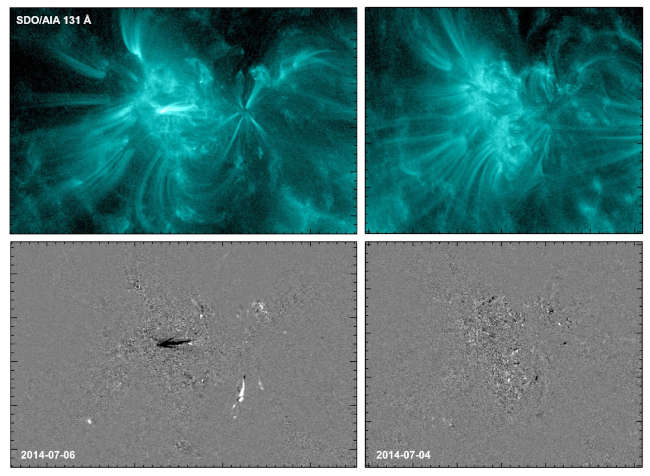
In the blazing upper atmosphere of the Sun, a team of scientists have found new clues that could help predict when and where the Sun’s next flare might explode.
Using data from NASA’s Solar Dynamics Observatory, or SDO, researchers from NorthWest Research Associates, or NWRA, identified small signals in the upper layers of the solar atmosphere, the corona, that can help identify which regions on the Sun are more likely to produce solar flares — energetic bursts of light and particles released from the Sun.
They found that above the regions about to flare, the corona produced small-scale flashes — like small sparklers before the big fireworks.
This information could eventually help improve predictions of flares and space weather storms — the disrupted conditions in space caused by the Sun’s activity.
Space weather can affect Earth in many ways: producing auroras, endangering astronauts, disrupting radio communications, and even causing large electrical blackouts.
Scientists have previously studied how activity in lower layers of the Sun’s atmosphere — such as the photosphere and chromosphere — can indicate impending flare activity in active regions, which are often marked by groups of sunspots, or strong magnetic regions on the surface of the Sun that are darker and cooler compared to their surroundings. The new findings, published in The Astrophysical Journal, add to that picture.
“We can get some very different information in the corona than we get from the photosphere, or ‘surface’ of the Sun,” said KD Leka, lead author on the new study who is also a designated foreign professor at Nagoya University in Japan. “Our results may give us a new marker to distinguish which active regions are likely to flare soon and which will stay quiet over an upcoming period of time.”
For their research, the scientists used a newly created image database of the Sun’s active regions captured by SDO. The publicly available resource, described in a companion paper also in The Astrophysical Journal, combines over eight years of images taken of active regions in ultraviolet and extreme-ultraviolet light.
Led by Karin Dissauer and engineered by Eric L. Wagner, the NWRA team’s new database makes it easier for scientists to use data from the Atmospheric Imaging Assembly, or AIA, on SDO for large statistical studies.
“It's the first time a database like this is readily available for the scientific community, and it will be very useful for studying many topics, not just flare-ready active regions,” Dissauer said.
The NWRA team studied a large sample of active regions from the database, using statistical methods developed by team member Graham Barnes. The analysis revealed small flashes in the corona preceded each flare. These and other new insights will give researchers a better understanding of the physics taking place in these magnetically active regions, with the goal of developing new tools to predict solar flares.
“With this research, we are really starting to dig deeper,” Dissauer said. “Down the road, combining all this information from the surface up through the corona should allow forecasters to make better predictions about when and where solar flares will happen.”
Mara Johnson-Groh works for NASA’s Goddard Space Flight Center in Greenbelt, Maryland.
LAKE COUNTY, Calif. — California hasn’t lost a species in 50 years, but that could soon change if efforts to save the Clear Lake hitch fail.
The population of the hitch, a large minnow native to Clear Lake and its tributaries, is crashing, local tribes are asking state and federal agencies for immediate intervention and on Thursday the state held a virtual meeting with Lake County residents and officials to discuss the emergency.
The hitch’s troubles began decades ago. Once reported to number in the millions, over the last decade, the hitch population has plummeted.
In 2014, as the situation was accelerating, the hitch was listed as a threatened species under the California Endangered Species Act. However, the federal government hasn’t followed suit so far.
The hitch has traditionally been a primary food source for Lake County’s Pomo tribes. In December, those tribes and the Center for Biological Diversity asked the U.S. Fish and Wildlife Service to provide emergency protections to the fish. They also held a summit with state and federal agencies to discuss immediate help for the hitch.
Concerns about the hitch led to the proposal for a proclamation of a local emergency by the Board of Supervisors at the Jan. 10 meeting, but that discussion was rescheduled to Jan. 24.
On Thursday, the State Water Resources Control Board held the first of two public listening sessions about the hitch.
Thursday’s State Water board session started out with some technical issues with its Zoom link. Officials said they have updated the links to avoid that problem at the Feb. 1 session.
Valerie Zimmer of the State Water Board said there is widespread agreement that the hitch has been in decline for a long time.
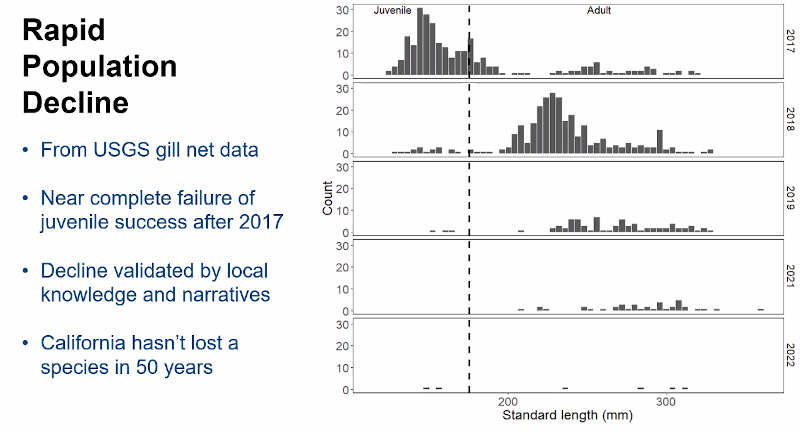
She showed a graph of hitch population and juvenile spawning data collected by the United States Geological Survey.
The data showed that there has been a near complete failure of juvenile hitch success after 2017, with Zimmer noting that the decline is validated by local knowledge and narratives.
The slide showed that a small number of juveniles were recorded in 2018, a smaller number in 2019. There were no numbers given for 2020, and then in 2021 no juveniles were recorded. In 2022, only a very small number were found.
“This looks like the population is crashing right now,” she said.
With the hitch having up to a six-year life cycle, if they don’t come back this year, Zimmer said they may be gone for good.
“Unfortunately we are late to this issue,” Zimmer said, adding that the state is catching up and working with local agencies and organizations.
As for why the hitch population is crashing now, Zimmer said there is no single cause and no single person who is responsible, although the drought is having an impact.
Zimmer said the hitch’s peril is due to human activity. Examples of harmful activities include:
• Flow barriers: Culverts, stream bed alterations and dams.
• Insufficient water flow volumes: Drought impacts, surface diversions and losing streams.
• Habitat degradation: Mining, land use changes, levee development and flood control.
• Predation and competition with invasive species
• Pollution: Mercury and harmful algal blooms.
Flow barriers may be a critical issue as hitch don’t jump over barriers. Zimmer said they can migrate when there is a lot of water, but not when water is low.
A key issue is lack of flow in Lake County’s creeks. “If there’s no water in the creeks, none of this other stuff matters,” Zimmer said.
Zimmer also showed a picture of a 2014 fish kill in Adobe Creek, when juvenile hitch got stuck and died. Just a week before, the creek was running very high, so a biologist couldn't get into the creek to get the fish out.
More recently, Lake County’s tribes have carried out successful fish rescues, such as one that occurred in April when Robinson Rancheria and Habematolel Pomo tribal members worked with the Lake County Water Resources staff and the California Department of Fish and Wildlife to rescue hundreds of hitch from an isolated pool in Adobe Creek near Soda Bay in Lakeport.
Other possible factors impacting the hitch’s numbers include illegal water diversions, cannabis, turning in pumps too early, overallocated water and groundwater use, especially when wells are close to creeks. Zimmer acknowledged data gaps and a lot that isn’t known.
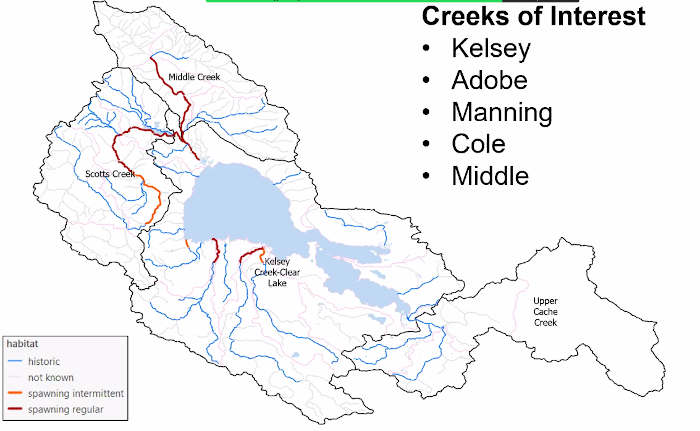
Zimmer said the focus is being placed on the creeks that historically have had a lot of hitch in them — Adobe, Cole, Kelsey, Manning and Middle creeks.
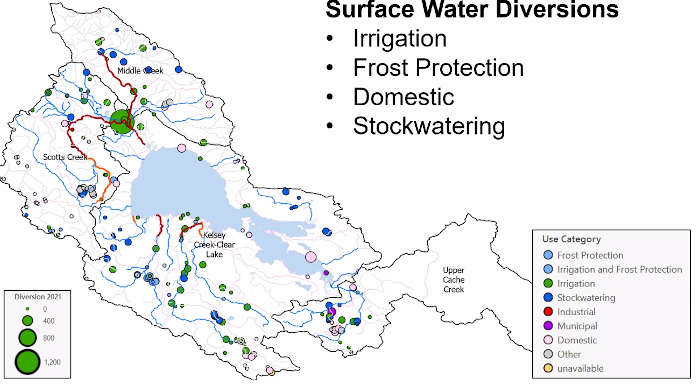
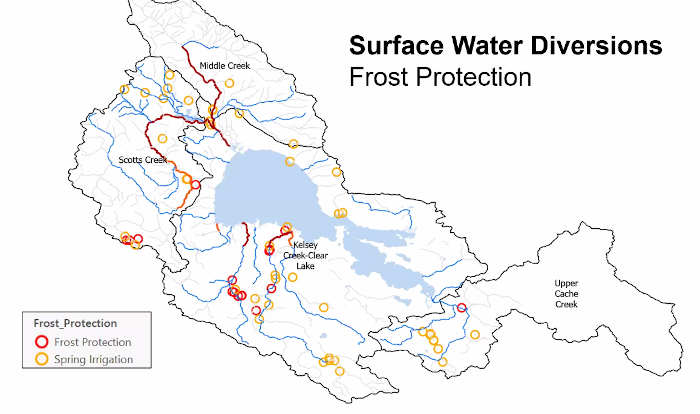
She showed maps of surface water diversions — irrigation, frost protection, domestic water and stock watering — as well as a map of uses like frost protection, which tends to occur in the spring when the hitch are migrating.
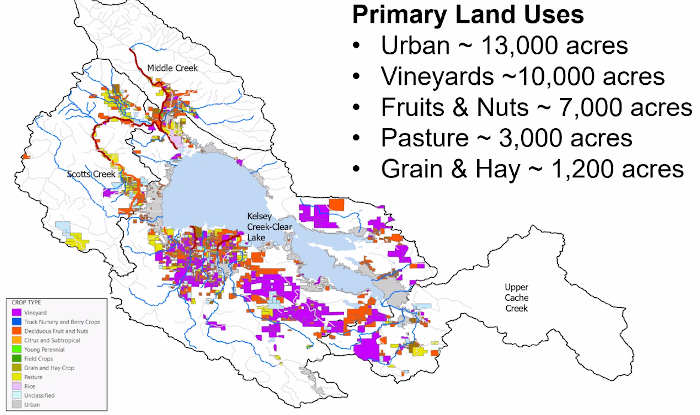
Primary uses for water in Lake County include urban, 13,000 acres; vineyards, 10,000 acres; fruits and nuts, 7,000 acres; pasture, 3,000 acres; and grain and hay, 1,200 acres.
Zimmer said the state is not looking at the entire county as it tries to address the situation. “We’re focusing on the areas that are important to the hitch.”
“I do think agriculture can be a really strong partner,” said Zimmer, explaining that some farmers are offering to put water into the creeks to get them moving so the fish can survive.
She said farmers also can help by looking for barriers — including roads and structures — on their properties that may impact the creeks.
John Murphy, a senior engineering geologist in the State Water Resources Control Board enforcement division, discussed the effort to get regulations in place, which can’t be done within just a few months, and takes time and data.
“At the end of the day, we know that the hitch is in trouble,” and the state wants to do everything they can to protect the fish, he said.
Murphy went over voluntary actions to keep water in the creeks this year, such as reductions in diversions and pumping, coordinating diversion and pumping timing, alternating frost protection methods and pump banks — using groundwater for streamflow. He said they are open to suggestions.
He said they have research going back to the 1950s when the hitch started having trouble.
There are concerns that, even with all of this year’s rains, the storm that took place on Wednesday could be the last rain for months, following a pattern from last year.
Murphy said they have information and momentum to help the fish. “We can’t lose this momentum. We don’t want the hitch going extinct on our watch.”
He said they are early in effort with lots of questions and possible solutions. Murphy added that they can’t let uncertainty about what actions to take lead to the hitch’s extinction.
As for what’s needed from the community, State Water Board staff said they need commitments for specific voluntary actions, such as reducing diversions and pumping from February to May, using alternative frost protection methods, coordinating diversion and pump timing.
They’re also looking for local coordinators, people to share data, leads on connecting with hard-to-reach people and invites to community meetings.
The state wants to hear what people would do to solve the problem in the short and long term, and get input on what specific steps the public thinks it should take.
There will be additional engagement opportunities with the state coming up.
The hitch will be discussed at the Board of Supervisors’ next meeting on Tuesday, Jan. 24, and the State Water Board will hold another listening session from 6 to 8 p.m. Wednesday, Feb. 1, via Zoom, http://bit.ly/CLH_Feb.1.
For more information, visit the State Water Board’s Hitch webpage. To receive email updates, email
Email Elizabeth Larson at
The meeting will take place from 5:30 to 7 p.m. Friday, Jan. 20, at the Lucerne Alpine Senior Center, 3985 Country Club Drive.
The meeting also will be available via Zoom. The meeting ID is 977 5740 1156, pass code is 589351. One tap mobile: +16694449171,,97757401156#,*589351#.
The Scotts Valley Band of Pomo Indians received a $5.2 million grant from the California Business, Consumer Services and Housing Agency in November to convert the historic 95-year-old building into 65 housing units for homeless youth from around the region.
The grant language stated that the Lake County Office of Education would be the primary partner, and that dozens more local organizations would be secondary partners. However, neither the Office of Education nor other partners said they knew about the application or the plan.
Lake County News has outlined the plan in a series of stories, beginning in December.
The tribe has since threatened legal action against Lake County News for covering the project.
Also in December, the Lucerne Area Town Hall passed a resolution condemning the plan.
Crandell initially only posted the meeting on his own Facebook page before the county of Lake shared it on its Facebook page and sent out an announcement about the meeting.
The meeting’s tentative guests include representatives from the offices of Assemblywoman Cecilia Aguiar-Curry and state Sen. Mike McGuire, and the California Business, Consumer Services Housing Agency.
Confirmed attendees include the Lake County Community Development Department, the Lake County Office of Education, the Scotts Valley Band of Pomo Indians and the Earthways Foundation, the organization that the county sold the Lucerne Hotel to in 2019 over community objections.
A question and answer session also is scheduled.
Email Elizabeth Larson at