 How to resolve AdBlock issue?
News
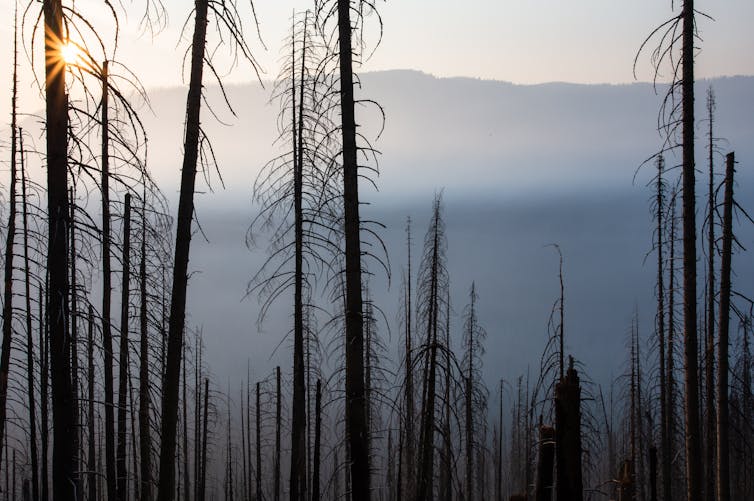
In the U.S., wildland firefighters are able to stop about 98% of all wildfires before the fires have burned even 100 acres. That may seem comforting, but decades of quickly suppressing fires has had unintended consequences.
Fires are a natural part of many landscapes globally. When forests aren’t allowed to burn, they become more dense, and dead branches, leaves and other biomass accumulate, leaving more fuel for the next fire. This buildup leads to more extreme fires that are even harder to put out. That’s why land managers set controlled burns and thin forests to clear out the undergrowth.
However, fuel accumulation isn’t the only consequence of fire suppression.
Fire suppression also disproportionately reduces certain types of fire. In a new study, my colleagues and I show how this effect, known as the suppression bias, compounds the impacts of fuel accumulation and climate change.
What happened to all the low-intensity fires?
Most wildfires are low-intensity. They ignite when conditions aren’t too dry or windy, and they can often be quickly extinguished.
The 2% of fires that escape suppression are those that are more extreme and much harder to fight. They account for about 98% of the burned area in a typical year.
In other words, trying to put out all wildfires doesn’t reduce the total amount of fire equally – instead, it limits low-intensity fires while extreme fires still burn. This effect is worsened by climate change.
Too much suppression makes fires more severe
In our study, we used a fire modeling simulation to explore the effects of the fire suppression bias and see how they compared to the effects of global warming and fuel accumulation alone.
Fuel accumulation and global warming both inherently make fires more severe. But over thousands of simulated fires, we found that allowing forests to burn only under the very worst conditions increased fire severity by the same amount as more than a century’s worth of fuel accumulation or 21st-century climate change.
The suppression bias also changes the way plants and animals interact with fire.
By removing low-intensity fires, humans may be changing the course of evolution. Without exposure to low-intensity fires, species can lose traits crucial for surviving and recovering from such events.
After extreme fires, landscapes have fewer seed sources and less shade. New seedlings have a harder time becoming established, and for those that do, the hotter and drier conditions reduce their chance of survival.
In contrast, low-intensity fires free up space and resources for new growth, while still retaining living trees and other biological legacies that support seedlings in their vulnerable initial years.
By quickly putting out low-intensity fires and allowing only extreme fires to burn, conventional suppression reduces the opportunities for climate-adapted plants to establish and help ecosystems adjust to changes like global warming.
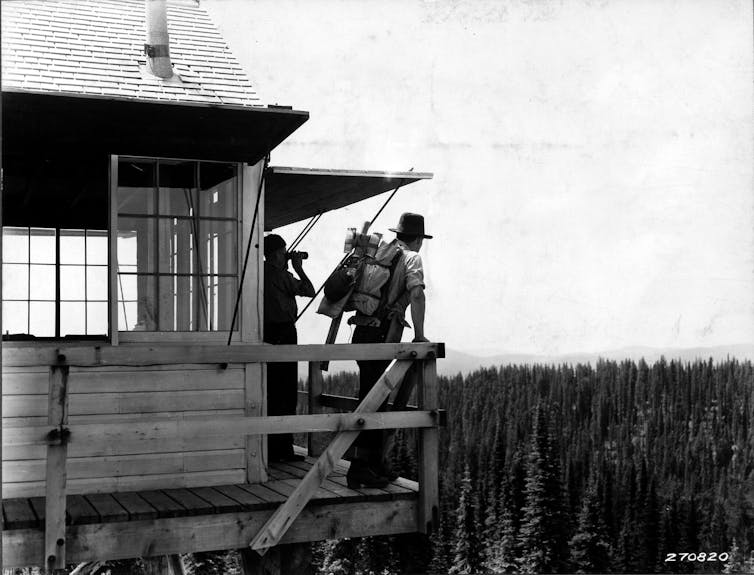
Suppression makes burned area increase faster
As the climate becomes hotter and drier, more area is burning in wildfires. If suppression removes fire, it should help slow this increase, right?
In fact, we found it does just the opposite.
We found that while conventional suppression led to less total area burning, the yearly burned area increased more than three times faster under conventional suppression than under less aggressive suppression efforts. The amount of area burned doubled every 14 years with conventional fire suppression under simulated climate change, instead of every 44 years when low- and moderate-intensity fires were allowed to burn. That raises concerns for how quickly people and ecosystems will have to adapt to extreme fires in the future.
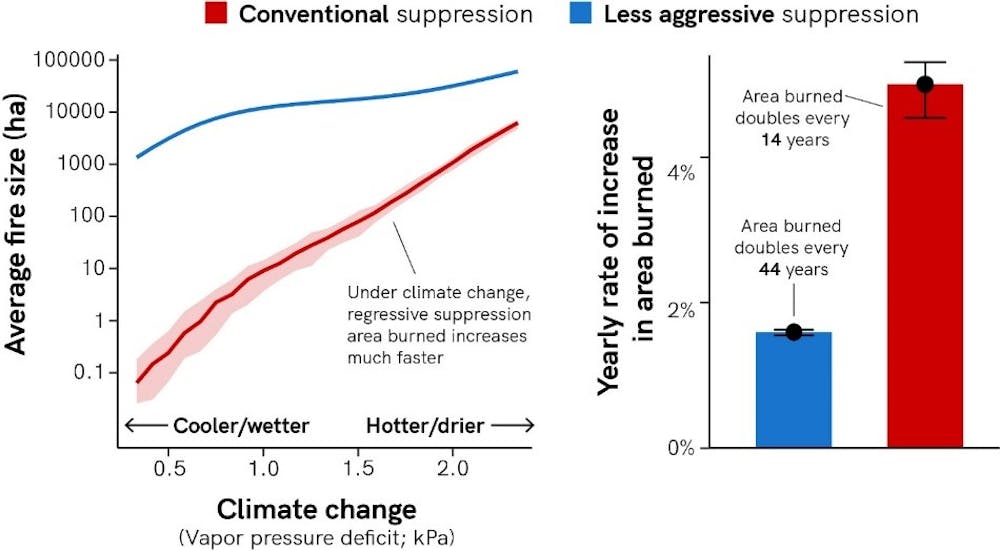
The fact that the amount of area burned is increasing is undoubtedly driven by climate change. But our study shows that the rate of this increase may also be a result of conventional fire management.
The near total suppression of fires over the last century means that even a little additional fire in a more fire-prone future can create big changes. As climate change continues to fuel more fires, the relative increase in area burned will be much bigger.
This puts more stress on communities as they adapt to increased extreme wildfires, from dealing with more wildfire smoke to even changing where people can live.
A way forward
To address the wildfire crisis, fire managers can be less aggressive in suppressing low- and moderate-intensity fires when it is safe to do so. They can also increase the use of prescribed fire and cultural burning to clear away brush and other fuel for fires.
These low-intensity fires will not only reduce the risk of future extreme fires, but they also will create conditions that favor the establishment of species better suited to the changing climate, thereby helping ecosystems adapt to global warming.
Coexisting with wildfire requires developing technologies and approaches that enable the safe management of wildfires under moderate burning conditions. Our study shows that this may be just as necessary as other interventions, such as reducing the number of fires unintentionally started by human activities and mitigating climate change.
Mark Kreider, Ph.D. Candidate in Forest and Conservation Science, University of Montana
This article is republished from The Conversation under a Creative Commons license. Read the original article.

NICE, Calif. — A member of Robinson Rancheria Band of Pomo Indians who got her start at the tribe’s casino has been named the casino’s general manager, a milestone for the business.
Robinson Rancheria Resort & Casino announced that Elizabeth Anderson Nix is its new general manager, the first member of the tribe and the first woman to hold the role.
“I am extremely honored and humbled to accept the leadership role of general manager,” Nix said.
For over 30 years, Nix has been a noteworthy tribal leader in the gaming industry.
She is an enrolled tribal member of the Robinson Rancheria Band of Pomo Indians and began her career at Robinson Rancheria Resort & Casino as a blackjack dealer in 1993.
By 2005, she became the table games manager and would remain in that role for six years before taking positions at Running Creek in Lake County and Graton Resort Casino in Sonoma County.
After four years of working in other resort properties, Nix returned home to Robinson Rancheria Resort & Casino as the director of table games in 2015.
She continued her climb to the top of the leadership hierarchy and became the director of gaming operations in 2018 before being recently promoted to general manager.
In its announcement on her hire, the casino’s leadership said Nix’s table games expertise allowed Robinson Rancheria Resort & Casino to maintain its dominant position as Lake County’s premier casino in California.
Under her direction, a new smoking slot lounge has been added to the bingo room to provide another environment for players who smoke.
The smoking room is less than 10% of the total gaming space at the casino resort, which allows it to provide clean air for the nonsmokers without any interference, the casino’s announcement explained.
“As a tribal member of the Robinson Rancheria Band of Pomo Indians it’s incredibly important to me as a stakeholder, but also as a leader, to step up and help lead this organization in a direction that will provide long-term viability and sustain economic development for our tribe,” said Nix.
The elections office said that a total of 4,499 ballots remain to be counted. That’s about 600 fewer ballots than the total count given a week ago.
This latest total count includes 4,189 vote-by-mail ballots, 266 provisional/conditional ballots, and 44 vote-by-mail ballots that require further review for various reasons.
Once the 28-day canvass is completed, then the primary results will be considered final and official, the elections office reported.
A new law that went into effect this year, AB 63, requires that the elections office update vote results and unprocessed ballot counts at least once per week and post the updated information on its website.
For more information, visit the Lake County Registrar of Voters website or call 707-263-2372 OR toll-free at 888-235-6730.
As utility bills continue to rise in California, Reps. Levin and Thompson, and their colleagues asked the CPUC to avoid implementing a high fixed charge that could impede progress on our climate goals or increase electricity costs for low-and middle- income families.
A fixed charge is a fixed fee that ratepayers will have to pay every month, regardless of how much electricity they use or try to conserve.
“We are concerned that a high fixed charge could undercut investments in renewable energy and energy efficiency that Congress intended to encourage with the Inflation Reduction Act,” explained the letter. “We are further concerned that a high fixed charge could increase the electricity bills of millions of Californians, especially those who live in small homes, condos and apartments. Such setbacks could harm our progress on federal and state clean energy, climate, and equity goals.
“Congress passed the Inflation Reduction Act to make electrification, energy efficiency improvements, and distributed energy resources more affordable for Americans. These measures will help to bring down utility bills, lower greenhouse gas emissions, and combat climate change,” the letter continued. “We are concerned that imposing a high fixed charge could make it substantially more difficult for families to realize cost savings from electrifying their homes, improving their energy efficiency, or installing distributed energy resources such as rooftop solar.”
The full letter is below.
Dear Commissioner Reynolds,
We write to express concern about the Income Graduated Fixed Charge (IGFC) proceeding at the California Public Utilities Commission (CPUC). We are concerned that a high fixed charge could undercut investments in renewable energy and energy efficiency that Congress intended to encourage with the Inflation Reduction Act. We are further concerned that a high fixed charge could increase the electricity bills of millions of Californians, especially those who live in small homes, condos and apartments. Such setbacks could harm our progress on federal and state clean energy, climate, and equity goals.
Proponents of the IGFC rightly state that electricity bills are quickly becoming a major burden on household incomes. However, we worry that their proposed solution – to impose a high monthly fixed charge regardless of how much electricity households use – is not the best tool to keep costs down and meet our climate goals.
California has long been a leader in energy efficiency and conservation measures. Known as the Rosenfeld curve, California’s per capita electricity consumption has stayed nearly flat since the 1970s thanks to these efforts. Imposing a high fixed charge may undercut these decades of progress by forcing people to pay their utility company before they even turn on the light switch.
Congress passed the Inflation Reduction Act to make electrification, energy efficiency improvements, and distributed energy resources more affordable for Americans. These measures will help to bring down utility bills, lower greenhouse gas emissions, and combat climate change. We are concerned that imposing a high fixed charge could make it substantially more difficult for families to realize cost savings from electrifying their homes, improving their energy efficiency, or installing distributed energy resources such as rooftop solar.
Proponents of the IGFC claim that a high fixed charge will accelerate electrification. However, we are concerned that these proposals may slow, not hasten, the fight against climate change. Modeling has found that proposals before the CPUC could lead to greater adoption of high-efficiency gas appliances instead of electrification, like electric vehicles and heat pumps, that we desperately need to decarbonize our grid.
Proponents of the IGFC also claim that it will reduce the overall electric bills of lower-income families and that it will reduce the cost of each unit of electricity. However, it could also impose the highest monthly fixed charges in the United States—fees that customers would have to pay regardless of their energy usage. The current average monthly fixed charge across U.S. investor-owned utilities is $11 per month. Proposals under consideration include monthly fixed charges as high as $128 for some families. Even $33 per month would distinguish California as having a monthly fixed charge three times the national average. And there is little to stop utilities from continuing to increase electric rates once they secure the highest fixed charges in the country.
Many lower- and middle-class Californians would see their overall bills increase under a high fixed charge proposal. For example, under the Joint Investor-Owned Utilities’ proposal, a single parent with one child living in a small apartment in the expensive San Diego area earning just $40,000 per year would be forced to pay a new fixed charge of $73 each month—regardless of how much they try to reduce their energy usage. This person could be one of the millions of Californians unduly harmed by this proposal.
We believe that a policy change of this magnitude requires thorough vetting and analysis. We urge the CPUC to ensure that any proposal it ultimately pursues neither inadvertently and disproportionately increases energy costs for low- and middle-income California families, nor slows down our efforts to address climate change through energy efficiency, conservation, or distributed energy resources. We encourage the Commission to fully consider any alternatives to lower California’s unacceptably high electric bills and reduce the energy burdens of low-income families, fixed-income seniors, and those who do their part to conserve electricity, while keeping in line with our climate goals.
Thank you for your consideration of our concerns.
Of the missing persons included in the National Missing and Unidentified Persons System, or NamUs, 3.5% were identified as American Indian and Alaska Native — more than three times their percentage of the U.S. population.
Complicated jurisdictional overlaps between federal, state, local and tribal law enforcement agencies exacerbate the problem.
“The tragedy of Missing and Murdered Indigenous People is an epidemic, and jurisdictional red tape and communication breakdowns fuel this crisis. Tribes in my district have been putting in the hard work to protect their people and lead on this issue — by which I am tremendously proud of and inspired — but they can’t do it alone,” said Rep. Huffman. “My bill with Rep. Schiff will help bridge the gap between tribes and local law enforcement so they can work together to keep tribal communities safe.”
“The violence facing our Indigenous communities, particularly women and girls, is a crisis we cannot ignore,” said Rep. Schiff. “With the complex nature of government-to-government relationships, sometimes this violence against women and Indigenous people can fall through the cracks, or lead to delays and inaction. Our bill aims to bridge this gap by promoting cooperation and information sharing between tribal, state, and local law enforcement agencies. This will not only save lives but also help keep our tribal communities safe and ensure that those who break the law are held to account.”
“Tribal communities continue to face the crisis of missing and murdered Indigenous people every day. Common sense reforms to support and prevent the disappearance of our people from their communities are vital to help end this crisis. Rep. Schiff’s and Rep. Huffman's bill is one of those common sense solutions which promotes information sharing between states and localities with Tribes. The National Indian Health Board is proud to support this bill which works to address the ongoing crisis of our missing and murdered Indigenous people,” said Chief William Smith, chairman of the National Indian Health Board.
The Tribal Community Protection Act would create a funding incentive through Byrne Justice Assistance Grants to states and localities that both submit written notification to tribes about restraining orders and temporary restraining orders so that they can be enforced by tribal law enforcement on tribal land, and accept and enforce tribal restraining orders and temporary restraining orders, in turn.
The Tribal Community Protection Act is supported by the National Congress of American Indians, National Council of Urban Indian Health, National Indian Health Board, National Indigenous Women’s Resource Center, and the Strong Hearted Native Women’s Coalition.
The Tribal Community Protection Act is co-sponsored by Representatives Adriano Espaillat (NY-13), Raul Ruiz (CA-25), Gwen Moore (WI-04), Andrea Salinas (OR-06), Julia Brownley (CA-26), Joyce Beatty (OH-03) and Dina Titus (NV-01).
Caltrans will spend approximately $930 million over the next four years to improve bicycle and pedestrian infrastructure throughout the state, according to a plan the California Transportation Commission approved.
This includes 265 miles of new and improved bike lanes on state highways and the addition of more than 1,300 safety elements by mid-2028.
The latest allocations include nearly $375 million from the federal Infrastructure Investment and Jobs Act of 2021 (IIJA) and $276 million via Senate Bill 1 (SB 1), the Road Repair and Accountability Act of 2017.
The California Transportation Commission also approved a series of transportation projects totaling approximately $1 billion in continuing a historic push to improve the vital transportation infrastructure through rural and urban projects throughout the state.
Those allocations include approximately $3.9 million for the construction of a left-turn lane and other roadway improvements on Highway 29 from south of Bottle Rock Road to north of Cole Creek Road near Kelseyville.
“The future of transportation relies on offering increased options for everybody, including better paths for walking and infrastructure for biking,” Caltrans Director Tony Tavares said. “These investments will help us build a California that fits every traveler, including those on foot, on bicycles, and on other personal mobility devices.”
The bicycle and pedestrian infrastructure spending plan is part of the 2024 State Highway Operation and Protection Program, or SHOPP.
Funding over the next four years will improve access and safety for bicyclists and pedestrians using the state highway system.
Of the 265 new and improved bike lanes, 203 miles are a combination of Class 1, 2 and 4 variety, and 62 miles are designated Class 3. Safety elements featured in the plan include more visible and separated bike lanes, ADA-accessible curb ramps, better signage, and upgraded signalization.
The following projects are among those that will focus on improvements in bicycle and pedestrian infrastructure:
A $36 million project in Imperial County on State Routes 115, 111 and 86 to fix existing sidewalks and add new sidewalks, Class II bike lanes, and Class IV separated bikeways. Improvements include ADA curb ramp upgrades, lighting systems, traffic signal system upgrades, and overhead sign structure rehabilitation.
A $19.6 million project on the Pacific Coast Highway (SR-1) in Santa Cruz County to repair 8.3 miles of pavement, guardrail, crosswalks, sign panels, and Class II bike lanes. This project includes new bike guide striping and enhanced signage. The finished product will all be brought up to the standards of the Americans with Disabilities Act (ADA).
In addition to Lake County’s project, the latest CTC-approved projects include:
Approximately $1.1 million in SB1 funding in support of allocations toward pavement repair, guardrail and ADA curb ramp upgrades and other roadway improvements on U.S. 101 from Route 1 to the Humboldt County Line at various locations near Leggett, Piercy and Cooks Valley in Mendocino County.
Approximately $10.4 million in emergency allocations toward the removal of slide material and hazardous trees, roadway repairs and the construction of rockfall barriers on U.S. 199 from Hiouchi to the Oregon State Line in Del Norte County following a series of wildfires that started on Aug. 15, 2023.
Approximately $3.2 million in emergency allocations toward debris removal, slide repair and rockfall mitigation and erosion control on U.S. 101 from north of Wilson Creek Road to south of Crescent City in Del Norte County.
Approximately $1.7 million including more than $1.5 million in federal IIJA funding in support allocations toward roadway safety improvements on U.S. 199 from the Middle Fork Smith River Bridge to near Gasquet in Del Norte County.
Approximately $1.4 million in support of allocations toward the construction of ADA curb ramps and sidewalks, retaining walls and roadway and culvert improvements on Route 1 in Fort Bragg from the Pudding Creek Bridge to Route 20 in Mendocino County.
Approximately $1.3 million in support of allocations toward the construction of a left-turn lane, install lighting and other roadway improvements on U.S. 101 from the Rowdy Creek Bridge to north of Fred Haight Drive near Smith River in Del Norte County.
IIJA, known as the “Bipartisan Infrastructure Law,” is a once-in-a-generation investment in our nation's infrastructure to improve the sustainability and resiliency of our energy, water, broadband and transportation systems. Since 2021, California has received nearly $38 billion in IIJA funds, including more than $27.6 billion for transportation-related projects.
In addition, SB 1 provides $5 billion in transportation funding each year that is shared between state and local agencies. Road projects progress through construction phases more quickly based on the availability of SB 1 funds, including those partially funded by SB 1.
Visit this website for more information about California transportation projects funded by IIJA and SB 1.