 How to resolve AdBlock issue?
News
The Employment Development Department said Friday that California’s unemployment rate increased to 5.3% in February, up from 5.2% in January, with a loss of 3,400 nonfarm payroll jobs. The state’s jobless rate in February 2023 was 4.5%.
In Lake County, unemployment in February was 7%, an improvement over the 7.4% rate reported in January. Lake’s February 2023 unemployment rate was 6.3%.
On the national level, the Bureau of Labor Statistics said the unemployment rate in February was 3.9%, up from 3.7% in January and 3.6% in February 2023. That’s the highest rate since January 2022.
Lake County’s total farm jobs rose by 13.5% while total nonfarm was up by 1.2% over January, the report showed.
Industries in Lake County with the largest job growth included wholesale trade, 14.3%; goods producing, 3.5%; and professional and business services, 2.7%. Only one industry reported a decrease — transportation, warehousing and utilities, which dropped by 1.5%.
California’s jobs market expansion turned 46 months old in February 2024. California has gained 3,037,600 jobs since the pre-pandemic peak in February 2020, which averages out to 66,035 per month.
The number of Californians employed in February was 18,321,900, a decrease of 20,100 persons from January’s total of 18,342,000 and down 82,600 from the employment total in February 2023, the report said.
At the same time, the EDD said the number of unemployed Californians was 1,027,000 in February, an increase of 13,100 over the month and up 165,400 in comparison to February 2023.
The report said California's downward-revised January 2024 nonfarm jobs total mirrors the nation, which also saw a large downward revision of approximately 124,000 jobs.
California’s number of jobs in the agriculture industry decreased from January by 2,100 to a total of 425,000 jobs in February. The agriculture industry had 26,100 more farm jobs in February 2024 than it did in February a year ago, the report said.
Lake County’s jobless rate ranked it No. 35 out of California’s 58 counties.
Lake’s neighboring county jobless rates and ranks were: Colusa, 20.4%, No. 58; Glenn, 8.1%, No. 44; Mendocino, 6.2%, No. 27; Napa, 4.5%, No. 9; Sonoma, 4.4%, No. 8; and Yolo, 6.3%, No. 29.
San Mateo County had the lowest unemployment rate in the state in February, 3.7%.
In related data that figures into the state’s unemployment rate, the EDD said there were 425,760 people certifying for Unemployment Insurance benefits during the February 2024 sample week. That compares to 392,541 people in January and 380,768 people in February 2023.
Concurrently, EDD said 41,260 initial claims were processed in the February 2024 sample week, which was a month-over decrease of 5,936 claims from January, but a year-over increase of 677 claims from February 2023.
Email Elizabeth Larson at
This semiannual event promotes safe and responsible off-highway vehicle, or OHV, recreation across California's dedicated OHV public lands.
This year’s theme reminds OHV recreational users to focus on sharing the responsibility of following safety protocols and protecting the state’s natural resources.
“It’s important that everyone in the OHV community understands that they share the responsibility for safety,” said Off-Highway Motor Vehicle Recreation Division, or OHMVR, Division Chief Callan McLaughlin. “We share our trails with many types of off-road vehicles and people of different skill levels, so everyone has the opportunity to enjoy our public lands.”
The Spring OHV Safety Week provides an excellent opportunity for all riders, both experienced and newcomers, to enhance their knowledge, skills, and awareness of safe OHV practices by taking safety courses and following simple rules. Training teaches everyone to “Share the Trails” by:
• Staying to the right: Practice proper trail etiquette by always staying to the right side of any trail.
• Show yourself: Use a whip and flag at least 8 feet from the ground and wear high-visibility clothing.
• Share your skills: Take a free safety class, which can help you become a more experienced rider, then share what you’ve learned with others.
During this year’s OHV Safety Week, several state vehicular recreation areas, or SVRAs, will host free safety training classes for OHV riders.
For those interested in participating in these free classes, schedules and sign-up information is available on the California Outdoor Recreation Foundation website.
In October 2020, the California OHMVR Commission passed a resolution dedicating two weeks of the year to promote and focus on safe and responsible OHV practices.
Working together with the Tread Lightly! Initiative, California Highway Patrol, California Outdoor Recreation Foundation, Specialty Vehicle Institute of America, ATV Safety Institute (ASI), Recreational Off-Highway Vehicle Association (ROHVA), Motorcycle Industry Council, Motorcycle Safety Foundation (MSF), and Bureau of Land Management, the OHMVR Division has been providing a mix of safety messages and activities during the OHV safety awareness weeks, using park interpretive programs, in-person events, and safety messaging via various social media platforms. Additionally, ASI, ROHVA, and MSF have teamed up with the division to provide free dirt bike, all-terrain vehicle, and recreational OHV training.
California’s OHMVR Program was created in 1971 out of the critical need to better manage the growing demands for OHV recreation, while fostering respect for private property rights and protecting the state’s natural and cultural resources.
Today, there are nine SVRAs across California: Carnegie SVRA, Clay Pit SVRA, Eastern Kern County Onyx Ranch SVRA, Heber Dunes SVRA, Hollister Hills SVRA, Hungry Valley SVRA, Oceano Dunes SVRA, Ocotillo Wells SVRA and Prairie City SVRA.
These public lands provide recreational opportunities on approximately 145,000 acres of lands with more than 600 miles of designated OHV trails and terrain. Some SVRAs also feature camping, swimming, and other recreational opportunities. A variety of wildlife, sensitive habitats, plants, and animal species call them home.
The OHMVR program also supports safe and responsible OHV recreation beyond the State Park System. Since 1971, more than $803 million in grants, managed by the OHMVR Division, have been awarded to federal and local partners, funding acquisition and development, resource protection, safety and education, and law enforcement for OHV recreation.
For more information about the OHMVR Division, including grant opportunities, please visit https://ohv.parks.ca.gov/.
The forecasted allocation is now 30 percent of requested supplies, up from the 15 percent allocation update announced last month.
The State Water Project is a critical water source for 29 public water agencies that serve 27 million Californians.
The revised allocation forecast is based on snow survey measurements and data up until March 1 and spring runoff forecasts outlined in the latest Bulletin 120, which was released on March 8.
The next possible allocation update would come after the next round of snow surveys around April 1. Currently, the statewide snowpack is 98 percent of average for this date.
The State Water Project has been focused on maximizing the capture and storage of water from this winter’s storms.
Storage has increased by 630,000 acre-feet at Lake Oroville and by 150,000 acre-feet at San Luis Reservoir since Jan. 1.
The ability to move water south through the system has been significantly impacted by the presence of threatened and endangered fish species near the State Water Project pumping facility in the south Delta.
The presence of these fish species has triggered requirements within the State and federal permits for the operation of the State Water Project and the federal Central Valley Project that have significantly reduced pumping from the Delta.
This reduction in pumping has limited the ability to move water into San Luis Reservoir.
“DWR continues to take proactive measures and use the best available science to operate our water storage and delivery system to balance water supply needs while protecting native fish species,” said DWR Director Karla Nemeth. “As we experience more extreme weather conditions, each year brings its own challenges and that’s why it’s so critical to continue to adapt our water system to build climate resilience.”
“We are pleased to see an increase in the allocation of SWP supplies for public water agencies and combined additional storage of 780,000 acre-feet at Lake Oroville and San Luis Reservoir. While 30% is certainly better than 15%, SWP agencies continue to pay for 100% of the system’s operation and maintenance regardless of how much water they receive,” said Jennifer Pierre, general manager of the State Water Contractors.
However, Pierre said that had the Delta Conveyance Project — a critical upgrade to California’s water infrastructure relied on by 27 million people, 750,000 acres of farmland and countless businesses — been in place this winter, “we could have moved an additional 730,000 acre-feet of water from Jan. 1 to March 14 while keeping endangered species like steelhead safe.”
Pierre added, “California’s climate is rapidly changing, and we must modernize our infrastructure so we can respond quickly to take advantage of unpredictable, flashy storm events and store as much water as possible for the next inevitable dry period. With rain and snow in this weekend’s forecast, we hope to see an increase in the April allocation update.”
DWR’s efforts to adapt to a changing climate include the advancement of the Delta Conveyance Project, which would construct new infrastructure that will make it possible to move more water during high flow events while helping fish species like Steelhead trout avoid threats posed by current pumping infrastructure.
Additionally, DWR and its state, federal, and local partners continue to invest in groundwater recharge projects, surface water storage like Sites Reservoir, and the expansion of desalination and stormwater capture.
California’s reservoirs remain in good shape thanks to last year’s strong winter storms. Statewide, reservoirs are at 115 percent of average for this time of year, with Lake Oroville, the State Water Project’s largest reservoir, at 125 percent of average and 86 percent of capacity.
The updated State Water Project allocation forecast announced Friday anticipates delivery of 30 percent of requested supplies to contractors south of the Delta, which accounts for the majority of contractors; 50 percent of requested supplies to contractors north of the Delta; and an anticipated 100 percent allocation to Feather River Settlement Contractors.
Allocations are updated monthly as snowpack, rainfall, and runoff information is assessed, with a final allocation typically determined in May or June following the April snow survey. The next possible allocation update would be in April.

Some adult children live with their parents. Perhaps they returned home after a divorce, the loss of a job, due to a disability, and perhaps they never left.
Often the parents provide free rent and utilities and even food and money to cover transportation and insurance. The children may take care of household chores.
What happens when the parents are incapacitated or die? Let us presume the parents have a living trust and durable powers of attorney to manage their assets.
If the parents become incapacitated but remain at home, the trust may expressly allow the children to live rent free as before. This presumes that the parents’ estate can afford to cover the expenses, including the additional expenses due to parents’ incapacity.
The dependent children may need to pay some or all the household expenses. Also, it may be necessary either to sell the house or to borrow against the equity. The trust should address these issues.
Typically, the parents’ trust says what happens if the incapacitated parents are no longer living at home because they live permanently at an assisted living or skilled nursing facility. Is the residence sold or maintained for the benefit of the dependent children? The possibilities vary with the circumstances. If the residence is sold, the trust may give the children time to relocate, and maybe, some cash to avoid problems and disagreements.
How are the sale proceeds used? Will the trust also assist the dependent children or must they wait till the parents die. Ultimately, when the parents die their trust will say how the estate is divided amongst the children, whether inheritances are distributed outright, are held in further trust, or used otherwise.
No one size fits all. Some parents feel that they need to leave more money to take care of dependent adult children who are unable to provide for themselves, especially disabled adult children. A special needs trust may be in order.
Sometimes the family home remains in trust to assist the children. The trust should say how the real property taxes, insurance, repairs, maintenance, and utilities are to be paid. Perhaps the parents may leave assets to pay some or all of such expenses.
The children may need to pay some or all these expenses, sooner or later. If the household related expenses cannot be paid the residence will have to be sold and the proceeds divided amongst the children, either equally or unequally, and again, either distributed outright or in further trust.
Holding assets in further trust may be necessary to protect children due to their inability to properly manage assets, due to their unpaid debts (creditor problems), due to predators, or due to the fact that they receive needs-based government benefits that may be lost unless the inheritance is placed into a special needs trust, as relevant.
Finally, parents with disabled children are often concerned about what happens to their dependent children after the parents die. Estate planning offers parents an opportunity to avoid unintended consequences and lessen the severity of what their dependent children will experience. It also gives the parents some peace of mind knowing that they have their affairs in order.
The foregoing discussion is not legal advice. Consult a qualified attorney for guidance.
Dennis A. Fordham, attorney, is a State Bar-Certified Specialist in estate planning, probate and trust law. His office is at 870 S. Main St., Lakeport, Calif. He can be reached at

On April 8, 2024, millions across the U.S. will have the once-in-a-lifetime chance to view a total solar eclipse. Cities including Austin, Texas; Buffalo, New York; and Cleveland, Ohio, will have a direct view of this rare cosmic event that lasts for just a few hours.
While you can see many astronomical events, such as comets and meteor showers, from anywhere on Earth, eclipses are different. You need to travel to what’s called the path of totality to experience the full eclipse. Only certain places get an eclipse’s full show, and that’s because of scale.
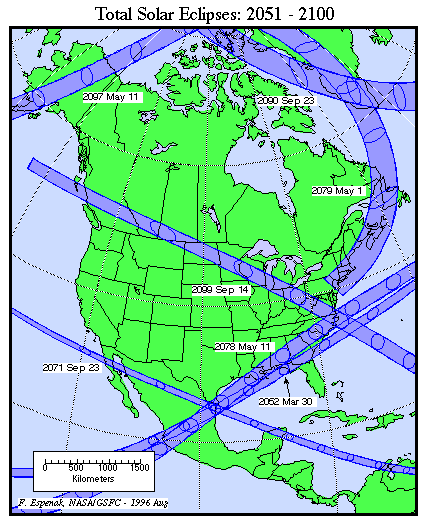
The relatively small size of the Moon and its shadow make eclipses truly once-in-a-lifetime opportunities. On average, total solar eclipses are visible somewhere on Earth once every few years. But from any one location on Earth, it is roughly 375 years between solar eclipses.
I’m an astronomer, but I have never seen a total solar eclipse, so I plan to drive to Erie, Pennsylvania, in the path of totality, for this one. This is one of the few chances I have to see a total eclipse without making a much more expensive trip to someplace more remote. Many people have asked me why nearby eclipses are so rare, and the answer is related to the size of the Moon and its distance from the Sun.
Size and scale
You can observe a solar eclipse when the Moon passes in front of the Sun, blocking some or all of the Sun from view. For people on Earth to be able to see an eclipse, the Moon, while orbiting around the Earth, must lie exactly along the observer’s line of sight with the Sun. Only some observers will see an eclipse, though, because not everyone’s view of the Sun will be blocked by the Moon on the day of an eclipse.
The fact that solar eclipses happen at all is a bit of a numerical coincidence. It just so happens that the Sun is approximately 400 times larger than the Moon and also 400 times more distant from the Earth.

So, even though the Moon is much smaller than the Sun, it is just close enough to Earth to appear the same size as the Sun when seen from Earth.
For example, your pinky finger is much, much smaller than the Sun, but if you hold it up at arm’s length, it appears to your eye to be large enough to block out the Sun. The Moon can do the same thing – it can block out the Sun if it’s lined up perfectly with the Sun from your point of view.
Path of totality
When the Earth, Moon and Sun line up perfectly, the Moon casts a shadow onto the Earth. Since the Moon is round, its shadow is round as it lands on Earth. The only people who see the eclipse are those in the area on Earth where the shadow lands at a given moment.
The Moon is continuously orbiting around the Earth, so as time goes on during the eclipse, the Moon’s shadow moves over the face of the Earth. Its shadow ends up looking like a thick line that can cover hundreds of miles in length. Astronomers call that line the path of totality.
From any given location along the path of totality, an observer can see the Sun completely eclipsed for a few minutes. Then, the shadow moves away from that location and the Sun slowly becomes more and more visible.
A tilted orbit
Solar eclipses don’t happen every single time the Moon passes in between Earth and the Sun. If that were the case, there would be a solar eclipse every month.
If you could float above the Earth’s North Pole and see the Moon’s orbit from above, you would see the Moon line up with the Sun once every time it orbits around the Earth, which is approximately once per month. From this high point of view, it looks like the Moon’s shadow should land on Earth every orbit.
However, if you could shift your perspective to look at the Moon’s orbit from the orbital plane, you would see that the Moon’s orbit is tilted by about 5 degrees compared with Earth’s orbit around the Sun. This tilt means that sometimes the Moon is too high and its shadow passes above the Earth, and sometimes the Moon is too low and its shadow passes below the Earth. An eclipse happens only when the Moon is positioned just right and its shadow lands on the Earth.
As time goes on, the Earth and the Moon continue spinning, and eventually the Moon aligns with Earth’s orbit around the Sun at the same moment the Moon passes between the Sun and the Earth.
While only certain cities are in the path of totality for this April’s eclipse, the entire U.S. is still close enough to this path that observers outside of the path of totality will see a partial eclipse. In those locations, the Moon will appear to pass in front of part of the Sun, leaving a crescent shape of the Sun still visible at the moment of maximum eclipse.
Christopher Palma, Teaching Professor, Department of Astronomy & Astrophysics, Penn State
This article is republished from The Conversation under a Creative Commons license. Read the original article.
The forecast calls for the main impacts to occur on Friday and Saturday, however, there are chances of rain until late next week.
The Lake County forecast anticipates close to an inch of rain on Friday and another half-inch on Saturday.
The rain will be coupled with high winds. Gusts topping 20 miles per hour are expected both days.
Forecasters said snow levels will remain above the 5,000-foot elevation mark on Friday, but could fall to lower levels on Saturday.
At the same time, the Sierras are forecast to get snow and a winter storm warning and winter weather advisory have been issued for eastern California.
After several days of warm and sunny weather, Lake County’s temperatures are expected to be in the low 50s during the day and low 40s at night into early next week, with nighttime temperatures set to drop into the 30s the middle of next week.
Email Elizabeth Larson at